Belgian Malinois vs Siberian Husky: Which Suits Your Home?
Quick answer
Malinois or Husky, which should you actually get?
If you want a dog that takes direction and works with you, the Malinois. If you want an independent, friendlier-with-strangers dog that will still test your fences, the Husky. Neither is a casual choice.
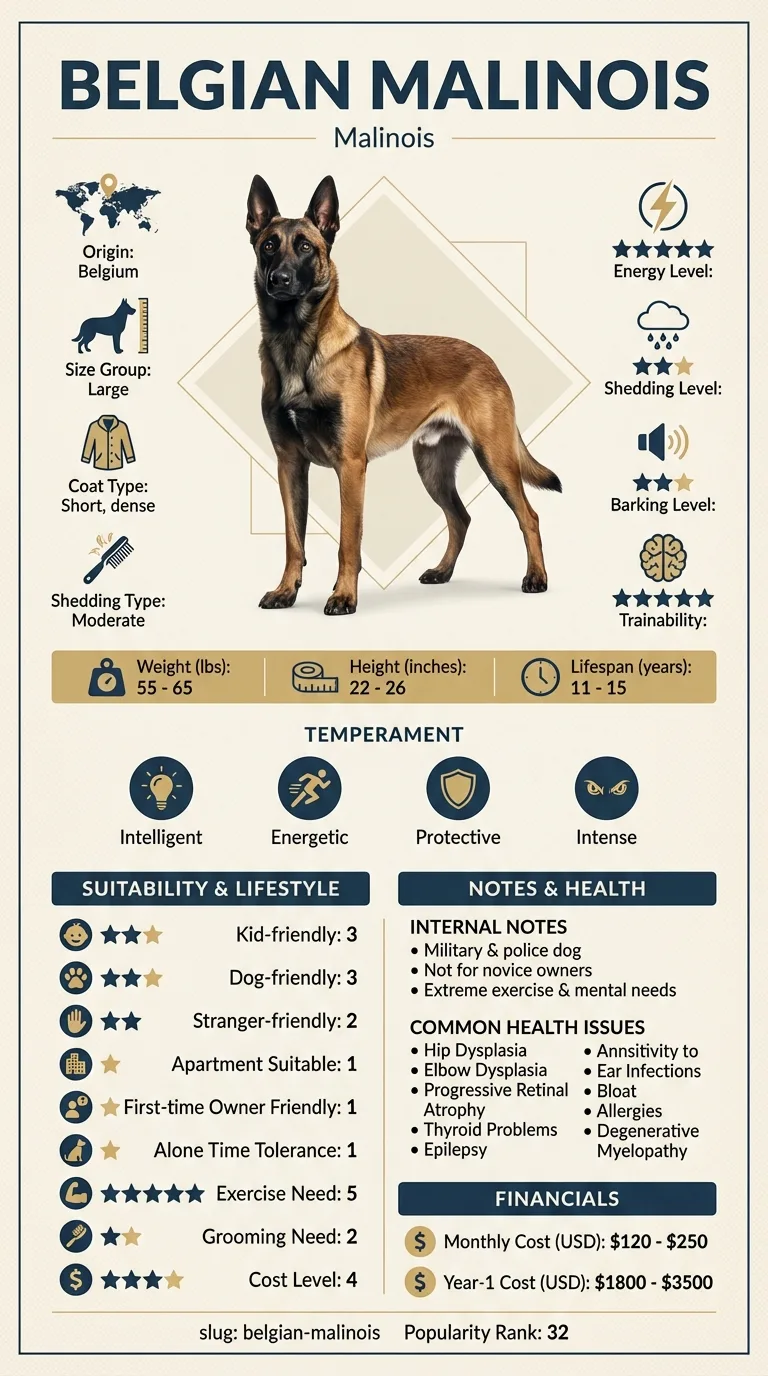
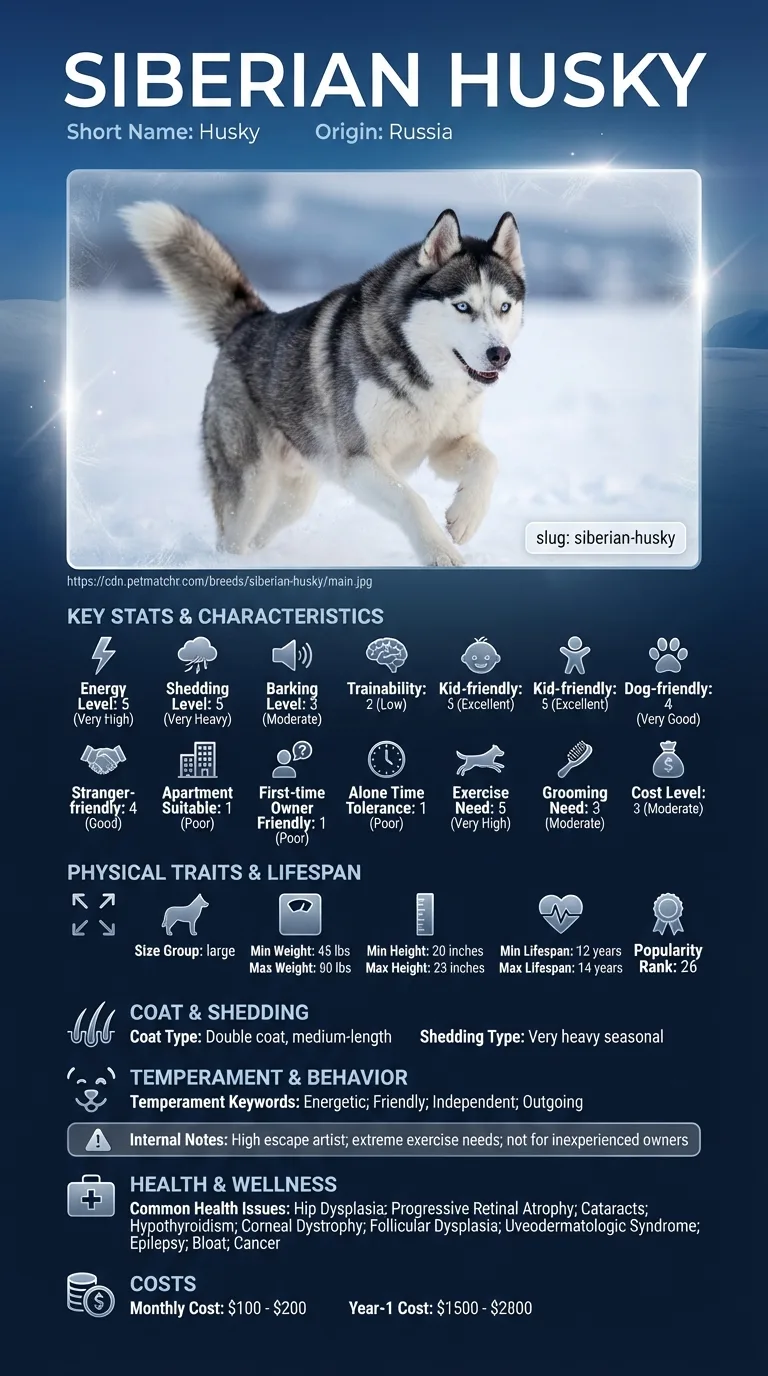
Belgian Malinois or Siberian Husky? On paper they differ most on trainability, and on the scales Belgian Malinois is the heavier at 55–65 lbs. Here is how the two compare on everything that shapes an ordinary week.
This is for someone already down to Belgian Malinois and Siberian Husky and deciding between them. For this pair the decision usually turns on trainability and shedding, so those are covered first and in most detail. Both rate 1/5 for flats, so housing does not settle this one. Breed history is left out; what follows is what you will actually live with.
Quick verdict
Between Belgian Malinois and Siberian Husky, trainability is what separates them, and Belgian Malinois is the lower-effort dog of the two to keep.
Choose belgian malinois if...
Choose Belgian Malinois if you do not want a standing grooming appointment, shedding is a problem in your house and you want a dog that picks up training quickly.
Choose siberian husky if...
Choose Siberian Husky if there are young children at home, you already have another dog and a smaller dog suits your car, your home or your back.
Head-to-head comparison
Feature
belgian malinois
siberian husky
Winner
Size class
large
large
Equal
Weight
55–65 lbs
45–60 lbs
Equal
Height
22–26 in
20–23 in
Equal
Lifespan
11–15 years
12–14 years
Equal
Exercise need
Very high (5/5)
Very high (5/5)
Equal
Grooming need
Low (2/5)
Moderate (3/5)
belgian malinois
Shedding
Moderate (3/5)
Very high (5/5)
belgian malinois
Energy level
Very high (5/5)
Very high (5/5)
Equal
Barking
Moderate (3/5)
Moderate (3/5)
Equal
Apartment suitability
Very low (1/5)
Very low (1/5)
Equal
Good for first-time owners
Very low (1/5)
Very low (1/5)
Equal
Tolerates being alone
Very low (1/5)
Very low (1/5)
Equal
Trainability
Very high (5/5)
Low (2/5)
belgian malinois
Good with kids
Moderate (3/5)
Very high (5/5)
siberian husky
Good with other dogs
Moderate (3/5)
High (4/5)
siberian husky
Friendly to strangers
Low (2/5)
High (4/5)
siberian husky
Cost level
High (4/5)
Moderate (3/5)
siberian husky
Coat
Short, dense
Double coat, medium-length
Equal
Origin
Belgium
Russia
Equal
Typical monthly cost
$120–$250
$100–$200
Equal
Typical first-year cost
$1,800–$3,500
$1,500–$2,800
Equal
Deep dive
Size and build
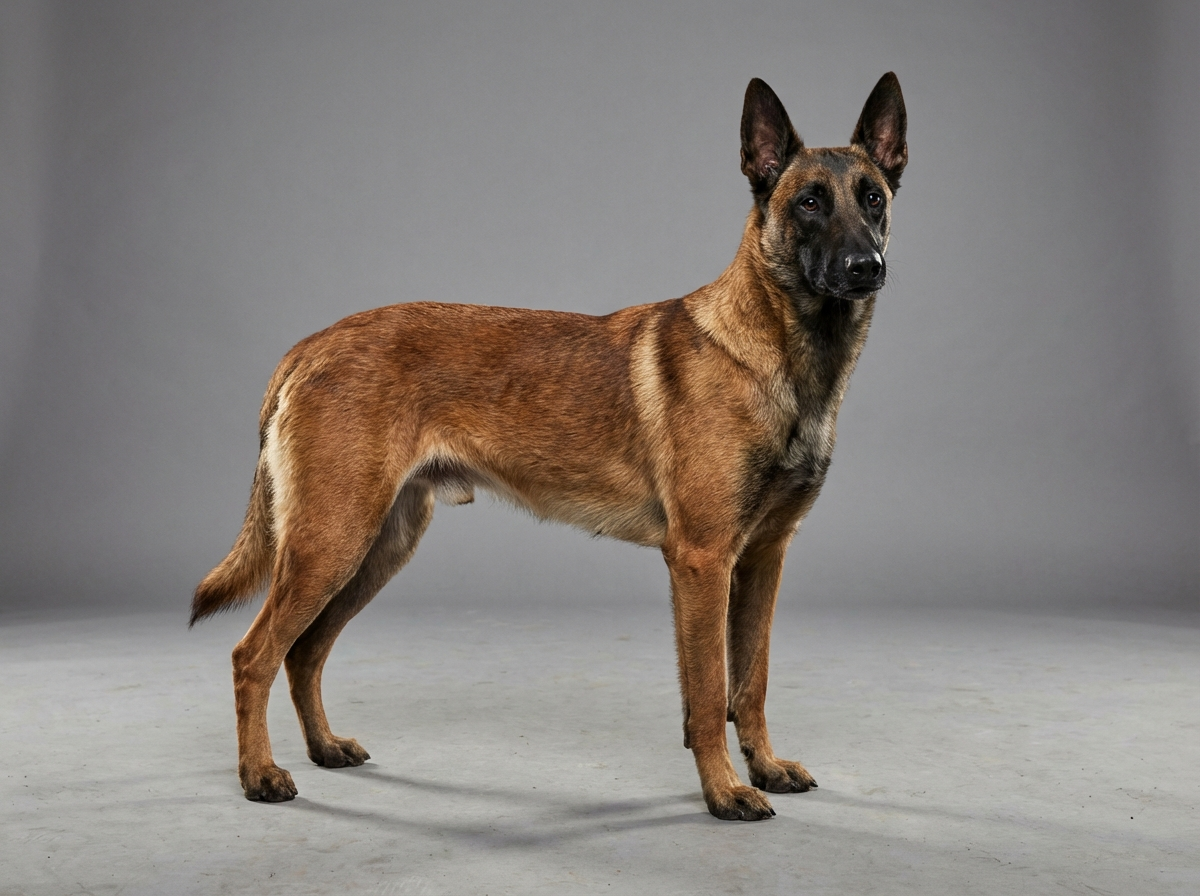
The Malinois runs 55 to 65 pounds and stands 22 to 26 inches at the shoulder; the Husky comes in a touch lighter and shorter, 45 to 60 pounds and 20 to 23 inches. Both are built for hard work rather than bulk, with lean, athletic frames and no wasted mass. Side by side the Malinois reads as the more square, muscular dog, while the Husky's frame is built for distance rather than power. Neither will feel small in a compact house.
Energy and exercise
Both breeds score a full 5 out of 5 for exercise need, and neither owner should read that as a suggestion. The Malinois was bred to work all day at a handler's side; the Husky was bred to pull a sled for hours across snow. A jog around the block satisfies neither one. Expect to budget well over an hour of real physical and mental work daily for either dog, indefinitely, for its entire working life.
Grooming and shedding
Grooming splits in the Malinois's favor: a 2 out of 5 grooming need against the Husky's 3 out of 5, since the Husky's thicker double coat needs more brushing to stay untangled. Shedding is the bigger gap. The Malinois sheds moderately (3/5); the Husky sheds heavily (5/5) and blows its coat seasonally, leaving drifts of fur twice a year. If you're sensitive to dog hair on furniture, that difference matters more than the grooming score suggests.
Apartment living, noise and time alone
Neither breed is suited to apartment life. Both score a rock-bottom 1 out of 5 for apartment suitability, 1 out of 5 for tolerating time alone, and 1 out of 5 for first-time owners. Barking is moderate and roughly even for both (3/5). What separates them isn't noise or space, it's what happens when either is left alone and under-exercised: destructive behavior, escape attempts, or in the Husky's case, a talent for digging and fence-jumping.
Training and owner experience
This is where the two breeds diverge sharply. The Malinois scores a 5 out of 5 for trainability, the breed of choice for police and military K9 units precisely because it takes direction so well. The Husky scores just 2 out of 5; it's intelligent but bred to think independently on a sled team, not to defer to a handler. A first-time owner will find the Malinois responsive and the Husky stubborn, even though neither is a beginner's dog overall.
Kids, other dogs and visitors
The Husky pulls ahead with families: 5/5 with kids versus the Malinois's 3/5, 4/5 with other dogs versus 3/5, and 4/5 with strangers versus the Malinois's 2/5. The Malinois's intensity and protective streak, useful in the working roles it's bred for, make it a poorer match for a house full of visitors and playdates. The Husky's pack-oriented, outgoing nature makes it the friendlier all-around family dog of the two, exercise demands aside.
Health and lifespan
Both breeds carry a 10-condition list and land in a similar 11-to-15-year range. Hip dysplasia, progressive retinal atrophy, epilepsy, and bloat show up on both lists, so joint screening and slow, split feeding matter for either dog. Beyond that they diverge: the Malinois's list leans toward elbow dysplasia and anesthesia sensitivity, while the Husky's includes several eye conditions, cataracts and corneal dystrophy among them, plus cancer risk.
Cost to keep
The Malinois runs pricier on the site's cost scale, 4 out of 5 versus 3 out of 5, with a monthly range of $120 to $250 against the Husky's $100 to $200, and a first-year range of $1,800 to $3,500 versus $1,500 to $2,800. Some of that gap is food and vet costs for a working-line dog; some is the higher price tag often attached to Malinois puppies from proven working lines.
Belgian Malinois vs Siberian Husky at a glance
Belgian Malinois weighs 55–65 lbs and lives 11–15 years; Siberian Husky weighs 45–60 lbs and lives 12–14 years. The two diverge most on trainability, shedding and good with kids and 1 other rated axes. They are level on tolerates being alone, apartment suitability and barking, so those cannot decide it. The comparison marks an easier option only where one exists. Facts like weight and country of origin are not scored. Both dogs are rated from the same dataset, which is what makes the numbers comparable with each other even though any individual dog sits somewhere inside its breed's range.
Belgian Malinois vs Siberian Husky: Which Suits Your Home? - Belgian Malinois vs Siberian Husky at a glance
Frequently asked questions
Which is bigger, the Belgian Malinois or the Siberian Husky?
The Malinois is slightly larger on paper, 55 to 65 pounds and 22 to 26 inches versus the Husky's 45 to 60 pounds and 20 to 23 inches, though both land solidly in the large-breed category and neither will feel small in your living room.
Which sheds more?
The Husky, by a wide margin. It scores 5 out of 5 for shedding against the Malinois's 3 out of 5, and it blows its undercoat seasonally in a way that produces noticeably more loose fur than the Malinois's shorter, denser coat.
Is either breed a good fit for a first-time owner?
No, both score a 1 out of 5 for first-time owners. The Malinois's intensity and work drive and the Husky's independence and escape artistry both require an owner who has handled a demanding dog before.
Can either of these breeds live in an apartment?
Not comfortably. Both score 1 out of 5 for apartment suitability and 1 out of 5 for tolerating time alone, so a small space with long stretches without exercise or company is a bad combination for either dog.
What does it cost to keep one of these dogs?
Expect $100 to $200 a month for a Husky and $120 to $250 for a Malinois, with first-year costs of roughly $1,500 to $2,800 and $1,800 to $3,500 respectively once initial vet work and gear are factored in.
Do they share any health risks?
Yes, hip dysplasia, progressive retinal atrophy, epilepsy, and bloat appear on both breeds' health lists, so joint and eye screening are worth asking about regardless of which one you choose.
Which is easier to train?
The Malinois, clearly. It scores 5 out of 5 for trainability against the Husky's 2 out of 5. Huskies are smart but bred to problem-solve independently, which makes them far less biddable in obedience work.
If you want a dog that takes direction and works with you, the Malinois. If you want an independent, friendlier-with-strangers dog that will still test your fences, the Husky. Neither is a casual choice.
Costs
How much does each cost monthly?
Roughly $100 to $200 for a Husky and $120 to $250 for a Malinois, mostly food, routine vet care, and, for the Malinois especially, training.
Living
How much exercise do they need?
Both max out the scale at 5 out of 5 for exercise need. Plan on over an hour of hard physical and mental work daily for either breed, every day.
Health
How long do they typically live?
11 to 15 years for the Malinois, 12 to 14 for the Husky, close enough that lifespan shouldn't be the deciding factor between them.
Related DogBreedCompass guides
Belgian Malinois breed guide – Readers comparing the two usually want the full profile of Belgian Malinois before deciding.
Siberian Husky breed guide – The same for Siberian Husky, so the comparison can be checked against the detail.
Belgian Malinois vs German Shorthaired Pointer – German Shorthaired Pointer is the closest breed to Belgian Malinois on the measured axes, so it is the natural next comparison.
Health information here is general and is not veterinary advice. If your dog shows pain, sudden behaviour change, or worsening symptoms, consult a licensed veterinarian.
Some links on this site are affiliate links. We may earn a commission at no extra cost to you, and we only suggest products we believe are helpful for dog owners.
We research and check what we publish, but we do not warrant that any figure, date, price, or statement is accurate, complete, or current, and we accept no liability for any loss, cost, injury, or other harm arising from the use of this site. Use it as one reference among several. You remain responsible for your own decisions and for your dog's care - confirm anything that matters with a licensed veterinarian or another qualified professional before you act on it. Full disclaimer.