Living
Which is better for a first-time dog owner?
The Collie, rated High (4/5) versus the Malinois's Very low (1/5).

Quick answer
Which is better for a first-time dog owner?
The Collie, rated High (4/5) versus the Malinois's Very low (1/5).
Belgian Malinois or Collie (Rough Collie)? On paper they differ most on good for first-time owners, and on the scales Collie (Rough Collie) is the heavier at 50–75 lbs. Here is how the two compare on everything that shapes an ordinary week.
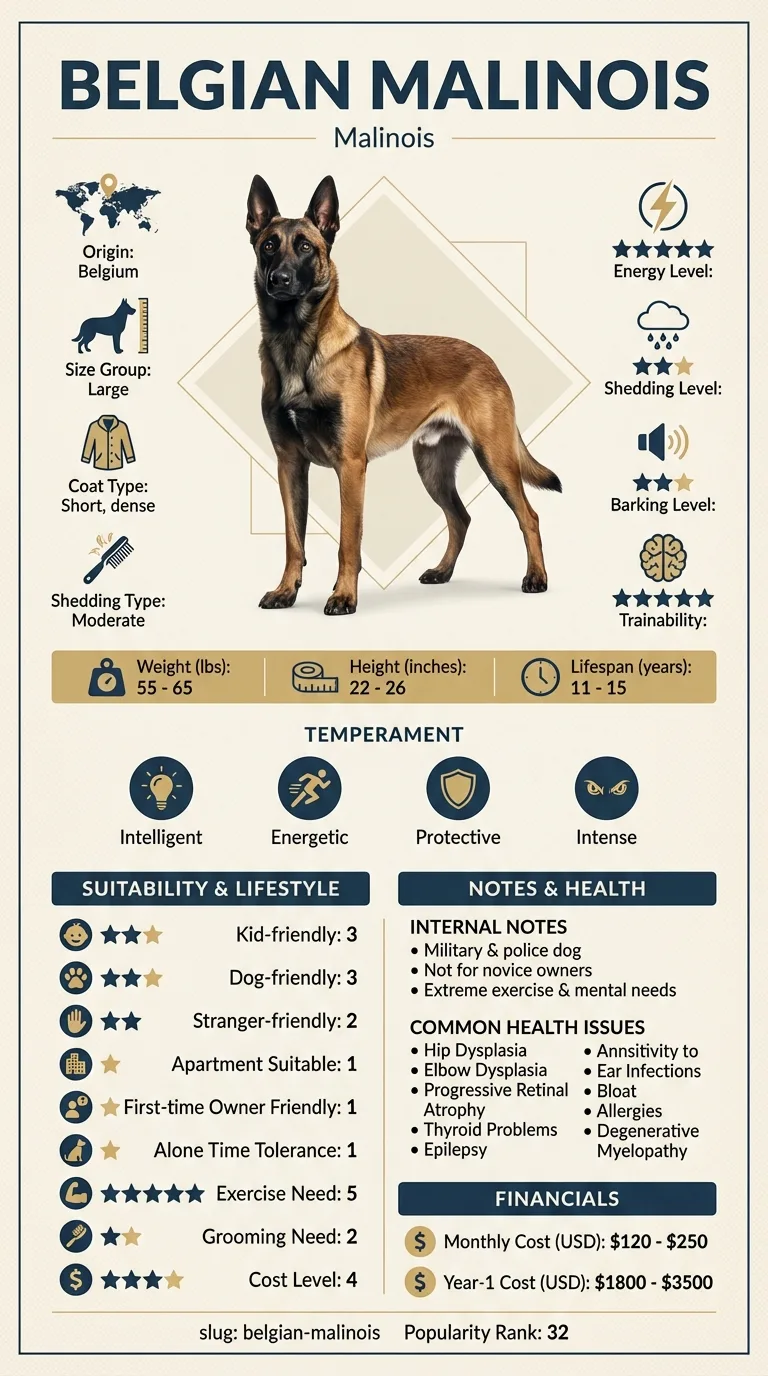
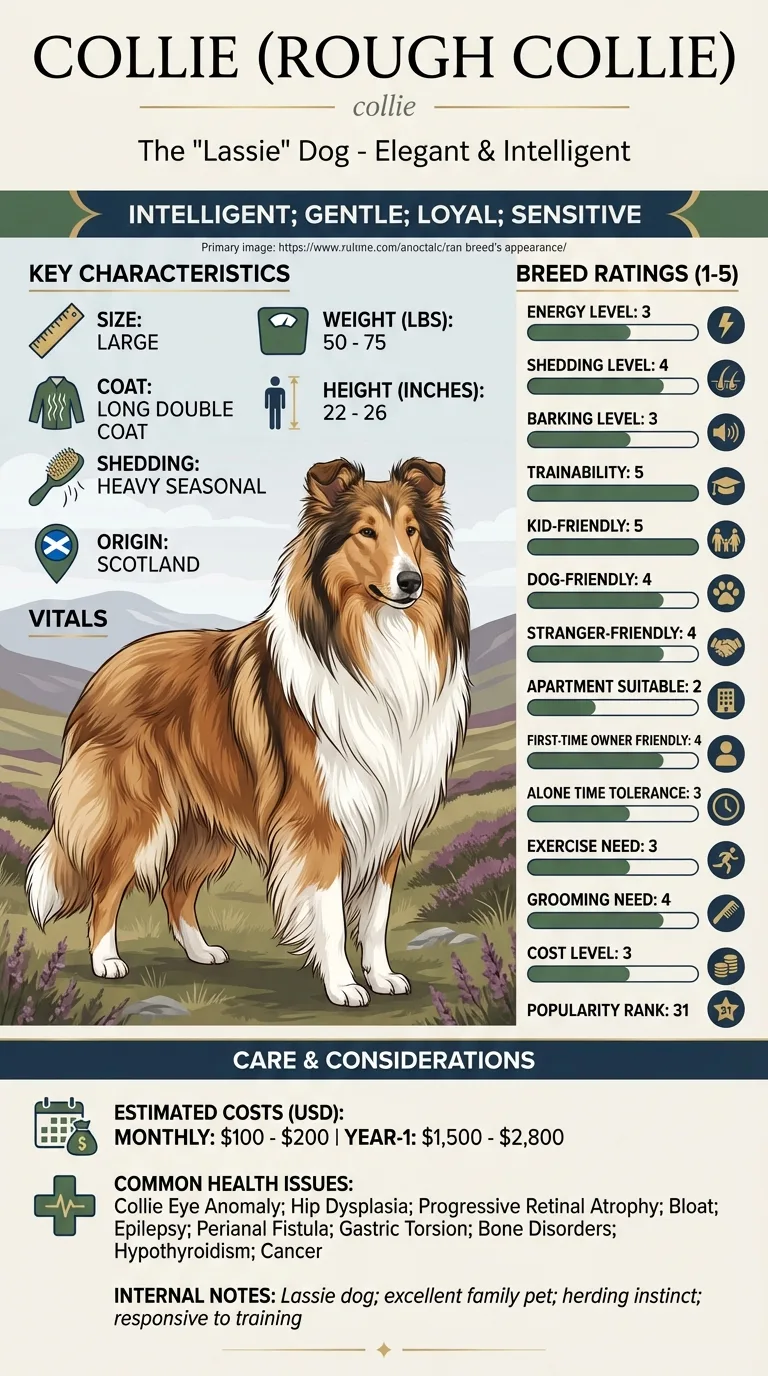
This is for someone already down to Belgian Malinois and Collie (Rough Collie) and deciding between them. For this pair the decision usually turns on good for first-time owners and exercise need, so those are covered first and in most detail. Anyone choosing from a flat has a clear answer here: Collie (Rough Collie) rates 2/5 against 1/5. It is written for the decision rather than the breed history.
Between Belgian Malinois and Collie (Rough Collie), good for first-time owners is what separates them, and Collie (Rough Collie) is the lower-effort dog of the two to keep.
Choose Belgian Malinois if you do not want a standing grooming appointment, shedding is a problem in your house and a smaller dog suits your car, your home or your back.
Choose Collie (Rough Collie) if this is your first dog, your walking routine is modest and the dog will be alone during the working day.
| Feature | belgian malinois | collie | Winner |
|---|---|---|---|
| Size class | large | large | Equal |
| Weight | 55–65 lbs | 50–75 lbs | Equal |
| Height | 22–26 in | 22–26 in | Equal |
| Lifespan | 11–15 years | 11–14 years | belgian malinois |
| Exercise need | Very high (5/5) | Moderate (3/5) | collie |
| Grooming need | Low (2/5) | High (4/5) | belgian malinois |
| Shedding | Moderate (3/5) | High (4/5) | belgian malinois |
| Energy level | Very high (5/5) | Moderate (3/5) | Equal |
| Barking | Moderate (3/5) | Moderate (3/5) | Equal |
| Apartment suitability | Very low (1/5) | Low (2/5) | collie |
| Good for first-time owners | Very low (1/5) | High (4/5) | collie |
| Tolerates being alone | Very low (1/5) | Moderate (3/5) | collie |
| Trainability | Very high (5/5) | Very high (5/5) | Equal |
| Good with kids | Moderate (3/5) | Very high (5/5) | collie |
| Good with other dogs | Moderate (3/5) | High (4/5) | collie |
| Friendly to strangers | Low (2/5) | High (4/5) | collie |
| Cost level | High (4/5) | Moderate (3/5) | collie |
| Coat | Short, dense | Long double coat | Equal |
| Origin | Belgium | Scotland | Equal |
| Typical monthly cost | $120–$250 | $100–$200 | Equal |
| Typical first-year cost | $1,800–$3,500 | $1,500–$2,800 | Equal |
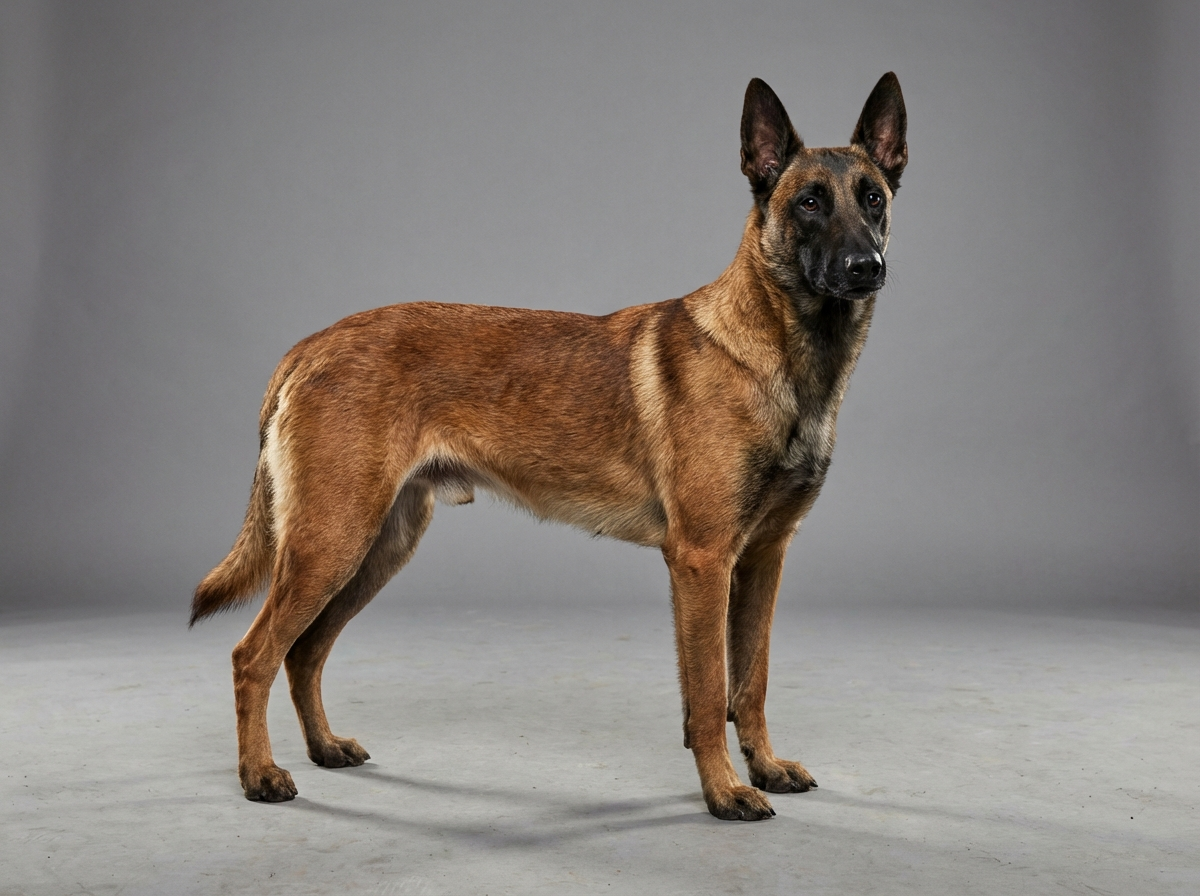
Weight ranges actually overlap here — a 55–65 lb Malinois sits inside the 50–75 lb range of a Rough Collie — but the two breeds carry that mass completely differently. The Malinois is dense, square, and muscular with a short coat that makes its athletic frame obvious at a glance, while the Collie's long double coat and lighter-boned, sloped build give it a softer, more elegant silhouette despite matching height, both running 22–26 inches. A Collie can look larger than it is once its coat is fully blown out, while a Malinois's visible musculature signals its working-dog purpose even before it moves.
The exercise gap is sharp: Very high (5/5) for the Malinois against Moderate (3/5) for the Collie, mirroring the same split in their energy level ratings. A Malinois with its Intense, Energetic temperament needs sustained daily work — running, herding drills, scent games — or it will find its own outlet, often destructively. The Collie, historically a herding dog itself, still wants a solid walk and some open-space time to satisfy its Intelligent, Loyal nature, but it tolerates a calmer daily rhythm far better than the Malinois does.
Coat care runs opposite to size expectations: the Malinois needs only Low (2/5) grooming and sheds a Moderate (3/5) amount from its short, dense coat, while the Collie demands High (4/5) grooming and sheds even more, at High (4/5), thanks to its long double coat. Collie owners should expect multiple weekly brushing sessions and heavier seasonal blowouts than a Malinois ever produces, plus more vacuuming and lint-rolling year-round. The Malinois's practical, low-fuss coat is one of the few areas where it's genuinely the easier breed to live with day to day.
Neither breed is an ideal apartment dog — the Malinois rates Very low (1/5) for apartment suitability and the Collie only slightly better at Low (2/5) — and both share Moderate (3/5) barking. Where they diverge is tolerating time alone: Very low (1/5) for the Malinois versus Moderate (3/5) for the Collie, a meaningful gap for anyone working full days outside the home. A Collie's Sensitive temperament means it still craves company and can develop separation anxiety, but it copes with solo stretches noticeably better than a Malinois, whose Protective, Intense nature makes prolonged isolation especially hard.
Trainability is a rare tie here — both breeds rate Very high (5/5) — but the experience needed to get there differs enormously, since first-time-owner suitability is Very low (1/5) for the Malinois against High (4/5) for the Collie. A Collie's Intelligent, Gentle disposition means it responds to consistent, kind training methods without needing an experienced handler's firm structure. The Malinois's same intelligence, paired with its Protective, Intense temperament, means untrained energy can turn into guarding or reactivity issues that novice owners aren't equipped to redirect, which is why breed clubs steer first-timers toward the Collie.
With kids the Collie rates Very high (5/5) against the Malinois's Moderate (3/5), consistent with the Collie's Gentle, Loyal temperament that made it a beloved family dog long before Lassie. The pattern repeats with strangers, Low (2/5) for the Malinois versus High (4/5) for the Collie, and other dogs, Moderate (3/5) versus High (4/5). A Collie's Sensitive streak means it can be startled by rough handling, so supervision with very young kids still matters, but its baseline temperament is built for family life in a way the Malinois's Protective instincts are not.
Lifespans sit close — 11–15 years for the Malinois, 11–14 for the Collie — but both carry substantial health watch-lists. The Malinois's ten flagged conditions include Hip Dysplasia, Elbow Dysplasia, Bloat, Epilepsy, and Degenerative Myelopathy, while the Collie's equally long list features Collie Eye Anomaly, Gastric Torsion, Perianal Fistula, Bone Disorders, and Cancer, plus shared risks like Hip Dysplasia, PRA, Bloat, and Epilepsy. The overlap on bloat-type conditions, Bloat for the Malinois and Gastric Torsion for the Collie, means both owners should learn the warning signs and consider slow-feed bowls regardless of which breed they choose.
Monthly costs run close — $120–$250 for the Malinois versus $100–$200 for the Collie — but first-year totals diverge more, at $1,800–$3,500 versus $1,500–$2,800, and cost level is rated High (4/5) for the Malinois against Moderate (3/5) for the Collie. Much of the Malinois's premium comes from structured training and higher-calorie feeding to match its Very high exercise need, while the Collie's costs lean toward grooming tools and time given its High grooming and shedding scores. Neither breed is a budget option, but the Collie's costs are more predictable year to year.
Belgian Malinois weighs 55–65 lbs and lives 11–15 years; Collie (Rough Collie) weighs 50–75 lbs and lives 11–14 years. The two diverge most on good for first-time owners, exercise need and grooming need and 4 other rated axes. They are level on barking and trainability, so those cannot decide it. In the table, a "winner" means easier for an ordinary household — not better. Size, coat and origin are recorded without a verdict. Because both breeds are scored the same way, the gaps are reliable even where the absolute numbers are rough.

Yes, considerably — the Collie rates High (4/5) for first-time owners versus the Malinois's Very low (1/5), largely because the Collie's Gentle, Loyal temperament responds well to standard training without the firm structure a Malinois needs.
The Collie, rated High (4/5) shedding against the Malinois's Moderate (3/5), owing to its long double coat compared to the Malinois's short, dense one.
Very — the Collie rates Very high (5/5) with kids, the top score on the scale, reflecting its historic role as a gentle family and herding companion.
No — the Malinois is rated Very high (5/5) for exercise while the Collie is Moderate (3/5), so the Malinois needs substantially more daily activity.
Collie Eye Anomaly, Gastric Torsion, Perianal Fistula, and Bone Disorders are specific to the Collie's list, while the Malinois carries Thyroid Problems and anesthesia sensitivity that don't appear on the Collie's.
The Collie, whose Moderate energy level and Gentle temperament make for a calmer household presence than the Malinois's Very high energy and Intense drive.
Roughly, though the Malinois runs slightly higher — $1,800–$3,500 in year one versus $1,500–$2,800 for the Collie — with the Malinois's premium driven by training and feeding rather than grooming.
The Collie, rated High (4/5) versus the Malinois's Very low (1/5).
The Malinois, rated Very high (5/5) versus the Collie's Moderate (3/5).
The Collie, with a long double coat versus the Malinois's short, dense one.
The Malinois, at 11–15 years versus the Collie's 11–14.
Secure checkout on Stripe. We never see your card.
7-day money-back guarantee. Instant access.
Health information here is general and is not veterinary advice. If your dog shows pain, sudden behaviour change, or worsening symptoms, consult a licensed veterinarian.
Some links on this site are affiliate links. We may earn a commission at no extra cost to you, and we only suggest products we believe are helpful for dog owners.
We research and check what we publish, but we do not warrant that any figure, date, price, or statement is accurate, complete, or current, and we accept no liability for any loss, cost, injury, or other harm arising from the use of this site. Use it as one reference among several. You remain responsible for your own decisions and for your dog's care - confirm anything that matters with a licensed veterinarian or another qualified professional before you act on it. Full disclaimer.
Match your lifestyle to the right dog.
Take quizNot sure which breed is right for you? Take our 2-minute quiz to find out.
Take the quiz