Behavior
Boxer or Weimaraner, which should I pick?
Go Weimaraner for a longer-lived, slightly less shedding dog if you can be home often. Go Boxer if your household includes young kids or other dogs, or if daily alone-time is unavoidable.

Quick answer
Boxer or Weimaraner, which should I pick?
Go Weimaraner for a longer-lived, slightly less shedding dog if you can be home often. Go Boxer if your household includes young kids or other dogs, or if daily alone-time is unavoidable.
Boxer or Weimaraner? On paper they differ most on tolerates being alone, and on the scales Weimaraner is the heavier at 55–90 lbs. Here is how the two compare on everything that shapes an ordinary week.
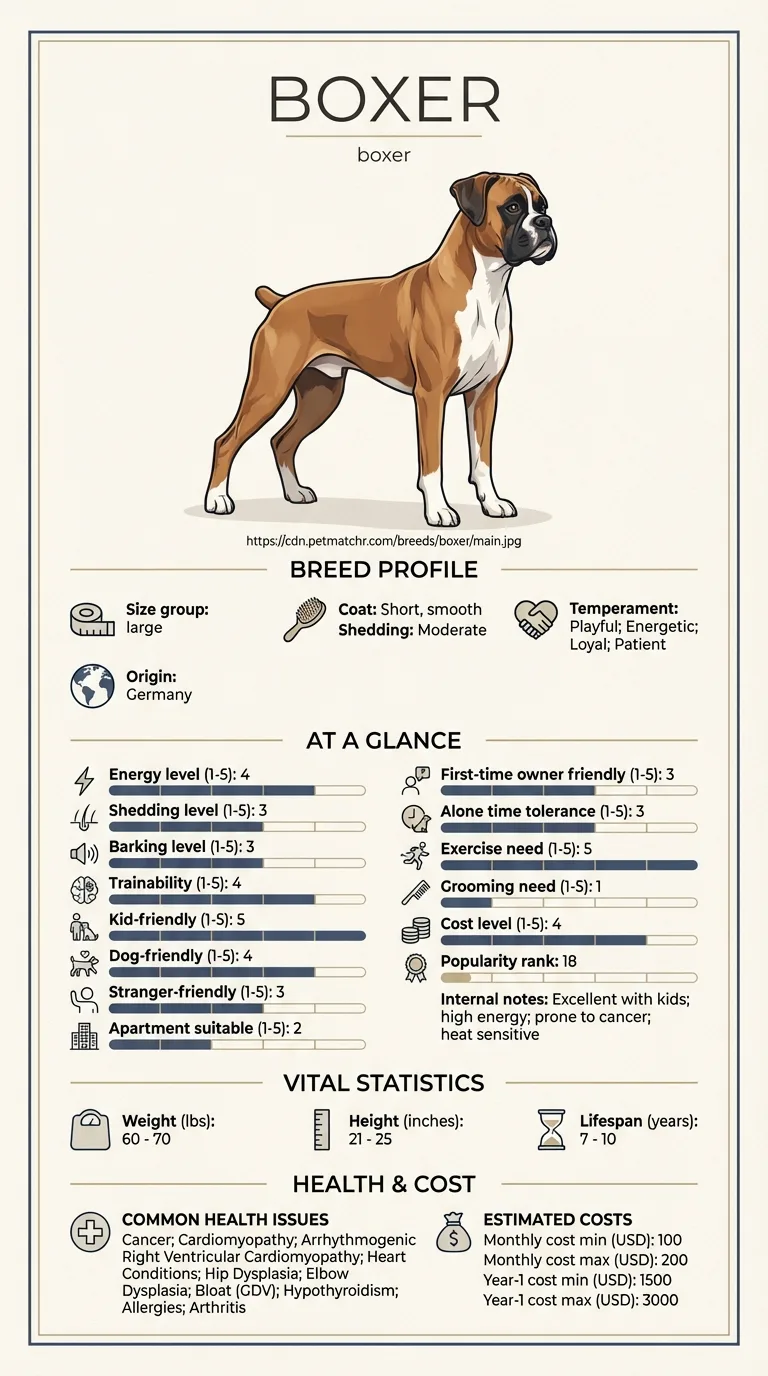
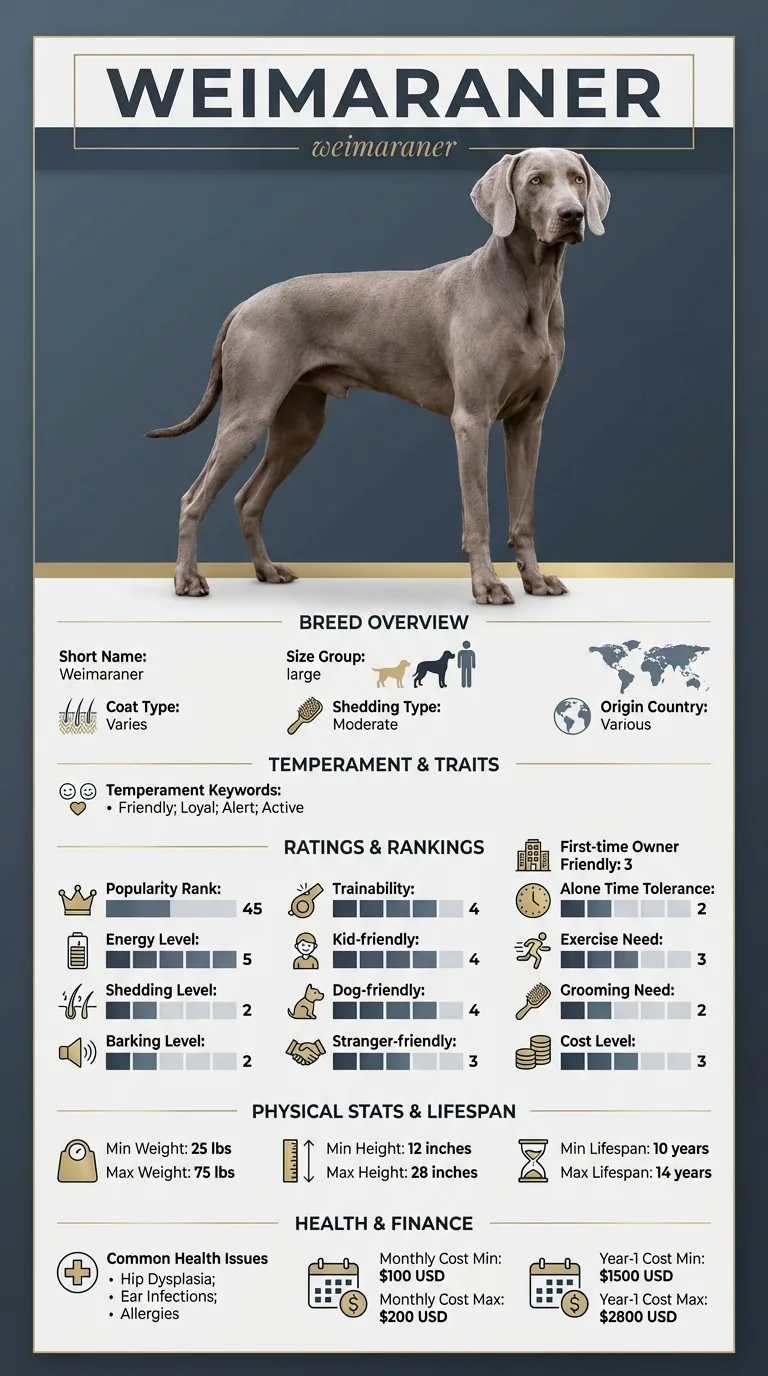
This is for someone already down to Boxer and Weimaraner and deciding between them. For this pair the decision usually turns on tolerates being alone, so those are covered first and in most detail. Anyone choosing from a flat has a clear answer here: Boxer rates 2/5 against 1/5. It is written for the decision rather than the breed history.
Between Boxer and Weimaraner, tolerates being alone is what separates them, and Boxer is the lower-effort dog of the two to keep.
Choose Boxer if this is your first dog, the dog will be alone during the working day and there are young children at home.
Choose Weimaraner if shedding is a problem in your house.
| Feature | boxer | weimaraner | Winner |
|---|---|---|---|
| Size class | large | large | Equal |
| Weight | 60–70 lbs | 55–90 lbs | Equal |
| Height | 21–25 in | 23–27 in | Equal |
| Lifespan | 7–10 years | 10–13 years | weimaraner |
| Exercise need | Very high (5/5) | Very high (5/5) | Equal |
| Grooming need | Very low (1/5) | Very low (1/5) | Equal |
| Shedding | Moderate (3/5) | Low (2/5) | weimaraner |
| Energy level | High (4/5) | Very high (5/5) | Equal |
| Barking | Moderate (3/5) | Moderate (3/5) | Equal |
| Apartment suitability | Low (2/5) | Very low (1/5) | boxer |
| Good for first-time owners | Moderate (3/5) | Low (2/5) | boxer |
| Tolerates being alone | Moderate (3/5) | Very low (1/5) | boxer |
| Trainability | High (4/5) | High (4/5) | Equal |
| Good with kids | Very high (5/5) | High (4/5) | boxer |
| Good with other dogs | High (4/5) | Moderate (3/5) | boxer |
| Friendly to strangers | Moderate (3/5) | Moderate (3/5) | Equal |
| Cost level | High (4/5) | Moderate (3/5) | weimaraner |
| Coat | Short, smooth | Short and sleek | Equal |
| Origin | Germany | Various | Equal |
| Typical monthly cost | $100–$200 | $110–$240 | Equal |
| Typical first-year cost | $1,500–$3,000 | $1,700–$3,200 | Equal |
The Weimaraner is the bigger dog on paper, with a weight range of 55-90 pounds that outstrips the Boxer's 60-70 at the top end, and a taller frame at 23-27 inches against 21-25. Both are classed large. In practice a male Weimaraner at the upper end of its range will noticeably out-scale most Boxers.
Exercise need ties at 5/5 for both breeds, but the Weimaraner rates higher on overall energy, very high (5/5) against the Boxer's high (4/5). This is a breed developed for all-day hunting stamina, and it shows: a bored, under-exercised Weimaraner is a genuinely difficult dog to live with.
Grooming is minimal for both (1/5 each), but the Weimaraner sheds less, low (2/5) versus the Boxer's moderate (3/5), despite having the more athletic, sleeker-looking coat. If shedding is your main filter, the Weimaraner has a slight edge here.
Neither dog is built for apartment life, but the Weimaraner rates worse, very low (1/5) against the Boxer's low (2/5). Barking is tied at moderate (3/5) for both, so it's the space and exercise demands driving the low scores, not noise. Add in the Weimaraner's very low alone-tolerance (1/5, against the Boxer's moderate 3/5) and a small-space, long-hours-away setup is a poor fit for either dog, worse for the Weimaraner.
Trainability ties at high (4/5) for both breeds. Where they split is first-time-owner suitability: the Boxer rates moderate (3/5), the Weimaraner low (2/5), reflecting its intensity and the health list's own note of separation-anxiety tendencies. Weimaraners are also described as headstrong in temperament, which can make training sessions a battle of wills even for an experienced handler.
The Boxer rates slightly better with both kids (5/5 vs 4/5) and other dogs (4/5 vs 3/5). Neither number is bad for the Weimaraner, but if you're weighing a multi-dog household or a home full of young kids, the Boxer has a modest edge across the board.
The Weimaraner outlives the Boxer by a meaningful margin, 10-13 years against 7-10. Its health list is notably shorter and more targeted: bloat, hip dysplasia, a growth disorder called hypertrophic osteodystrophy, a clotting disorder called Von Willebrand disease, and separation anxiety. The Boxer's list is longer and leans harder toward cancer and cardiac disease. Both share bloat and hip dysplasia as risks to watch.
The Weimaraner runs a bit more expensive month to month, $110-240 against the Boxer's $100-200, and its first-year range is higher too, $1,700-3,200 versus $1,500-3,000. Despite that, its overall cost rating is lower (3/5 vs 4/5), suggesting the Boxer's ongoing costs add up in ways the sticker price doesn't fully capture.
Boxer weighs 60–70 lbs and lives 7–10 years; Weimaraner weighs 55–90 lbs and lives 10–13 years. The two diverge most on tolerates being alone. They are level on barking, exercise need and grooming need, so those cannot decide it. In the table, a "winner" means easier for an ordinary household — not better. Size, coat and origin are recorded without a verdict. Because both breeds are scored the same way, the gaps are reliable even where the absolute numbers are rough.

The Weimaraner, usually, its 55-90 pound range and 23-27 inch height both edge out the Boxer's 60-70 pounds and 21-25 inches at the top end, though a lean Weimaraner and a stocky Boxer can look closer in person.
The Weimaraner, rated low (2/5) against the Boxer's moderate (3/5). Both have short, easy-care coats, so the difference is more about the amount of hair than the grooming effort involved.
The Boxer is the safer bet, rated 3/5 for first-timers against the Weimaraner's 2/5. The Weimaraner's intensity, headstrong streak, and separation-anxiety tendencies make it a harder assignment without prior dog experience.
Neither is well-suited to it, the Boxer rates low (2/5), the Weimaraner very low (1/5). Both also handle being alone poorly relative to a full workday, the Weimaraner especially so.
The Weimaraner, in raw dollars, $110-240 monthly and $1,700-3,200 in year one, both above the Boxer's ranges, though its overall cost rating (3/5) is actually lower than the Boxer's (4/5).
Bloat and hip dysplasia appear on both lists. Beyond that the Boxer carries more cardiac and cancer risk, while the Weimaraner's list flags a bone-growth disorder and a clotting disorder specific to the breed.
Yes, it's listed directly among the breed's health concerns, and its very low alone-tolerance score (1/5) backs that up. A Weimaraner left alone for long stretches regularly is a common source of behavioral problems in the breed.
Go Weimaraner for a longer-lived, slightly less shedding dog if you can be home often. Go Boxer if your household includes young kids or other dogs, or if daily alone-time is unavoidable.
Roughly $100-200 for the Boxer, $110-240 for the Weimaraner, close, with the Weimaraner running a touch higher.
Both need 5/5, serious daily exercise, not optional. The Weimaraner's overall energy rates even higher, so plan accordingly.
The Weimaraner, by two to three years typically, 10-13 years against the Boxer's 7-10.
Secure checkout on Stripe. We never see your card.
7-day money-back guarantee. Instant access.

Health information here is general and is not veterinary advice. If your dog shows pain, sudden behaviour change, or worsening symptoms, consult a licensed veterinarian.
Some links on this site are affiliate links. We may earn a commission at no extra cost to you, and we only suggest products we believe are helpful for dog owners.
We research and check what we publish, but we do not warrant that any figure, date, price, or statement is accurate, complete, or current, and we accept no liability for any loss, cost, injury, or other harm arising from the use of this site. Use it as one reference among several. You remain responsible for your own decisions and for your dog's care - confirm anything that matters with a licensed veterinarian or another qualified professional before you act on it. Full disclaimer.
Match your lifestyle to the right dog.
Take quizNot sure which breed is right for you? Take our 2-minute quiz to find out.
Take the quiz