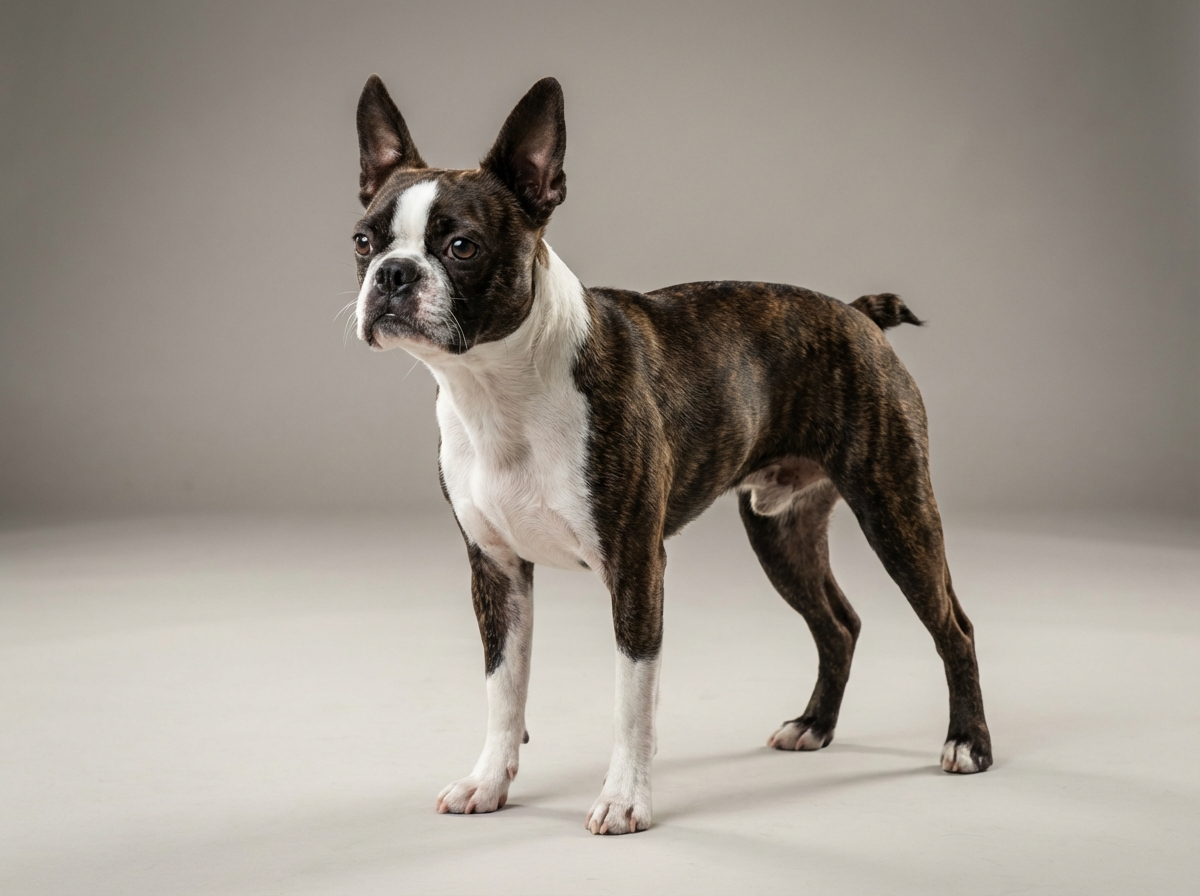
Health
How many of this breed's documented problems are eye conditions?
Two of five - cataracts and corneal ulcers - which is why eye monitoring matters more in Bostons than in most breeds.

Quick answer
How many of this breed's documented problems are eye conditions?
Two of five - cataracts and corneal ulcers - which is why eye monitoring matters more in Bostons than in most breeds.
This is one of the few areas of canine health where organised screening genuinely works, and where the questions you ask a breeder before you buy shape the next twelve years.
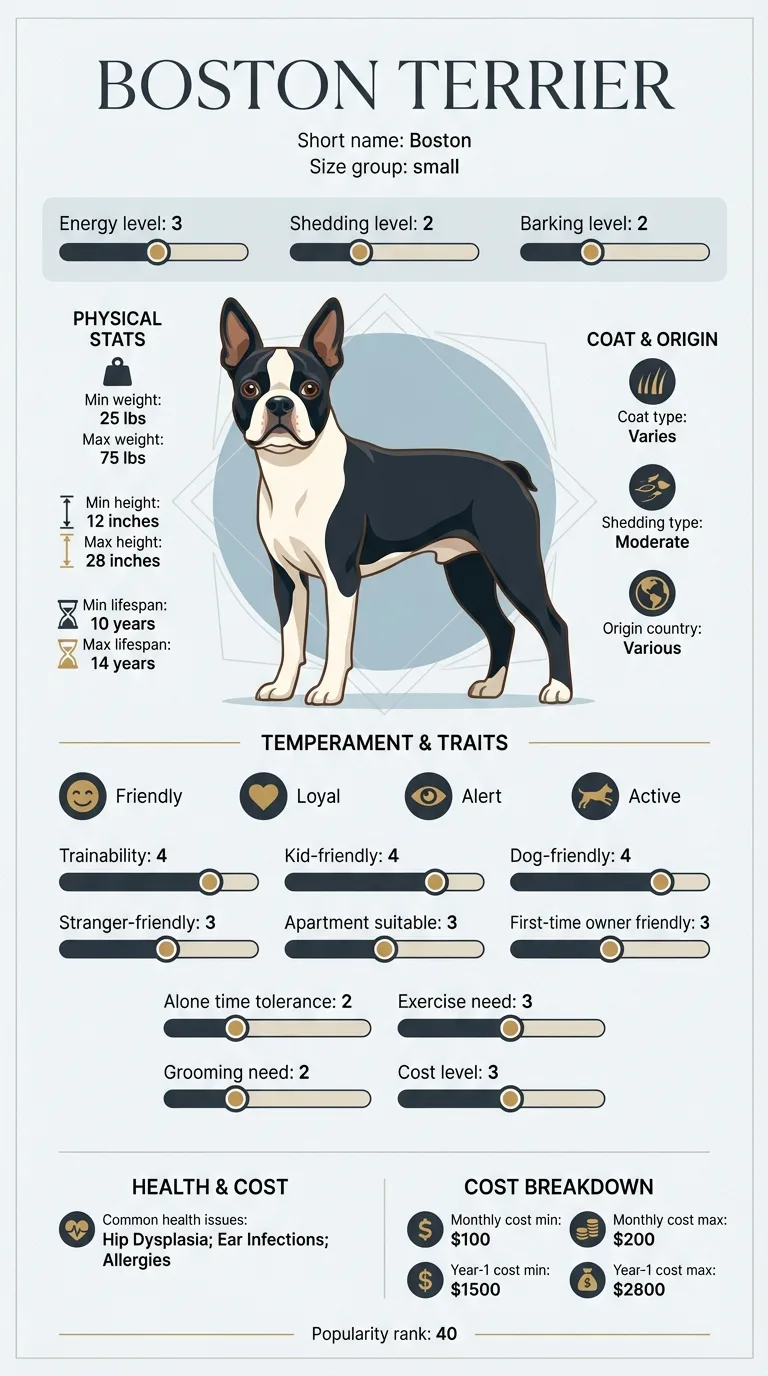
People choosing a Boston puppy and unsure what testing to ask for, owners wanting a sensible monitoring schedule rather than a list of frightening conditions, and breeders working out what to prioritise.
This guide is not medical advice. If your dog shows pain, sudden behavior change, or worsening symptoms, consult a licensed veterinarian.
Some links may be affiliate links. We may earn a commission at no extra cost to you. We only suggest products we believe are helpful for dog owners.
Two of the five health conditions consistently documented in Boston Terriers are ocular - cataracts and corneal ulcers - which makes eye screening and monitoring central rather than optional in this breed. Formal examination by an ophthalmologist reveals conditions invisible from outside, DNA testing addresses the inherited cataract specifically, and a one-minute monthly home check covers the interval between professional appointments.
Eye conditions are disproportionately represented in this breed's documented health profile, and both listed conditions are frequent enough that most Boston owners will encounter one across a dog's eleven to thirteen years. That frequency is precisely why organised screening exists for the breed and why annual examination is worth booking rather than assuming.
The Boston's skull shape places the eyes forward in shallow orbits, with less bony protection and, in some dogs, lids that do not fully close over the globe. That anatomy explains the corneal ulceration on the breed's list directly. The cataract entry is genetic rather than structural, and has an established early-onset hereditary form for which DNA testing is available. The compensating advantage is visibility: a prominent, well-lit eye on a short-coated dog is very easy for an owner to examine properly.
Everything that can touch an eye matters more in this breed. Dense undergrowth on walks, cats in the household, rough play with larger dogs, dusty or windy conditions, and shampoo during bathing are all routine hazards that a deep-set eye would shrug off. Household lighting matters for a different reason - most owners check eyes indoors under yellow light, where subtle colour and clarity changes are effectively invisible.
Book promptly for any asymmetry between the eyes, new cloudiness, a change in pupil size, persistent discharge, or a dog rubbing at its face. Seek same-day care if an eye is painful, squinted, held shut, red, or if the cornea looks dull, hazy or has a visible defect - corneal ulcers in this breed can deepen within a day. Treat as an immediate emergency any bulging or displaced eye, sudden severe pain, an eye that has been struck, or apparent sudden loss of vision. Never put drops or ointment from a previous problem into an eye, as some worsen a corneal injury considerably.
See all Boston Terrier health problems, which breeds are prone to eye disorders, or the full Boston Terrier breed guide for temperament, exercise needs and ownership costs.
A screening examination takes under an hour including dilation, and results are given the same day. Monitoring is a lifetime commitment rather than a project - monthly at home, annually with a vet. Nothing about screening prevents a condition; it changes when you find it, and for eyes that difference is frequently the difference between treatment and loss.
A documented eye history rather than an assumed one, problems found while they are small, comfortable eyes throughout life, and an owner who can tell a vet exactly when something changed because there is a photograph from the month before.
A screening eye examination is performed by a veterinary ophthalmologist, usually as part of an organised breed scheme. It is not the brief look your vet gives with a torch at a routine appointment, and the difference is substantial.
The pupils are dilated with drops, which takes twenty minutes or so, and the eye is then examined in a darkened room with a slit lamp and an indirect ophthalmoscope. That combination allows the examiner to look through the eye in optical sections - the cornea layer by layer, the lens, the fluid behind it, and the retina at the back. Conditions invisible from outside are visible in that examination.
The result is a certificate recording what was found on that date, for that dog. It is a snapshot rather than a lifetime guarantee, which is why breeding animals are re-examined periodically rather than tested once.
Separately, DNA testing exists for the early-onset hereditary cataract associated with this breed. A genetic test and an eye examination answer different questions: the DNA test says what the dog carries, the examination says what the dog currently has. Responsible breeding uses both.

Professional screening happens once or twice a year. The rest of the time it is you. This takes a minute in daylight and catches most of what matters in a breed whose eyes are this exposed.
Simeon had been photographing his Boston Nell's eyes on the first of every month for two years, mostly because a forum post had suggested it and it took no time. When he noticed a faint haze in her left eye one August, he was able to open his phone and establish that it had not been there in June and was faintly present in July. That single fact - one month, not one year - shaped the appointment completely, because gradual and recent are managed differently from gradual and long-standing. The diagnosis was an early lens change, and Nell went onto an ophthalmologist's monitoring schedule rather than an urgent pathway. Simeon's photographs have since been useful twice more. His view is that the habit costs him ten seconds a month and has twice replaced a guess with a date.
Key takeaway: Photograph both eyes monthly. In a breed where two of five documented conditions are ocular, being able to date a change is worth more than being able to describe it.
Cataracts and corneal ulcers both appear on this breed's core health list, alongside airway disease, patellar luxation and deafness. Two of five documented conditions being ocular is why eye care carries such weight in this breed.
Ask to see current eye examination certificates for both parents, and DNA test results for hereditary cataract. Ask when the parents were last examined, not simply whether they have ever been tested.
At every routine veterinary appointment, and specifically annually. Dogs used for breeding are examined more frequently under scheme rules, and any dog with an existing eye condition follows whatever schedule its ophthalmologist sets.
For a pet with healthy eyes and an attentive owner, an annual check by your own vet is usually sufficient. Specialist examination is indicated when something abnormal is found, when vision seems affected, or for breeding animals.
Inherited ones cannot be prevented in an individual dog, only avoided at the breeding stage. Injury-related conditions - the corneal ulcers this breed is prone to - are substantially preventable through sensible management.
It depends entirely on the condition. Cataracts are not painful in themselves; ulcers and raised pressure are, sometimes severely. Behaviour - squinting, rubbing, withdrawal - tells you more about comfort than appearance does.
Yes. Several conditions develop with age, and a clear certificate at two says nothing about the eye at nine. Annual checks in senior dogs catch problems while they are still treatable.
Two of five - cataracts and corneal ulcers - which is why eye monitoring matters more in Bostons than in most breeds.
Compare the two eyes head-on in daylight. Asymmetry in openness, prominence, colour or blinking is the finding that matters.
Current eye examination certificates for both parents plus hereditary cataract DNA results - and check the dates, not just that testing was done.
Annually as a minimum, and at any routine appointment in between. More often if a condition has already been found.
A one-page prep sheet for this condition: the signs, the questions to ask, what to get priced. Unlocks here.
You get: Vet visit prep sheet
No spam. One-click unsubscribe. See our privacy policy.
Preview page 1 before you decide.