Health
Is hip dysplasia rare or common in Akitas?
It's common enough to be listed among the breed's documented health concerns, not a rare or unusual finding.

Quick answer
Is hip dysplasia rare or common in Akitas?
It's common enough to be listed among the breed's documented health concerns, not a rare or unusual finding.
Prospective Akita owners researching this breed often land on hip dysplasia as a named concern — the more useful question is what that actually means for the odds facing any one dog.
This question comes up most for people still deciding whether to get an Akita, and for new owners of a puppy trying to understand what a breeder's hip-screening paperwork actually tells them.
This guide is not medical advice. If your dog shows pain, sudden behavior change, or worsening symptoms, consult a licensed veterinarian.
Some links may be affiliate links. We may earn a commission at no extra cost to you. We only suggest products we believe are helpful for dog owners.
Check this first
If you're researching prevalence because your own Akita has started showing symptoms, the same triage applies regardless of the breed-level statistics: a dog that suddenly can't bear weight on a rear leg, cries out when the hip is touched, or collapses in the hindquarters needs same-day veterinary attention.
A gradual bunny-hop gait, reluctance to climb stairs, or slower rising after rest is a signal to schedule hip X-rays soon, not necessarily an emergency. These changes are common enough in the breed that a vet visit for evaluation, rather than panic, is the right first step.
What prevalence statistics can't tell you is how any specific dog will respond to management — many Akitas with imaging-confirmed hip dysplasia live full, active lives with appropriate weight control and exercise modification.
If any of these apply, call your vet or an emergency clinic now. The rest of this page is for the cases that are not an emergency.
Hip dysplasia prevalence describes how often a condition shows up across a breed population, and for the Akita it's documented frequently enough to be listed among the breed's common health concerns. That statistic is a planning tool for prospective and current owners, not a diagnosis for any individual dog.
Exact percentages vary by data source and by bloodline, but hip dysplasia is consistently listed among the more frequently documented health concerns for the Akita, similar to many other large and giant breeds, which is why screening is widely recommended before breeding.
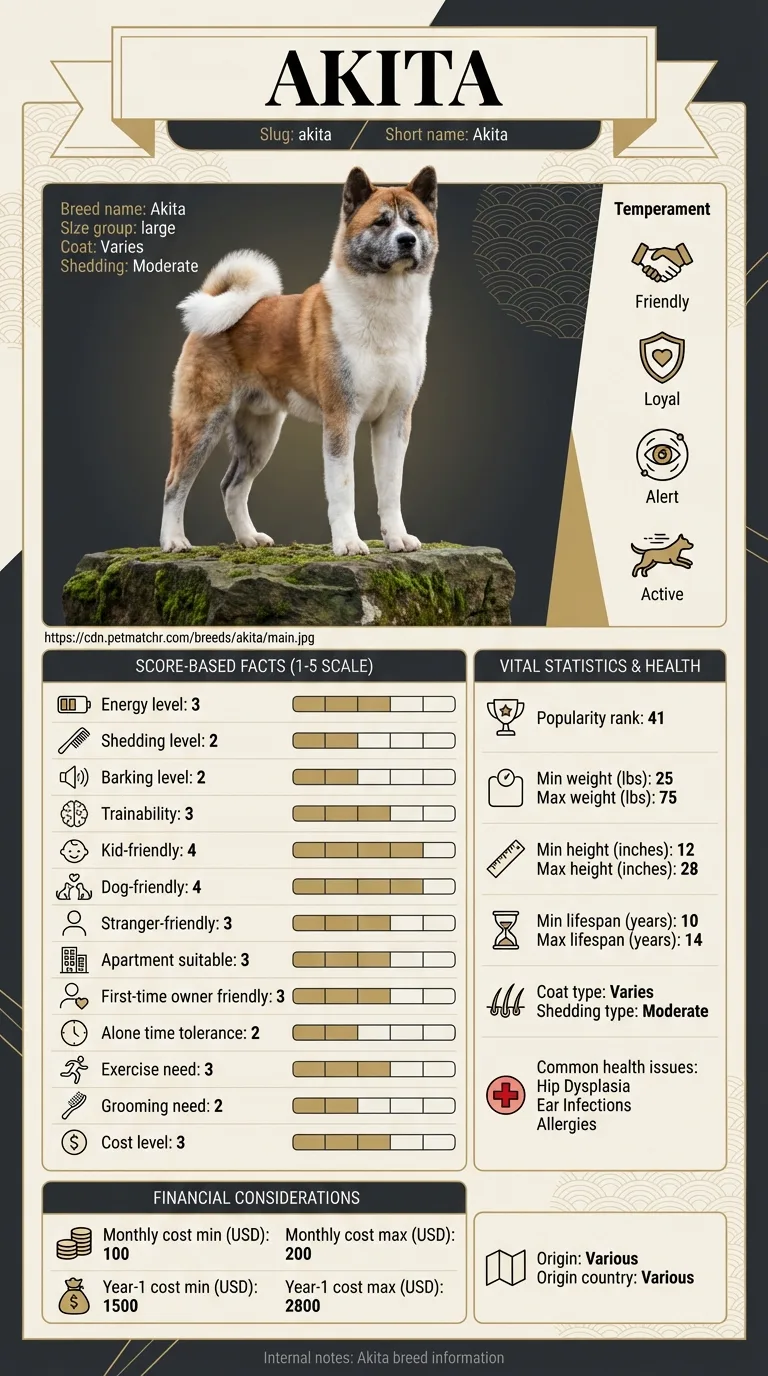
The Akita's substantial size, reaching up to 130 pounds, means that whatever baseline rate of joint malformation exists in the breed's gene pool carries more functional consequence than the same conformation would in a small dog. This is part of why hip dysplasia is specifically flagged for this breed rather than being a generic catch-all warning.
Screening practices vary by breeder and region, and puppies from unscreened parents carry unknown risk rather than necessarily low risk. Growth-phase nutrition and exercise also shape how much a given genetic predisposition actually translates into symptoms later in life.
Talk to a vet about baseline hip imaging if you're considering breeding your dog, if a breeder's paperwork is incomplete, or if you notice any gait changes such as bunny-hopping or reluctance to climb stairs. Seek same-day care for sudden hind-leg lameness or collapse.
Prevalence numbers get misread and misapplied more often than almost any other piece of breed research. Avoid these mistakes.
See all Akita health problems, which breeds are prone to hip dysplasia prevalence, or the full Akita breed guide for temperament, exercise needs and ownership costs.
Hip screening results (via OFA) are typically available a few weeks after imaging is submitted; PennHIP scoring is often available faster through the certified vet performing it. Neither test changes overnight, but they give a clear planning baseline for the years ahead.
Success looks like an informed decision — either choosing a puppy from screened, lower-risk parents, or knowingly taking on an unscreened dog with a realistic plan for monitoring and managing hip health over its lifetime.
Before bringing home his Akita puppy Yuki, Felix in Burlington asked the breeder for hip and elbow certification on both parents. The breeder provided OFA paperwork showing 'Good' hip ratings for both, which reassured Felix but didn't fully eliminate his concern given how often hip dysplasia came up in his research. Felix fed Yuki a controlled-growth large-breed diet, kept her lean, and paced her exercise carefully through her first two years. At her two-year checkup, Yuki's own hip X-rays came back clear. Felix still watches her gait closely, knowing that screened parents lower but don't erase the odds.
Key takeaway: Prevalence data is most useful as a planning tool — asking for real screening documentation and managing growth-phase care are the concrete steps within an owner's control.
Yes — it's specifically named among the documented common health concerns for the breed, which reflects both genetic predisposition seen in some lines and the mechanical demands the breed's large size puts on the joint.
No — rates vary meaningfully by breed and even by bloodline within a breed, which is why screening programs report statistics by breed rather than treating all large dogs the same.
Ask for their OFA (Orthopedic Foundation for Animals) hip evaluation or PennHIP score. Reputable breeders screen both parents and should be able to provide documentation rather than just a verbal assurance.
It significantly lowers the odds but doesn't guarantee it, since hip dysplasia is influenced by multiple genes as well as environmental factors during a puppy's growth.
OFA's standard evaluation is done at two years or older, once the hip joint has fully matured; PennHIP can assess joint laxity as early as sixteen weeks using a different technique.
It's a reason to be proactive rather than alarmed — feeding a controlled-growth diet, avoiding excess weight, and pacing exercise appropriately are sensible regardless of a specific dog's genetic risk.
For most prospective owners, no — it's a reason to choose a breeder who screens for hips (or, for a rescue, to budget for the possibility) rather than a reason to avoid the breed altogether.
It's common enough to be listed among the breed's documented health concerns, not a rare or unusual finding.
OFA hip certification or a PennHIP score for both parent dogs, with actual documentation rather than a verbal claim.
Reputable breeders' prices often reflect these health-testing costs, which is a reasonable tradeoff against later veterinary expense.
Yes — lean body weight and appropriately paced exercise meaningfully reduce symptoms even in a dog with imperfect hip conformation.
No — elbow screening is also worth asking about, since elbow dysplasia is a related developmental concern in large breeds.
A one-page prep sheet for this condition: the signs, the questions to ask, what to get priced. Unlocks here.
You get: Vet visit prep sheet
No spam. One-click unsubscribe. See our privacy policy.
Preview page 1 before you decide.