It depends heavily on space and exercise capacity: the Saint Bernard needs less activity (low, 2/5) but far more room, while the Boxer needs a real exercise routine (very high, 5/5) but takes up less space and less budget doing it.
Boxer or Saint Bernard? On paper they differ most on exercise need, and on the scales Saint Bernard is the heavier at 120–180 lbs. Here is how the two compare on everything that shapes an ordinary week.
This is for someone already down to Boxer and Saint Bernard and deciding between them. For this pair the decision usually turns on exercise need and grooming need, so those are covered first and in most detail. Anyone choosing from a flat has a clear answer here: Boxer rates 2/5 against 1/5. There is no origin story here — only what changes about your week.
Quick verdict
Between Boxer and Saint Bernard, exercise need is what separates them; neither is the lower-effort dog overall.
Choose boxer if...
Choose Boxer if you do not want a standing grooming appointment, shedding is a problem in your house and you want a dog that picks up training quickly.
Choose saint bernard if...
Choose Saint Bernard if your walking routine is modest.
Head-to-head comparison
Feature
boxer
saint bernard
Winner
Size class
large
giant
Equal
Weight
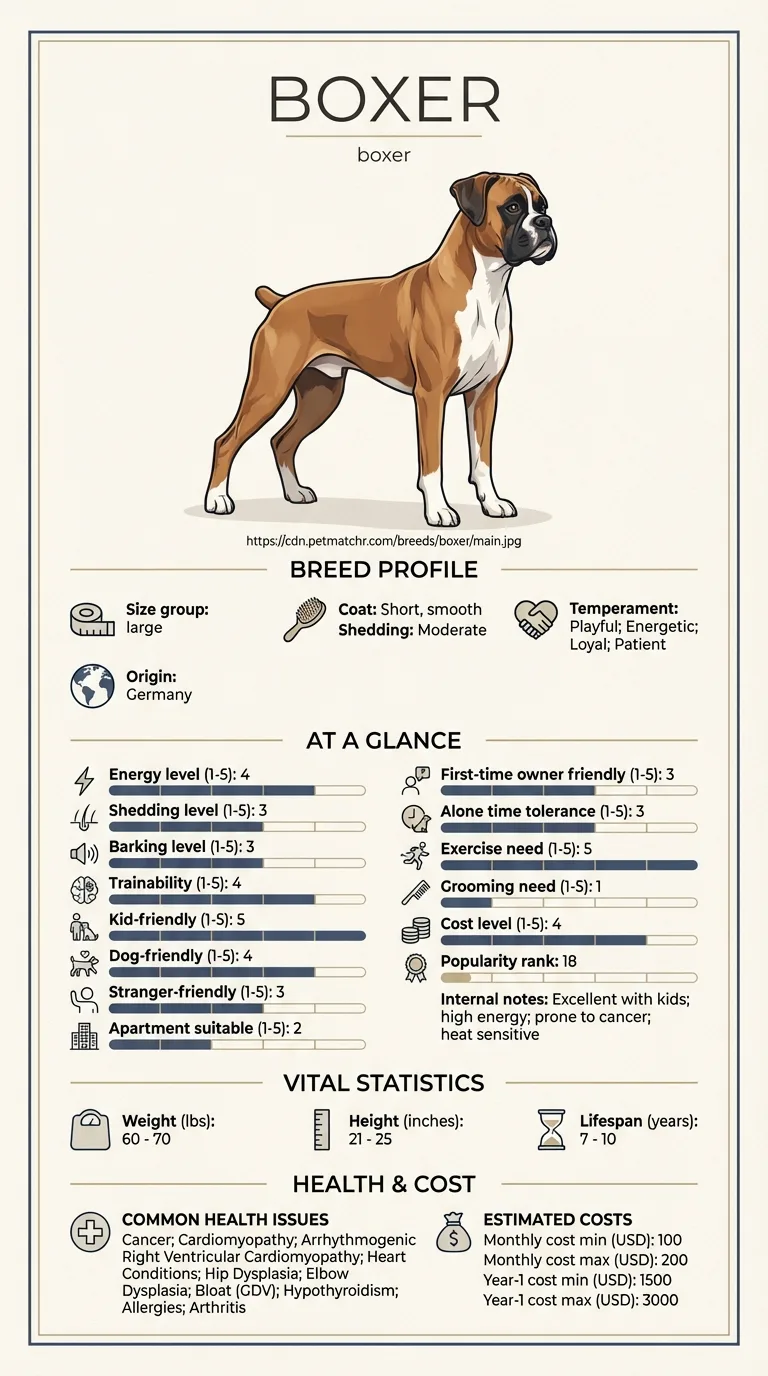
60–70 lbs
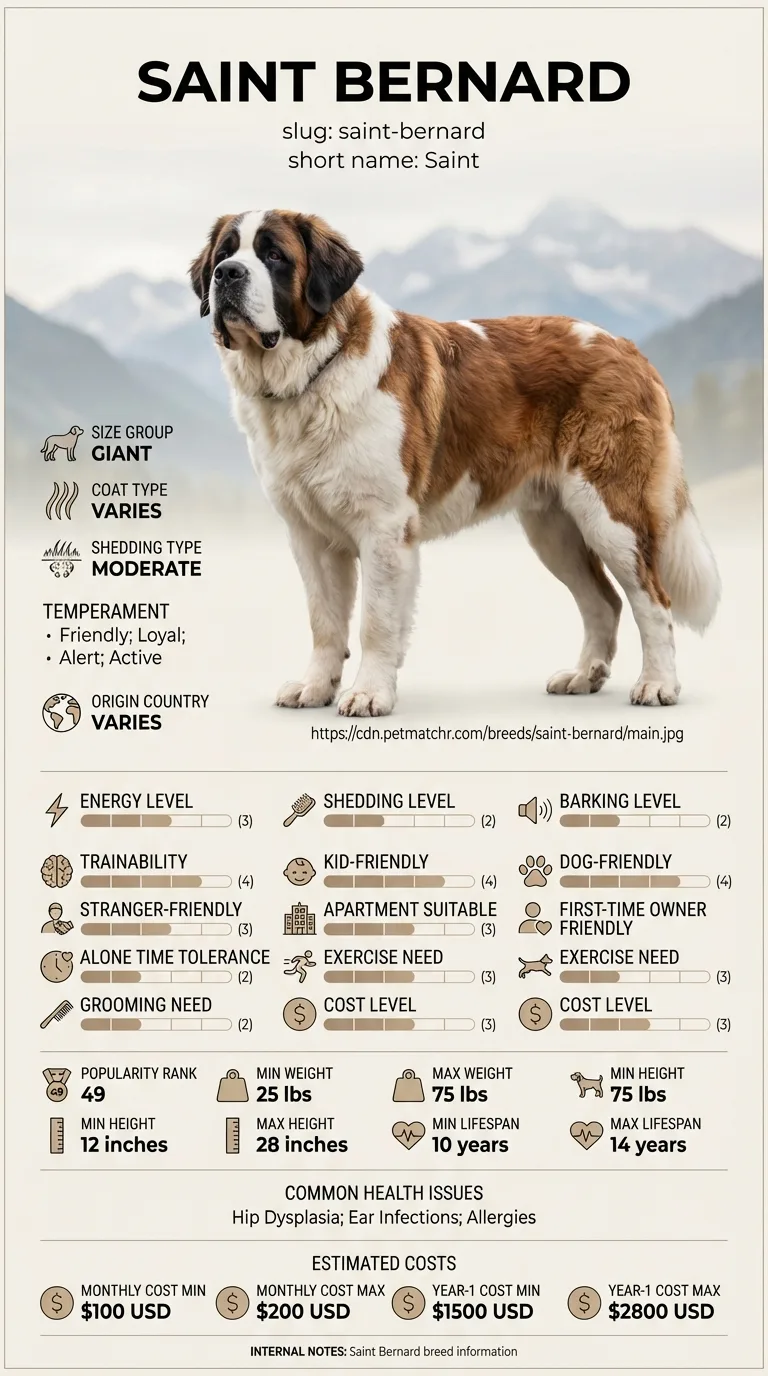
120–180 lbs
Equal
Height
21–25 in
26–30 in
Equal
Lifespan
7–10 years
8–10 years
saint bernard
Exercise need
Very high (5/5)
Low (2/5)
saint bernard
Grooming need
Very low (1/5)
Moderate (3/5)
boxer
Shedding
Moderate (3/5)
High (4/5)
boxer
Energy level
High (4/5)
Low (2/5)
Equal
Barking
Moderate (3/5)
Low (2/5)
saint bernard
Apartment suitability
Low (2/5)
Very low (1/5)
boxer
Good for first-time owners
Moderate (3/5)
Moderate (3/5)
Equal
Tolerates being alone
Moderate (3/5)
Moderate (3/5)
Equal
Trainability
High (4/5)
Moderate (3/5)
boxer
Good with kids
Very high (5/5)
Very high (5/5)
Equal
Good with other dogs
High (4/5)
High (4/5)
Equal
Friendly to strangers
Moderate (3/5)
High (4/5)
saint bernard
Cost level
High (4/5)
Very high (5/5)
boxer
Coat
Short, smooth
Short or long double coat
Equal
Origin
Germany
Various
Equal
Typical monthly cost
$100–$200
$150–$310
Equal
Typical first-year cost
$1,500–$3,000
$2,200–$4,200
Equal
Deep dive
Size and build
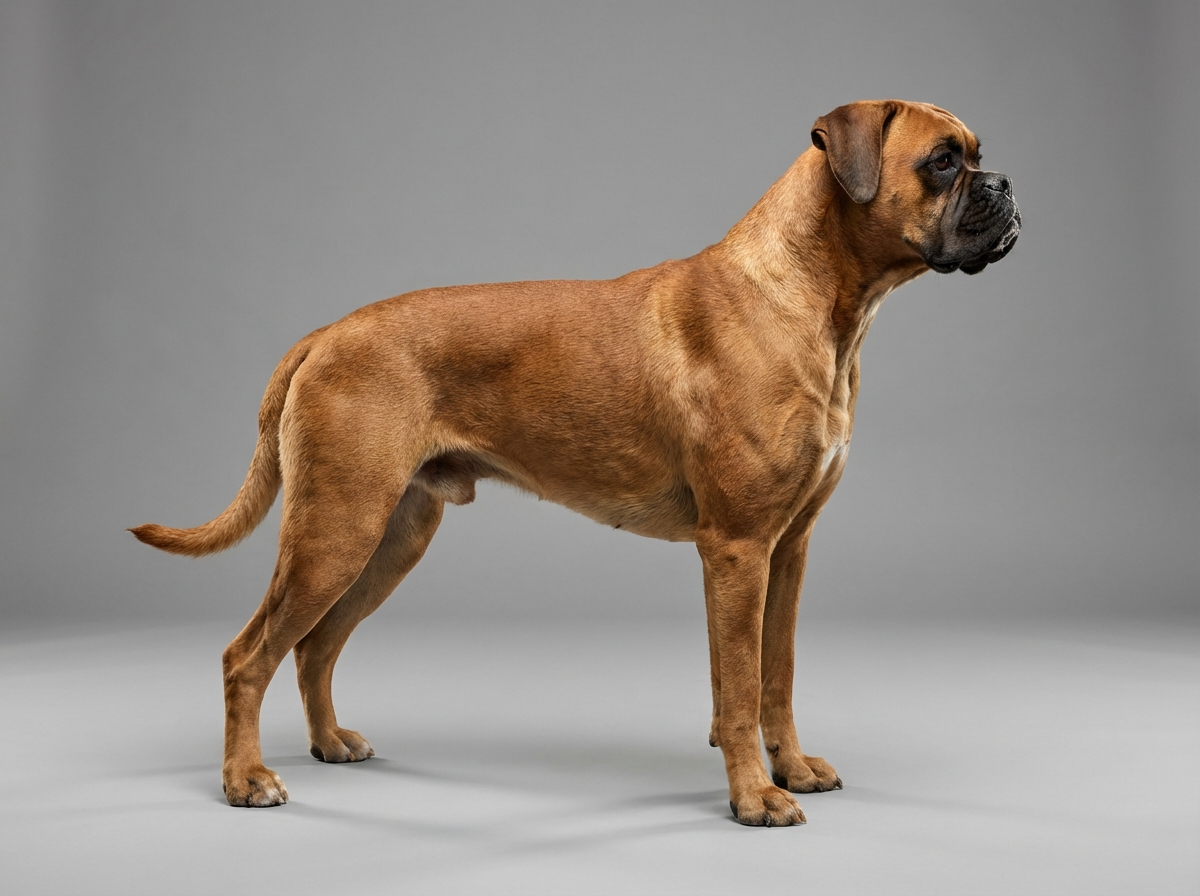
The Saint Bernard is in a different weight class entirely — 120-180 lbs against the Boxer's 60-70, more than double, and classified as a giant breed against the Boxer's large. Height follows suit, 26-30 inches versus 21-25. This isn't a matchup of similar dogs; it's a comparison for someone deciding between big and enormous. Everything about daily life scales with that number, from the size of the crate you'll need to how much food goes in the bowl.
Energy and exercise
Despite the size gap, exercise need runs the opposite direction you'd expect: the Boxer rates very high (5/5), the Saint Bernard just low (2/5). Giant breeds like this one are famously low-key for their size, content with modest daily walks rather than sustained activity — a Saint Bernard that gets over-exercised, especially in heat, is a bigger health risk than one that gets too little.
Grooming and shedding
The Boxer stays low-maintenance here at very low (1/5) grooming and moderate (3/5) shedding, while the Saint Bernard steps up to moderate (3/5) grooming and high (4/5) shedding — its double coat, whether short or long, comes out in volume. If fur management is a concern, this pairing tilts firmly toward the Boxer. Neither breed demands the constant trims a curly- or wiry-coated dog would, but the Saint Bernard's volume of loose fur is still something to plan around.
Apartment living, noise and time alone
Neither dog belongs in a small apartment, but the Saint Bernard is the more extreme case — very low (1/5) apartment suitability against the Boxer's already-low 2/5. Barking favors the Saint Bernard though, low (2/5) against the Boxer's moderate (3/5); size, not noise, is what rules this breed out of compact living. A house with real square footage, not just a yard, is the baseline requirement for a dog that can weigh 180 lbs.
Training and owner experience
The Boxer trains more readily, high (4/5) against the Saint Bernard's moderate (3/5), though both land at moderate (3/5) for first-time-owner suitability and tolerate alone time about the same (moderate 3/5 for both). A Saint Bernard's sheer size means training matters just as much as with a more difficult breed — a large, undertrained dog is harder to manage regardless of temperament.
Kids, other dogs and visitors
Both breeds score very high (5/5) with kids and high (4/5) with other dogs — a clean tie on family fit. The Saint Bernard is friendlier with strangers, rated high (4/5) against the Boxer's moderate (3/5), consistent with its reputation as a gentle, welcoming giant. Families that host frequently may find the Saint Bernard's easygoing manner with new faces the more convenient trait of the two.
Health and lifespan
Lifespan is short for both, and close: 7-10 years for the Boxer, 8-10 for the Saint Bernard — giant breeds simply don't get the extra years smaller dogs do. Hip and elbow dysplasia and bloat appear on both health lists, structural and digestive risks tied to large body size, while the Boxer adds cancer and heart disease, and the Saint Bernard adds dilated cardiomyopathy and entropion, an eyelid condition, to its own list.
Cost to keep
The Saint Bernard is the pricier dog to keep — cost level very high (5/5) against the Boxer's high (4/5), with monthly costs of $150-310 versus $100-200 and first-year costs of $2,200-4,200 versus $1,500-3,000. Food volume alone for a dog that can weigh 180 lbs accounts for a meaningful share of that gap. Insurance premiums and vet visit pricing also tend to scale with a dog's weight, adding further to the Saint Bernard's higher ceiling.
Boxer vs Saint Bernard at a glance
Boxer weighs 60–70 lbs and lives 7–10 years; Saint Bernard weighs 120–180 lbs and lives 8–10 years. The two diverge most on exercise need, grooming need and energy level. They are level on tolerates being alone, good with other dogs and good for first-time owners, so those cannot decide it. Where the table declares a winner it means less work for the owner, nothing more; descriptive rows are left as ties on purpose. The value here is in the differences between the two columns; treat any single score as approximate.
Boxer vs Saint Bernard: Which Suits Your Home? - Boxer vs Saint Bernard at a glance
Frequently asked questions
How much bigger is a Saint Bernard than a Boxer?
Substantially — 120-180 lbs against 60-70, more than double, and it's classified as a giant breed rather than large. Expect a correspondingly bigger crate, bigger food bill, and bigger vet bills.
Which needs more exercise?
The Boxer, by a wide margin — very high (5/5) against the Saint Bernard's low (2/5). Giant breeds like the Saint Bernard are generally low-energy for their size.
Which sheds more?
The Saint Bernard, rated high (4/5) against the Boxer's moderate (3/5) — its double coat produces significant volume even though grooming need itself is only moderate (3/5).
What does each cost to keep?
The Saint Bernard runs $150-310 monthly and $2,200-4,200 in year one; the Boxer runs $100-200 and $1,500-3,000. Size drives most of that gap.
Do they share health risks?
Yes — hip dysplasia, elbow dysplasia, and bloat appear on both lists, all tied to the physical stress of carrying a large frame.
Which lives longer?
Neither lives especially long — 7-10 years for the Boxer, 8-10 for the Saint Bernard, both short lifespans typical of large and giant breeds.
Is either good with kids?
Both are, tied at very high (5/5) — a genuine strength for either breed if you have children in the house.
It depends heavily on space and exercise capacity: the Saint Bernard needs less activity (low, 2/5) but far more room, while the Boxer needs a real exercise routine (very high, 5/5) but takes up less space and less budget doing it.
Costs
What's the monthly cost gap?
Meaningful — $150-310 for the Saint Bernard against $100-200 for the Boxer, driven mostly by food volume.
Behavior
How much exercise does each need?
Opposite ends of the scale — very high (5/5) for the Boxer, low (2/5) for the Saint Bernard, despite the size difference running the other way.
Health
Which lives longer?
The Saint Bernard, marginally — 8-10 years against the Boxer's 7-10, though both are short-lived relative to smaller breeds.
Related DogBreedCompass guides
Boxer breed guide – Readers comparing the two usually want the full profile of Boxer before deciding.
Saint Bernard breed guide – The same for Saint Bernard, so the comparison can be checked against the detail.
Boxer vs Welsh Springer Spaniel – Welsh Springer Spaniel is the closest breed to Boxer on the measured axes, so it is the natural next comparison.
Saint Bernard vs Newfoundland – Newfoundland sits closest to Saint Bernard, which makes it the alternative worth ruling out.
What Boxer costs to keep – Anyone weighing these two is usually also pricing them, and the cost pages carry city-level figures.
Saint Bernard health problems – The health pages set out what each breed is actually screened for.
Health information here is general and is not veterinary advice. If your dog shows pain, sudden behaviour change, or worsening symptoms, consult a licensed veterinarian.
Some links on this site are affiliate links. We may earn a commission at no extra cost to you, and we only suggest products we believe are helpful for dog owners.
We research and check what we publish, but we do not warrant that any figure, date, price, or statement is accurate, complete, or current, and we accept no liability for any loss, cost, injury, or other harm arising from the use of this site. Use it as one reference among several. You remain responsible for your own decisions and for your dog's care - confirm anything that matters with a licensed veterinarian or another qualified professional before you act on it. Full disclaimer.