Living
Which is bigger?
The Husky, by a huge margin, up to 60 lbs versus the Yorkie's 7 lb maximum.

Quick answer
Which is bigger?
The Husky, by a huge margin, up to 60 lbs versus the Yorkie's 7 lb maximum.
Siberian Husky or Yorkshire Terrier? On paper they differ most on apartment suitability, and on the scales Siberian Husky is the heavier at 45–60 lbs. Here is how the two compare on everything that shapes an ordinary week.
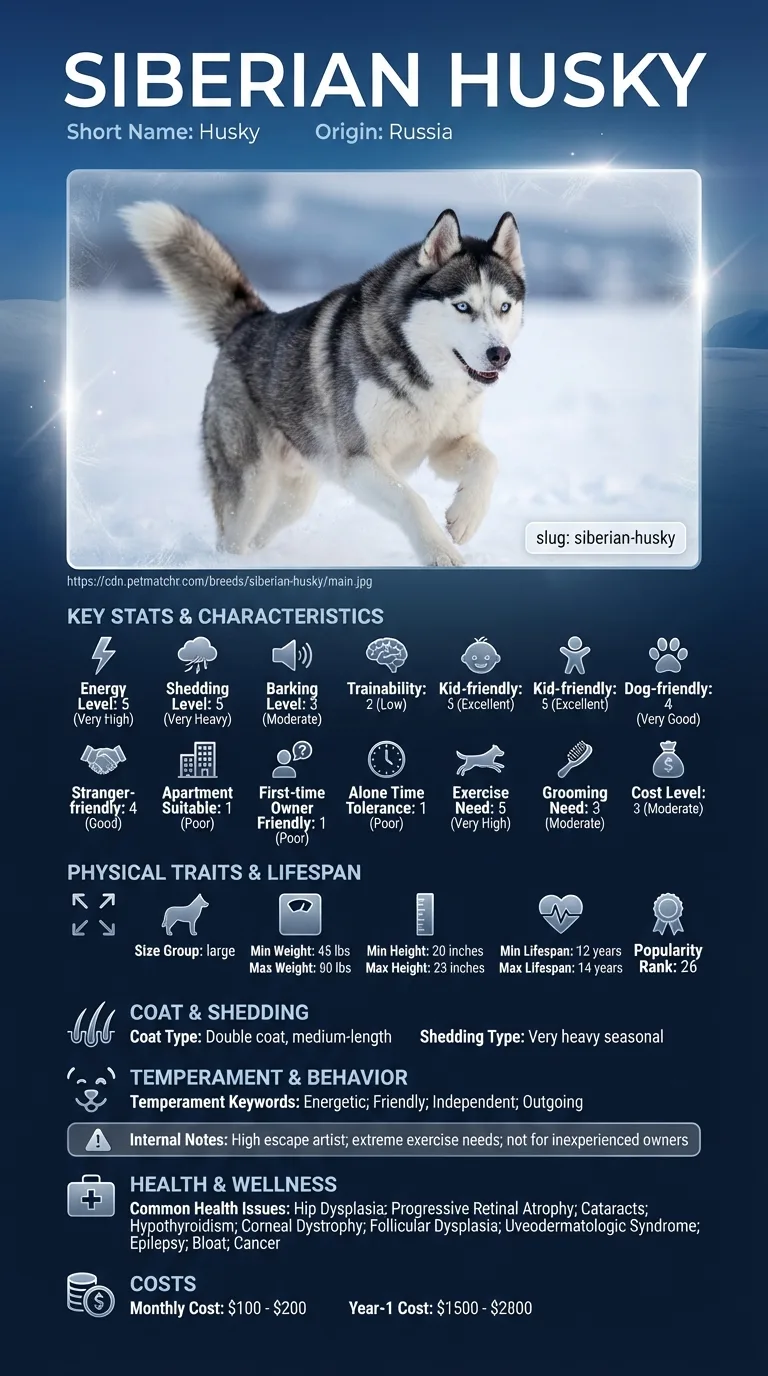
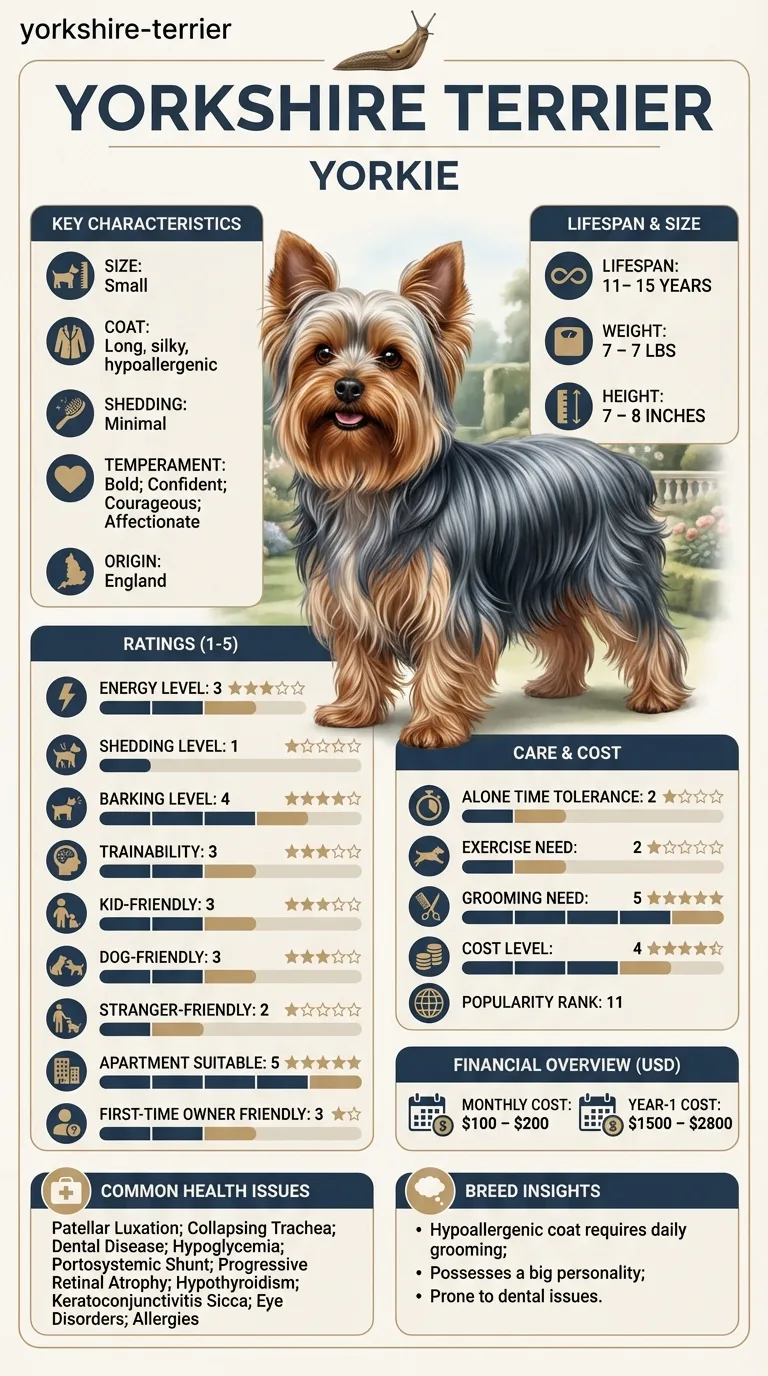
This is for someone already down to Siberian Husky and Yorkshire Terrier and deciding between them. For this pair the decision usually turns on apartment suitability and shedding, so those are covered first and in most detail. Anyone choosing from a flat has a clear answer here: Yorkshire Terrier rates 5/5 against 1/5. The focus throughout is on daily consequences rather than breed background.
Between Siberian Husky and Yorkshire Terrier, apartment suitability is what separates them, and Yorkshire Terrier is the lower-effort dog of the two to keep.
Choose Siberian Husky if you do not want a standing grooming appointment, there are young children at home and you already have another dog.
Choose Yorkshire Terrier if you are in a flat or a smaller home, this is your first dog and shedding is a problem in your house.
| Feature | siberian husky | yorkshire terrier | Winner |
|---|---|---|---|
| Size class | large | small | Equal |
| Weight | 45–60 lbs | 4–7 lbs | Equal |
| Height | 20–23 in | 7–8 in | Equal |
| Lifespan | 12–14 years | 11–15 years | Equal |
| Exercise need | Very high (5/5) | Low (2/5) | yorkshire terrier |
| Grooming need | Moderate (3/5) | Very high (5/5) | siberian husky |
| Shedding | Very high (5/5) | Very low (1/5) | yorkshire terrier |
| Energy level | Very high (5/5) | Moderate (3/5) | Equal |
| Barking | Moderate (3/5) | High (4/5) | siberian husky |
| Apartment suitability | Very low (1/5) | Very high (5/5) | yorkshire terrier |
| Good for first-time owners | Very low (1/5) | Moderate (3/5) | yorkshire terrier |
| Tolerates being alone | Very low (1/5) | Low (2/5) | yorkshire terrier |
| Trainability | Low (2/5) | Moderate (3/5) | yorkshire terrier |
| Good with kids | Very high (5/5) | Moderate (3/5) | siberian husky |
| Good with other dogs | High (4/5) | Moderate (3/5) | siberian husky |
| Friendly to strangers | High (4/5) | Low (2/5) | siberian husky |
| Cost level | Moderate (3/5) | High (4/5) | siberian husky |
| Coat | Double coat, medium-length | Long, silky, hypoallergenic | Equal |
| Origin | Russia | England | Equal |
| Typical monthly cost | $100–$200 | $100–$190 | Equal |
| Typical first-year cost | $1,500–$2,800 | $1,400–$2,900 | Equal |
Few pairings on this site show a size gap as dramatic as this one: a Siberian Husky runs 45-60 lbs and 20-23 inches, while a Yorkshire Terrier weighs just 4-7 lbs and stands 7-8 inches, a Husky can outweigh a Yorkie by more than tenfold. The Husky's dense double coat and athletic sled-dog build contrast completely with the Yorkie's long, silky, hypoallergenic coat and toy-sized frame, closer in scale to a large housecat than to the Husky. This isn't a comparison of two similar dogs with different quirks; it's a comparison of two entirely different categories of pet, and that gap shapes nearly every other line on the table.
The Husky's Very high (5/5) exercise need towers over the Yorkshire Terrier's Low (2/5), a sled dog built for distance work against a toy companion bred largely for companionship. Energy level narrows the gap slightly, Very high (5/5) for the Husky against Moderate (3/5) for the Yorkie, since Yorkies are famously spirited for their size even if they don't need miles of exercise to express it. A Husky without serious daily outlets becomes destructive; a Yorkie without much exercise at all remains perfectly content with short walks and indoor play. These are close to opposite ends of the exercise spectrum on this entire site.
Grooming flips the size stereotype: the tiny Yorkshire Terrier actually needs more grooming, Very high (5/5), than the much larger Husky, Moderate (3/5), because its long, silky coat requires regular brushing and trimming to avoid mats. Shedding runs the other direction, the Husky sheds Very high (5/5), with dramatic seasonal coat blows, while the Yorkie sheds Very low (1/5) thanks to its hair-like, hypoallergenic coat. So a Husky owner deals with far more loose fur around the house, while a Yorkie owner deals with far more time at the grooming table or groomer's chair.
Apartment suitability is close to a mirror image: Very low (1/5) for the Husky, Very high (5/5) for the Yorkshire Terrier. But barking flips the advantage, the Yorkie rates High (4/5) for barking against the Husky's Moderate (3/5), and small terriers are notorious for reacting vocally to hallway noises and doorbells in ways a Husky, more likely to howl than yap, often doesn't. Alone-tolerance still favors the Yorkie, Low (2/5) versus the Husky's Very low (1/5), though neither breed is genuinely comfortable with long solo stretches. For most apartment dwellers, the Yorkie's space needs are simply easier to meet than the Husky's.
Trainability favors the Yorkshire Terrier, Moderate (3/5) versus the Husky's Low (2/5), and first-time-owner suitability follows the same direction, Moderate (3/5) against Very low (1/5). Neither breed is considered highly trainable in absolute terms, the Husky's Independent nature and the Yorkie's Bold, Confident terrier stubbornness both push back against effortless obedience, but the Yorkie's smaller size makes any training lapses far more manageable day to day than a 60-lb Husky testing boundaries. A first-time owner determined to choose between these two would have an easier road with the Yorkshire Terrier, if a more vocal one.
The Husky pulls ahead across the social categories: Very high (5/5) with kids against the Yorkie's Moderate (3/5), High (4/5) with other dogs against Moderate (3/5), and High (4/5) friendly to strangers against the Yorkie's Low (2/5). The temperament lists explain why, the Husky is Friendly, Outgoing, built for pack life, while the Yorkie is Bold, Confident, Courageous, a terrier temperament that can read as feisty or defensive rather than instantly welcoming, especially toward boisterous kids or unfamiliar dogs. Families with young children or a household full of visitors may find the Husky the more naturally sociable of the two.
Lifespan is essentially tied, 12-14 years for the Husky against 11-15 for the Yorkie. Health profiles differ sharply in kind: the Husky's list centers on eye conditions and orthopedic issues (Hip Dysplasia, Cataracts, Progressive Retinal Atrophy, Bloat, Cancer), while the Yorkie's longer ten-item list reflects classic toy-breed vulnerabilities, Collapsing Trachea, Hypoglycemia, Portosystemic Shunt, and Patellar Luxation, alongside Dental Disease and Allergies. Both share Progressive Retinal Atrophy and Hypothyroidism, suggesting eye and thyroid screening is worthwhile regardless of which breed you choose. The Yorkie's smaller frame brings its own distinct fragility risks the robust Husky simply doesn't share.
Cost level favors the Husky, Moderate (3/5) against the Yorkie's High (4/5), though the typical monthly ranges are close, $100-$200 for the Husky versus $100-$190 for the Yorkie, and first-year costs overlap almost entirely, $1,500-$2,800 versus $1,400-$2,900. The Yorkie's higher cost rating reflects its Very high (5/5) grooming need, which brings recurring professional grooming bills that scale up over a dog's lifetime even though its food costs are minimal given its 4-7 lb frame. The Husky, despite eating considerably more, avoids that grooming line item and comes out slightly ahead on overall cost level.
Siberian Husky weighs 45–60 lbs and lives 12–14 years; Yorkshire Terrier weighs 4–7 lbs and lives 11–15 years. The two diverge most on apartment suitability, shedding and exercise need and 5 other rated axes. Almost every rated axis separates them at least slightly. The table below marks a winner only where one breed is genuinely easier for a typical owner; size and origin are facts rather than merits and stay level. Ratings come from one source applied to both breeds, so they are meaningful against each other rather than as absolute scores.

Enormous, a Husky weighs 45-60 lbs against the Yorkie's 4-7 lbs, meaning a Husky can weigh more than ten times as much as a Yorkie.
The Husky, dramatically, Very high (5/5) versus the Yorkie's Very low (1/5), since the Yorkie's coat behaves more like hair than fur.
The Yorkshire Terrier, rated Very high (5/5) for apartment suitability against the Husky's Very low (1/5), though the Yorkie's High (4/5) barking rating is worth planning for with close neighbors.
It's rated only Moderate (3/5) with kids, lower than the Husky's Very high (5/5); a Yorkie's small size makes rough handling by young children a real injury risk.
The Yorkshire Terrier, its long, silky coat needs Very high (5/5) grooming, more than the much larger Husky's Moderate (3/5).
Toy-breed-specific issues dominate: Collapsing Trachea, Hypoglycemia, Portosystemic Shunt, and Patellar Luxation, alongside Dental Disease and several eye conditions.
The Yorkshire Terrier, rated High (4/5) versus the Husky's Moderate (3/5), though Huskies are known to howl and vocalize in their own distinctive way.
The Husky, by a huge margin, up to 60 lbs versus the Yorkie's 7 lb maximum.
The Yorkshire Terrier, rated Very low (1/5) versus the Husky's Very high (5/5).
The Yorkshire Terrier, rated High (4/5) versus the Husky's Moderate (3/5).
The Yorkshire Terrier, rated Very high (5/5) versus the Husky's Very low (1/5).
Secure checkout on Stripe. We never see your card.
7-day money-back guarantee. Instant access.
Health information here is general and is not veterinary advice. If your dog shows pain, sudden behaviour change, or worsening symptoms, consult a licensed veterinarian.
Some links on this site are affiliate links. We may earn a commission at no extra cost to you, and we only suggest products we believe are helpful for dog owners.
We research and check what we publish, but we do not warrant that any figure, date, price, or statement is accurate, complete, or current, and we accept no liability for any loss, cost, injury, or other harm arising from the use of this site. Use it as one reference among several. You remain responsible for your own decisions and for your dog's care - confirm anything that matters with a licensed veterinarian or another qualified professional before you act on it. Full disclaimer.
Match your lifestyle to the right dog.
Take quizNot sure which breed is right for you? Take our 2-minute quiz to find out.
Take the quiz