Living
Which is friendlier to strangers?
The Pug, rated very high (5/5) versus the Rottweiler Mix's low (2/5).

Quick answer
Which is friendlier to strangers?
The Pug, rated very high (5/5) versus the Rottweiler Mix's low (2/5).
Pug or Rottweiler Mix? On paper they differ most on apartment suitability, and on the scales Rottweiler Mix is the heavier at 80–135 lbs. Here is how the two compare on everything that shapes an ordinary week.
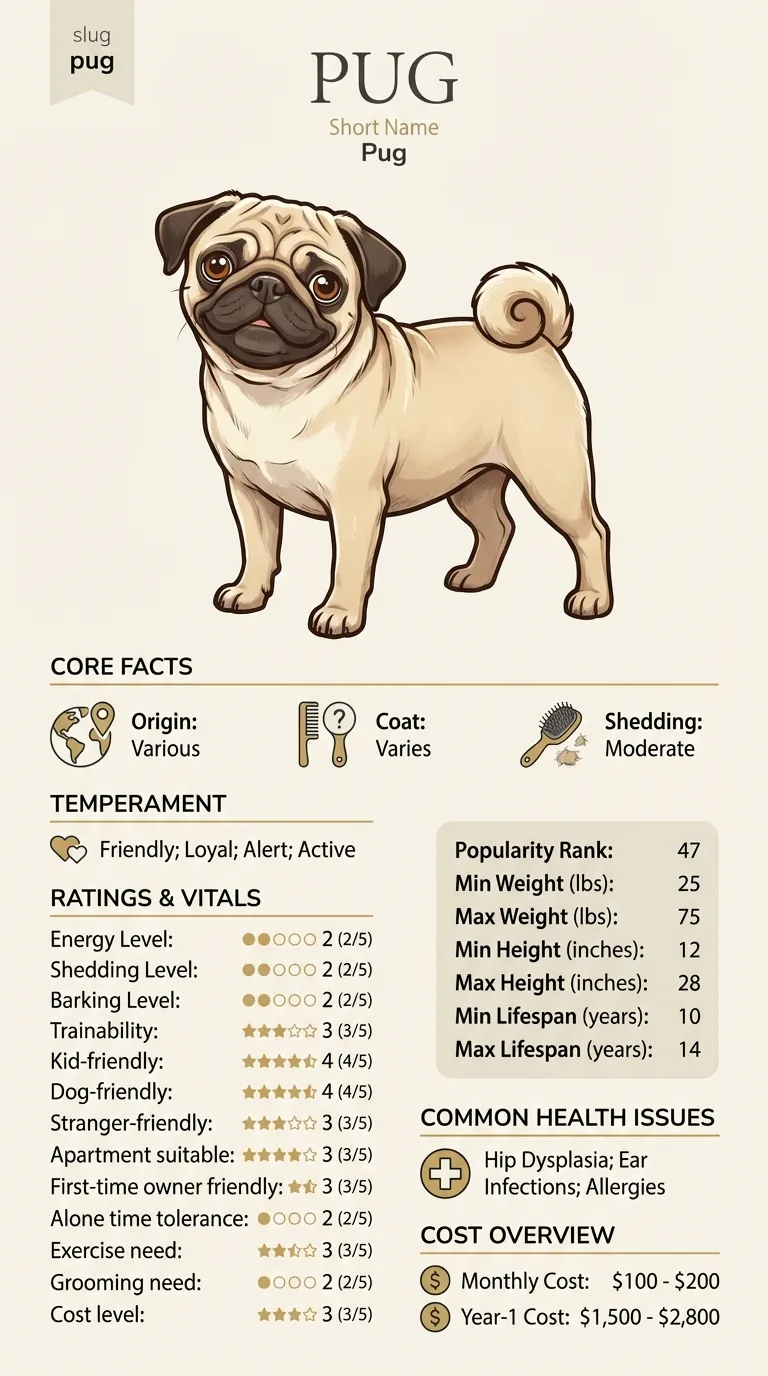
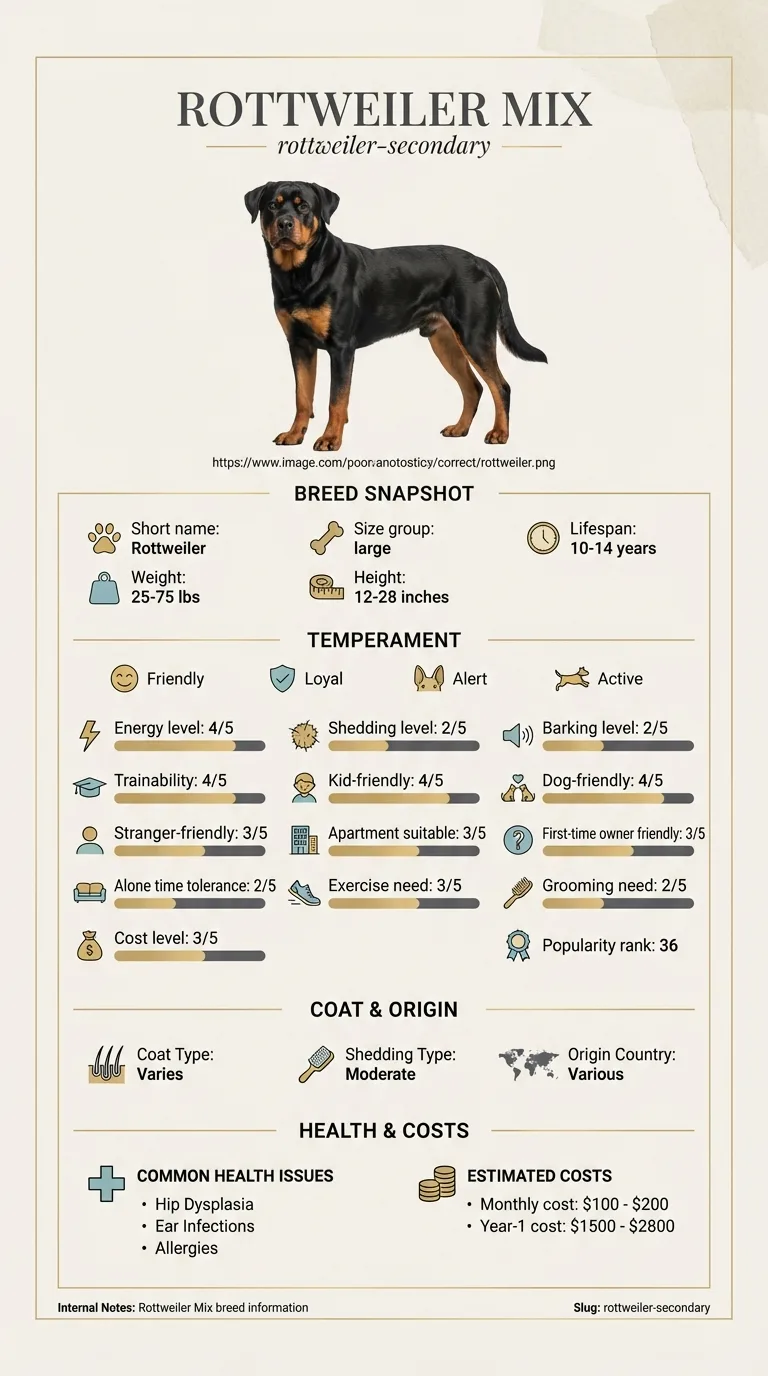
This is for someone already down to Pug and Rottweiler Mix and deciding between them. For this pair the decision usually turns on apartment suitability and good for first-time owners, so those are covered first and in most detail. Anyone choosing from a flat has a clear answer here: Pug rates 5/5 against 2/5. The focus throughout is on daily consequences rather than breed background.
Between Pug and Rottweiler Mix, apartment suitability is what separates them, and Pug is the lower-effort dog of the two to keep.
Choose Pug if you are in a flat or a smaller home, this is your first dog and your walking routine is modest.
Choose Rottweiler Mix if shedding is a problem in your house, the dog will be alone during the working day and you want a dog that picks up training quickly.
| Feature | pug | rottweiler secondary | Winner |
|---|---|---|---|
| Size class | small | large | Equal |
| Weight | 14–18 lbs | 80–135 lbs | Equal |
| Height | 10–13 in | 22–27 in | Equal |
| Lifespan | 13–15 years | 9–10 years | pug |
| Exercise need | Low (2/5) | High (4/5) | pug |
| Grooming need | Low (2/5) | Low (2/5) | Equal |
| Shedding | High (4/5) | Moderate (3/5) | rottweiler secondary |
| Energy level | Low (2/5) | Moderate (3/5) | Equal |
| Barking | Low (2/5) | Low (2/5) | Equal |
| Apartment suitability | Very high (5/5) | Low (2/5) | pug |
| Good for first-time owners | Very high (5/5) | Low (2/5) | pug |
| Tolerates being alone | Low (2/5) | Moderate (3/5) | rottweiler secondary |
| Trainability | Moderate (3/5) | High (4/5) | rottweiler secondary |
| Good with kids | Very high (5/5) | Moderate (3/5) | pug |
| Good with other dogs | High (4/5) | Low (2/5) | pug |
| Friendly to strangers | Very high (5/5) | Low (2/5) | pug |
| Cost level | Moderate (3/5) | High (4/5) | pug |
| Coat | Short, smooth double coat | Short, dense double coat | Equal |
| Origin | Various | Various | Equal |
| Typical monthly cost | $80–$150 | $110–$240 | Equal |
| Typical first-year cost | $1,100–$2,300 | $1,700–$3,200 | Equal |
Even against a mixed-breed Rottweiler, the size gap with a Pug barely narrows: 14 to 18 pounds and 10-13 inches for the Pug against 80 to 135 pounds and 22-27 inches for the Rottweiler Mix — identical weight and height ranges to a purebred Rottweiler in this dataset. Mixed heritage sometimes softens a breed's extremes, but here the Rottweiler Mix's frame remains squarely large-breed territory, with a short, dense double coat over a solidly built body. The Pug's short, smooth double coat and compact, muscular frame remain a companion-sized contrast regardless of which Rottweiler lineage sits on the other side of the comparison.
The Rottweiler Mix rates high (4/5) for exercise need against the Pug's low (2/5), though its energy level comes in at a more moderate 3/5 rather than the higher rating seen in some purebred Rottweiler comparisons — mixed heritage can soften day-to-day intensity even when the underlying exercise requirement stays high. The Pug's low exercise and energy scores reflect its brachycephalic build, which limits safe exertion, especially in warm weather. Owners drawn to a Rottweiler Mix specifically because it seems calmer than a purebred should still expect a genuinely active dog that needs regular structured outings, not a low-key companion.
Grooming need ties at low (2/5) for both breeds, but shedding tips toward the Pug this time — high (4/5) against the Rottweiler Mix's moderate (3/5), a slightly lower shedding score than some purebred Rottweiler comparisons in this dataset show. Both coats are short and double-layered, so neither breed needs professional grooming, but both will leave hair on furniture and clothing year-round rather than shedding seasonally. A household choosing between these two specifically to minimize hair cleanup won't find a dramatic winner here — plan on regular brushing and vacuuming regardless of which one joins the family.
Apartment suitability rates very high (5/5) for the Pug against low (2/5) for the Rottweiler Mix, and barking actually ties at low (2/5) for both — neither breed is a nuisance barker through shared walls. Alone-time tolerance edges toward the Rottweiler Mix at moderate (3/5) versus the Pug's low (2/5), a small but real advantage for a household with unpredictable work hours. Even so, the size and exercise mismatch means a small apartment remains a much easier fit for the Pug; a Rottweiler Mix genuinely benefits from more room to move regardless of how well it tolerates solitude.
Trainability favors the Rottweiler Mix at high (4/5) against the Pug's moderate (3/5), with a confident, loyal, watchful, steady temperament that responds well to consistent structure. First-time-owner suitability draws the sharpest line in this section — very high (5/5) for the Pug versus low (2/5) for the Rottweiler Mix — since a novice handling a large, watchful dog benefits from prior experience setting boundaries early. The Pug's charming, mischievous, affectionate nature can make training sessions less predictable moment to moment, but its smaller size means mistakes carry lower stakes for an inexperienced owner.
The Pug rates ahead of the Rottweiler Mix across every household-fit measure here: very high (5/5) versus moderate (3/5) with kids, high (4/5) versus low (2/5) with other dogs, and very high (5/5) versus low (2/5) with strangers. The Rottweiler Mix's watchful, steady temperament makes it naturally reserved around unfamiliar people and other dogs, which calls for careful, gradual introductions rather than assuming friendliness by default. Families with a busy household of visiting kids, dogs, or guests will likely find the Pug's broad, easygoing sociability the lower-friction choice by a clear margin.
The Pug's 13-to-15-year lifespan outpaces the Rottweiler Mix's 9-to-10 by roughly four to five years, a gap driven by size even though the mix's range runs slightly shorter than some purebred Rottweiler entries. Both breeds carry a five-condition health list of similar length, though the specifics differ sharply: the Pug's is shaped by its flat face — BOAS, Pug Dog Encephalitis, corneal ulcers, hemivertebrae, and obesity — while the Rottweiler Mix's leans structural and cardiac — hip dysplasia, elbow dysplasia, osteosarcoma, subaortic stenosis, and cruciate ligament tears. Neither list is short enough to skip pre-adoption health screening conversations with a vet.
Cost level rates moderate (3/5) for the Pug and high (4/5) for the Rottweiler Mix, with monthly costs of $80 to $150 against $110 to $240 and first-year totals of $1,100 to $2,300 versus $1,700 to $3,200. The Rottweiler Mix's larger body drives most of the gap through food volume and veterinary pricing scaled to size, while the Pug's costs lean more toward managing its breed-specific health conditions over time. Both ranges sit close to their purebred-Rottweiler counterparts elsewhere in this dataset, suggesting mixed heritage doesn't meaningfully lower the cost of keeping a large dog.
Pug weighs 14–18 lbs and lives 13–15 years; Rottweiler Mix weighs 80–135 lbs and lives 9–10 years. The two diverge most on apartment suitability, good for first-time owners and exercise need and 3 other rated axes. They are level on barking and grooming need, so those cannot decide it. The table below marks a winner only where one breed is genuinely easier for a typical owner; size and origin are facts rather than merits and stay level. Ratings come from one source applied to both breeds, so they are meaningful against each other rather than as absolute scores.

This entry's data suggests a somewhat more moderate energy level (3/5) than some purebred Rottweiler comparisons show, though exercise need remains high (4/5), so it's still a genuinely active breed.
The Pug, rated very high (5/5) for first-time owners versus the Rottweiler Mix's low (2/5).
The Pug, rated high (4/5), slightly ahead of the Rottweiler Mix's moderate (3/5).
Hip dysplasia, elbow dysplasia, osteosarcoma, subaortic stenosis, and cruciate ligament tears — five conditions leaning toward structural and cardiac risk.
The Pug, at 13-15 years, compared with 9-10 years for the Rottweiler Mix.
Not especially — they rate low (2/5) for compatibility with other dogs, versus high (4/5) for the Pug, so introductions should be gradual and supervised.
The Pug, at $80-$150 versus $110-$240 for the Rottweiler Mix.
The Pug, rated very high (5/5) versus the Rottweiler Mix's low (2/5).
The Rottweiler Mix, rated high (4/5) versus the Pug's low (2/5).
The Rottweiler Mix, rated moderate (3/5) versus the Pug's low (2/5).
The Rottweiler Mix, rated high (4/5) versus the Pug's moderate (3/5).
See every pug comparison.
Secure checkout on Stripe. We never see your card.
7-day money-back guarantee. Instant access.
Health information here is general and is not veterinary advice. If your dog shows pain, sudden behaviour change, or worsening symptoms, consult a licensed veterinarian.
Some links on this site are affiliate links. We may earn a commission at no extra cost to you, and we only suggest products we believe are helpful for dog owners.
We research and check what we publish, but we do not warrant that any figure, date, price, or statement is accurate, complete, or current, and we accept no liability for any loss, cost, injury, or other harm arising from the use of this site. Use it as one reference among several. You remain responsible for your own decisions and for your dog's care - confirm anything that matters with a licensed veterinarian or another qualified professional before you act on it. Full disclaimer.
Match your lifestyle to the right dog.
Take quizNot sure which breed is right for you? Take our 2-minute quiz to find out.
Take the quiz