Costs
Pug cost in Wilmington
About $85–$161/month, $1,183–$2,475 for year one — near average, with Delaware's tax-free supplies and Philadelphia-area specialist access roughly a half-hour away.

See Pug price across all cities →
Quick answer
Pug cost in Wilmington
About $85–$161/month, $1,183–$2,475 for year one — near average, with Delaware's tax-free supplies and Philadelphia-area specialist access roughly a half-hour away.
A Pug in Wilmington runs about $85 to $161 a month, with the first year landing near $1,183 to $2,475, close to the national average. Wilmington's genuine advantage for this breed is positional: Delaware charges no state sales tax on any supply purchase, general costs sit slightly below average, and the region's major veterinary specialty resources in the Philadelphia area are roughly a half-hour up I-95 — a combination of low everyday cost and high-end access that most markets make you choose between.
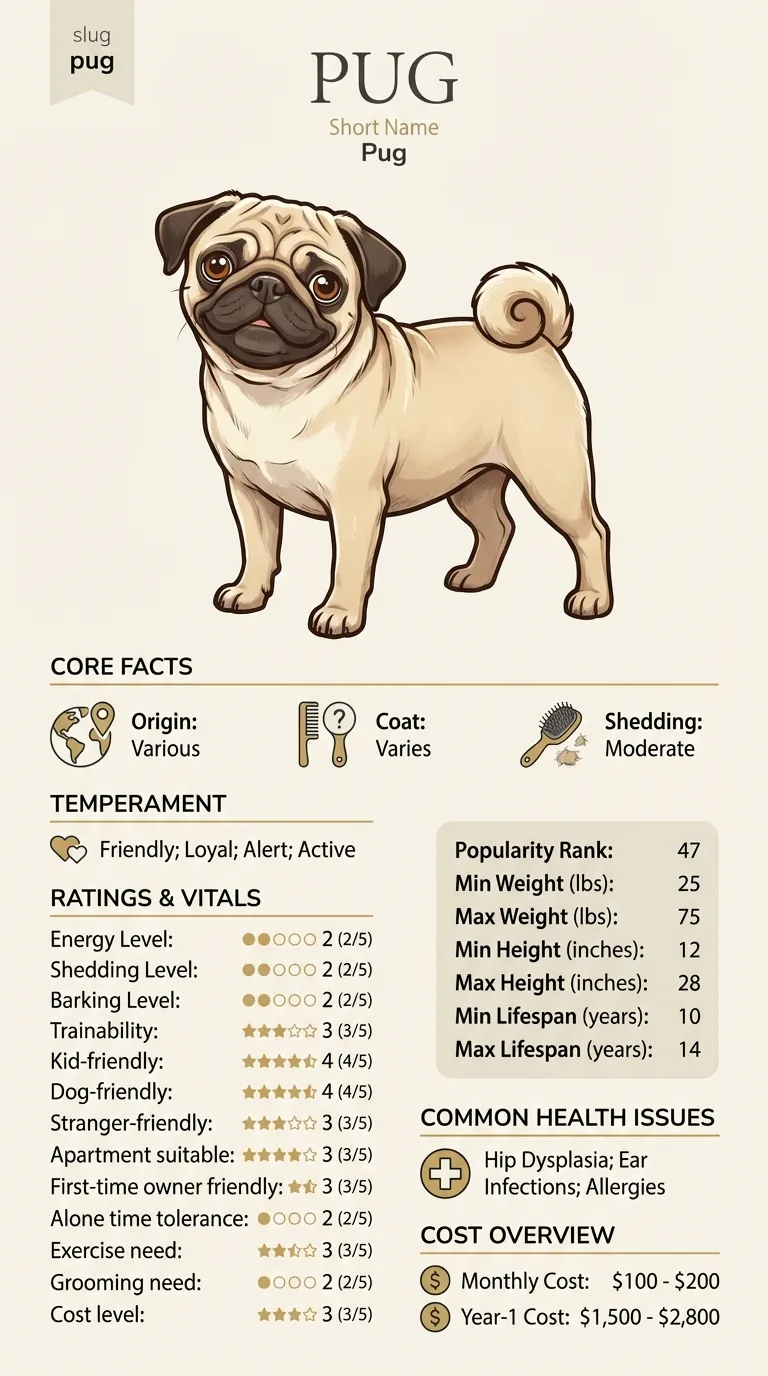
Brachycephalic Airway Syndrome (BOAS) and Pug Dog Encephalitis are this breed's more commonly documented health risks, alongside real, documented Corneal Ulcers and Hemivertebrae risk. This breed's low exercise needs make Obesity a real, common risk that itself worsens breathing effort, making weight management a genuine, ongoing cost.
These figures reflect Wilmington's near-average pricing and Delaware's absent sales tax, with the real structural advantage being metro-depth specialist access at small-state everyday costs.
Estimate · source: estimation · confidence: medium · updated 2026-09-06 · not a quote
| Item | Cost range |
|---|---|
One-time setup (initial vet visit, spay/neuter, gear) Covers the first exam, vaccinations, spay/neuter if needed, and basic gear — priced at Wilmington's near-average rates. | $295 - $494 |
| Item | Cost range |
|---|---|
Food (weight-managed portions) Reflects this breed's genuine 14-to-18-pound size and documented Obesity risk, purchased free of Delaware's absent state sales tax. | $36 - $59 |
Each range starts from a national baseline for this breed's size class and is then adjusted for local cost of living and veterinary pricing. The baselines, and the source each one came from, are listed on our sources page (dataset 2026.09). Two inputs, the purchase price and the emergency reserve, have no published national figure we could verify, so we leave them to you rather than invent them.
These are planning estimates, not quotes. Your own numbers will move with the individual dog, your vet and your insurer. Build a budget with your own figures.
For a Pug in Wilmington, insurance is genuinely worth taking seriously given this breed's documented BOAS, Pug Dog Encephalitis and Corneal Ulcer risks, particularly because easy specialist access makes referral care more likely to actually be used.
Given this breed's documented multi-specialty risk profile, insurance purchased while the dog is young is worth pricing out seriously before anything is on record.
Owners who've built a genuinely solid emergency fund and are comfortable managing a procedure themselves can reasonably self-insure instead.
Wilmington's combination of tax-free supplies and nearby specialist depth is genuinely favorable for this breed, provided the referral relationship is set up before it's needed.
This breed's documented risk list rewards specialist proximity more than most: airway surgery for BOAS, neurology for Pug Dog Encephalitis, ophthalmology for Corneal Ulcers, and an orthopedic-neurologic question in Hemivertebrae.
Most markets force a trade — pay metro prices for that depth of access, or accept a long drive from a cheaper one. Wilmington sits on the edge of the Philadelphia metro inside a small, low-cost state with no sales tax, which means everyday spending happens at Delaware rates while referral options remain roughly a half-hour up the interstate. Establishing a primary vet who already has referral relationships across the state line is the step that actually converts geography into an advantage.
Wilmington otherwise runs close to the national average on general costs, and the region's temperate climate keeps parasite prevention a clearly seasonal rather than year-round expense.

A Wilmington owner whose Pug developed a stubborn eye problem expected the referral process to mean time off work and a long drive, the way it had for a relative in a rural county. Their vet made one call and had them seen by an ophthalmologist across the state line the same week. The bill was a metro bill; everything else about owning the dog stayed priced at Delaware rates.
Key takeaway: In Wilmington, a small tax-free state on a major metro's edge gives this breed's demanding risk list an unusually convenient answer.
About $85–$161, near the national average, with Delaware's absent sales tax trimming every supply purchase.
Roughly $1,183–$2,475, including the initial vet exam, spay/neuter if needed, and gear on top of ongoing monthly costs.
Its documented risk list spans airway surgery, neurology, ophthalmology and orthopedics — four different specialties, which is unusual for a dog this size.
Establish a primary vet who already holds referral relationships across the state line, so a referral is a phone call rather than a search.
Worth pricing out given this breed's documented BOAS and Pug Dog Encephalitis risks, bought while the dog is young and before anything is on record.
Around $555 covers a typical significant vet visit in this market, reflecting Wilmington's near-average local pricing and this breed's real emergency-risk profile.
About $85–$161/month, $1,183–$2,475 for year one — near average, with Delaware's tax-free supplies and Philadelphia-area specialist access roughly a half-hour away.
This guide is not medical advice. If your dog shows pain, sudden behavior change, or worsening symptoms, consult a licensed veterinarian.
Some links may be affiliate links. We may earn a commission at no extra cost to you. We only suggest products we believe are helpful for dog owners.
We research and check what we publish, but we do not warrant that any figure, date, price, or statement is accurate, complete, or current, and we accept no liability for any loss, cost, injury, or other harm arising from the use of this site. Use it as one reference among several. You remain responsible for your own decisions and for your dog's care - confirm anything that matters with a licensed veterinarian or another qualified professional before you act on it. Full disclaimer.
One sheet with every line item, the emergency fund and when insurance pays off - unlocks on this page.
You get: 12-month budget sheet
No spam. One-click unsubscribe. See our privacy policy.
Preview page 1 before you decide.