Behavior
Which breed sheds more?
The Siberian Husky, rated very high (5/5), against the Pomeranian's high (4/5).

Quick answer
Which breed sheds more?
The Siberian Husky, rated very high (5/5), against the Pomeranian's high (4/5).
Pomeranian or Siberian Husky? On paper they differ most on apartment suitability, and on the scales Siberian Husky is the heavier at 45–60 lbs. Here is how the two compare on everything that shapes an ordinary week.
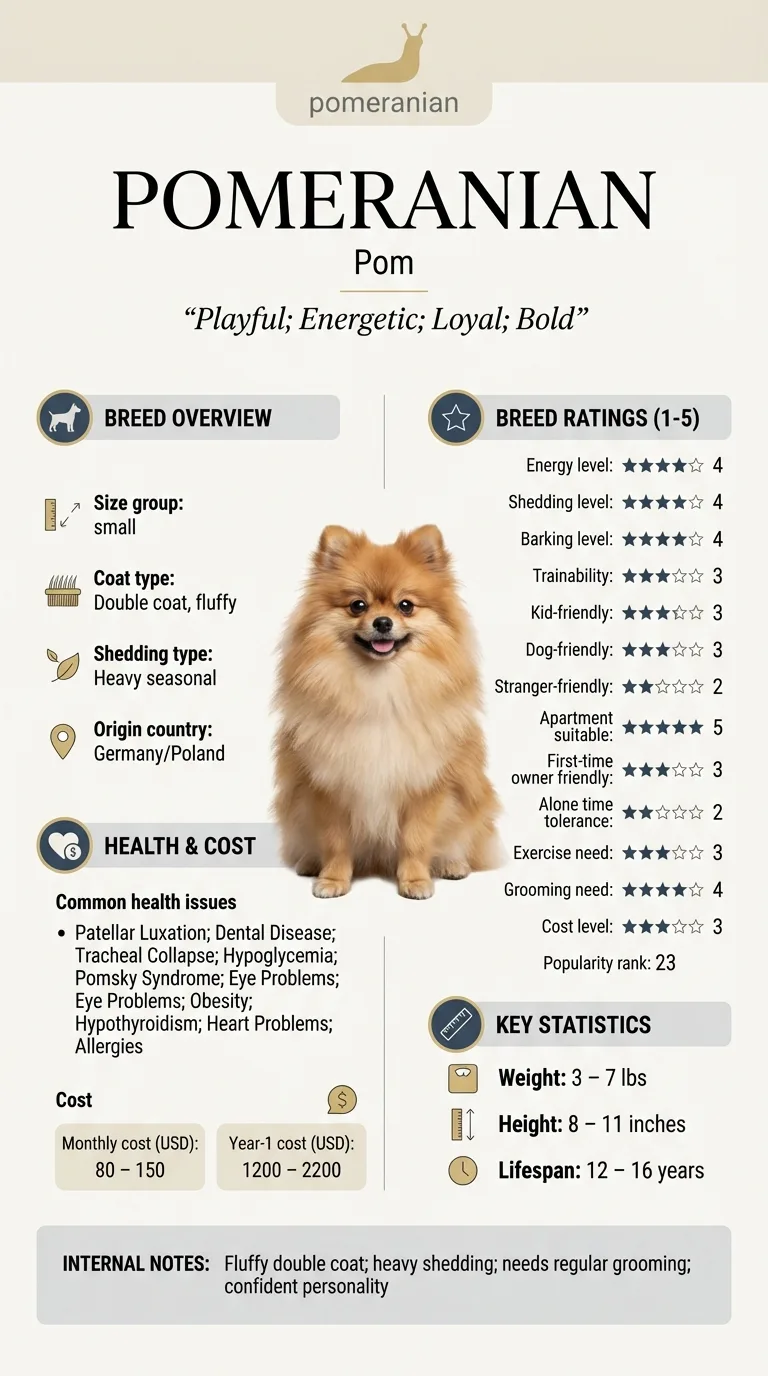
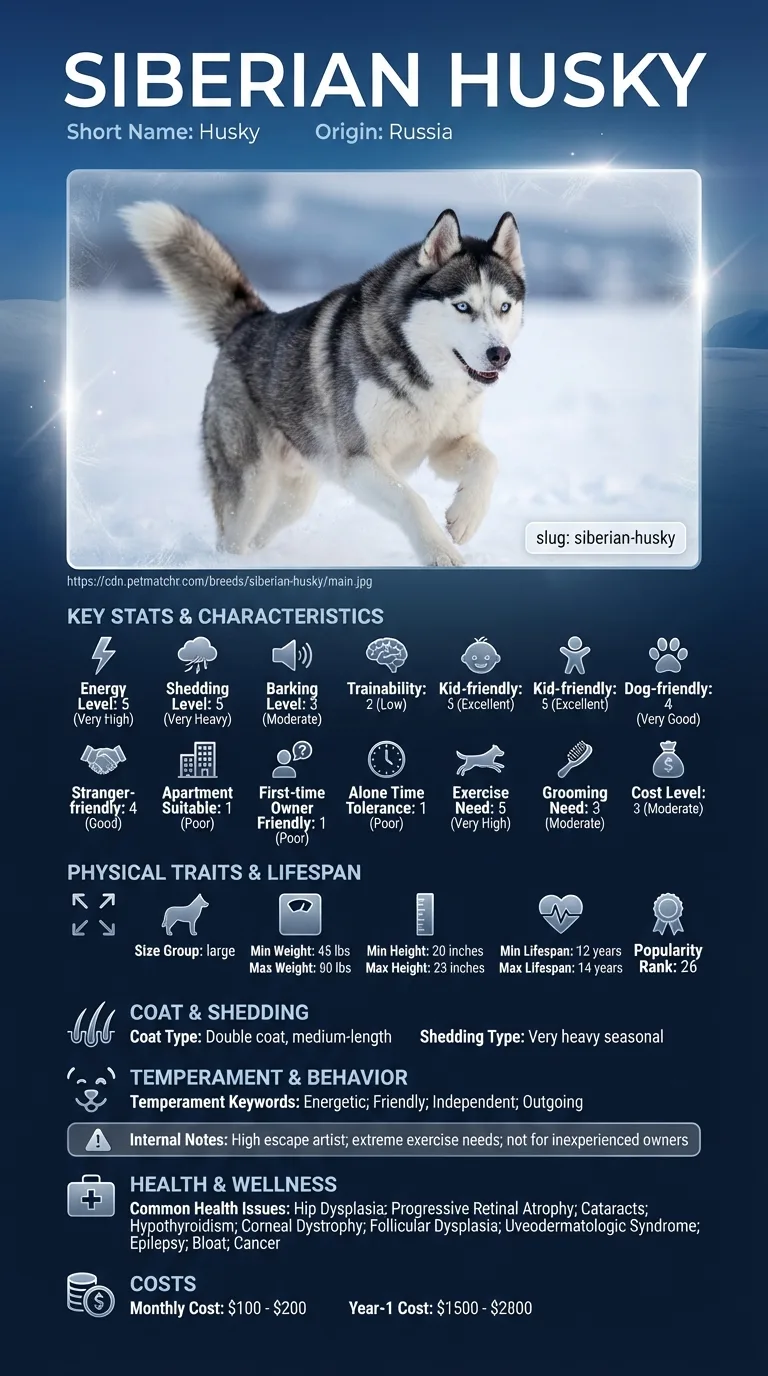
This is for someone already down to Pomeranian and Siberian Husky and deciding between them. For this pair the decision usually turns on apartment suitability and exercise need, so those are covered first and in most detail. Anyone choosing from a flat has a clear answer here: Pomeranian rates 5/5 against 1/5. There is no origin story here — only what changes about your week.
Between Pomeranian and Siberian Husky, apartment suitability is what separates them, and Pomeranian is the lower-effort dog of the two to keep.
Choose Pomeranian if you are in a flat or a smaller home, this is your first dog and shedding is a problem in your house.
Choose Siberian Husky if you do not want a standing grooming appointment, there are young children at home and you already have another dog.
| Feature | pomeranian | siberian husky | Winner |
|---|---|---|---|
| Size class | small | large | Equal |
| Weight | 3–7 lbs | 45–60 lbs | Equal |
| Height | 8–11 in | 20–23 in | Equal |
| Lifespan | 12–16 years | 12–14 years | pomeranian |
| Exercise need | Moderate (3/5) | Very high (5/5) | pomeranian |
| Grooming need | High (4/5) | Moderate (3/5) | siberian husky |
| Shedding | High (4/5) | Very high (5/5) | pomeranian |
| Energy level | High (4/5) | Very high (5/5) | Equal |
| Barking | High (4/5) | Moderate (3/5) | siberian husky |
| Apartment suitability | Very high (5/5) | Very low (1/5) | pomeranian |
| Good for first-time owners | Moderate (3/5) | Very low (1/5) | pomeranian |
| Tolerates being alone | Low (2/5) | Very low (1/5) | pomeranian |
| Trainability | Moderate (3/5) | Low (2/5) | pomeranian |
| Good with kids | Moderate (3/5) | Very high (5/5) | siberian husky |
| Good with other dogs | Moderate (3/5) | High (4/5) | siberian husky |
| Friendly to strangers | Low (2/5) | High (4/5) | siberian husky |
| Cost level | Moderate (3/5) | Moderate (3/5) | Equal |
| Coat | Double coat, fluffy | Double coat, medium-length | Equal |
| Origin | Germany/Poland | Russia | Equal |
| Typical monthly cost | $80–$150 | $100–$200 | Equal |
| Typical first-year cost | $1,200–$2,200 | $1,500–$2,800 | Equal |
Three to seven pounds is the Pomeranian's entire weight class — a dog that could ride comfortably in a jacket pocket — while a Siberian Husky runs 45 to 60 pounds on a frame built for pulling sleds across arctic distances. The height gap is just as extreme, 8 to 11 inches against 20 to 23. Both wear a double coat, and both carry a 'fluffy' or 'medium-length' coat description, but the volume of fur a Husky produces on its larger frame dwarfs what a Pomeranian's tiny body can generate. It's a genuinely odd comparison on paper: one dog is a companion lapdog descended from larger spitz-type sled dogs, and the other still does the sled-pulling job its ancestors were bred for.
Exercise need rates moderate (3/5) for the Pomeranian and very high (5/5) for the Husky, a gap that reflects the Husky's working heritage as an endurance sled dog bred to run for hours in cold conditions. A bored, under-exercised Husky is notorious for digging, escaping fenced yards, and howling — its energetic, independent temperament doesn't wait patiently for attention the way a smaller companion breed might. The Pomeranian's energy is real but contained; short bursts of play and a couple of walks generally satisfy it, though its energy level still rates high (4/5), which surprises owners expecting a lapdog to be sedentary. Underestimating either breed's activity needs based on size alone is a common mismatch.
Grooming need actually favors the Husky, moderate (3/5) against the Pomeranian's high (4/5), even though the Husky sheds more overall — very high (5/5) versus the Pomeranian's still-substantial high (4/5). The Pomeranian's fluffy double coat mats easily around the ears, tail, and britches without regular brushing, and its small size doesn't reduce the grooming time much since detail work on a tiny, dense coat takes patience. The Husky's coat mostly sheds itself clean twice a year in dramatic 'blowouts' that fill vacuum bags but require less routine brushing between those seasonal events. Neither breed suits someone hoping for a fur-free home, but the day-to-day grooming burden actually lands harder on the much smaller dog.
Apartment suitability could hardly split further apart — very high (5/5) for the Pomeranian, very low (1/5) for the Husky — and tolerating time alone follows the same direction, low (2/5) versus very low (1/5), meaning neither breed is ideal for long solo stretches but the Husky is worse. Barking, though, favors the Husky: moderate (3/5) against the Pomeranian's high (4/5), though Husky owners will note that vocalization often takes the form of dramatic howling and 'talking' rather than straightforward barking, which can be just as disruptive to neighbors in a shared building. A Husky's combination of size, exercise needs, and escape-artist reputation makes small-space living genuinely difficult regardless of how it scores on noise alone.
Trainability favors the Pomeranian, moderate (3/5) against the Husky's low (2/5), and 'independent' is the key word in the Husky's temperament profile — a trait inherited from generations of sled dogs that needed to make split-second navigation decisions without waiting for a musher's command. That independence translates into a strong-willed, sometimes selectively-obedient adult dog even with consistent training. First-time-owner suitability tells the same story more starkly: moderate (3/5) for the Pomeranian against very low (1/5) for the Husky, one of the lowest scores in this entire comparison. A Husky's intelligence is real, but it applies that intelligence toward its own goals as often as toward pleasing an owner.
Good with kids favors the Husky decisively, very high (5/5) against the Pomeranian's moderate (3/5), and good with other dogs follows suit, high (4/5) versus moderate (3/5) — a Husky's friendly, outgoing pack heritage makes it broadly sociable. Friendliness to strangers shows the widest gap of all: high (4/5) for the Husky against a notably low (2/5) for the Pomeranian, whose bold, loyal temperament tends toward suspicion of unfamiliar people despite its toy-breed size. A tiny, bold dog that doesn't warm to strangers can still nip or snap defensively, so households that entertain often may find the naturally outgoing Husky the more relaxed presence with guests, size and exercise demands aside.
A Pomeranian's 12-to-16-year lifespan runs a bit longer than the Husky's 12-to-14, and their health lists point in genuinely different directions. Tracheal collapse and Pomsky Syndrome sit near the top of the Pomeranian's list — the former a structural airway weakness common in toy breeds, the latter specific to the breed — alongside hypoglycemia, a blood-sugar crash risk especially in Pomeranian puppies, and dental disease from a small mouth crowded with teeth. The Husky's risks lean toward eye conditions — progressive retinal atrophy, cataracts, corneal dystrophy, and uveodermatologic syndrome, an uncommon autoimmune condition affecting skin and eyes together — plus hip dysplasia, epilepsy, bloat, and cancer. Hypothyroidism is the one condition both lists share.
Cost level actually ties, moderate (3/5) for both breeds, though the dollar figures diverge somewhat: $1,200-$2,200 first-year for the Pomeranian against $1,500-$2,800 for the Husky, with monthly costs of $80-$150 versus $100-$200. A three-to-seven-pound dog eats a fraction of what a 60-pound one does, which keeps the Pomeranian's baseline lower, but its longer, more varied health list — tracheal collapse management, dental cleanings for a small crowded mouth, and heart problem monitoring — adds up over a lifespan that runs several years longer than the Husky's. The Husky's larger food bill and its own eye-condition screening land it at a similar overall cost despite the size gap working in the opposite direction.
Pomeranian weighs 3–7 lbs and lives 12–16 years; Siberian Husky weighs 45–60 lbs and lives 12–14 years. The two diverge most on apartment suitability, exercise need and good for first-time owners and 2 other rated axes. Almost every rated axis separates them at least slightly. Where the table declares a winner it means less work for the owner, nothing more; descriptive rows are left as ties on purpose. The value here is in the differences between the two columns; treat any single score as approximate.

Its fluffy double coat mats easily around the ears and legs and rates high (4/5) for grooming need, actually higher-maintenance day to day than the larger Husky's coat.
No — it rates very low (1/5) for first-time-owner suitability, one of the lowest scores in this comparison, due to its independence and escape tendencies.
The Husky, rated high (4/5), compared to the Pomeranian's low (2/5), despite the Pomeranian's much smaller and seemingly less intimidating size.
It's a condition specific to the Pomeranian's health profile, listed alongside more familiar risks like hypoglycemia and tracheal collapse.
The Siberian Husky by a wide margin, rated very high (5/5) against the Pomeranian's moderate (3/5).
The Pomeranian, typically 12 to 16 years, compared to the Husky's 12 to 14.
The Siberian Husky, rated very high (5/5), against the Pomeranian's high (4/5).
The Pomeranian, rated high (4/5), compared to the Husky's moderate (3/5) — though Huskies are known for howling instead.
The Pomeranian, rated moderate (3/5) for trainability against the Husky's low (2/5).
The Pomeranian, rated very high (5/5) for apartment suitability, versus the Husky's very low (1/5).
Secure checkout on Stripe. We never see your card.
7-day money-back guarantee. Instant access.
Health information here is general and is not veterinary advice. If your dog shows pain, sudden behaviour change, or worsening symptoms, consult a licensed veterinarian.
Some links on this site are affiliate links. We may earn a commission at no extra cost to you, and we only suggest products we believe are helpful for dog owners.
We research and check what we publish, but we do not warrant that any figure, date, price, or statement is accurate, complete, or current, and we accept no liability for any loss, cost, injury, or other harm arising from the use of this site. Use it as one reference among several. You remain responsible for your own decisions and for your dog's care - confirm anything that matters with a licensed veterinarian or another qualified professional before you act on it. Full disclaimer.
Match your lifestyle to the right dog.
Take quizNot sure which breed is right for you? Take our 2-minute quiz to find out.
Take the quiz