Akita or Pomeranian: The Same Coat Rules at Two Extremes
Quick answer
Akita vs Pomeranian: which should I choose?
The Pomeranian if you live in a flat and want a bold little spitz with the same wary temperament in miniature. The Akita if you want quiet and a dog that copes alone — it barks at 2/5 against the Pom's 4/5.
These two are relatives. The Pomeranian is a spitz — the same family as the Akita, the Husky and the Malamute — bred down from northern sled and herding dogs until it weighed three to seven pounds. It kept the double coat, the pricked ears, the curled tail and the opinion, and it kept the one rule that matters most: never clip it.
This page is for someone weighing a very small fluffy companion against a large guardian, and for anyone who wants to understand what the two share. It covers the coat rules that apply to both, shedding, windpipe and knee fragility, barking, and cost.
Quick verdict
The Pomeranian gives you the spitz temperament and the spitz coat in a body small enough for any flat, and it is more fragile and much noisier than the Akita.
Choose akita if...
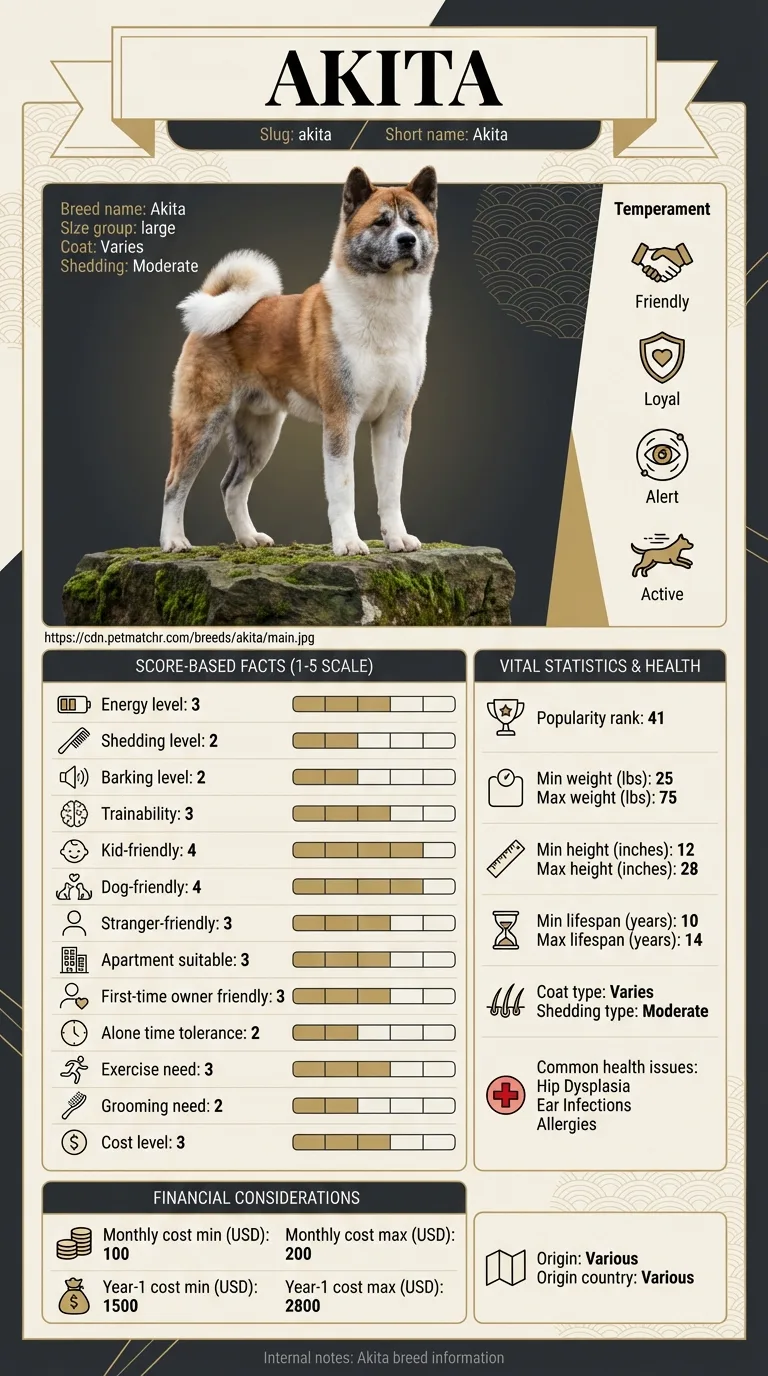
Choose the Akita if you want quiet and a dog that copes alone. It barks at 2/5 against the Pomeranian's 4/5, grooms at 3/5 against 4/5, and tolerates being alone at 3/5 against 2/5. You are accepting 5/5 shedding, 1/5 for first-time owners, 2/5 with other dogs, $110–$240 a month and a shorter life.
Choose pomeranian if...
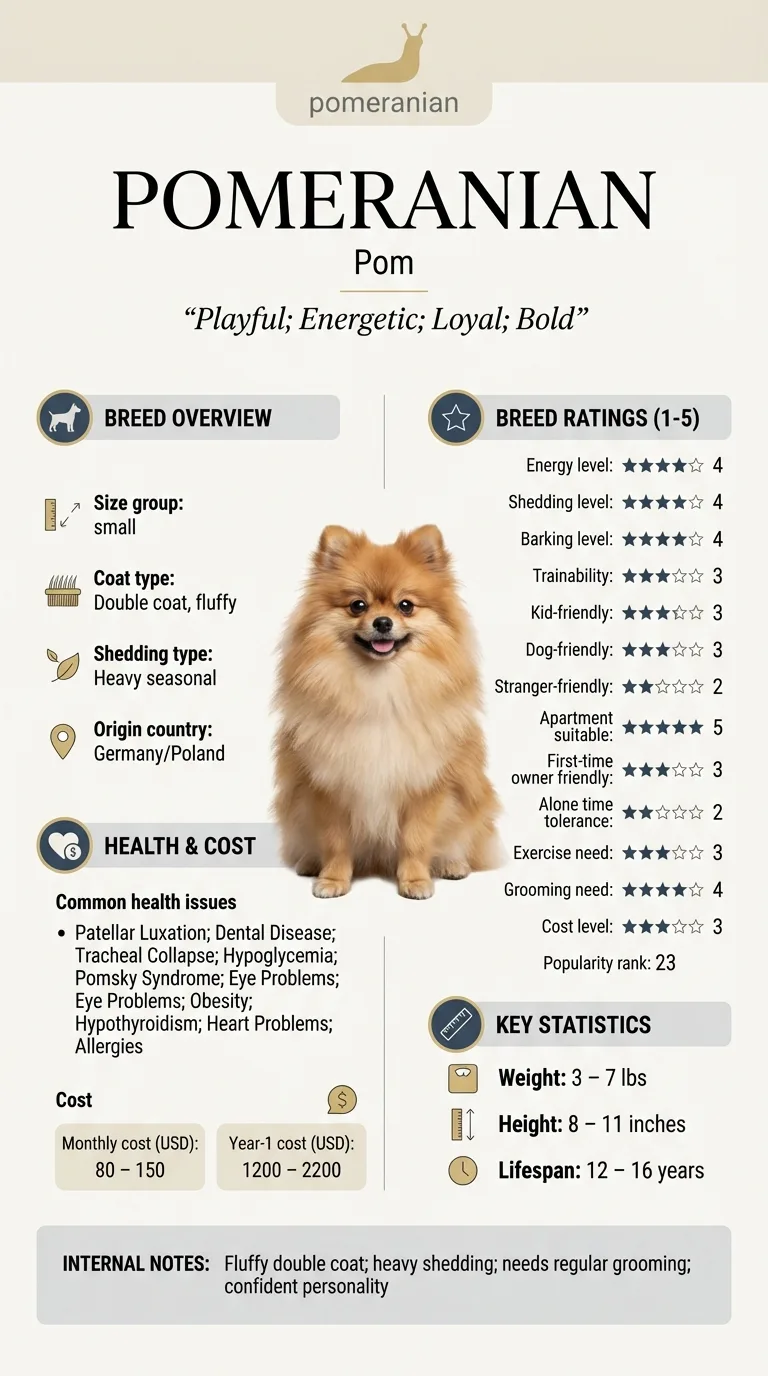
Choose the Pomeranian if you live in a flat and want a bold, characterful little dog. It rates 5/5 for apartments, lives 12 to 16 years and costs $80–$150 a month. You are accepting 4/5 barking, 4/5 shedding from a tiny dog, patellar and tracheal fragility, and 2/5 with strangers — the same wariness the Akita has.
Head-to-head comparison
Feature
akita
pomeranian
Winner
Weight
70–130 lbs
3–7 lbs
Equal
Height
24–28 in
8–11 in
Equal
Lifespan
10–13 years
12–16 years
pomeranian
Coat
Dense double coat
Fluffy double coat
Equal
Grooming need
Moderate (3/5)
High (4/5)
akita
Shedding
Very high (5/5)
High (4/5)
pomeranian
Energy level
Moderate (3/5)
High (4/5)
Equal
Exercise need
Moderate (3/5)
Moderate (3/5)
Equal
Trainability
Moderate (3/5)
Moderate (3/5)
Equal
Barking
Low (2/5)
High (4/5)
akita
Good with kids
Moderate (3/5)
Moderate (3/5)
Equal
Good with other dogs
Low (2/5)
Moderate (3/5)
pomeranian
Friendly to strangers
Low (2/5)
Low (2/5)
Equal
Apartment suitability
Low (2/5)
Very high (5/5)
pomeranian
Good for first-time owners
Very low (1/5)
Moderate (3/5)
pomeranian
Tolerates being alone
Moderate (3/5)
Low (2/5)
akita
Typical monthly cost
$110–$240
$80–$150
pomeranian
Typical first-year cost
$1,700–$3,200
$1,200–$2,200
pomeranian
Deep dive
The rule that applies to both: never clip a double coat
The most useful thing this comparison can tell you is a rule that applies identically at both ends of the scale.
A double coat has a coarse outer layer and a soft insulating undercoat. It keeps heat out as well as in. Clipping it removes the outer layer, which regrows slowly or not at all, while the undercoat regrows quickly and densely — and the result is a coat that traps heat, loses its weather resistance and often never recovers its texture.
In Pomeranians this has a name among owners: post-clipping alopecia. Coat that is shaved for convenience or for a summer trim can come back patchy, woolly, or not at all, and there is no reliable fix. Alopecia X, sometimes called black skin disease, is a separate coat-loss condition that also appears in the breed and looks similar.
The correct maintenance for both breeds is the same: brush through to the skin, rake the undercoat out during the shedding periods, and trim only feet, sanitary areas and stray hair.
Grooming is 4/5 for the Pomeranian against 3/5 for the Akita, and shedding is 4/5 against 5/5 — an enormous amount of hair from a three-pound dog.
Knees, windpipe and blood sugar
Three items on the Pomeranian's list change how the dog is handled day to day.
Tracheal collapse is the most important. The cartilage rings supporting the windpipe soften and flatten, producing a honking cough that worsens with excitement, heat or pressure on the throat. A harness rather than a collar is not a preference in this breed, it is a rule for life.
Patellar luxation is the common orthopaedic problem — a kneecap that slips out of its groove, producing a momentary skipping step. Many cases are mild; some need surgery. Discouraging jumps down from furniture helps.
Hypoglycaemia is a puppy risk. A three-pound body has almost no glycogen reserve, so a missed meal or a stressful day can cause weakness, wobbling or collapse. Frequent small meals through the first months are standard, and a listless small-breed puppy should be seen quickly.
Dental disease is the recurring cost, as in every tiny breed, and daily brushing genuinely reduces the anaesthetics needed across a sixteen-year life.
The Akita's burden is autoimmune and endocrine, with hip dysplasia and bloat.
Bold, vocal and easy to spoil
The Pomeranian's 4/5 barking is the trait most likely to cause trouble in a flat. It is alert, opinionated and has a sharp voice, and it will announce the corridor, the lift and the neighbour's television.
It reduces with work — blocking window sightlines, teaching a settled alternative, rewarding quiet — but the baseline is high.
The subtler risk is the one every small breed faces. A five-pound dog that growls at a visitor gets picked up rather than trained, so the behaviour is rehearsed daily and never interrupted. Treat a Pomeranian like a dog: let it walk, socialise it properly from eight weeks with calm adult dogs and a wide range of people, and do not permit anything you would not permit from a large breed.
At 3/5 with other dogs it is moderately social. At 2/5 for solitude it is closely bonded and does not suit a household that is out all day without cover.
The Akita's reserve is the same trait with much greater consequences, and its adult views on other dogs arrive at social maturity around two years old.
Cheap monthly, long commitment
The Pomeranian runs $80–$150 a month against the Akita's $110–$240, and $1,200–$2,200 against $1,700–$3,200 in the first year.
Grooming is the item that narrows it. A 4/5 coat on a small dog is manageable at home if you learn to line brush and rake, and most owners still use a groomer periodically — for feet, sanitary trims and the shedding seasons.
Dentistry is the predictable veterinary cost. Anaesthetic dental work every couple of years across a sixteen-year life is normal for the size.
The number that changes the picture is that lifespan. Twelve to sixteen years against ten to thirteen means the cheaper monthly figure runs several years longer, and over a lifetime the totals converge more than the monthly comparison suggests.
On housing the Pomeranian rates 5/5 for apartments against 2/5 — with barking as the caveat — and both breeds need summer walks moved to the cool ends of the day, because a double coat is a double coat at any size.
Akita vs Pomeranian: family resemblance at two scales
Six rows tie: exercise at 3/5, trainability at 3/5, children at 3/5, strangers at 2/5, and both coats are true doubles.
The stranger rating is the family trait showing through. Spitz breeds tend to be reserved rather than effusive, and the Pomeranian is genuinely wary of people it does not know — bold about it, in the way small dogs often are, but wary. That is the same 2/5 the Akita carries, expressed at a twentieth of the weight.
Trainability at 3/5 for both is also a spitz characteristic. Neither breed is stupid and neither is eager to please; both consider the request first.
Where they part company is noise and durability. 4/5 barking against 2/5, and a three-pound frame with a soft windpipe and slipping kneecaps against a hundred-pound dog with none of those concerns.
Akita or Pomeranian: The Same Coat Rules at Two Extremes - Akita vs Pomeranian: family resemblance at two scales
Frequently asked questions
Are Pomeranians really related to Akitas?
Both are spitz-type dogs — the family that includes the Husky, the Malamute and the Japanese breeds. The Pomeranian was bred down from larger German Spitz stock and kept the double coat, pricked ears, curled tail and reserved temperament. It rates 2/5 with strangers, exactly as the Akita does.
Can you shave a Pomeranian in summer?
No. A double coat insulates against heat as well as cold, and shaving it removes the outer layer, which regrows slowly or not at all while the undercoat comes back thick. Owners call the result post-clipping alopecia, and there is no reliable fix. The same rule applies to the Akita.
How much do Pomeranians shed?
4/5, against the Akita's 5/5 — a genuinely surprising volume of hair for a three-to-seven-pound dog, with two heavy seasonal drops on top of steady year-round loss. Grooming is 4/5: brush to the skin and rake the undercoat out during the shedding periods rather than clipping it off.
Should a Pomeranian wear a collar?
No — a harness, for life. Tracheal collapse is on the breed's condition list, and pressure on a windpipe with softening cartilage makes it worse. The characteristic sign is a honking cough that gets worse with excitement, heat or pulling on the lead.
Do Pomeranians bark a lot?
Yes — 4/5 against the Akita's 2/5, with a sharp carrying voice. It will announce the corridor, the lift and the neighbours. Blocking window sightlines and training a settled alternative reduces it considerably, but the baseline is high and it will not become a quiet dog.
Are Pomeranians good with children?
Moderately, at 3/5 — the same as the Akita, for the opposite reason. A three-to-seven-pound dog with fine bones is genuinely at risk from a toddler, and dogs handled roughly learn to defend themselves. It suits older, calmer children and a quiet household.
Which lives longer?
The Pomeranian, at 12 to 16 years against the Akita's 10 to 13. That is a long commitment for a dog that will still need daily tooth brushing, harness walks and coat work at the end of it, and it is worth planning for rather than treating as a bonus.
The Pomeranian if you live in a flat and want a bold little spitz with the same wary temperament in miniature. The Akita if you want quiet and a dog that copes alone — it barks at 2/5 against the Pom's 4/5.
Costs
How much does each cost per month?
The Pomeranian runs $80–$150 a month and the Akita $110–$240, with first-year totals of $1,200–$2,200 and $1,700–$3,200 — though the Pomeranian is paid for two to six years longer.
Living
Do they need the same amount of exercise?
Yes — both rate 3/5, around forty-five to sixty minutes a day, which surprises people about the Pomeranian. It rates 4/5 for energy and is an active little dog, not a cushion ornament.
Behavior
Why is my Pomeranian wary of visitors?
Because it is a spitz. Reserve with strangers is a family trait, and the breed rates 2/5 — the same as the Akita. Socialise it properly from eight weeks and treat it like a dog rather than lifting it away from every situation that worries it.
Related DogBreedCompass guides
Akita breed guide – The Akita profile covers guardian temperament and the long socialisation window the breed needs.
Pomeranian breed guide – The Pomeranian profile covers coat rules, small-breed health and socialisation.
Akita vs Shiba Inu – The Shiba Inu is the small Japanese spitz with the closest temperament to an Akita.
Akita vs Chihuahua – The Chihuahua is the other tiny breed with similar dental and tracheal concerns.
Pomeranian skin allergies – Skin and coat problems in double-coated small breeds are worth recognising early.
Akita autoimmune diseases – Autoimmune disease is the Akita's most distinctive burden and the first question for a breeder.
Health information here is general and is not veterinary advice. If your dog shows pain, sudden behaviour change, or worsening symptoms, consult a licensed veterinarian.
Some links on this site are affiliate links. We may earn a commission at no extra cost to you, and we only suggest products we believe are helpful for dog owners.
We research and check what we publish, but we do not warrant that any figure, date, price, or statement is accurate, complete, or current, and we accept no liability for any loss, cost, injury, or other harm arising from the use of this site. Use it as one reference among several. You remain responsible for your own decisions and for your dog's care - confirm anything that matters with a licensed veterinarian or another qualified professional before you act on it. Full disclaimer.