Living
Which is bigger?
The Saint Bernard, at 120-180 lbs versus the Golden's 55-75 lbs.

Quick answer
Which is bigger?
The Saint Bernard, at 120-180 lbs versus the Golden's 55-75 lbs.
Golden Retriever or Saint Bernard? On paper they differ most on exercise need, and on the scales Saint Bernard is the heavier at 120–180 lbs. Here is how the two compare on everything that shapes an ordinary week.
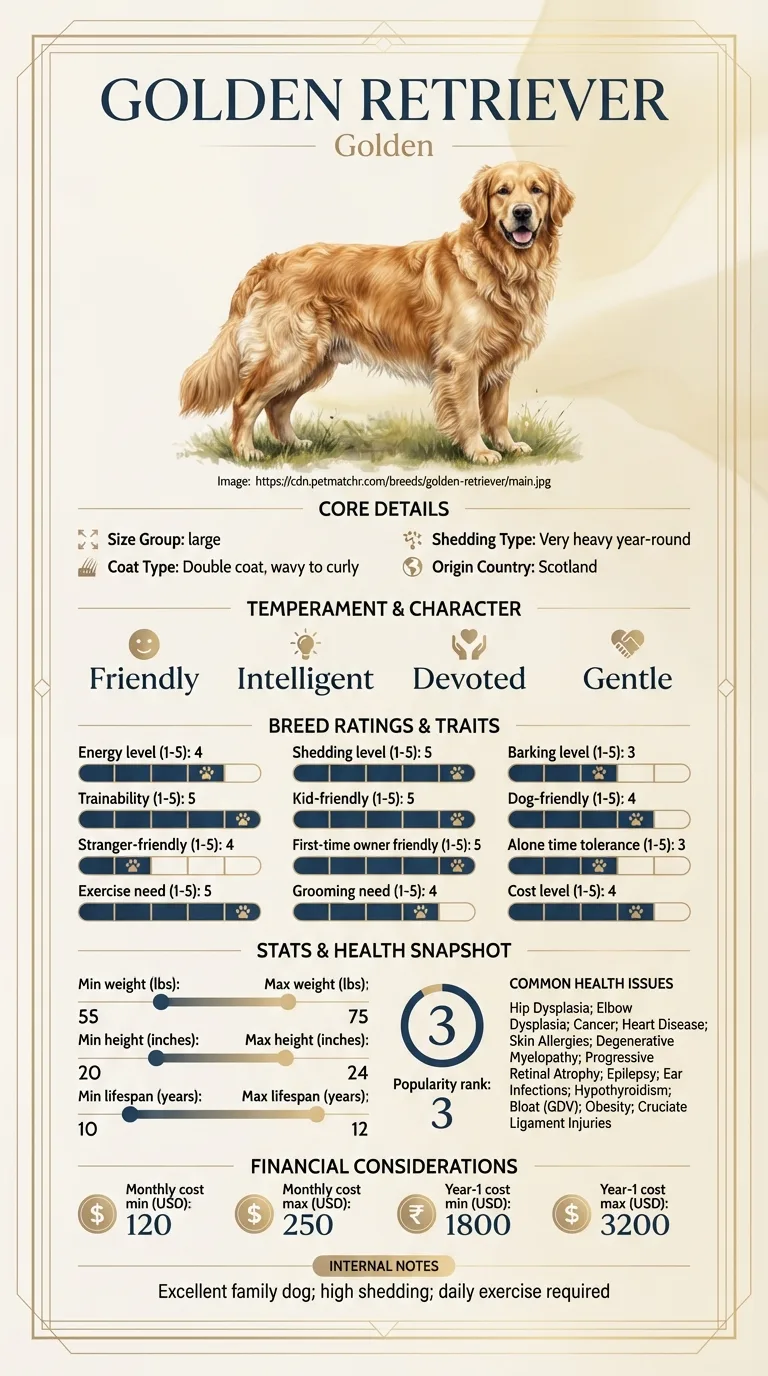
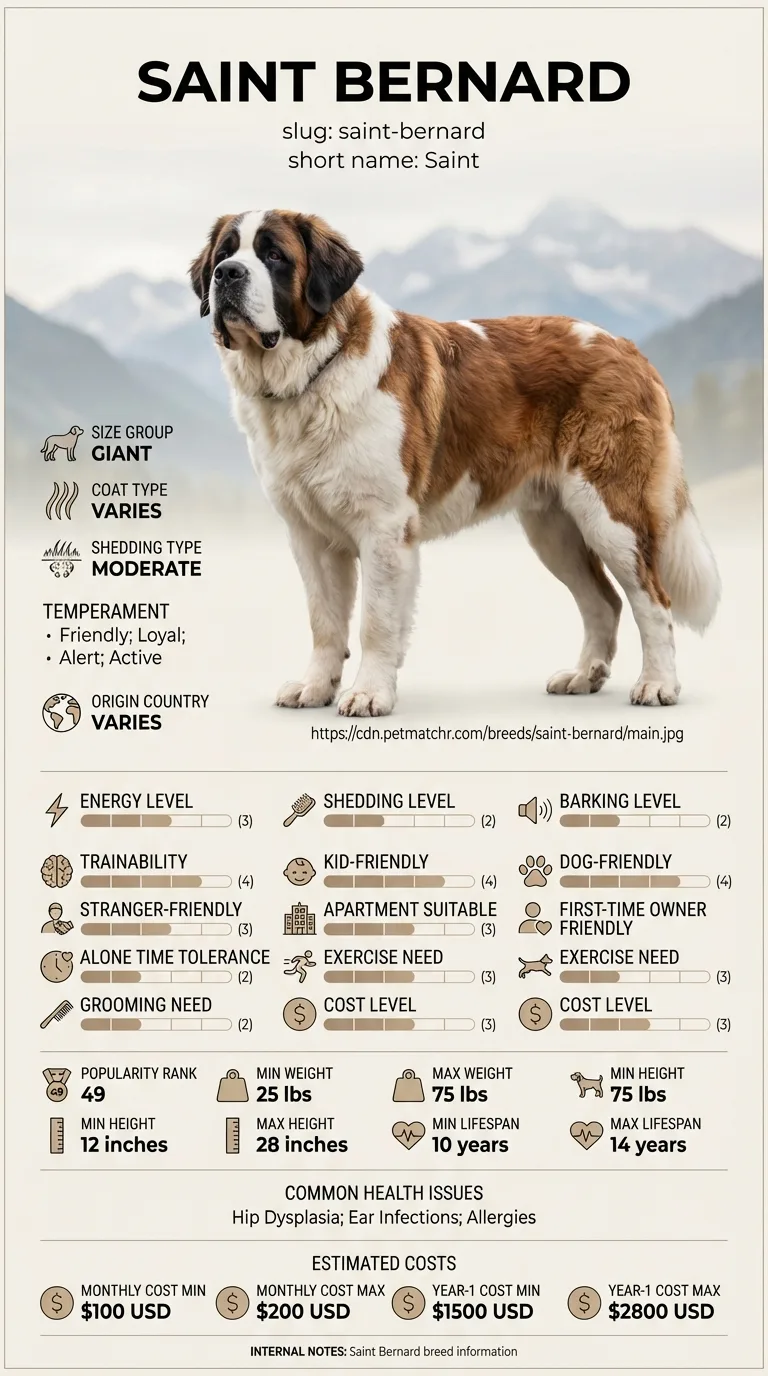
This is for someone already down to Golden Retriever and Saint Bernard and deciding between them. For this pair the decision usually turns on exercise need and energy level, so those are covered first and in most detail. Anyone choosing from a flat has a clear answer here: Golden Retriever rates 2/5 against 1/5. The focus throughout is on daily consequences rather than breed background.
Between Golden Retriever and Saint Bernard, exercise need is what separates them, and Saint Bernard is the lower-effort dog of the two to keep.
Choose Golden Retriever if this is your first dog, you want a dog that picks up training quickly and a smaller dog suits your car, your home or your back.
Choose Saint Bernard if you do not want a standing grooming appointment, shedding is a problem in your house and your walking routine is modest.
| Feature | golden retriever | saint bernard | Winner |
|---|---|---|---|
| Size class | large | giant | Equal |
| Weight | 55–75 lbs | 120–180 lbs | Equal |
| Height | 20–24 in | 26–30 in | Equal |
| Lifespan | 10–12 years | 8–10 years | golden retriever |
| Exercise need | Very high (5/5) | Low (2/5) | saint bernard |
| Grooming need | High (4/5) | Moderate (3/5) | saint bernard |
| Shedding | Very high (5/5) | High (4/5) | saint bernard |
| Energy level | High (4/5) | Low (2/5) | Equal |
| Barking | Moderate (3/5) | Low (2/5) | saint bernard |
| Apartment suitability | Low (2/5) | Very low (1/5) | golden retriever |
| Good for first-time owners | Very high (5/5) | Moderate (3/5) | golden retriever |
| Tolerates being alone | Moderate (3/5) | Moderate (3/5) | Equal |
| Trainability | Very high (5/5) | Moderate (3/5) | golden retriever |
| Good with kids | Very high (5/5) | Very high (5/5) | Equal |
| Good with other dogs | High (4/5) | High (4/5) | Equal |
| Friendly to strangers | High (4/5) | High (4/5) | Equal |
| Cost level | High (4/5) | Very high (5/5) | golden retriever |
| Coat | Double coat, wavy to curly | Short or long double coat | Equal |
| Origin | Scotland | Various | Equal |
| Typical monthly cost | $120–$250 | $150–$310 | Equal |
| Typical first-year cost | $1,800–$3,200 | $2,200–$4,200 | Equal |
The Saint Bernard sits in a size class of its own — giant, at 120-180 lbs and 26-30 inches, versus the Golden Retriever's large 55-75 lbs and 20-24 inches, meaning a full-grown Saint Bernard can weigh more than double a Golden. Its short-or-long double coat comes in two recognized coat lengths, another way the breed diverges from the Golden's single wavy-to-curly coat type. That sheer scale shapes nearly every other comparison on this page, from exercise capacity to cost, and households should honestly assess whether they have the space, vehicle, and physical strength a 180 lb dog requires before anything else.
Exercise need flips dramatically in the Golden's favor here, Very High (5/5) against the Saint Bernard's Low (2/5) — despite its size, the Saint Bernard is a famously low-key breed suited to short walks and lounging rather than sustained activity, partly because its giant frame and shorter muzzle make it more prone to overheating during exertion. Energy level is listed as tied even though the Golden rates High (4/5) against the Saint Bernard's Low (2/5), reflecting how the numbers capture two very different personalities: one restless and driven, one calm and Patient by nature.
Grooming need favors the Saint Bernard slightly, Moderate (3/5) against the Golden's High (4/5), even accounting for its large surface area of coat to maintain. Shedding still favors the Saint Bernard marginally, High (4/5) against the Golden's Very High (5/5), though realistically both breeds put out a substantial amount of hair given their size — a giant breed shedding at a High rate can produce more total hair volume than a large breed shedding at Very High, even though the numeric score is lower. Neither dog suits an owner hoping to avoid regular vacuuming.
Neither breed suits apartment living, and the Saint Bernard actually rates worse, Very Low (1/5) against the Golden's already-Low (2/5) — its sheer size alone makes small-space living impractical regardless of temperament. Barking favors the Saint Bernard, Low (2/5) against the Golden's Moderate (3/5), fitting its Watchful but calm nature. Alone-time tolerance ties at Moderate (3/5) for both. This is fundamentally a large-house-and-yard comparison; anyone in a smaller home should look elsewhere entirely rather than trying to choose between these two specifically.
The Golden holds a clear trainability edge, Very High (5/5) against the Saint Bernard's Moderate (3/5), and also leads on first-time-owner suitability, Very High (5/5) against Moderate (3/5). The Saint Bernard's Gentle, Patient temperament makes it a famously easygoing giant breed, but its sheer size means even moderate training gaps, like poor leash manners or jumping, carry outsized real-world consequences that a smaller or more trainable dog wouldn't. First-time owners drawn to the Saint Bernard's calm nature should still plan on consistent early training given how much strength the adult dog will eventually carry.
Both breeds rate Very High (5/5) on good-with-kids, and the Saint Bernard's reputation as a patient, tolerant giant with children is well earned, backed by Gentle and Patient both appearing in its temperament list. Good-with-other-dogs and friendly-to-strangers both tie at High (4/5) as well, making this one of the more evenly matched household-fit comparisons on the site. The main practical caution with the Saint Bernard isn't temperament but physical size — even a gentle 150 lb dog can accidentally knock over a small child simply by walking past, a consideration worth planning around rather than avoiding the breed for.
The Saint Bernard's 8-10 year lifespan is notably shorter than the Golden's 10-12 years, a common pattern among giant breeds that simply age faster than large ones. Its five documented conditions — Hip Dysplasia, Elbow Dysplasia, Dilated Cardiomyopathy, Entropion, and Bloat (GDV) — overlap with the Golden's list on Hip Dysplasia and Bloat, but the Saint Bernard's cardiomyopathy risk and giant-breed joint strain add their own distinct concerns. Given both breeds' deep chests, Bloat (GDV) prevention, slow feeding and no vigorous exercise right after meals, is worth taking seriously with either dog, but especially with the heavier Saint Bernard.
The Saint Bernard actually costs more to keep, rated Very High (5/5) against the Golden's High (4/5), with a $150-$310 monthly range and $2,200-$4,200 first-year cost versus the Golden's $120-$250 and $1,800-$3,200. That premium comes directly from its size: more food, larger-dose medications, bigger equipment like crates and car harnesses, and higher-cost veterinary procedures if surgery is ever needed. Anyone comparing these two purely on temperament should factor in that the Saint Bernard's day-to-day cost of ownership runs meaningfully higher across nearly every category tied to its giant-breed size.
Golden Retriever weighs 55–75 lbs and lives 10–12 years; Saint Bernard weighs 120–180 lbs and lives 8–10 years. The two diverge most on exercise need, energy level and good for first-time owners and 1 other rated axes. They are level on tolerates being alone, good with other dogs and good with kids, so those cannot decide it. The table below marks a winner only where one breed is genuinely easier for a typical owner; size and origin are facts rather than merits and stay level. Ratings come from one source applied to both breeds, so they are meaningful against each other rather than as absolute scores.

No — it rates Low (2/5) exercise need against the Golden's Very High (5/5), making it one of the more sedentary giant breeds.
Yes, rated Very High (5/5), matching the Golden Retriever, thanks to its famously Gentle, Patient temperament, though its size means supervision around toddlers is still wise.
The Saint Bernard, rated Very High (5/5) cost against the Golden's High (4/5), with a $2,200-$4,200 first-year range versus $1,800-$3,200.
The Golden Retriever, averaging 10-12 years against the Saint Bernard's 8-10 years, a typical pattern for giant versus large breeds.
Not comfortably — it rates Very Low (1/5) apartment suitability, worse even than the Golden's already-Low (2/5) score, due to its sheer size.
The Golden Retriever, rated Very High (5/5) trainability against the Saint Bernard's Moderate (3/5).
Yes — both are documented for Hip Dysplasia and Bloat (GDV), a condition worth watching closely in either deep-chested breed.
The Saint Bernard, at 120-180 lbs versus the Golden's 55-75 lbs.
The Saint Bernard, rated Low (2/5) versus the Golden's Very High (5/5).
The Saint Bernard, rated Very High (5/5) cost versus the Golden's High (4/5).
The Golden Retriever, averaging 10-12 years versus the Saint Bernard's 8-10 years.
Secure checkout on Stripe. We never see your card.
7-day money-back guarantee. Instant access.



Health information here is general and is not veterinary advice. If your dog shows pain, sudden behaviour change, or worsening symptoms, consult a licensed veterinarian.
Some links on this site are affiliate links. We may earn a commission at no extra cost to you, and we only suggest products we believe are helpful for dog owners.
We research and check what we publish, but we do not warrant that any figure, date, price, or statement is accurate, complete, or current, and we accept no liability for any loss, cost, injury, or other harm arising from the use of this site. Use it as one reference among several. You remain responsible for your own decisions and for your dog's care - confirm anything that matters with a licensed veterinarian or another qualified professional before you act on it. Full disclaimer.
Match your lifestyle to the right dog.
Take quizNot sure which breed is right for you? Take our 2-minute quiz to find out.
Take the quiz