Living
Which is bigger?
The Saint Bernard, weighing 120-180 lbs versus the GWP's 60-70 lbs.

Quick answer
Which is bigger?
The Saint Bernard, weighing 120-180 lbs versus the GWP's 60-70 lbs.
German Wirehaired Pointer or Saint Bernard? On paper they differ most on exercise need, and on the scales Saint Bernard is the heavier at 120–180 lbs. Here is how the two compare on everything that shapes an ordinary week.
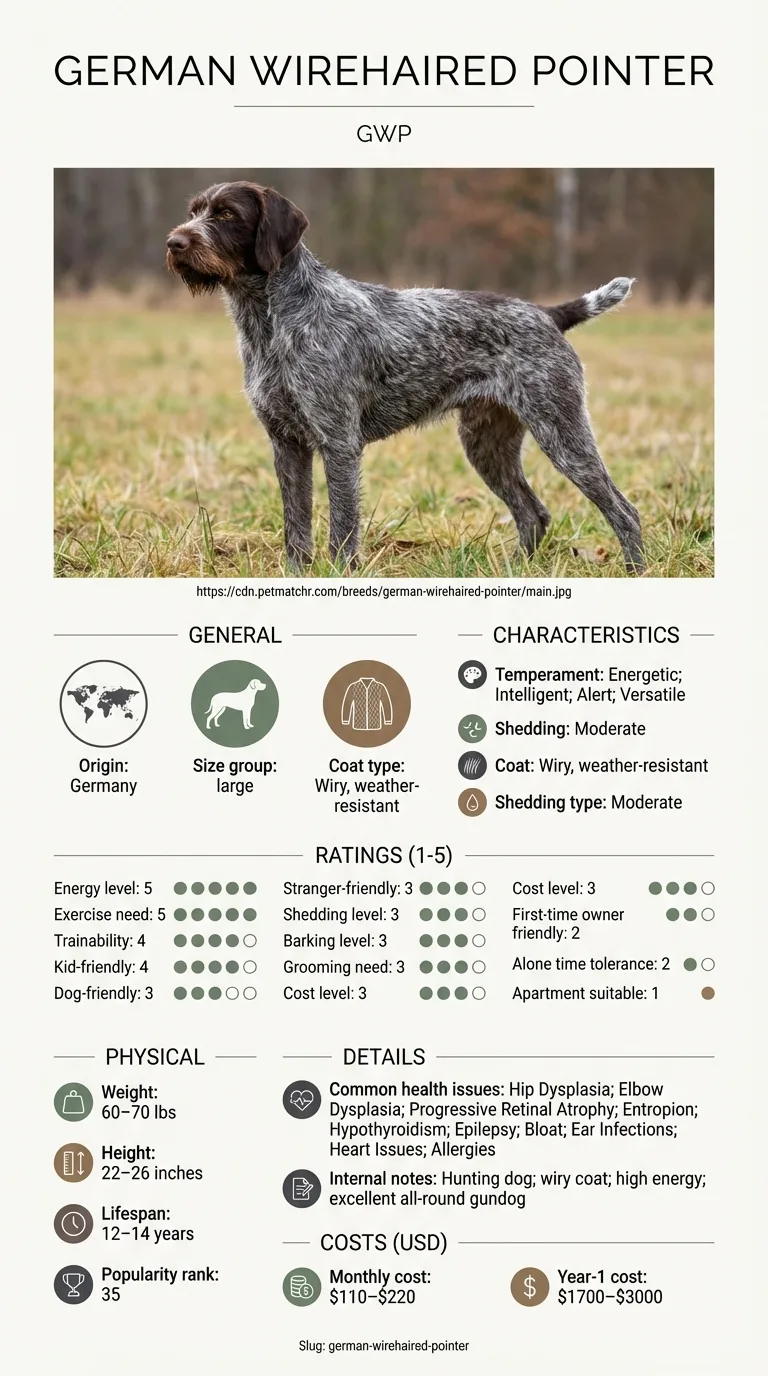
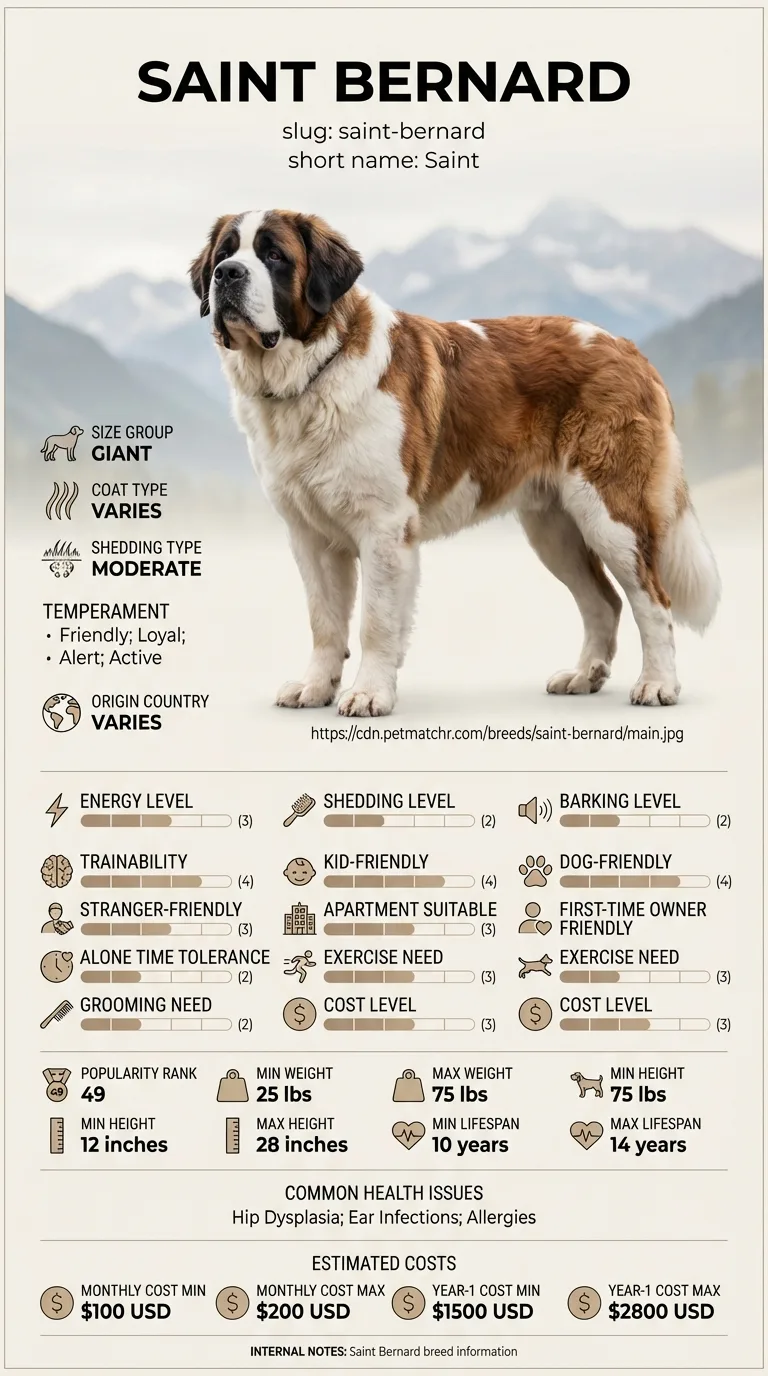
This is for someone already down to German Wirehaired Pointer and Saint Bernard and deciding between them. For this pair the decision usually turns on exercise need and energy level, so those are covered first and in most detail. Both rate 1/5 for flats, so housing does not settle this one. Breed history is left out; what follows is what you will actually live with.
Between German Wirehaired Pointer and Saint Bernard, exercise need is what separates them, and Saint Bernard is the lower-effort dog of the two to keep.
Choose German Wirehaired Pointer if shedding is a problem in your house, you want a dog that picks up training quickly and a smaller dog suits your car, your home or your back.
Choose Saint Bernard if this is your first dog, your walking routine is modest and the dog will be alone during the working day.
| Feature | german wirehaired pointer | saint bernard | Winner |
|---|---|---|---|
| Size class | large | giant | Equal |
| Weight | 60–70 lbs | 120–180 lbs | Equal |
| Height | 22–26 in | 26–30 in | Equal |
| Lifespan | 12–14 years | 8–10 years | german wirehaired pointer |
| Exercise need | Very high (5/5) | Low (2/5) | saint bernard |
| Grooming need | Moderate (3/5) | Moderate (3/5) | Equal |
| Shedding | Moderate (3/5) | High (4/5) | german wirehaired pointer |
| Energy level | Very high (5/5) | Low (2/5) | Equal |
| Barking | Moderate (3/5) | Low (2/5) | saint bernard |
| Apartment suitability | Very low (1/5) | Very low (1/5) | Equal |
| Good for first-time owners | Low (2/5) | Moderate (3/5) | saint bernard |
| Tolerates being alone | Low (2/5) | Moderate (3/5) | saint bernard |
| Trainability | High (4/5) | Moderate (3/5) | german wirehaired pointer |
| Good with kids | High (4/5) | Very high (5/5) | saint bernard |
| Good with other dogs | Moderate (3/5) | High (4/5) | saint bernard |
| Friendly to strangers | Moderate (3/5) | High (4/5) | saint bernard |
| Cost level | Moderate (3/5) | Very high (5/5) | german wirehaired pointer |
| Coat | Wiry, weather-resistant | Short or long double coat | Equal |
| Origin | Germany | Various | Equal |
| Typical monthly cost | $110–$220 | $150–$310 | Equal |
| Typical first-year cost | $1,700–$3,000 | $2,200–$4,200 | Equal |
The Saint Bernard operates in an entirely different weight class: 120-180 lbs and 26-30 inches, giant-sized against the GWP's large 60-70 lbs and 22-26 inches. A Saint Bernard can weigh two to three times as much as a GWP and stand several inches taller at the shoulder, a scale difference that shapes nearly everything else about ownership -- from the size of crate and vehicle needed to the sheer physical presence in a home. Anyone picturing these two together should expect the Saint Bernard to genuinely dominate a room in a way the athletic, mid-sized GWP simply doesn't.
Exercise need flips dramatically here: very high (5/5) for the GWP against low (2/5) for the Saint Bernard, and energy level tells the same story (very high, 5/5, versus low, 2/5). Despite its giant size, the Saint Bernard is a famously low-key breed content with modest daily walks, while the GWP's hunting drive demands vigorous, sustained activity. This is a rare case where the physically larger dog is actually the easier one to exercise -- owners drawn to the Saint Bernard's calm presence should not expect it to double as a running or hiking partner.
Grooming ties at moderate (3/5) for both breeds, but shedding favors the GWP: moderate (3/5) against the Saint Bernard's high (4/5). A Saint Bernard's short or long double coat, built for cold-weather work, sheds substantially, especially during seasonal blowouts, while the GWP's wiry coat sheds more evenly and manageably. Given the Saint Bernard's sheer size, that higher shed rate means considerably more volume of fur around the house in absolute terms, even at a comparable grooming-need rating.
Both breeds tie at very low (1/5) for apartment suitability -- genuinely neither is suited to small-space living, though for different reasons. The GWP needs room to burn its very high exercise drive, while the Saint Bernard's sheer bulk makes cramped quarters impractical regardless of its low exercise need. Barking favors the Saint Bernard at low (2/5) against the GWP's moderate (3/5). Tolerance for being alone favors the Saint Bernard too, moderate (3/5) versus the GWP's low (2/5) -- a calmer, steadier temperament that handles solo time better despite its imposing size.
Trainability favors the GWP, high (4/5) against the Saint Bernard's moderate (3/5), but first-time owner suitability flips: the Saint Bernard rates moderate (3/5) while the GWP rates low (2/5). The Saint Bernard's gentle, patient temperament forgives a less experienced handler's mistakes even if it learns commands a bit more slowly, while the GWP's energetic, versatile drive needs someone ready to channel real intensity from day one. Sheer size still matters for a novice Saint Bernard owner, though -- a giant breed that pulls on leash is a different challenge than a stubborn command.
The Saint Bernard edges ahead almost across the board: very high (5/5) with kids against the GWP's high (4/5), high (4/5) with other dogs against moderate (3/5), and high (4/5) friendliness to strangers against the GWP's moderate (3/5). Its gentle, patient, friendly temperament lives up to the classic Saint Bernard reputation. Families who host often or have young children constantly bringing friends over will likely find the Saint Bernard's easygoing nature the more forgiving fit, so long as its size is managed carefully around small kids.
The GWP holds a substantial lifespan edge, 12-14 years against the Saint Bernard's short 8-10 years, typical for a giant breed. Shared risks include hip dysplasia, elbow dysplasia, entropion, and bloat (GDV) -- appearing on both lists. The Saint Bernard's shorter, five-item list adds dilated cardiomyopathy as its most serious unique concern, while the GWP's ten-item list includes progressive retinal atrophy, hypothyroidism, epilepsy, ear infections, heart issues, and allergies. Giant breeds like the Saint Bernard also face elevated bloat risk simply due to their deep chest and size, making feeding management a real priority.
Cost level favors the GWP clearly: moderate (3/5) against the Saint Bernard's very high (5/5), the highest cost rating in this comparison. Monthly costs run $110-$220 for the GWP versus $150-$310 for the Saint Bernard, and first-year costs of $1,700-$3,000 versus $2,200-$4,200. A giant breed simply eats more, needs larger everything -- bedding, crates, medications dosed by weight -- and the Saint Bernard's shorter lifespan means those costs compress into fewer years. Owners drawn to the breed's gentle temperament should budget accordingly for the premium that comes with its size.
German Wirehaired Pointer weighs 60–70 lbs and lives 12–14 years; Saint Bernard weighs 120–180 lbs and lives 8–10 years. The two diverge most on exercise need, energy level and cost level. They are level on apartment suitability and grooming need, so those cannot decide it. The comparison marks an easier option only where one exists. Facts like weight and country of origin are not scored. Both dogs are rated from the same dataset, which is what makes the numbers comparable with each other even though any individual dog sits somewhere inside its breed's range.

The German Wirehaired Pointer by far -- very high (5/5) exercise need versus the Saint Bernard's low (2/5); despite its giant size, the Saint Bernard is a relatively low-energy breed.
The Saint Bernard, rating very high (5/5) versus the GWP's high (4/5), living up to its gentle, patient reputation.
The GWP, rating moderate (3/5) overall cost versus the Saint Bernard's very high (5/5) -- the giant breed's size drives up food, medication, and general upkeep costs.
The German Wirehaired Pointer, typically 12-14 years, well ahead of the Saint Bernard's 8-10 years, a common tradeoff for giant breeds.
More so than the GWP -- it rates moderate (3/5) for first-time owners against the GWP's low (2/5), thanks to its patient, forgiving temperament, though its size still requires careful handling.
The Saint Bernard sheds more, rating high (4/5) against the GWP's moderate (3/5), and its larger size means more total fur volume.
The Saint Bernard, rating high (4/5) versus the GWP's moderate (3/5) -- consistent with its friendly, watchful-but-welcoming temperament.
The Saint Bernard, weighing 120-180 lbs versus the GWP's 60-70 lbs.
The Saint Bernard, with a low (2/5) energy level versus the GWP's very high (5/5).
The Saint Bernard, rating low (2/5) barking versus the GWP's moderate (3/5).
The German Wirehaired Pointer, with a moderate (3/5) cost level versus the Saint Bernard's very high (5/5).
Secure checkout on Stripe. We never see your card.
7-day money-back guarantee. Instant access.
Health information here is general and is not veterinary advice. If your dog shows pain, sudden behaviour change, or worsening symptoms, consult a licensed veterinarian.
Some links on this site are affiliate links. We may earn a commission at no extra cost to you, and we only suggest products we believe are helpful for dog owners.
We research and check what we publish, but we do not warrant that any figure, date, price, or statement is accurate, complete, or current, and we accept no liability for any loss, cost, injury, or other harm arising from the use of this site. Use it as one reference among several. You remain responsible for your own decisions and for your dog's care - confirm anything that matters with a licensed veterinarian or another qualified professional before you act on it. Full disclaimer.
Match your lifestyle to the right dog.
Take quizNot sure which breed is right for you? Take our 2-minute quiz to find out.
Take the quiz