Living
Which is smaller?
The Pomeranian, at just 3-7 pounds versus the GWP's 60-70.

Quick answer
Which is smaller?
The Pomeranian, at just 3-7 pounds versus the GWP's 60-70.
German Wirehaired Pointer or Pomeranian? On paper they differ most on apartment suitability, and on the scales German Wirehaired Pointer is the heavier at 60–70 lbs. Here is how the two compare on everything that shapes an ordinary week.
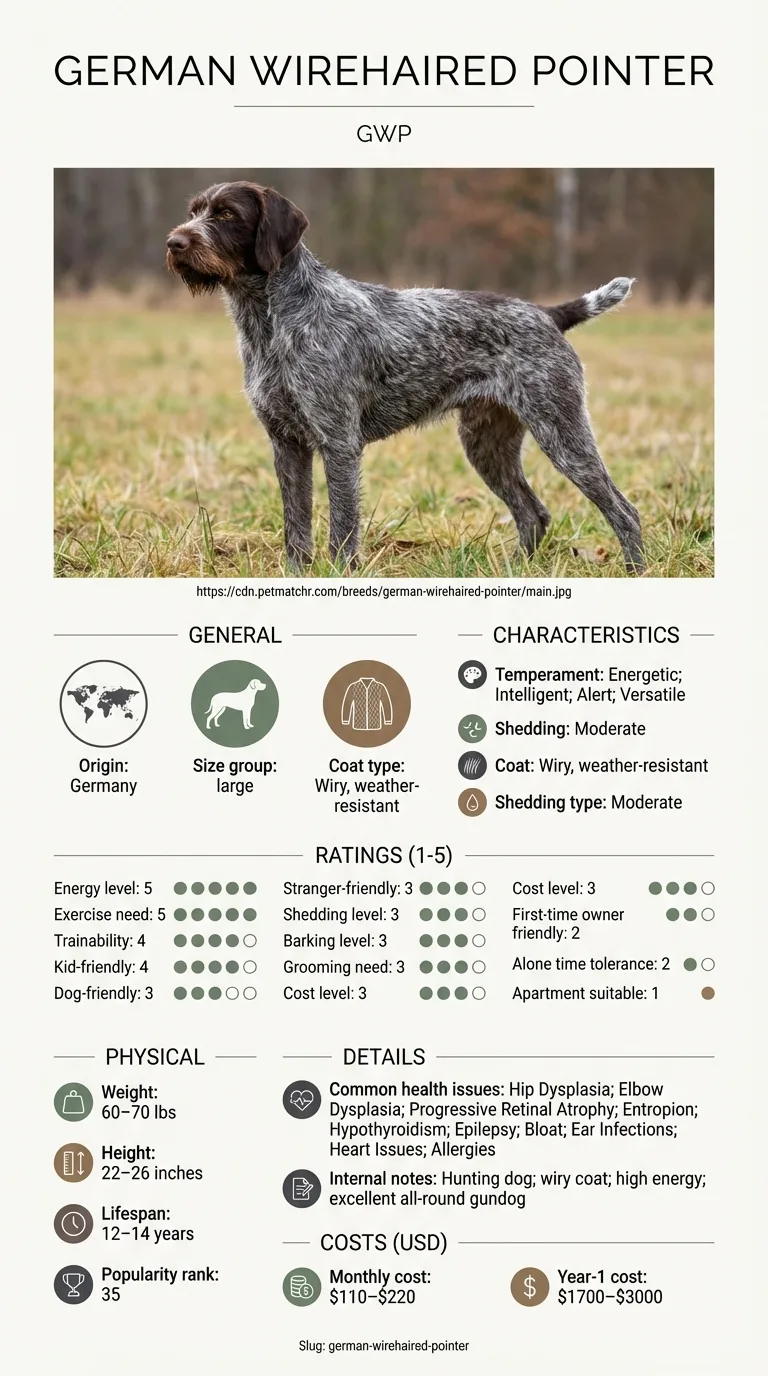
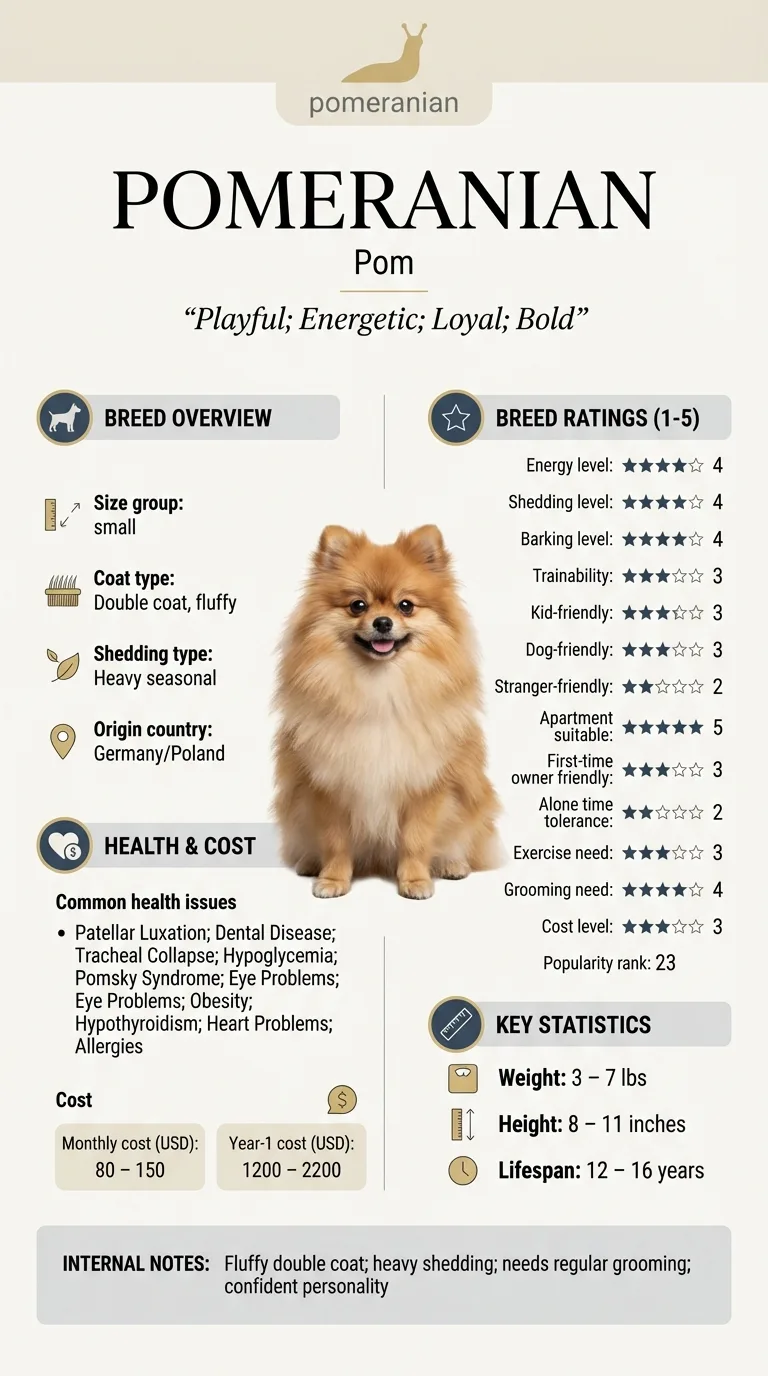
This is for someone already down to German Wirehaired Pointer and Pomeranian and deciding between them. For this pair the decision usually turns on apartment suitability and exercise need, so those are covered first and in most detail. Anyone choosing from a flat has a clear answer here: Pomeranian rates 5/5 against 1/5. Breed history is left out; what follows is what you will actually live with.
Between German Wirehaired Pointer and Pomeranian, apartment suitability is what separates them, and Pomeranian is the lower-effort dog of the two to keep.
Choose German Wirehaired Pointer if you do not want a standing grooming appointment, shedding is a problem in your house and there are young children at home.
Choose Pomeranian if you are in a flat or a smaller home, this is your first dog and your walking routine is modest.
| Feature | german wirehaired pointer | pomeranian | Winner |
|---|---|---|---|
| Size class | large | small | Equal |
| Weight | 60–70 lbs | 3–7 lbs | Equal |
| Height | 22–26 in | 8–11 in | Equal |
| Lifespan | 12–14 years | 12–16 years | pomeranian |
| Exercise need | Very high (5/5) | Moderate (3/5) | pomeranian |
| Grooming need | Moderate (3/5) | High (4/5) | german wirehaired pointer |
| Shedding | Moderate (3/5) | High (4/5) | german wirehaired pointer |
| Energy level | Very high (5/5) | High (4/5) | Equal |
| Barking | Moderate (3/5) | High (4/5) | german wirehaired pointer |
| Apartment suitability | Very low (1/5) | Very high (5/5) | pomeranian |
| Good for first-time owners | Low (2/5) | Moderate (3/5) | pomeranian |
| Tolerates being alone | Low (2/5) | Low (2/5) | Equal |
| Trainability | High (4/5) | Moderate (3/5) | german wirehaired pointer |
| Good with kids | High (4/5) | Moderate (3/5) | german wirehaired pointer |
| Good with other dogs | Moderate (3/5) | Moderate (3/5) | Equal |
| Friendly to strangers | Moderate (3/5) | Low (2/5) | german wirehaired pointer |
| Cost level | Moderate (3/5) | Moderate (3/5) | Equal |
| Coat | Wiry, weather-resistant | Double coat, fluffy | Equal |
| Origin | Germany | Germany/Poland | Equal |
| Typical monthly cost | $110–$220 | $80–$150 | Equal |
| Typical first-year cost | $1,700–$3,000 | $1,200–$2,200 | Equal |
At 3-7 pounds, the Pomeranian is one of the tiniest breeds on this site, dwarfed by the GWP's 60-70 pound frame -- a difference of up to 67 pounds between two dogs that, remarkably, share partial German ancestry (the Pomeranian traces to the Germany/Poland border region, the GWP to Germany outright). Height reflects the same gap: 8-11 inches for the Pomeranian versus 22-26 inches for the GWP. The Pomeranian's fluffy double coat gives it a rounder, more compact silhouette than its actual body size would suggest, while the GWP's wiry coat lies close and functional. This is a pairing where "small dog energy" is not a myth -- more on that below.
Exercise need favors the GWP needing more, Very high (5/5) against the Pomeranian's Moderate (3/5), but energy level nearly ties -- Very high versus High (4/5) -- because Pomeranians pack outsized enthusiasm into a tiny body, per their playful, energetic, bold temperament listing. A Pomeranian's exercise needs can be met with short walks and vigorous indoor play, while a GWP demands sustained outdoor exertion daily. Don't mistake the Pomeranian's small size for low spirit, though: bold and energetic are literally on its temperament list, and many owners report a Pomeranian acting like a much bigger dog trapped in a small frame.
The GWP holds the edge on both fronts: Moderate (3/5) grooming against the Pomeranian's High (4/5), and Moderate (3/5) shedding against the Pomeranian's High (4/5). That fluffy double coat looks glamorous but needs regular brushing to prevent matting, plus it blows its undercoat heavily during seasonal shedding periods. The GWP's wiry coat needs only occasional hand-stripping and produces steadier, more moderate shedding year-round. Anyone drawn to the Pomeranian's plush appearance should budget real weekly grooming time, since neglecting that coat can lead to painful matting close to the skin, especially around the legs and rear.
Apartment suitability heavily favors the Pomeranian, Very high (5/5) against the GWP's Very low (1/5), matching its small size and Moderate exercise needs perfectly. Barking flips hard toward the GWP as quieter, though: Moderate (3/5) versus the Pomeranian's High (4/5) -- Pomeranians are notorious alert-barkers, quick to sound off at doorbells, other dogs, or passing strangers. Both breeds share Low (2/5) tolerance for being alone, so neither is well-suited to owners gone for long stretches. A Pomeranian fits small-space living well on paper, but its vocal tendencies deserve serious consideration in apartment buildings with noise-sensitive neighbors.
Trainability favors the GWP, High (4/5) against the Pomeranian's Moderate (3/5), and first-time-owner suitability favors the Pomeranian, Moderate (3/5) versus the GWP's Low (2/5) -- a somewhat counterintuitive split, since it means the more trainable breed is harder for beginners. The explanation lies in exercise demands: a GWP's Very high needs overwhelm novices regardless of how well it learns commands, while a Pomeranian's bold, sometimes willful streak (per its temperament list) can make training slower going even though its overall care burden is lighter. Prospective owners should weigh which challenge -- exercise management or a stubborn streak -- they're better equipped to handle.
The GWP outranks the Pomeranian with kids, High (4/5) against Moderate (3/5), reflecting size and durability more than temperament -- a tiny 3-7 pound dog is simply more vulnerable to injury from rough child play. Good with other dogs ties at Moderate (3/5) for both. Friendly to strangers favors the GWP, Moderate (3/5) against the Pomeranian's Low (2/5); Pomeranians can be more reserved or vocal toward unfamiliar people despite their loyal, bold nature toward their own family. Households with young, boisterous kids or frequent visitors may find the GWP the steadier social fit, while quieter households may enjoy the Pomeranian's loyal, spirited companionship.
The Pomeranian holds a lifespan edge, 12-16 years against the GWP's 12-14, common among small breeds. Its health list is notably long at ten items -- patellar luxation, dental disease, tracheal collapse, hypoglycemia, Pomsky syndrome, eye problems, obesity, hypothyroidism, heart problems and allergies -- reflecting typical toy-breed vulnerabilities, especially tracheal collapse and dental disease. The GWP's ten-item list leans large-breed instead: hip and elbow dysplasia, bloat, epilepsy among them. The two share hypothyroidism and allergy risk. Pomeranian owners should be especially mindful of dental hygiene and careful leash handling, since collars can aggravate a trachea already prone to collapse in the breed.
Cost level ties at Moderate (3/5) for both breeds, but the dollar figures diverge: $80-150 monthly and $1,200-2,200 first-year for the Pomeranian versus $110-220 monthly and $1,700-3,000 for the GWP. Food costs explain much of the everyday gap given the roughly tenfold weight difference, but the Pomeranian's extensive health list -- including dental disease and tracheal collapse -- can mean higher per-visit veterinary costs even on a smaller overall budget. The GWP's spending concentrates more predictably in food and exercise-related needs. Prospective owners of either breed should budget beyond the sticker averages for breed-specific veterinary monitoring.
German Wirehaired Pointer weighs 60–70 lbs and lives 12–14 years; Pomeranian weighs 3–7 lbs and lives 12–16 years. The two diverge most on apartment suitability and exercise need. They are level on tolerates being alone, cost level and good with other dogs, so those cannot decide it. The comparison marks an easier option only where one exists. Facts like weight and country of origin are not scored. Both dogs are rated from the same dataset, which is what makes the numbers comparable with each other even though any individual dog sits somewhere inside its breed's range.

The GWP, rated Moderate (3/5) for barking versus the Pomeranian's High (4/5); Pomeranians are known alert-barkers.
The Pomeranian, rated Very high (5/5) for apartment suitability versus the GWP's Very low (1/5).
The Pomeranian, at 12-16 years versus the GWP's 12-14 years.
Somewhat -- it rates Moderate (3/5) versus the GWP's Low (2/5) for first-time owners, though its bold, sometimes willful streak still requires consistent training.
The Pomeranian, rated High (4/5) versus the GWP's Moderate (3/5).
The GWP, rated High (4/5) versus the Pomeranian's Moderate (3/5), largely due to its sturdier build.
Tracheal collapse, dental disease, patellar luxation, hypoglycemia and heart problems are all listed -- dental hygiene and gentle leash handling matter especially.
The Pomeranian, at just 3-7 pounds versus the GWP's 60-70.
The Pomeranian, rated High (4/5) versus the GWP's Moderate (3/5).
The Pomeranian, rated Moderate (3/5) versus the GWP's Very high (5/5).
The Pomeranian, at 12-16 years versus the GWP's 12-14 years.
Secure checkout on Stripe. We never see your card.
7-day money-back guarantee. Instant access.
Health information here is general and is not veterinary advice. If your dog shows pain, sudden behaviour change, or worsening symptoms, consult a licensed veterinarian.
Some links on this site are affiliate links. We may earn a commission at no extra cost to you, and we only suggest products we believe are helpful for dog owners.
We research and check what we publish, but we do not warrant that any figure, date, price, or statement is accurate, complete, or current, and we accept no liability for any loss, cost, injury, or other harm arising from the use of this site. Use it as one reference among several. You remain responsible for your own decisions and for your dog's care - confirm anything that matters with a licensed veterinarian or another qualified professional before you act on it. Full disclaimer.
Match your lifestyle to the right dog.
Take quizNot sure which breed is right for you? Take our 2-minute quiz to find out.
Take the quiz