Behavior
Which needs more grooming?
The Poodle, rated Very high (5/5) versus the GWP's Moderate (3/5).

Quick answer
Which needs more grooming?
The Poodle, rated Very high (5/5) versus the GWP's Moderate (3/5).
German Wirehaired Pointer or Poodle? On paper they differ most on exercise need, and on the scales German Wirehaired Pointer is the heavier at 60–70 lbs. Here is how the two compare on everything that shapes an ordinary week.
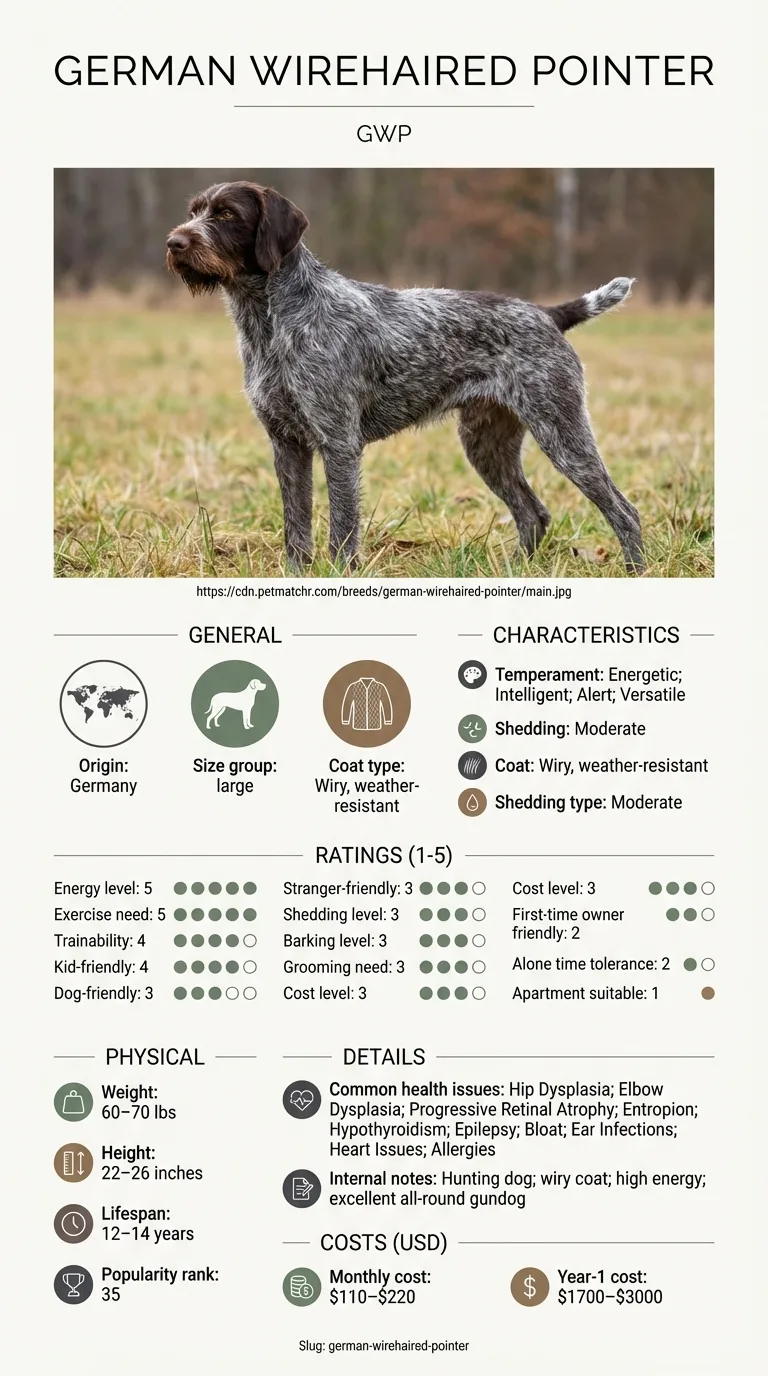
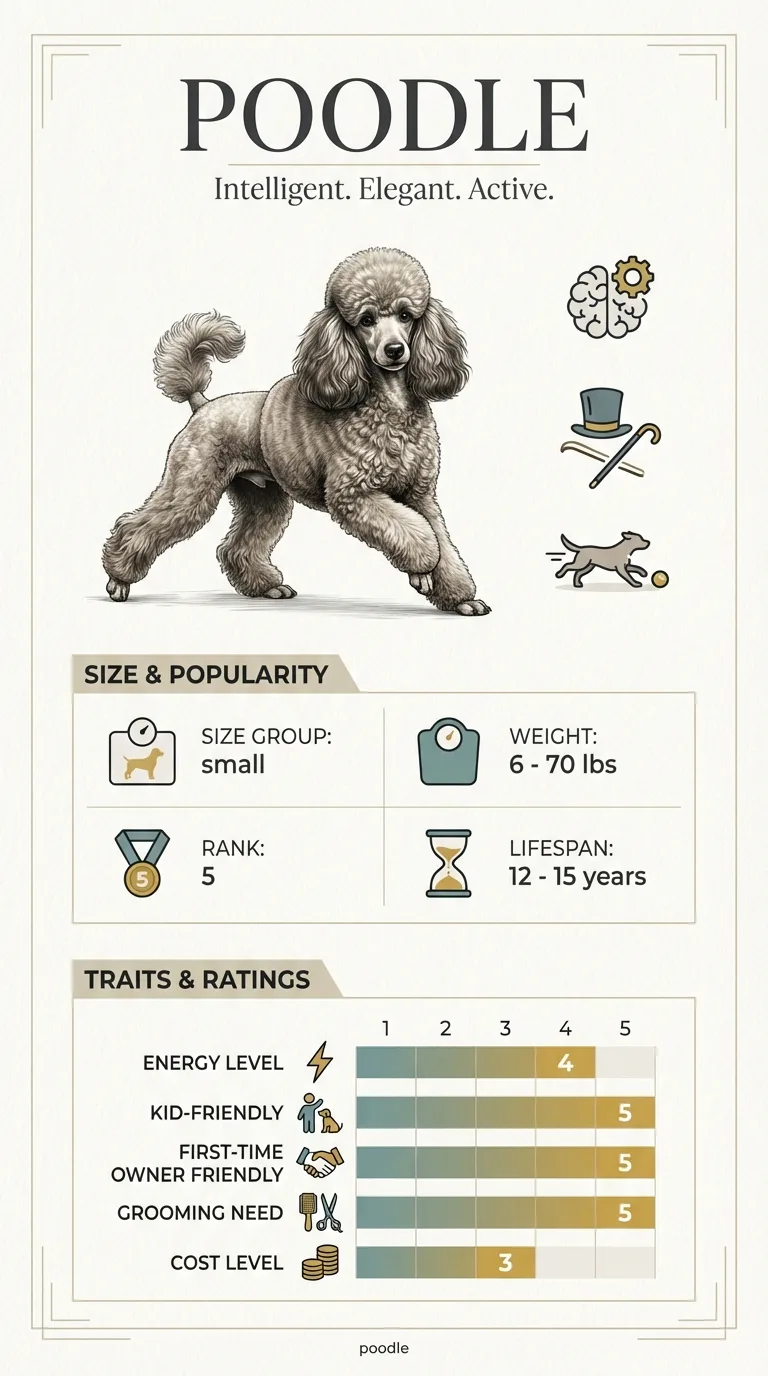
This is for someone already down to German Wirehaired Pointer and Poodle and deciding between them. For this pair the decision usually turns on exercise need and trainability, so those are covered first and in most detail. Anyone choosing from a flat has a clear answer here: German Wirehaired Pointer rates 1/5 against 0/5. There is no origin story here — only what changes about your week.
Between German Wirehaired Pointer and Poodle, exercise need is what separates them, and Poodle is the lower-effort dog of the two to keep.
Choose German Wirehaired Pointer if you do not want a standing grooming appointment, you already have another dog and you want a dog that picks up training quickly.
Choose Poodle if this is your first dog, shedding is a problem in your house and your walking routine is modest.
| Feature | german wirehaired pointer | poodle | Winner |
|---|---|---|---|
| Size class | large | small | Equal |
| Weight | 60–70 lbs | 6–70 lbs | Equal |
| Height | 22–26 in | 0–0 in | Equal |
| Lifespan | 12–14 years | 12–15 years | poodle |
| Exercise need | Very high (5/5) | — (0/5) | poodle |
| Grooming need | Moderate (3/5) | Very high (5/5) | german wirehaired pointer |
| Shedding | Moderate (3/5) | — (0/5) | poodle |
| Energy level | Very high (5/5) | High (4/5) | Equal |
| Barking | Moderate (3/5) | — (0/5) | poodle |
| Apartment suitability | Very low (1/5) | — (0/5) | german wirehaired pointer |
| Good for first-time owners | Low (2/5) | Very high (5/5) | poodle |
| Tolerates being alone | Low (2/5) | — (0/5) | german wirehaired pointer |
| Trainability | High (4/5) | — (0/5) | german wirehaired pointer |
| Good with kids | High (4/5) | Very high (5/5) | poodle |
| Good with other dogs | Moderate (3/5) | — (0/5) | german wirehaired pointer |
| Friendly to strangers | Moderate (3/5) | — (0/5) | german wirehaired pointer |
| Cost level | Moderate (3/5) | Moderate (3/5) | Equal |
| Coat | Wiry, weather-resistant | Curly, dense single coat | Equal |
| Origin | Germany | — | Equal |
| Typical monthly cost | $110–$220 | $0–$0 | Equal |
| Typical first-year cost | $1,700–$3,000 | $0–$0 | Equal |
The Poodle entry here spans an unusually wide weight range, 6-70 pounds, reflecting how the breed covers everything from Toy to Standard varieties in one line -- height isn't specified in this dataset, a reminder that "Poodle" without a size qualifier covers a lot of ground. The GWP, by contrast, holds a consistent 60-70 pound, 22-26 inch frame. At the top of its range a Standard Poodle could match the GWP's size closely; at the bottom, a Toy Poodle would be a fraction of it. Anyone using this comparison should really pin down which Poodle variety they mean, since traits like the Very high (5/5) kid-friendliness rating here likely reflect data averaged across sizes rather than one specific variety.
Exercise need isn't scored in this dataset for the Poodle, but energy level is, rating High (4/5) against the GWP's Very high (5/5) -- a near-tie that suggests Poodles, regardless of size, tend to be genuinely energetic dogs rather than lapdogs, contrary to their elegant reputation. The GWP's temperament list of energetic, intelligent, alert and versatile signals a working-dog drive that likely exceeds most Poodle varieties' needs in practice, even without a formal exercise-need score to compare directly. Prospective owners should treat the missing exercise-need figure as a gap to research by specific Poodle size rather than assume it's automatically lower than the GWP's Very high rating.
Grooming need is one of the clearest data points here: Very high (5/5) for the Poodle against the GWP's Moderate (3/5), reflecting the Poodle's dense, curly single coat that requires regular professional clipping regardless of variety size. Shedding isn't scored for the Poodle in this dataset, but Poodles are widely known as low-shedding dogs thanks to that curly, hair-like coat, which likely explains why a shedding figure wasn't prioritized here -- it's a near-non-issue compared to the GWP's Moderate (3/5) shedding. The tradeoff is clear either way: the Poodle demands far more grooming appointments, while the GWP demands far more brushing-adjacent maintenance around loose hair.
Apartment suitability, tolerating time alone, and barking aren't scored for the Poodle in this dataset, so definitive comparisons on those fronts aren't available here. What is clear is that the GWP rates Very low (1/5) for apartment suitability and Low (2/5) for tolerating time alone, driven by its Very high exercise and energy needs. Poodles, especially Toy and Miniature varieties, are commonly considered adaptable to smaller spaces given their moderate size options, but without a scored figure in this dataset that remains a general breed characteristic rather than a sourced comparison point here. Anyone weighing apartment life heavily should research the specific Poodle size they're considering directly.
Trainability isn't numerically scored for the Poodle here, but good-for-first-time-owners rates Very high (5/5) against the GWP's Low (2/5) -- a substantial, well-supported gap. Poodles are widely regarded as one of the most trainable breed families, and their intelligent, elegant, active temperament listing supports that reputation even without a direct trainability figure in this table. The GWP's energetic, versatile, working-dog nature makes it considerably more demanding for a first-time owner to manage, primarily due to its exercise requirements rather than any deficit in intelligence -- its own trainability, elsewhere in this comparison set, is consistently rated High (4/5) against other breeds.
Good with kids is well-supported and favors the Poodle, Very high (5/5) against the GWP's High (4/5). Good with other dogs and friendly to strangers aren't scored for the Poodle in this dataset, so no direct comparison is available on those two fronts. What the data does support is that both breeds bring notably positive family temperaments -- elegant, intelligent, active for the Poodle and energetic, intelligent, alert, versatile for the GWP -- suggesting neither is a poor household choice, just different in daily-life demands. Families weighing this pairing should lean on the well-supported kid-friendliness gap while researching other social traits independently for their specific Poodle size.
Lifespan favors the Poodle, 12-15 years against the GWP's 12-14 -- a modest edge. This dataset doesn't list specific health conditions for the Poodle, which is a real gap given how much health profiles can vary between Toy, Miniature and Standard varieties; conditions like patellar luxation and progressive retinal atrophy are commonly associated with the breed family generally, but aren't confirmed in this particular record. The GWP's ten-condition list -- hip and elbow dysplasia, PRA, entropion, hypothyroidism, epilepsy, bloat, ear infections, heart issues and allergies -- is fully documented here. Anyone prioritizing health-cost predictability should note that the GWP's profile is the better-sourced one in this specific comparison.
Cost level ties at Moderate (3/5) for both breeds, but the dollar figures aren't populated for the Poodle in this dataset -- both monthly and first-year costs show as unavailable, while the GWP's run $110-220 monthly and $1,700-3,000 in year one. Given the Poodle's Very high grooming need, professional grooming costs are almost certainly a meaningful, recurring expense regardless of the missing figures here, likely comparable to or exceeding the GWP's overall spending once grooming is factored in. Prospective owners should treat the GWP's cost figures as the reliable anchor in this comparison and budget Poodle grooming costs separately based on their local groomer's rates.
German Wirehaired Pointer weighs 60–70 lbs and lives 12–14 years; Poodle weighs 6–70 lbs and lives 12–15 years. The two diverge most on exercise need, trainability and shedding and 6 other rated axes. Almost every rated axis separates them at least slightly. Where the table declares a winner it means less work for the owner, nothing more; descriptive rows are left as ties on purpose. The value here is in the differences between the two columns; treat any single score as approximate.

This record covers 'Poodle' broadly rather than a specific size variety, and several fields -- like exercise need and specific cost figures -- aren't populated; the general Poodle (all sizes) comparison has fuller data if you want a more complete picture.
The Poodle, rated Very high (5/5) versus the GWP's Moderate (3/5) -- its curly coat needs regular professional clipping.
The Poodle, at 12-15 years versus the GWP's 12-14 years.
Yes, rated Very high (5/5) versus the GWP's Low (2/5) for first-time owners.
The Poodle, rated Very high (5/5) versus the GWP's High (4/5).
This dataset doesn't score Poodle shedding directly, but Poodles are broadly known as low-shedding dogs thanks to their curly coat, unlike the GWP's Moderate (3/5) shedding rating.
The GWP -- its ten-condition list is fully detailed here, while the Poodle's health data isn't populated in this particular record.
The Poodle, rated Very high (5/5) versus the GWP's Moderate (3/5).
The Poodle, rated Very high (5/5) versus the GWP's Low (2/5) for first-time owners.
The Poodle, at 12-15 years versus the GWP's 12-14 years.
The Poodle, rated Very high (5/5) versus the GWP's High (4/5).
Secure checkout on Stripe. We never see your card.
7-day money-back guarantee. Instant access.
Health information here is general and is not veterinary advice. If your dog shows pain, sudden behaviour change, or worsening symptoms, consult a licensed veterinarian.
Some links on this site are affiliate links. We may earn a commission at no extra cost to you, and we only suggest products we believe are helpful for dog owners.
We research and check what we publish, but we do not warrant that any figure, date, price, or statement is accurate, complete, or current, and we accept no liability for any loss, cost, injury, or other harm arising from the use of this site. Use it as one reference among several. You remain responsible for your own decisions and for your dog's care - confirm anything that matters with a licensed veterinarian or another qualified professional before you act on it. Full disclaimer.
Match your lifestyle to the right dog.
Take quizNot sure which breed is right for you? Take our 2-minute quiz to find out.
Take the quiz