Cane Corso or Papillon, which fits a small household better?
For an apartment, a first dog, or a lower budget, the Papillon wins on nearly every measure. The Corso is the right pick only if you specifically want a large protective breed and have the space and experience for it.
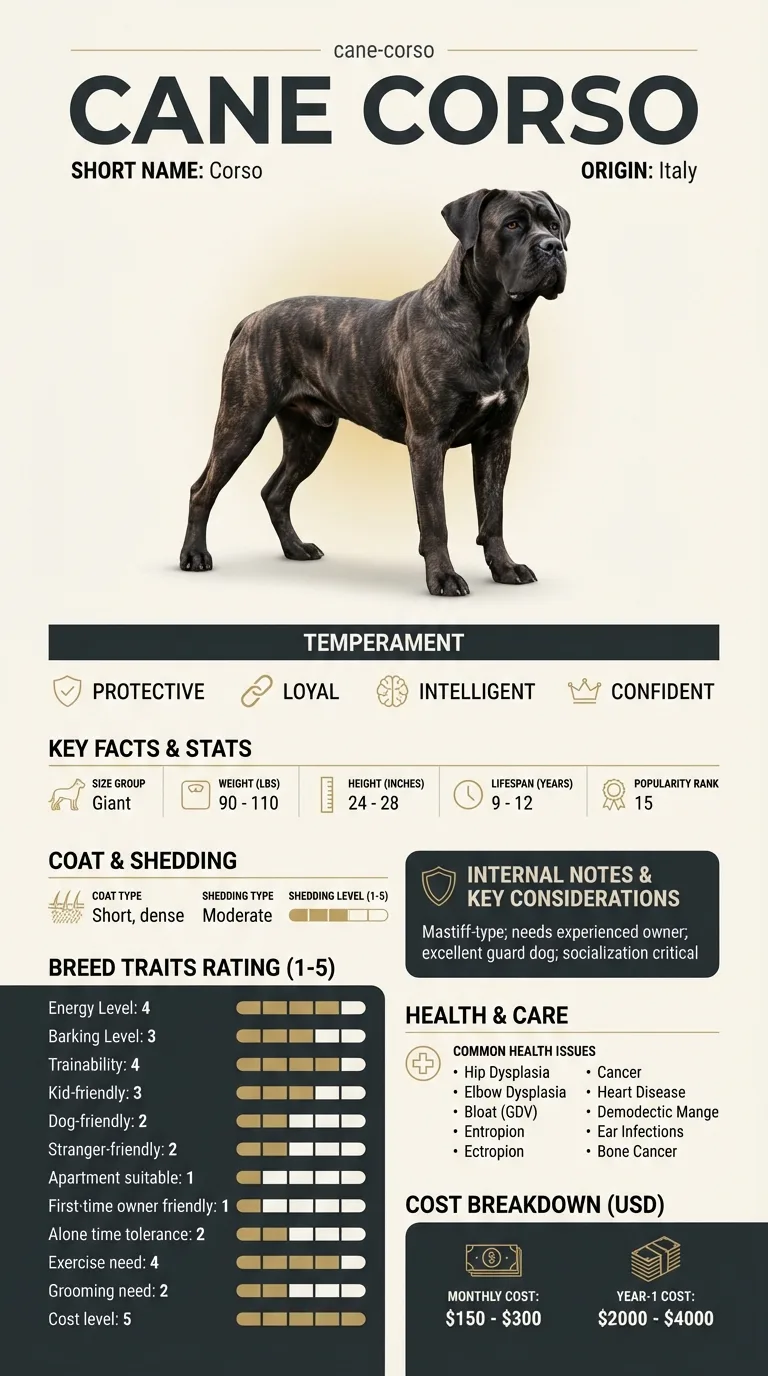
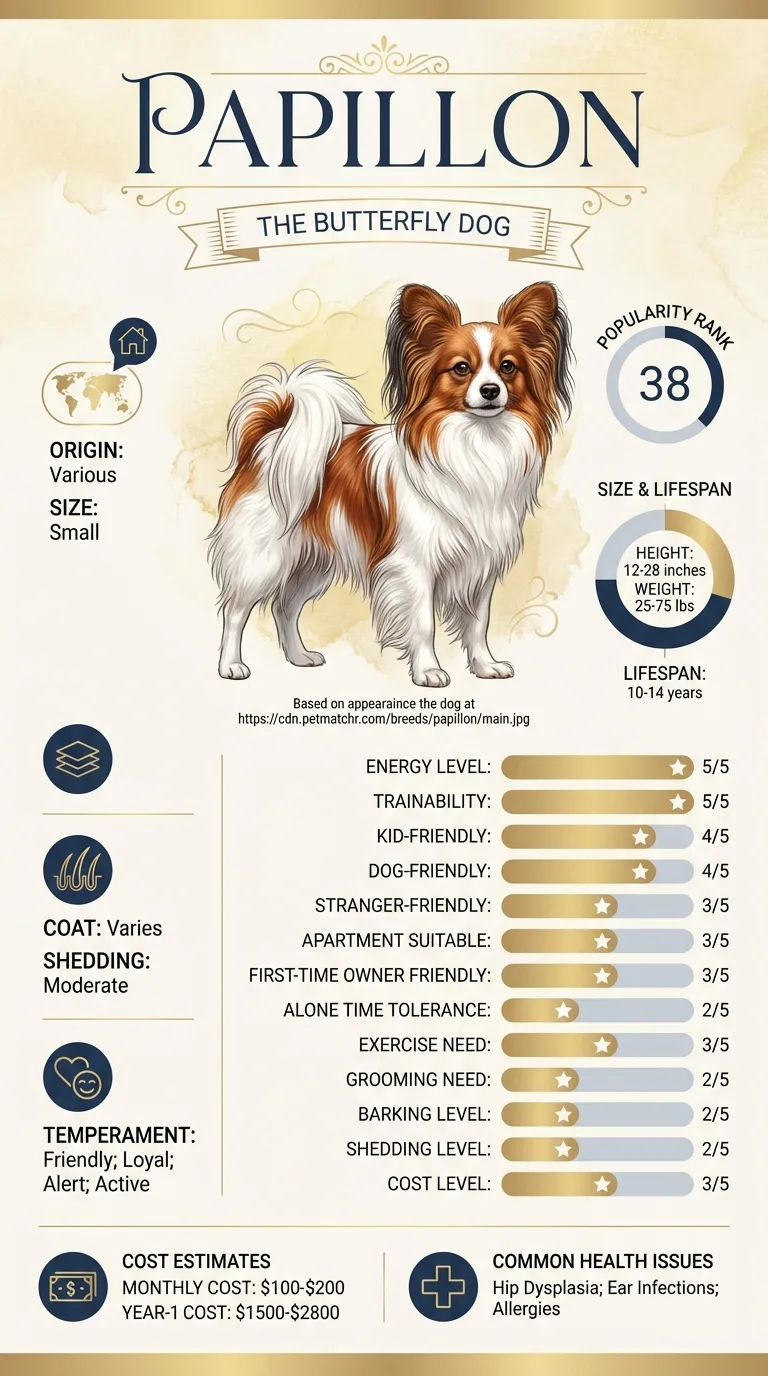
Cane Corso or Papillon? On paper they differ most on apartment suitability, and on the scales Cane Corso is the heavier at 90–110 lbs. Here is how the two compare on everything that shapes an ordinary week.
This is for someone already down to Cane Corso and Papillon and deciding between them. For this pair the decision usually turns on apartment suitability and good for first-time owners, so those are covered first and in most detail. Anyone choosing from a flat has a clear answer here: Papillon rates 5/5 against 1/5. Breed history is left out; what follows is what you will actually live with.
Quick verdict
Between Cane Corso and Papillon, apartment suitability is what separates them, and Papillon is the lower-effort dog of the two to keep.
Choose cane corso if...
Choose Cane Corso if you want a dog that can keep up with an active routine and you want a dog that is more watchful with visitors.
Choose papillon if...
Choose Papillon if you are in a flat or a smaller home, this is your first dog and shedding is a problem in your house.
Head-to-head comparison
Feature
cane corso
papillon
Winner
Size class
giant
small
Equal
Weight
90–110 lbs
5–10 lbs
Equal
Height
24–28 in
8–11 in
Equal
Lifespan
9–12 years
14–16 years
papillon
Exercise need
High (4/5)
Moderate (3/5)
papillon
Grooming need
Low (2/5)
Low (2/5)
Equal
Shedding
Moderate (3/5)
Low (2/5)
papillon
Energy level
High (4/5)
High (4/5)
Equal
Barking
Moderate (3/5)
High (4/5)
cane corso
Apartment suitability
Very low (1/5)
Very high (5/5)
papillon
Good for first-time owners
Very low (1/5)
High (4/5)
papillon
Tolerates being alone
Low (2/5)
Low (2/5)
Equal
Trainability
High (4/5)
Very high (5/5)
papillon
Good with kids
Moderate (3/5)
Moderate (3/5)
Equal
Good with other dogs
Low (2/5)
High (4/5)
papillon
Friendly to strangers
Low (2/5)
High (4/5)
papillon
Cost level
Very high (5/5)
Low (2/5)
papillon
Coat
Short, dense
Long, silky single coat
Equal
Origin
Italy
Various
Equal
Typical monthly cost
$150–$300
$80–$150
Equal
Typical first-year cost
$2,000–$4,000
$1,100–$2,300
Equal
Deep dive
Size and build
A Papillon weighs 5 to 10 pounds. A Cane Corso weighs 90 to 110. That's roughly a tenfold difference, and it shows in height too, 8 to 11 inches against 24 to 28. There's no overlap in the practical realities of ownership here: crate size, car space, even how you pick the dog up, are entirely different questions for these two breeds.
Energy and exercise
Energy level actually ties at high (4/5) for both breeds, which surprises people who assume a toy breed is low-key. Exercise need splits them, though, the Corso rates high (4/5) against the Papillon's moderate (3/5). The Papillon channels its energy into shorter, more frequent bursts of activity rather than the sustained output a Corso wants.
Grooming and shedding
Grooming ties at low (2/5) for both breeds, which is a little unexpected given the Papillon's long, silky coat, but that coat is a single layer without a heavy undercoat, so it doesn't mat the way a double coat would. Shedding favors the Papillon slightly, low, 2/5, versus the Corso's moderate, 3/5.
Apartment living, noise and time alone
The Papillon is built for small spaces, a very high 5/5 for apartment suitability, while the Corso bottoms out at 1/5. The trade-off is noise: the Papillon barks more (high, 4/5) than the Corso (moderate, 3/5), so thin apartment walls may hear about it. Both breeds tolerate being alone poorly, rated low across the board.
Training and owner experience
The Papillon is one of the most trainable small breeds around, rated very high (5/5), against the Corso's still-solid high (4/5). First-time-owner suitability is where the real gap opens: 4/5 for the Papillon versus a rock-bottom 1/5 for the Corso. A quick-witted, confident toy breed is simply a gentler introduction to dog ownership than a guardian giant.
Kids, other dogs and visitors
Kids ties at moderate (3/5) for both, the Papillon's small, fragile frame offsets its otherwise friendly nature around children. The Papillon pulls ahead with other dogs, high, 4/5, versus low, 2/5, and with strangers, high, 4/5, versus low, 2/5, which tracks with its alert-but-friendly temperament against the Corso's more protective, reserved wiring.
Health and lifespan
The lifespan gap here is large, 14 to 16 years for the Papillon against 9 to 12 for the Corso, nearly a doubling in the small dog's favor. Notably, the two breeds' health risks don't overlap much at all: the Papillon's list, patellar luxation, PRA, dental disease, collapsing trachea, is dominated by small-breed joint and airway issues, while the Corso's centers on giant-breed concerns like bloat, cancer, and joint dysplasia.
Cost to keep
Cost level splits sharply, very high (5/5) for the Corso against low (2/5) for the Papillon, and the dollar figures follow suit: $150-$300 a month for the Corso versus $80-$150 for the Papillon, and $2,000-$4,000 against $1,100-$2,300 for the first year. A Papillon is, in almost every practical sense, the cheaper dog to own.
Cane Corso vs Papillon at a glance
Cane Corso weighs 90–110 lbs and lives 9–12 years; Papillon weighs 5–10 lbs and lives 14–16 years. The two diverge most on apartment suitability, good for first-time owners and cost level and 2 other rated axes. They are level on tolerates being alone, energy level and grooming need, so those cannot decide it. The comparison marks an easier option only where one exists. Facts like weight and country of origin are not scored. Both dogs are rated from the same dataset, which is what makes the numbers comparable with each other even though any individual dog sits somewhere inside its breed's range.
Cane Corso vs Papillon: Which Suits Your Home? - Cane Corso vs Papillon at a glance
Frequently asked questions
Is a Papillon a good first dog?
Yes, it rates 4/5 for first-time owners and 5/5 for trainability, a strong combination for someone new to dog ownership. A Cane Corso, by contrast, rates just 1/5 for first-time owners.
Why does a Papillon bark more than a Cane Corso?
The data rates Papillon barking as high (4/5) against the Corso's moderate (3/5), small, alert breeds are frequently more vocal than large guardian breeds, even though the Corso is the more imposing dog.
How much does a Papillon cost compared to a Cane Corso?
Considerably less, $80-$150 a month and $1,100-$2,300 in the first year for a Papillon, against $150-$300 and $2,000-$4,000 for a Corso.
Which breed lives longer?
The Papillon, often by four to seven years, 14 to 16 years against the Corso's 9 to 12.
Do Cane Corsos and Papillons share health risks?
Barely, their listed conditions don't overlap. The Papillon's risks center on small-breed joint and dental issues, while the Corso's center on giant-breed joint, bloat, and cancer risk.
Is a Papillon suitable for apartment living?
Very, it rates a full 5/5 for apartment suitability, one of the highest scores possible. The Corso rates 1/5 and needs considerably more space.
Which breed is more energetic day to day?
They tie at high (4/5) for overall energy level, though the Corso edges ahead on total exercise need (4/5 versus the Papillon's 3/5).
Cane Corso or Papillon, which fits a small household better?
For an apartment, a first dog, or a lower budget, the Papillon wins on nearly every measure. The Corso is the right pick only if you specifically want a large protective breed and have the space and experience for it.
Costs
What's the monthly cost gap?
$150-$300 for the Corso versus $80-$150 for the Papillon, the Corso costs roughly double.
Training
Which needs more exercise?
The Corso, rated high (4/5) against the Papillon's moderate (3/5), even though both tie on overall energy level.
Health
Which breed lives longer?
The Papillon, often by half again the Corso's lifespan, 14-16 years versus 9-12.
Related DogBreedCompass guides
Cane Corso breed guide – Readers comparing the two usually want the full profile of Cane Corso before deciding.
Papillon breed guide – The same for Papillon, so the comparison can be checked against the detail.
Cane Corso vs Rottweiler – Rottweiler is the closest breed to Cane Corso on the measured axes, so it is the natural next comparison.
Papillon vs Maltese – Maltese sits closest to Papillon, which makes it the alternative worth ruling out.
What Cane Corso costs to keep – Anyone weighing these two is usually also pricing them, and the cost pages carry city-level figures.
Papillon health problems – The health pages set out what each breed is actually screened for.
Health information here is general and is not veterinary advice. If your dog shows pain, sudden behaviour change, or worsening symptoms, consult a licensed veterinarian.
Some links on this site are affiliate links. We may earn a commission at no extra cost to you, and we only suggest products we believe are helpful for dog owners.
We research and check what we publish, but we do not warrant that any figure, date, price, or statement is accurate, complete, or current, and we accept no liability for any loss, cost, injury, or other harm arising from the use of this site. Use it as one reference among several. You remain responsible for your own decisions and for your dog's care - confirm anything that matters with a licensed veterinarian or another qualified professional before you act on it. Full disclaimer.