Living
Which is bigger?
The Newfoundland, at 100-150 lbs versus the Brittany's 30-40 lbs.

Quick answer
Which is bigger?
The Newfoundland, at 100-150 lbs versus the Brittany's 30-40 lbs.
Brittany Spaniel or Newfoundland? On paper they differ most on grooming need, and on the scales Newfoundland is the heavier at 100–150 lbs. Here is how the two compare on everything that shapes an ordinary week.
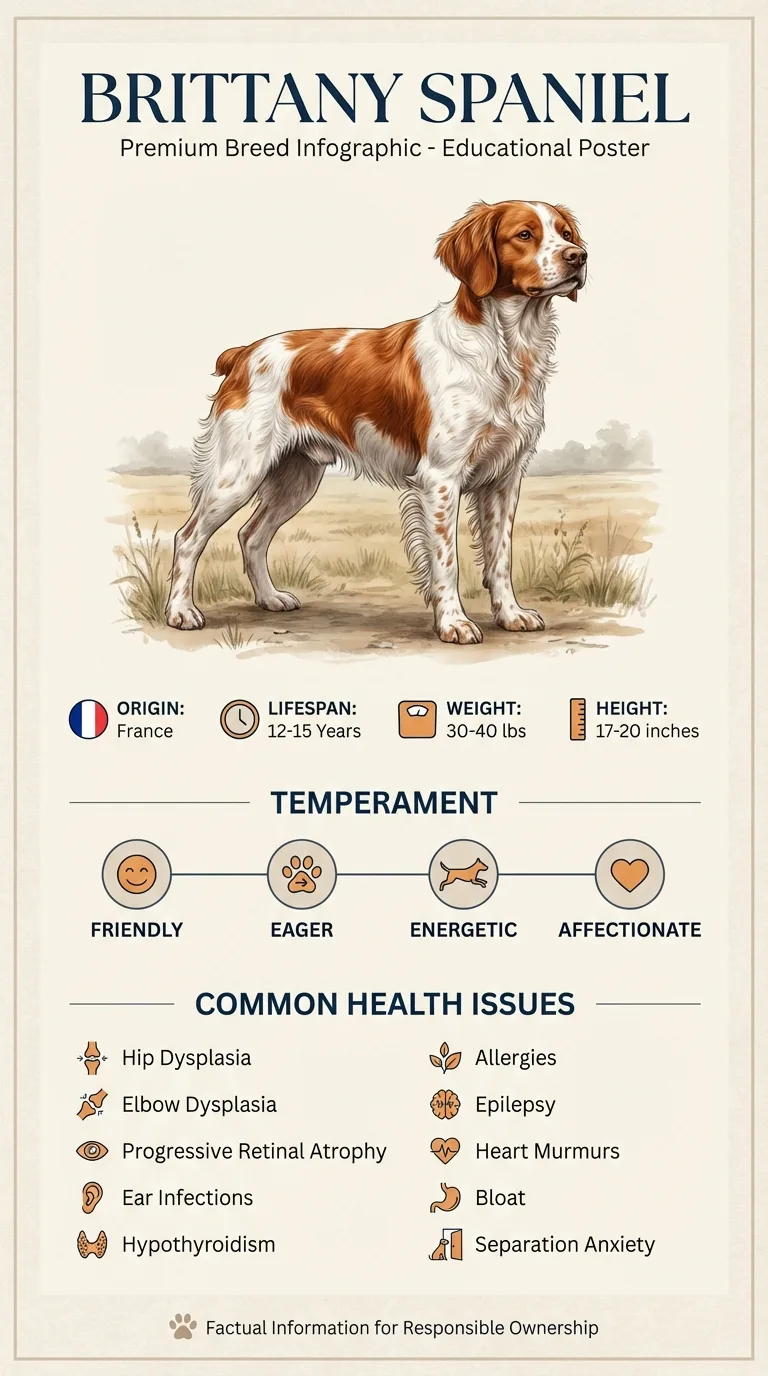
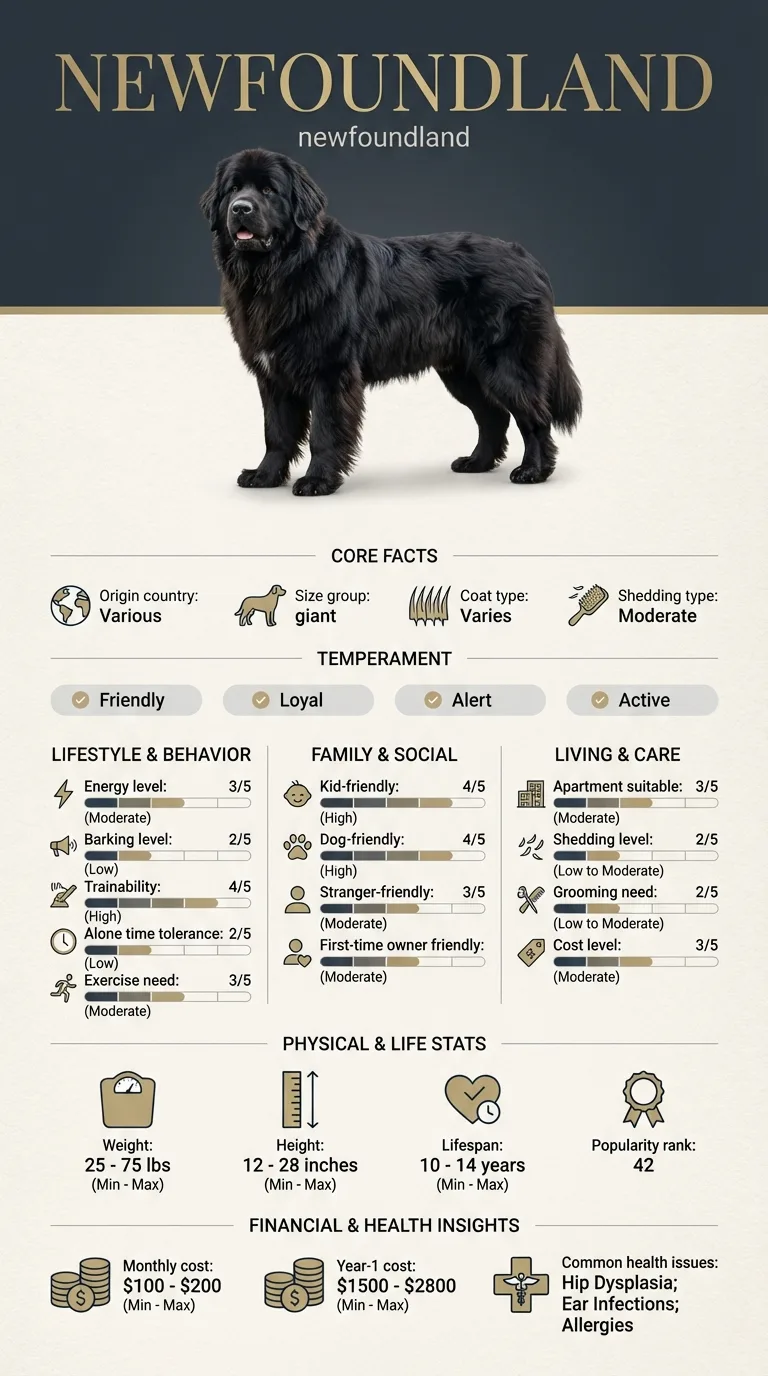
This is for someone already down to Brittany Spaniel and Newfoundland and deciding between them. For this pair the decision usually turns on grooming need and energy level, so those are covered first and in most detail. Anyone choosing from a flat has a clear answer here: Brittany Spaniel rates 3/5 against 1/5. The focus throughout is on daily consequences rather than breed background.
Between Brittany Spaniel and Newfoundland, grooming need is what separates them, and Brittany Spaniel is the lower-effort dog of the two to keep.
Choose Brittany Spaniel if you are in a flat or a smaller home, this is your first dog and you do not want a standing grooming appointment.
Choose Newfoundland if your walking routine is modest and the dog will be alone during the working day.
| Feature | brittany | newfoundland | Winner |
|---|---|---|---|
| Size class | medium | giant | Equal |
| Weight | 30–40 lbs | 100–150 lbs | Equal |
| Height | 17–20 in | 26–28 in | Equal |
| Lifespan | 12–15 years | 9–10 years | brittany |
| Exercise need | High (4/5) | Moderate (3/5) | newfoundland |
| Grooming need | Low (2/5) | High (4/5) | brittany |
| Shedding | Moderate (3/5) | Very high (5/5) | brittany |
| Energy level | High (4/5) | Low (2/5) | Equal |
| Barking | Low (2/5) | Low (2/5) | Equal |
| Apartment suitability | Moderate (3/5) | Very low (1/5) | brittany |
| Good for first-time owners | High (4/5) | Moderate (3/5) | brittany |
| Tolerates being alone | Low (2/5) | Moderate (3/5) | newfoundland |
| Trainability | Very high (5/5) | High (4/5) | brittany |
| Good with kids | Very high (5/5) | Very high (5/5) | Equal |
| Good with other dogs | Very high (5/5) | High (4/5) | brittany |
| Friendly to strangers | High (4/5) | High (4/5) | Equal |
| Cost level | Moderate (3/5) | Very high (5/5) | brittany |
| Coat | Medium, wavy coat | Heavy water-resistant double coat | Equal |
| Origin | France | Various | Equal |
| Typical monthly cost | $90–$180 | $150–$310 | Equal |
| Typical first-year cost | $1,300–$2,500 | $2,200–$4,200 | Equal |
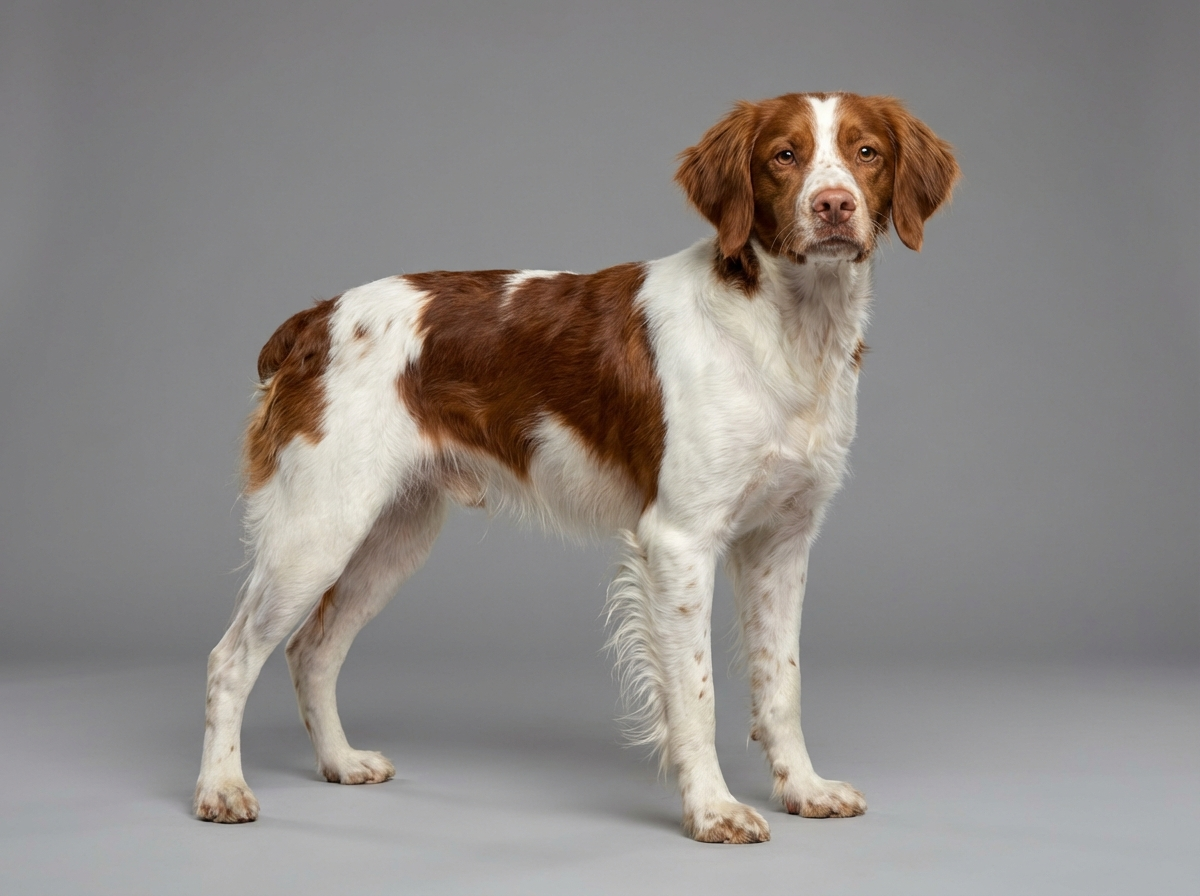
Picture them side by side and the Newfoundland doesn't just outweigh the Brittany -- at 100 to 150 pounds it can be three to four times heavier than the 30-to-40-pound Brittany, and its 26-to-28 inch shoulder height means it looks a grown adult in the eye while the Brittany's 17-to-20 inch frame stays around knee level. This is medium against giant, not medium against small, and it shows up in everything from doorway clearance to the size of food bowl needed. The Newfoundland's heavy, water-resistant double coat also adds visual bulk the leaner, wavy-coated Brittany doesn't carry, even before scale is factored in.
The exercise-need numbers actually favor the smaller dog for activity level: Brittany High (4/5) versus Newfoundland Moderate (3/5), and energy level tells the sharper story -- the Brittany is rated High (4/5) energy, the Newfoundland just Low (2/5). A Newfoundland is a working water-rescue breed built for bursts of powerful swimming, not all-day trotting, and its calm, patient temperament means it's content with a couple of moderate walks and pond time if available. The Brittany, true to its bird-dog roots, wants sustained daily movement -- a Newfoundland owner who tries to match a Brittany's pace will tire the wrong dog.
Grooming need is High (4/5) for the Newfoundland against Low (2/5) for the Brittany, and shedding widens the gap further: Very high (5/5) for the Newfoundland's heavy double coat versus Moderate (3/5) for the Brittany. A Newfoundland's coat sheds seasonally in genuinely large volumes -- owners often describe drifts of undercoat during spring blowouts -- and needs multiple brushing sessions a week to control matting, especially around the ears and britches. The Brittany's medium wavy coat wipes down easily and rarely mats. Anyone sensitive to dog hair on clothing and furniture should weigh the Newfoundland's coat volume seriously before falling for its temperament.
Apartment suitability draws the starkest line in this comparison: Very low (1/5) for the Newfoundland against Moderate (3/5) for the Brittany, a gap driven almost entirely by sheer size rather than temperament -- both breeds are rated Low (2/5) for barking, so noise complaints aren't the issue. A 130-pound dog needs floor space to turn around and a yard to be comfortable long-term, something most apartments simply don't offer. On being left alone, the Newfoundland actually does slightly better, Moderate (3/5) versus the Brittany's Low (2/5), so a Newfoundland in a house with a yard may tolerate solo time better than a Brittany would in a smaller space.
The Brittany rates Very high (5/5) for trainability and High (4/5) for first-time-owner suitability; the Newfoundland rates High (4/5) and Moderate (3/5) on the same measures. Neither gap is large, but the Newfoundland's size changes what training failure looks like -- a poorly leash-trained 140-pound dog is a safety issue in a way a 35-pound Brittany pulling on lead simply isn't. The Newfoundland's sweet, patient, devoted nature makes it eager to please once training starts, and its calm temperament means sessions rarely turn frantic. First-time owners choosing the Newfoundland should prioritize leash and recall work early, before size makes corrections harder.
Both breeds score Very high (5/5) with kids, and the Newfoundland's reputation as a gentle giant is backed by data rating it High (4/5) with strangers and High (4/5) with other dogs -- just one point behind the Brittany's Very high (5/5) on both. The practical difference is physical: a devoted, patient 130-pound dog leaning against a toddler is a different management challenge than an energetic 35-pound Brittany doing the same thing. Families with very young children often need to supervise the Newfoundland less for temperament than for sheer mass, while the livelier Brittany needs more supervision for enthusiasm than size.
Lifespan is the sharpest number in this whole comparison: 12-15 years for the Brittany against just 9-10 for the Newfoundland, a gap typical of giant breeds carrying that much frame. The Newfoundland's five listed conditions lean cardiac and structural -- Subaortic Stenosis and Dilated Cardiomyopathy alongside Hip Dysplasia, Cystinuria, and Bloat (GDV) -- meaning cardiac screening before breeding and slow-feeding to reduce bloat risk both matter. The Brittany's longer list of ten includes Epilepsy, Heart Murmurs, and Separation Anxiety on top of joint and eye conditions. Both share Hip Dysplasia and bloat risk, so a raised feeder and split meals are sensible for either dog.
Cost level is rated Very high (5/5) for the Newfoundland against Moderate (3/5) for the Brittany, and the monthly ranges confirm it: $150-310 for the Newfoundland versus $90-180 for the Brittany, with first-year costs of $2,200-4,200 against $1,300-2,500. Food alone explains much of the gap -- a 130-pound dog eats several times what a 35-pound one does -- and the Newfoundland's heavy coat adds grooming-tool and possibly professional-groomer costs the Brittany skips. Pet insurance premiums also tend to scale with breed size and known cardiac risk, so a Newfoundland owner should expect to budget toward the top of that range rather than the bottom.
Brittany Spaniel weighs 30–40 lbs and lives 12–15 years; Newfoundland weighs 100–150 lbs and lives 9–10 years. The two diverge most on grooming need, energy level and apartment suitability and 2 other rated axes. They are level on barking, good with kids and friendly to strangers, so those cannot decide it. The table below marks a winner only where one breed is genuinely easier for a typical owner; size and origin are facts rather than merits and stay level. Ratings come from one source applied to both breeds, so they are meaningful against each other rather than as absolute scores.

Not necessarily, but its Very low (1/5) apartment-suitability score and 100-150 lb weight mean it needs real floor space and ideally a yard, unlike the Brittany's Moderate (3/5) rating.
The Brittany, with a 12-15 year lifespan against the Newfoundland's 9-10 years, a gap typical for a giant breed.
No -- the Newfoundland rates Moderate (3/5) exercise need and Low (2/5) energy, well below the Brittany's High (4/5) on both.
The Newfoundland, rated Very high (5/5) shedding against the Brittany's Moderate (3/5), due to its heavy double coat.
Yes, rated Very high (5/5) with kids, matching the Brittany, and their patient, calm temperament is well suited to family life despite their size.
The Newfoundland runs notably higher, $150-310 monthly and $2,200-4,200 in year one, against the Brittany's $90-180 and $1,300-2,500.
Subaortic Stenosis and Dilated Cardiomyopathy, both cardiac conditions, appear on the Newfoundland's list but not the Brittany's, making cardiac screening a priority when choosing a Newfoundland breeder.
The Newfoundland, at 100-150 lbs versus the Brittany's 30-40 lbs.
The Brittany, rated Low (2/5) against the Newfoundland's High (4/5).
The Newfoundland, rated Moderate (3/5) versus the Brittany's Low (2/5).
The Brittany, with a first-year cost of $1,300-2,500 against the Newfoundland's $2,200-4,200.
Secure checkout on Stripe. We never see your card.
7-day money-back guarantee. Instant access.
Health information here is general and is not veterinary advice. If your dog shows pain, sudden behaviour change, or worsening symptoms, consult a licensed veterinarian.
Some links on this site are affiliate links. We may earn a commission at no extra cost to you, and we only suggest products we believe are helpful for dog owners.
We research and check what we publish, but we do not warrant that any figure, date, price, or statement is accurate, complete, or current, and we accept no liability for any loss, cost, injury, or other harm arising from the use of this site. Use it as one reference among several. You remain responsible for your own decisions and for your dog's care - confirm anything that matters with a licensed veterinarian or another qualified professional before you act on it. Full disclaimer.
Match your lifestyle to the right dog.
Take quizNot sure which breed is right for you? Take our 2-minute quiz to find out.
Take the quiz