Living
Which dog fits better into a smaller home?
The Shar-Pei, with a 4/5 apartment score and low exercise need, compared to the Boxer's 2/5 and high energy demands.

Quick answer
Which dog fits better into a smaller home?
The Shar-Pei, with a 4/5 apartment score and low exercise need, compared to the Boxer's 2/5 and high energy demands.
Boxer or Chinese Shar-Pei? On paper they differ most on exercise need, and on the scales Boxer is the heavier at 60–70 lbs. Here is how the two compare on everything that shapes an ordinary week.
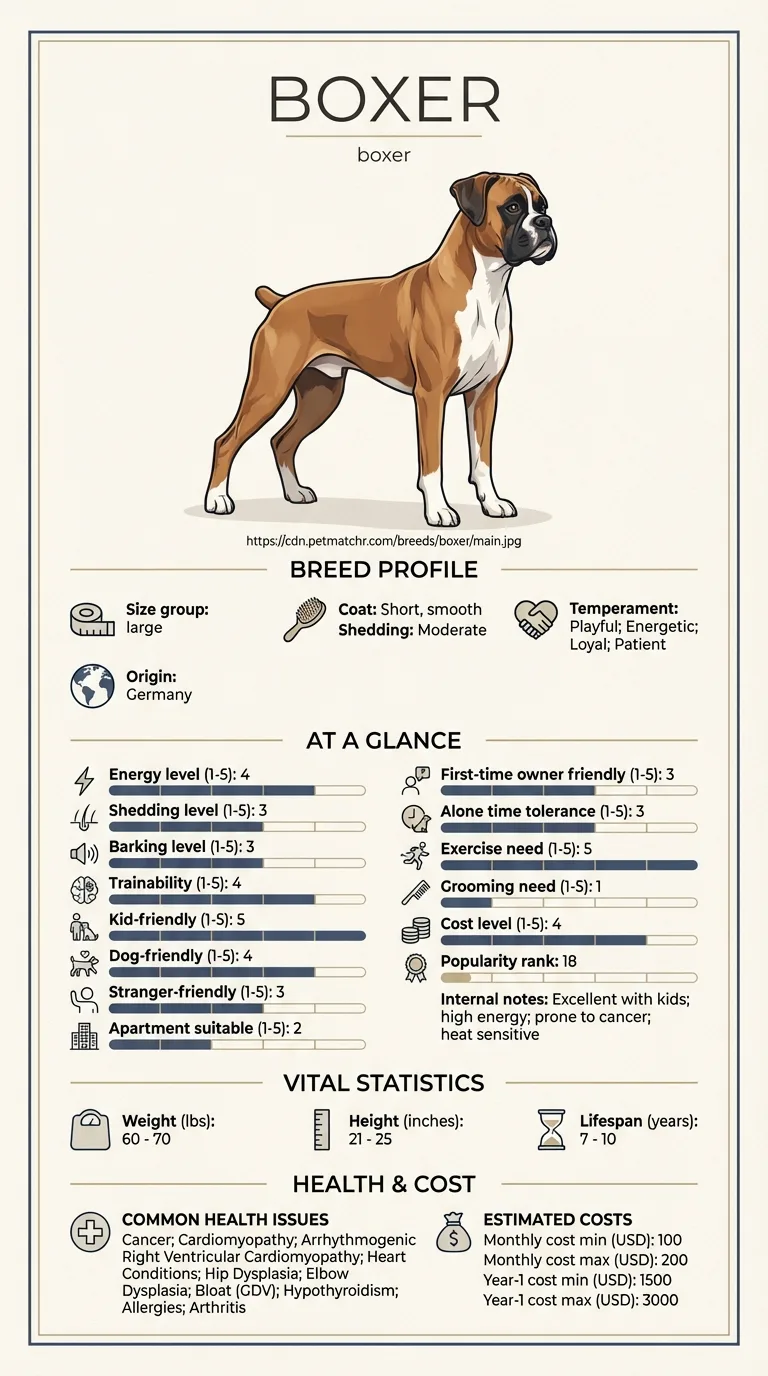
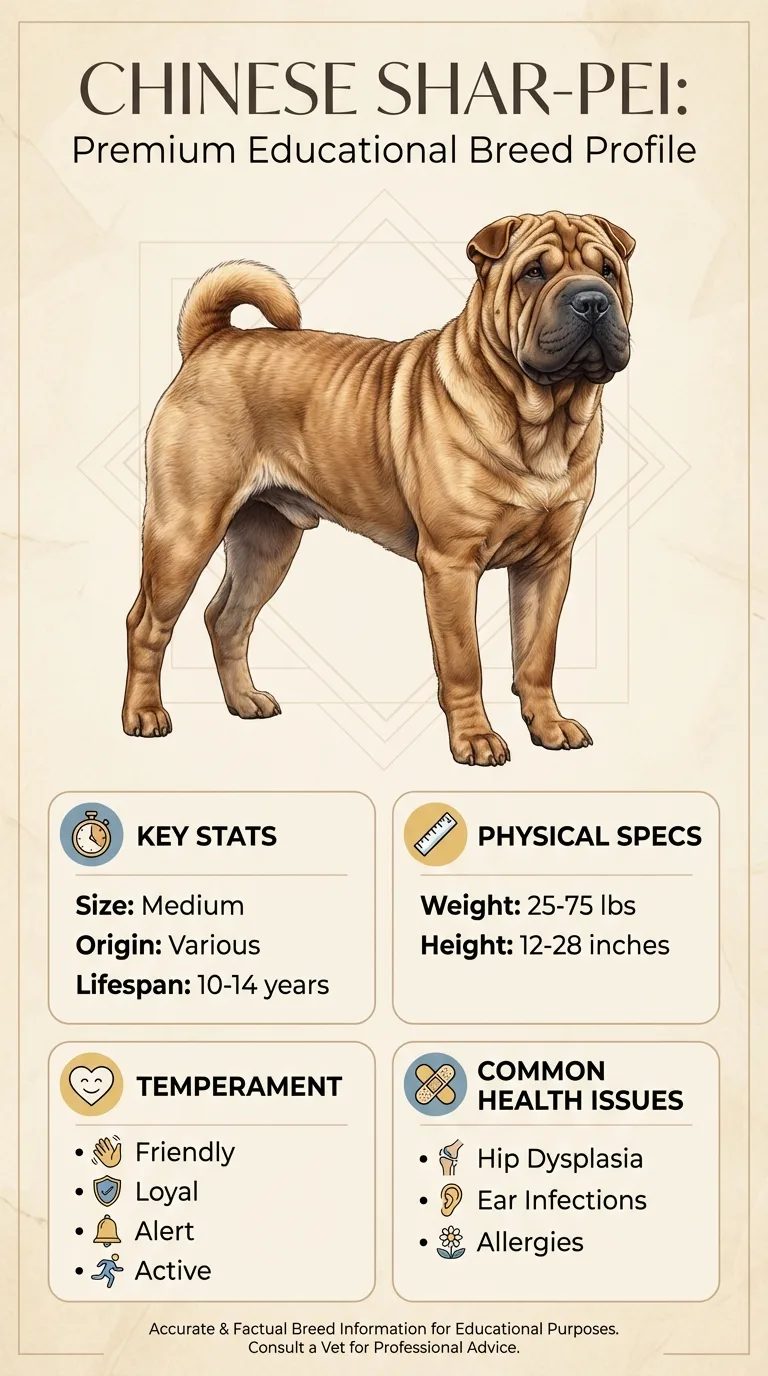
This is for someone already down to Boxer and Chinese Shar-Pei and deciding between them. For this pair the decision usually turns on exercise need and energy level, so those are covered first and in most detail. Anyone choosing from a flat has a clear answer here: Chinese Shar-Pei rates 4/5 against 2/5. It is written for the decision rather than the breed history.
Between Boxer and Chinese Shar-Pei, exercise need is what separates them, and Chinese Shar-Pei is the lower-effort dog of the two to keep.
Choose Boxer if this is your first dog, you do not want a standing grooming appointment and there are young children at home.
Choose Chinese Shar-Pei if you are in a flat or a smaller home, shedding is a problem in your house and your walking routine is modest.
| Feature | boxer | chinese shar pei | Winner |
|---|---|---|---|
| Size class | large | medium | Equal |
| Weight | 60–70 lbs | 45–60 lbs | Equal |
| Height | 21–25 in | 18–20 in | Equal |
| Lifespan | 7–10 years | 8–12 years | chinese shar pei |
| Exercise need | Very high (5/5) | Low (2/5) | chinese shar pei |
| Grooming need | Very low (1/5) | Low (2/5) | boxer |
| Shedding | Moderate (3/5) | Low (2/5) | chinese shar pei |
| Energy level | High (4/5) | Low (2/5) | Equal |
| Barking | Moderate (3/5) | Low (2/5) | chinese shar pei |
| Apartment suitability | Low (2/5) | High (4/5) | chinese shar pei |
| Good for first-time owners | Moderate (3/5) | Low (2/5) | boxer |
| Tolerates being alone | Moderate (3/5) | Moderate (3/5) | Equal |
| Trainability | High (4/5) | Low (2/5) | boxer |
| Good with kids | Very high (5/5) | Moderate (3/5) | boxer |
| Good with other dogs | High (4/5) | Low (2/5) | boxer |
| Friendly to strangers | Moderate (3/5) | Low (2/5) | boxer |
| Cost level | High (4/5) | High (4/5) | Equal |
| Coat | Short, smooth | Short and harsh | Equal |
| Origin | Germany | Various | Equal |
| Typical monthly cost | $100–$200 | $100–$200 | Equal |
| Typical first-year cost | $1,500–$3,000 | $1,400–$2,900 | Equal |
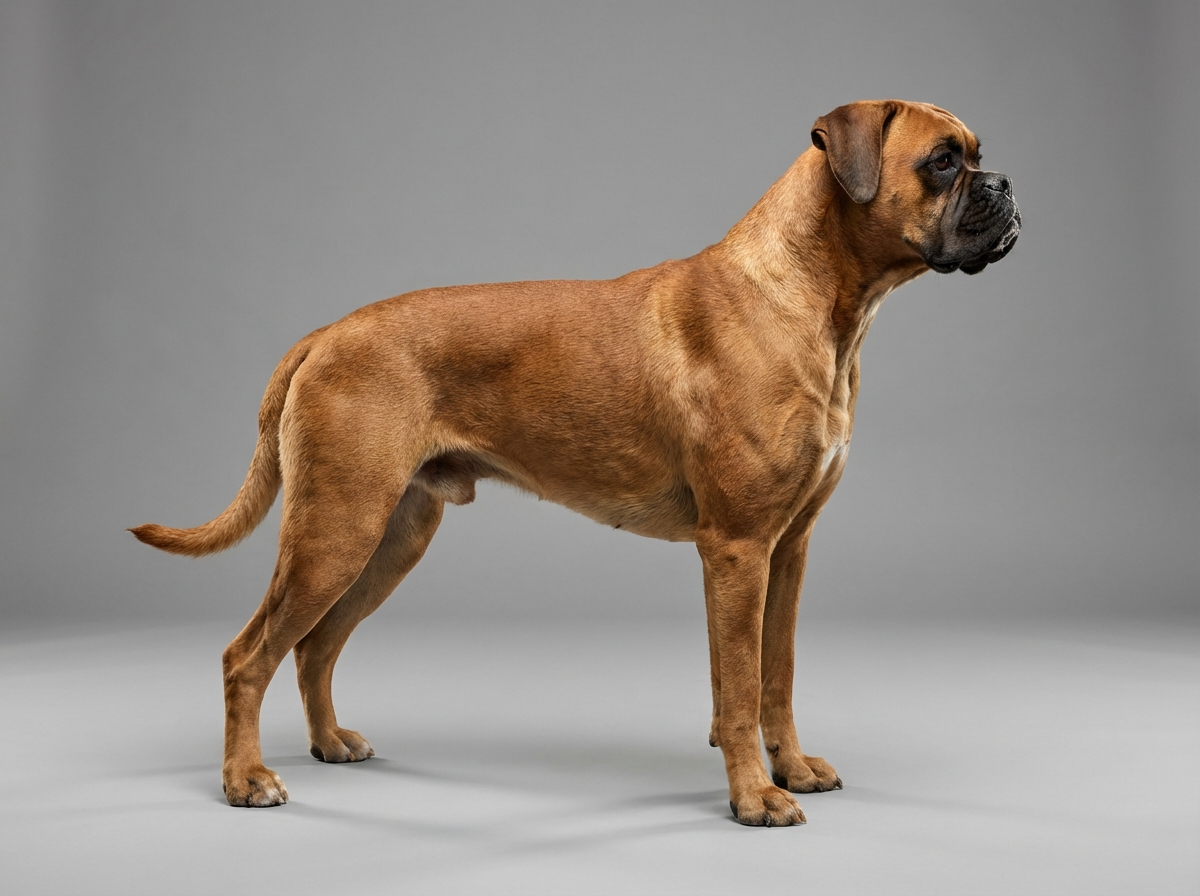
Size isn't the story here - the Shar-Pei runs 45-60 lbs and 18-20 inches, close enough to the Boxer's 60-70 lbs and 21-25 inches that either could plausibly fit the same crate. The real divide shows up in the coat and posture: the Boxer is smooth-muscled and athletic-looking, the Shar-Pei built low and wrinkled, with a shorter, harsher coat suited to a very different job history.
Despite being a similarly sized dog, the Shar-Pei rates just 2/5 for exercise need against the Boxer's 5/5 - a genuinely large gap for two medium-large breeds. Energy level follows the same pattern (4/5 vs 2/5). If you want a running or hiking partner, this comparison isn't close; the Boxer wants the miles and the Shar-Pei is happy watching you leave without it.
Both breeds are low-maintenance in the brush-and-go sense - the Boxer at 1/5, the Shar-Pei at 2/5 for grooming need, with the Shar-Pei shedding slightly less too (2/5 vs 3/5). The catch is the Shar-Pei's skin folds, which need regular wiping and drying to prevent the dermatitis it's prone to. Low grooming effort doesn't mean zero attention to the skin underneath.
The Shar-Pei is the quieter, more space-efficient dog on paper: 4/5 for apartment suitability and a low 2/5 for barking, against the Boxer's 2/5 and 3/5. Both tolerate being alone about equally (3/5 each). A reserved, independent breed like the Shar-Pei genuinely does better in confined spaces than a Boxer that wants to move and interact constantly. That independence cuts both ways, though - it also means less enthusiasm about being your full-time companion.
The Boxer is the easier dog to raise if you're new to this: 4/5 trainability and 3/5 for first-time owners, against the Shar-Pei's 2/5 on both counts. Shar-Peis are famously independent and reserved by temperament, which in practice means training sessions demand more patience and consistency than most first-time owners expect going in. An experienced handler who respects that independence rather than fighting it tends to get further with a Shar-Pei than sheer repetition does.
The Boxer outscores the Shar-Pei across the board with people: 5/5 versus 3/5 with kids, 4/5 versus 2/5 with other dogs, 3/5 versus 2/5 with strangers. None of this makes the Shar-Pei a bad dog - its temperament (loyal, independent, reserved, calm) is simply built around one household rather than the whole neighborhood. A Boxer greets everyone; a Shar-Pei decides who's worth greeting.
Lifespans sit closer than most pairings on this site - 7-10 years for the Boxer, 8-12 for the Shar-Pei - so this isn't the deciding factor it is elsewhere. Health risks diverge more: the Boxer's list is cardiac- and cancer-heavy, while the Shar-Pei's centers on skin fold dermatitis, entropion, and the breed-specific Familial Shar-Pei Fever. Both carry hip dysplasia and hypothyroidism risk in different forms.
Cost level rates identically here - high (4/5) for both breeds - and the dollar ranges nearly overlap: $100-200 monthly for each, $1,500-3,000 for the Boxer's first year against $1,400-2,900 for the Shar-Pei's. This is one of the rare matchups where budget genuinely isn't a differentiator; whatever else decides this comparison, cost won't be it.
Boxer weighs 60–70 lbs and lives 7–10 years; Chinese Shar-Pei weighs 45–60 lbs and lives 8–12 years. The two diverge most on exercise need, energy level and apartment suitability and 3 other rated axes. They are level on tolerates being alone and cost level, so those cannot decide it. In the table, a "winner" means easier for an ordinary household — not better. Size, coat and origin are recorded without a verdict. Because both breeds are scored the same way, the gaps are reliable even where the absolute numbers are rough.

A bit, but not dramatically - 45-60 lbs against the Boxer's 60-70 lbs. Both are medium-to-large dogs; the real differences show up in temperament and exercise needs rather than size.
The Shar-Pei, slightly - 2/5 against the Boxer's 3/5. Neither is a heavy shedder, and both have coats that need minimal brushing.
Generally not the easiest choice - it rates 2/5 for both trainability and first-time-owner suitability, well below the Boxer's 4/5 and 3/5. Its independent, reserved nature asks for more handling experience than a beginner typically has.
The Shar-Pei, at 4/5 versus the Boxer's 2/5, helped along by its low 2/5 exercise need. The Boxer's energy just doesn't fit a small footprint well.
Almost identically - $100-200 for the Boxer and the same $100-200 for the Shar-Pei, with first-year totals of $1,500-3,000 and $1,400-2,900 respectively.
Hip dysplasia and hypothyroidism appear on both lists. Beyond that they diverge - the Boxer runs more cardiac and cancer risk, the Shar-Pei more skin and eye conditions tied to its wrinkled coat.
The Boxer, clearly - 3/5 with strangers and 4/5 with other dogs, against the Shar-Pei's 2/5 on both. The Shar-Pei's reserved temperament means it takes its time warming up to anyone outside the household.
The Shar-Pei, with a 4/5 apartment score and low exercise need, compared to the Boxer's 2/5 and high energy demands.
Almost the same - $100-200 for either breed, with first-year totals landing within a couple hundred dollars of each other.
Much less - 2/5 against the Boxer's 5/5, despite being a similarly sized dog. The Shar-Pei is content with modest daily activity.
The Shar-Pei has a slight edge, 8-12 years versus the Boxer's 7-10, though the gap is smaller than in most Boxer comparisons.
Secure checkout on Stripe. We never see your card.
7-day money-back guarantee. Instant access.
Health information here is general and is not veterinary advice. If your dog shows pain, sudden behaviour change, or worsening symptoms, consult a licensed veterinarian.
Some links on this site are affiliate links. We may earn a commission at no extra cost to you, and we only suggest products we believe are helpful for dog owners.
We research and check what we publish, but we do not warrant that any figure, date, price, or statement is accurate, complete, or current, and we accept no liability for any loss, cost, injury, or other harm arising from the use of this site. Use it as one reference among several. You remain responsible for your own decisions and for your dog's care - confirm anything that matters with a licensed veterinarian or another qualified professional before you act on it. Full disclaimer.
Match your lifestyle to the right dog.
Take quizNot sure which breed is right for you? Take our 2-minute quiz to find out.
Take the quiz