Behavior
Bloodhound or Standard Poodle — which is the easier overall choice?
The Standard Poodle trains far more easily and lives longer, but costs more to keep and needs regular professional grooming the Bloodhound never asks for.

Quick answer
Bloodhound or Standard Poodle — which is the easier overall choice?
The Standard Poodle trains far more easily and lives longer, but costs more to keep and needs regular professional grooming the Bloodhound never asks for.
Bloodhound or Poodle (Standard)? On paper they differ most on grooming need, and on the scales Bloodhound is the heavier at 90–110 lbs. Here is how the two compare on everything that shapes an ordinary week.
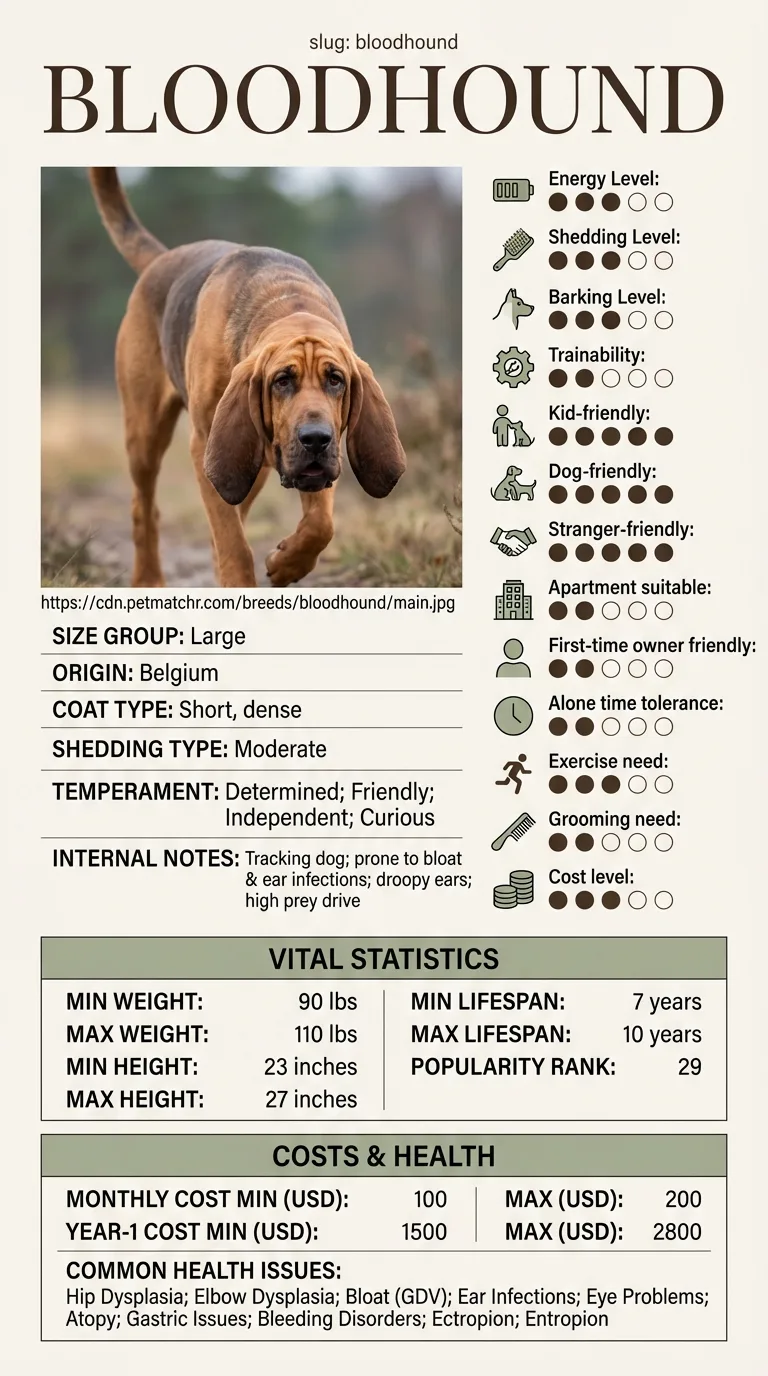
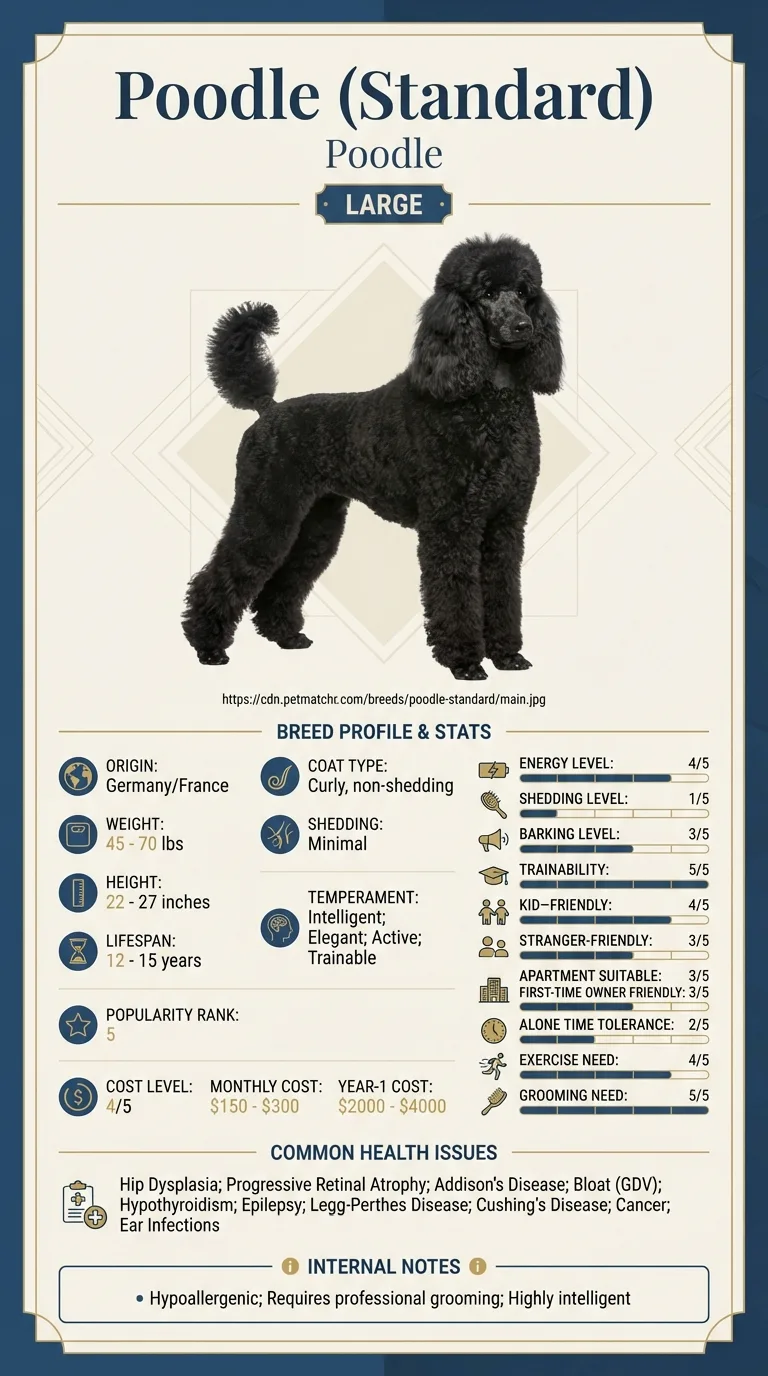
This is for someone already down to Bloodhound and Poodle (Standard) and deciding between them. For this pair the decision usually turns on grooming need and trainability, so those are covered first and in most detail. Anyone choosing from a flat has a clear answer here: Poodle (Standard) rates 3/5 against 2/5. Breed history is left out; what follows is what you will actually live with.
Between Bloodhound and Poodle (Standard), grooming need is what separates them, and Bloodhound is the lower-effort dog of the two to keep.
Choose Bloodhound if you do not want a standing grooming appointment and your walking routine is modest.
Choose Poodle (Standard) if you are in a flat or a smaller home, this is your first dog and shedding is a problem in your house.
| Feature | bloodhound | poodle standard | Winner |
|---|---|---|---|
| Size class | large | large | Equal |
| Weight | 90–110 lbs | 45–70 lbs | Equal |
| Height | 23–27 in | 22–27 in | Equal |
| Lifespan | 7–10 years | 12–15 years | poodle standard |
| Exercise need | Moderate (3/5) | High (4/5) | bloodhound |
| Grooming need | Low (2/5) | Very high (5/5) | bloodhound |
| Shedding | Moderate (3/5) | Very low (1/5) | poodle standard |
| Energy level | Moderate (3/5) | High (4/5) | Equal |
| Barking | Moderate (3/5) | Moderate (3/5) | Equal |
| Apartment suitability | Low (2/5) | Moderate (3/5) | poodle standard |
| Good for first-time owners | Low (2/5) | Moderate (3/5) | poodle standard |
| Tolerates being alone | Low (2/5) | Low (2/5) | Equal |
| Trainability | Low (2/5) | Very high (5/5) | poodle standard |
| Good with kids | High (4/5) | High (4/5) | Equal |
| Good with other dogs | High (4/5) | High (4/5) | Equal |
| Friendly to strangers | High (4/5) | Moderate (3/5) | bloodhound |
| Cost level | Moderate (3/5) | High (4/5) | bloodhound |
| Coat | Short, dense | Curly, non-shedding | Equal |
| Origin | Belgium | Germany/France | Equal |
| Typical monthly cost | $100–$200 | $150–$300 | Equal |
| Typical first-year cost | $1,500–$2,800 | $2,000–$4,000 | Equal |
This is the closest size match among the Poodle comparisons. The Standard Poodle weighs 45-70 lbs and stands 22-27 inches, against the Bloodhound's 90-110 lbs and 23-27 inches — nearly identical in height, with the Bloodhound carrying substantially more weight. If you like the idea of a Poodle but want something closer to the Bloodhound's physical presence, the Standard is the size to look at.
The Standard Poodle asks more of you physically, high (4/5) exercise need against the Bloodhound's moderate (3/5), reflecting its history as an active water retriever. Both rate high (4/5) on energy level, but the Poodle typically wants that energy directed into structured play, swimming, or retrieving games. The Bloodhound is content covering ground slowly, nose down, rather than working at speed.
The Standard Poodle needs very high (5/5) grooming against the Bloodhound's low (2/5), but sheds far less, very low (1/5) versus moderate (3/5). A Standard Poodle's coat requires trims roughly every six weeks, more work than most owners expect from a "big dog." The Bloodhound's short coat needs none of that scheduled upkeep — a real tradeoff between grooming cost and shedding cleanup.
Both breeds rate poorly for apartment life, but the Standard Poodle is slightly better positioned, moderate (3/5) against the Bloodhound's low (2/5) — its trainability likely helps here more than its size, which is nearly as large as the Bloodhound's. Barking is tied at moderate (3/5). Both tolerate being alone poorly, tied at low (2/5), so this comparison doesn't produce an easy winner for a small home.
The Standard Poodle rates very high (5/5) on trainability, one of the strongest scores on this site, against the Bloodhound's low (2/5). First-time-owner suitability follows the same direction, moderate (3/5) versus low (2/5). Standard Poodles were bred as working retrievers and take direction well; the Bloodhound's job has always been to trust its nose over its handler.
Both breeds rate high (4/5) with kids and other dogs. The Bloodhound is friendlier with strangers, high (4/5) against the Standard Poodle's moderate (3/5) — Poodles can carry a touch of reserve with unfamiliar people even as adults. Given how close these two are in size, that stranger-friendliness gap may matter more here than in comparisons against a much smaller Poodle.
The Standard Poodle lives longer, 12-15 years against the Bloodhound's 7-10. Its health list runs to ten conditions, including cancer, Cushing's disease and epilepsy, with three overlapping the Bloodhound's list: hip dysplasia, bloat, and ear infections. Given that both are large, deep-chested breeds, bloat precaution — slow feeding, no vigorous exercise right after meals — applies equally to either dog.
The Standard Poodle costs more to keep, high (4/5) against the Bloodhound's moderate (3/5). Monthly costs run $150-300 for the Poodle versus $100-200 for the Bloodhound, and first-year costs land at $2,000-4,000 versus $1,500-2,800. Grooming is the main driver — a Standard-sized coat takes real time and money to keep trimmed every four to six weeks, and that expense doesn't taper off once the puppy stage ends the way some other costs do.
Bloodhound weighs 90–110 lbs and lives 7–10 years; Poodle (Standard) weighs 45–70 lbs and lives 12–15 years. The two diverge most on grooming need, trainability and shedding. They are level on tolerates being alone, barking and good with other dogs, so those cannot decide it. The comparison marks an easier option only where one exists. Facts like weight and country of origin are not scored. Both dogs are rated from the same dataset, which is what makes the numbers comparable with each other even though any individual dog sits somewhere inside its breed's range.

The Bloodhound is heavier, 90-110 lbs versus 45-70 lbs, but they're nearly the same height — 23-27 inches versus 22-27 inches. This is the closest size match among the Poodle comparisons on this site.
The Bloodhound, rated moderate (3/5) against the Standard Poodle's very low (1/5). The tradeoff is grooming: the Poodle needs very high (5/5) upkeep against the Bloodhound's low (2/5).
Yes — moderate (3/5) first-time-owner suitability and very high (5/5) trainability, both ahead of the Bloodhound's low (2/5) scores on each.
Neither is ideal given their size, but the Standard Poodle rates moderate (3/5) against the Bloodhound's low (2/5) on apartment suitability. Both tolerate solo time poorly, tied at low (2/5).
$150-300 for the Standard Poodle versus $100-200 for the Bloodhound, with grooming as the main reason the Poodle runs higher despite similar height.
Yes, three overlap: hip dysplasia, bloat, and ear infections. The Standard Poodle's list is longer overall, including cancer, Cushing's disease and epilepsy, conditions absent from the Bloodhound's profile.
The Standard Poodle, at 12-15 years against the Bloodhound's 7-10 years.
The Standard Poodle trains far more easily and lives longer, but costs more to keep and needs regular professional grooming the Bloodhound never asks for.
$150-300 for the Standard Poodle versus $100-200 for the Bloodhound, driven mainly by grooming.
The Standard Poodle, rated high (4/5) against the Bloodhound's moderate (3/5) — its retriever background means it wants more structured activity.
The Standard Poodle, at 12-15 years versus the Bloodhound's 7-10 years.
Secure checkout on Stripe. We never see your card.
7-day money-back guarantee. Instant access.
Health information here is general and is not veterinary advice. If your dog shows pain, sudden behaviour change, or worsening symptoms, consult a licensed veterinarian.
Some links on this site are affiliate links. We may earn a commission at no extra cost to you, and we only suggest products we believe are helpful for dog owners.
We research and check what we publish, but we do not warrant that any figure, date, price, or statement is accurate, complete, or current, and we accept no liability for any loss, cost, injury, or other harm arising from the use of this site. Use it as one reference among several. You remain responsible for your own decisions and for your dog's care - confirm anything that matters with a licensed veterinarian or another qualified professional before you act on it. Full disclaimer.
Match your lifestyle to the right dog.
Take quizNot sure which breed is right for you? Take our 2-minute quiz to find out.
Take the quiz