Bloodhound vs German Wirehaired Pointer: Which Suits Your Home?
Quick answer
Bloodhound or GWP overall?
If you're an active household that can meet a 5/5 exercise need and want a dog that trains more easily, the GWP fits better. Choose the Bloodhound for its calmer, more independent nature and its stronger nose-driven focus.
Bloodhound or German Wirehaired Pointer? On paper they differ most on exercise need, and on the scales Bloodhound is the heavier at 90–110 lbs. Here is how the two compare on everything that shapes an ordinary week.
This is for someone already down to Bloodhound and German Wirehaired Pointer and deciding between them. For this pair the decision usually turns on exercise need and energy level, so those are covered first and in most detail. Anyone choosing from a flat has a clear answer here: Bloodhound rates 2/5 against 1/5. Breed history is left out; what follows is what you will actually live with.
Quick verdict
Between Bloodhound and German Wirehaired Pointer, exercise need is what separates them, and Bloodhound is the lower-effort dog of the two to keep.
Choose bloodhound if...
Choose Bloodhound if you do not want a standing grooming appointment, your walking routine is modest and you already have another dog.
Choose german wirehaired pointer if...
Choose German Wirehaired Pointer if you want a dog that picks up training quickly, a smaller dog suits your car, your home or your back and you want a dog that can keep up with an active routine.
Head-to-head comparison
Feature
bloodhound
german wirehaired pointer
Winner
Size class
large
large
Equal
Weight
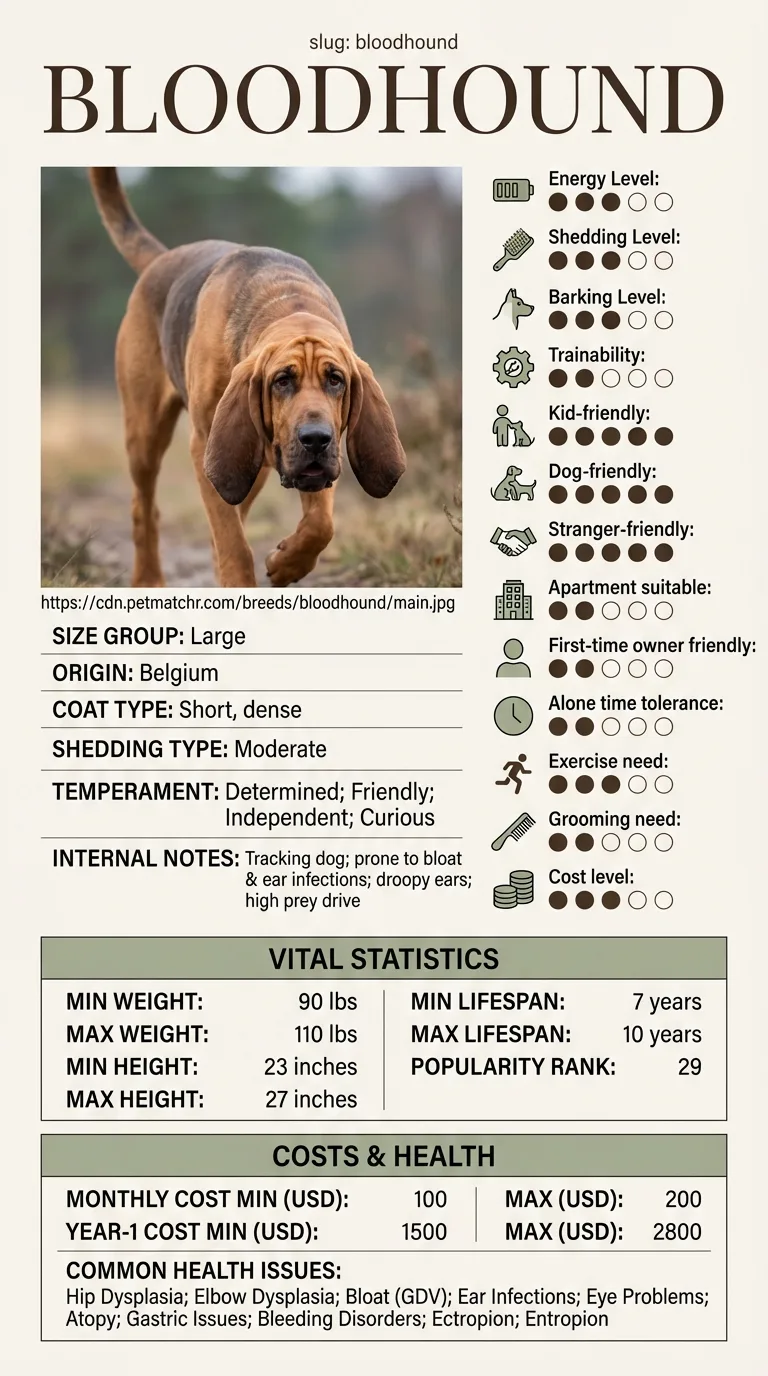
90–110 lbs
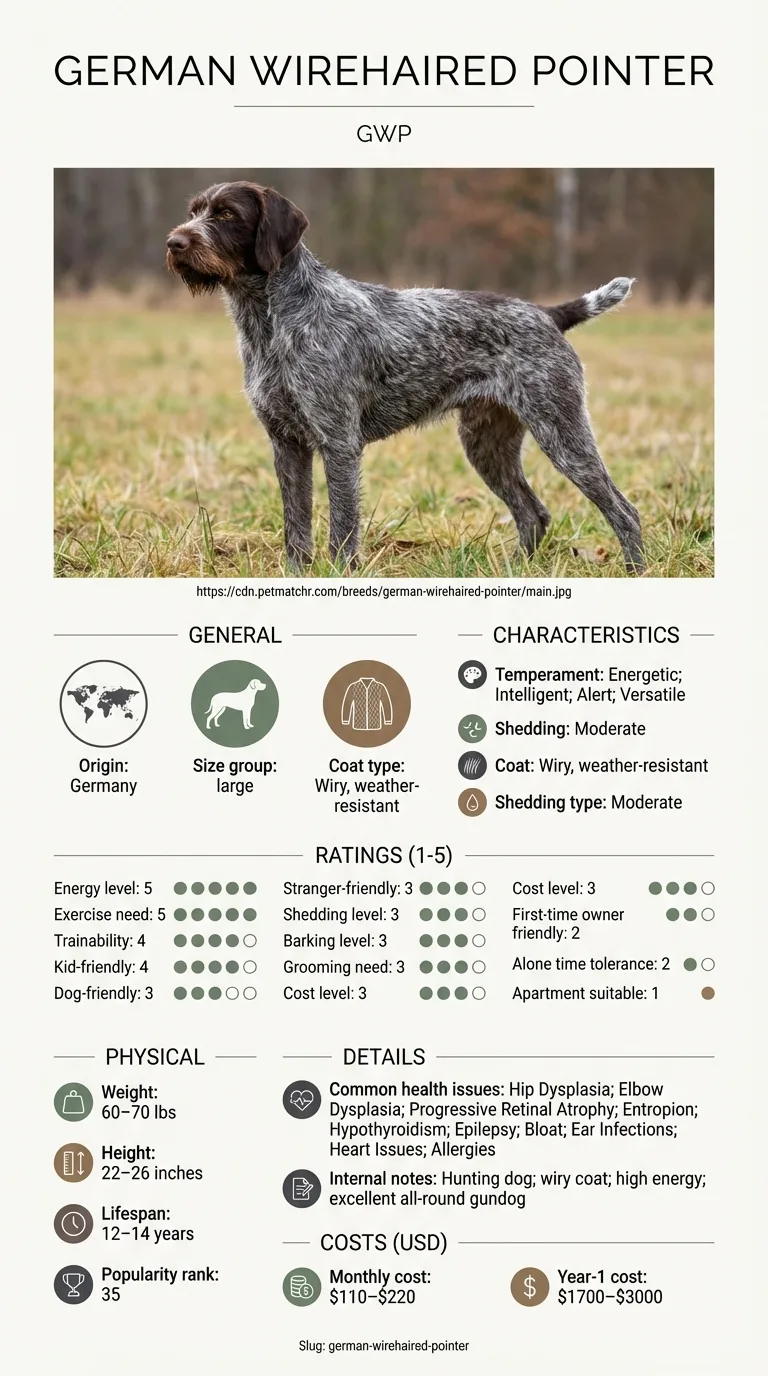
60–70 lbs
Equal
Height
23–27 in
22–26 in
Equal
Lifespan
7–10 years
12–14 years
german wirehaired pointer
Exercise need
Moderate (3/5)
Very high (5/5)
bloodhound
Grooming need
Low (2/5)
Moderate (3/5)
bloodhound
Shedding
Moderate (3/5)
Moderate (3/5)
Equal
Energy level
Moderate (3/5)
Very high (5/5)
Equal
Barking
Moderate (3/5)
Moderate (3/5)
Equal
Apartment suitability
Low (2/5)
Very low (1/5)
bloodhound
Good for first-time owners
Low (2/5)
Low (2/5)
Equal
Tolerates being alone
Low (2/5)
Low (2/5)
Equal
Trainability
Low (2/5)
High (4/5)
german wirehaired pointer
Good with kids
High (4/5)
High (4/5)
Equal
Good with other dogs
High (4/5)
Moderate (3/5)
bloodhound
Friendly to strangers
High (4/5)
Moderate (3/5)
bloodhound
Cost level
Moderate (3/5)
Moderate (3/5)
Equal
Coat
Short, dense
Wiry, weather-resistant
Equal
Origin
Belgium
Germany
Equal
Typical monthly cost
$100–$200
$110–$220
Equal
Typical first-year cost
$1,500–$2,800
$1,700–$3,000
Equal
Deep dive
Size and build
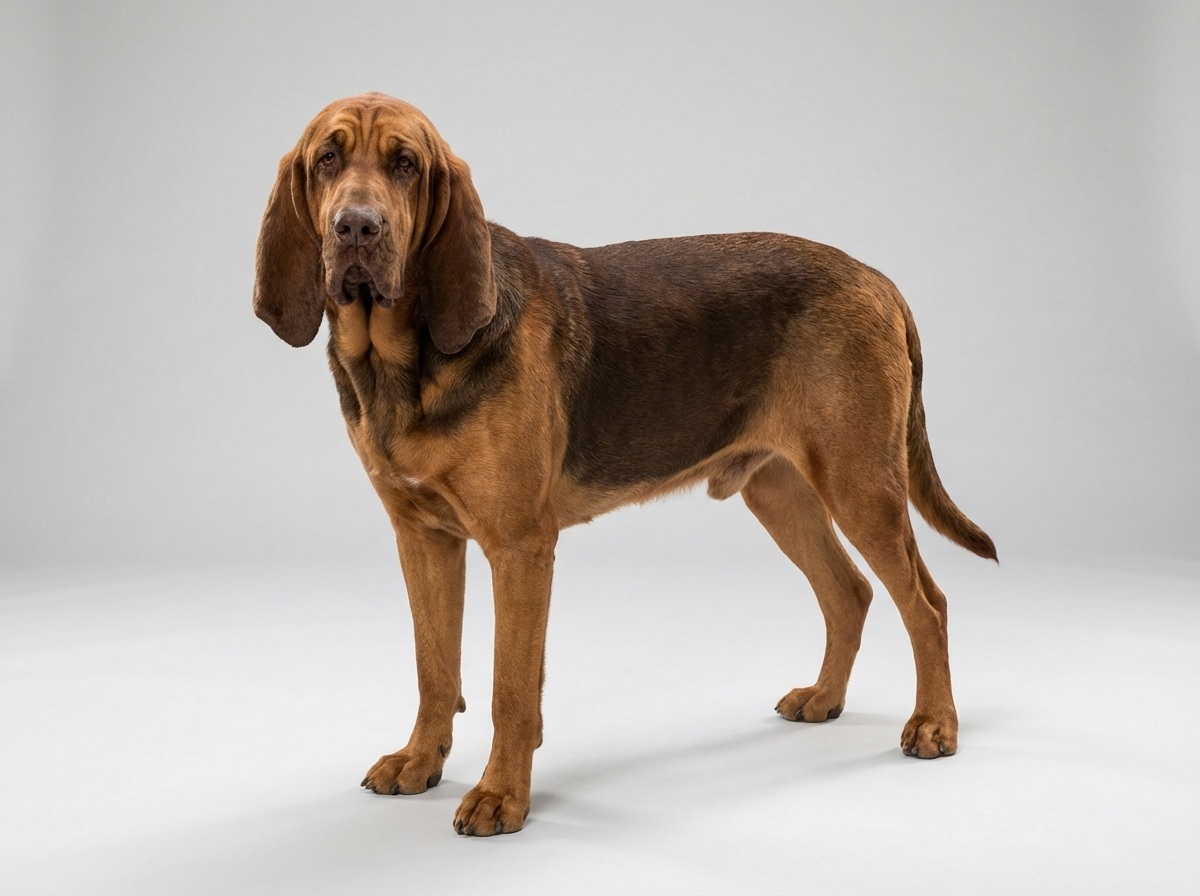
Weight overlaps more here than height would suggest. The Bloodhound's 90-110 lb frame dwarfs the German Wirehaired Pointer's 60-70 lbs, but the two stand within an inch of each other at the shoulder - 23-27 in versus 22-26 in. Picture the GWP as a stockier, more compact build; the Bloodhound carries roughly 30-40 lbs more without much added height, which shows up mostly in chest depth and loose skin rather than leg length.
Energy and exercise
Exercise need is a 5/5 for the GWP against a 3/5 for the Bloodhound - this is a dog bred to hunt upland birds over rough terrain for hours at a stretch. The Bloodhound's moderate rating still means daily walks, just not the same intensity. If your week doesn't include an hour-plus of vigorous activity most days, the GWP will find its own outlets, usually ones you won't like.
Grooming and shedding
Here the Bloodhound actually has the lighter routine: grooming need rates 2/5 for the Bloodhound versus 3/5 for the GWP, whose wiry, weather-resistant coat needs occasional hand-stripping to stay in shape. Shedding comes out equal at 3/5 for both. So while neither breed sheds excessively, the GWP asks a little more of your time or your groomer's schedule to keep that coat right.
Apartment living, noise and time alone
Apartment suitability is rough for both - 2/5 for the Bloodhound, a near-bottom 1/5 for the GWP. Barking is moderate across the board (3/5 each), so it's not noise driving that low score, it's space and exercise demands. Both dogs also tolerate solitude poorly, rating 2/5 on being left alone, so long workdays are a problem regardless of which one you pick.
Training and owner experience
The GWP trains more readily, rating 4/5 versus the Bloodhound's 2/5 - a real gap, if not as extreme as with some pointer breeds. Both still land at 2/5 for first-time-owner suitability, which tells you trainability alone doesn't make a dog easy; the GWP's relentless energy and the Bloodhound's nose-first stubbornness each require an owner who has done this before.
Kids, other dogs and visitors
Good with kids at 4/5 for both breeds, this pairing is close. It splits with other dogs - the Bloodhound rates 4/5, the GWP a more middling 3/5, worth knowing if you already have a multi-dog household. Both score 3-4/5 on friendliness to strangers, with the Bloodhound edging ahead at 4/5 against the GWP's 3/5. Neither breed is aloof with new people, but the Bloodhound tends to warm up faster.
Health and lifespan
Lifespan favors the GWP considerably - 12 to 14 years against the Bloodhound's 7 to 10, a gap of up to seven years. Shared risks include hip dysplasia and elbow dysplasia. Beyond that the lists diverge: the Bloodhound also deals with bloat, ear infections, eye problems, atopy, gastric issues, bleeding disorders, ectropion and entropion, while the GWP's risks include progressive retinal atrophy, entropion, hypothyroidism, epilepsy, bloat, ear infections, heart issues and allergies.
Cost to keep
Monthly costs sit close together - $100-200 for the Bloodhound, $110-220 for the GWP - with both rated a moderate 3/5 for overall cost. First-year totals show a similar small gap: $1,500-2,800 versus $1,700-3,000. Neither breed will surprise you financially compared to the other; the difference is marginal enough that lifestyle fit should drive the decision, not price.
Bloodhound vs German Wirehaired Pointer at a glance
Bloodhound weighs 90–110 lbs and lives 7–10 years; German Wirehaired Pointer weighs 60–70 lbs and lives 12–14 years. The two diverge most on exercise need, energy level and trainability. They are level on tolerates being alone, barking and cost level, so those cannot decide it. The comparison marks an easier option only where one exists. Facts like weight and country of origin are not scored. Both dogs are rated from the same dataset, which is what makes the numbers comparable with each other even though any individual dog sits somewhere inside its breed's range.
Bloodhound vs German Wirehaired Pointer: Which Suits Your Home? - Bloodhound vs German Wirehaired Pointer at a glance
Frequently asked questions
How much heavier is the Bloodhound than the German Wirehaired Pointer?
By quite a bit - up to 50 lbs more at the top of each range (110 lbs versus 70 lbs), even though they're within an inch of each other in height.
Which breed sheds more?
They're tied at a moderate 3/5 for shedding. The difference is grooming effort, not shedding volume - the GWP's wiry coat needs more hands-on maintenance to stay weather-resistant.
Is either a good first dog?
Not ideally. Both score 2/5 for first-time owners. The GWP's very high exercise and energy needs overwhelm novices just as often as the Bloodhound's stubborn, scent-obsessed independence does.
How do they do in apartments?
Poorly, especially the GWP at 1/5 apartment suitability. The Bloodhound isn't much better at 2/5. Both need house-and-yard space more than a unit with shared walls.
What's the cost difference?
Small. Monthly costs run $100-200 for the Bloodhound and $110-220 for the GWP, with matching moderate cost ratings and first-year totals within a few hundred dollars of each other.
Do their health risks overlap?
Partially - both face hip and elbow dysplasia, bloat and ear infections. The Bloodhound adds eye and skin conditions to its list; the GWP adds epilepsy, heart issues and allergies.
Which one lives longer?
The GWP, and by a wide margin - up to 14 years versus the Bloodhound's ceiling of 10. That's one of the biggest gaps in this comparison.
If you're an active household that can meet a 5/5 exercise need and want a dog that trains more easily, the GWP fits better. Choose the Bloodhound for its calmer, more independent nature and its stronger nose-driven focus.
Costs
Monthly cost?
$100-200 for the Bloodhound, $110-220 for the GWP - close enough that cost shouldn't decide it.
Living
Exercise need?
The GWP needs far more - 5/5 versus the Bloodhound's 3/5.
Health
Lifespan?
The GWP typically lives 12-14 years, well past the Bloodhound's 7-10 year range.
Related DogBreedCompass guides
Bloodhound breed guide – Readers comparing the two usually want the full profile of Bloodhound before deciding.
Bloodhound vs Old English Sheepdog – Old English Sheepdog is the closest breed to Bloodhound on the measured axes, so it is the natural next comparison.
Health information here is general and is not veterinary advice. If your dog shows pain, sudden behaviour change, or worsening symptoms, consult a licensed veterinarian.
Some links on this site are affiliate links. We may earn a commission at no extra cost to you, and we only suggest products we believe are helpful for dog owners.
We research and check what we publish, but we do not warrant that any figure, date, price, or statement is accurate, complete, or current, and we accept no liability for any loss, cost, injury, or other harm arising from the use of this site. Use it as one reference among several. You remain responsible for your own decisions and for your dog's care - confirm anything that matters with a licensed veterinarian or another qualified professional before you act on it. Full disclaimer.