Living
Which is bigger?
The Belgian Malinois, at 55-65 lbs versus the Griffon's 8-12 lbs.

Quick answer
Which is bigger?
The Belgian Malinois, at 55-65 lbs versus the Griffon's 8-12 lbs.
Belgian Malinois or Brussels Griffon? On paper they differ most on apartment suitability, and on the scales Belgian Malinois is the heavier at 55–65 lbs. Here is how the two compare on everything that shapes an ordinary week.
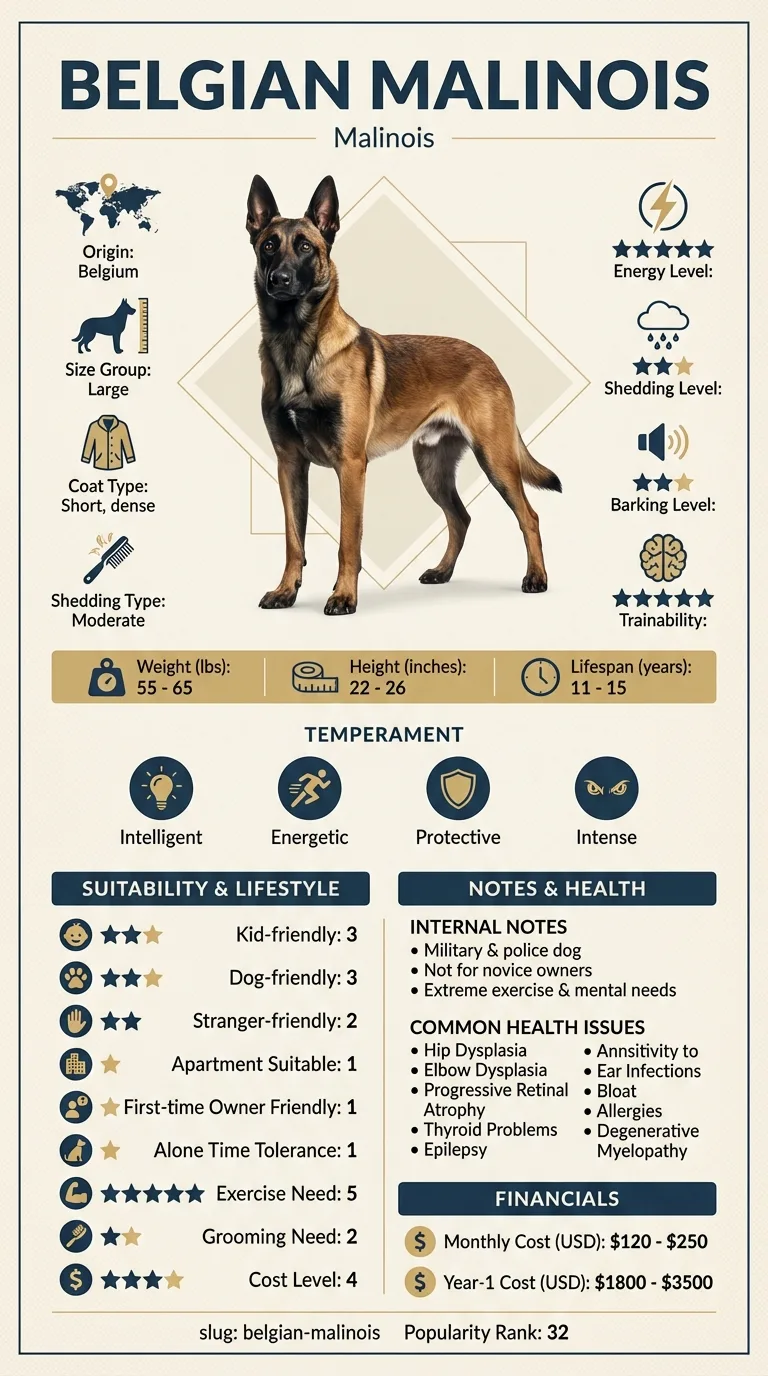
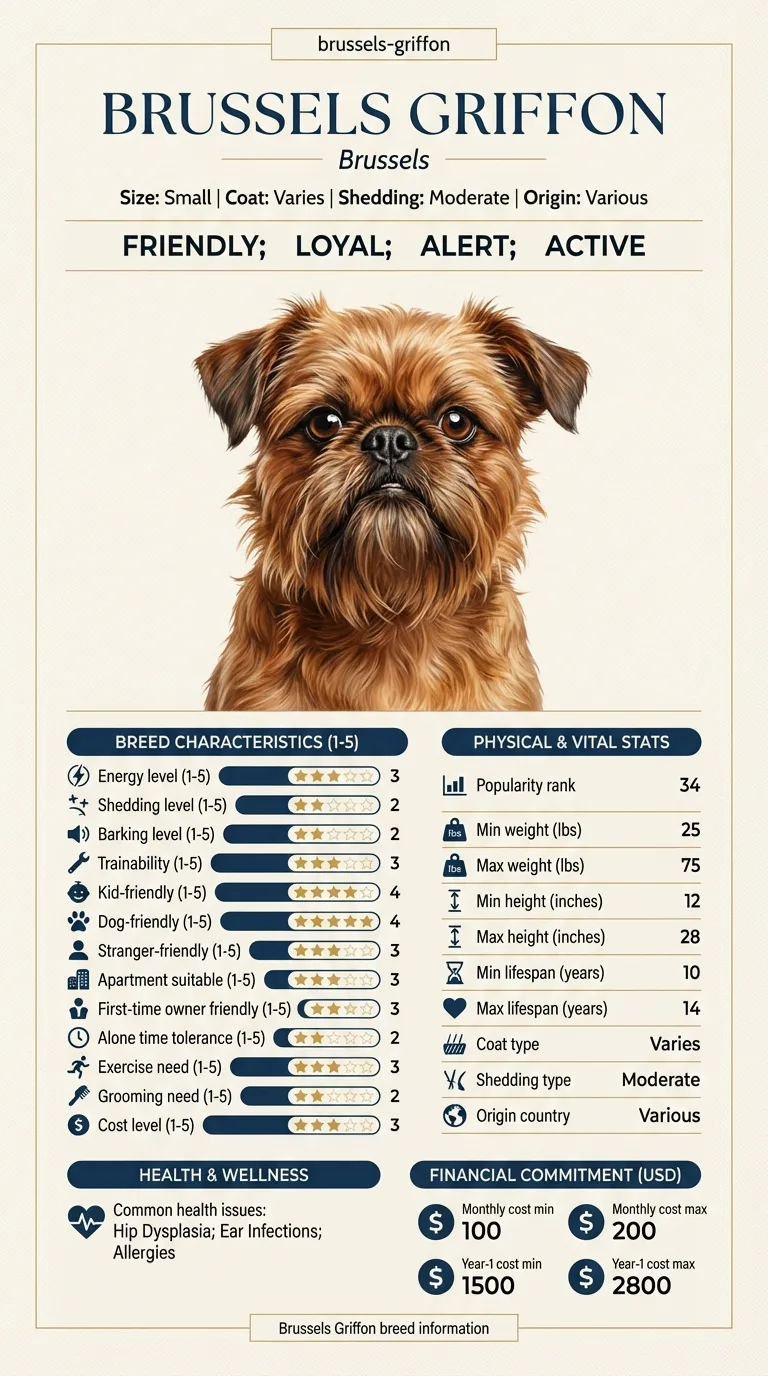
This is for someone already down to Belgian Malinois and Brussels Griffon and deciding between them. For this pair the decision usually turns on apartment suitability and exercise need, so those are covered first and in most detail. Anyone choosing from a flat has a clear answer here: Brussels Griffon rates 5/5 against 1/5. The focus throughout is on daily consequences rather than breed background.
Between Belgian Malinois and Brussels Griffon, apartment suitability is what separates them, and Brussels Griffon is the lower-effort dog of the two to keep.
Choose Belgian Malinois if you do not want a standing grooming appointment, you want a dog that picks up training quickly and you want a dog that can keep up with an active routine.
Choose Brussels Griffon if you are in a flat or a smaller home, this is your first dog and shedding is a problem in your house.
| Feature | belgian malinois | brussels griffon | Winner |
|---|---|---|---|
| Size class | large | small | Equal |
| Weight | 55–65 lbs | 8–12 lbs | Equal |
| Height | 22–26 in | 7–10 in | Equal |
| Lifespan | 11–15 years | 12–15 years | brussels griffon |
| Exercise need | Very high (5/5) | Low (2/5) | brussels griffon |
| Grooming need | Low (2/5) | Moderate (3/5) | belgian malinois |
| Shedding | Moderate (3/5) | Low (2/5) | brussels griffon |
| Energy level | Very high (5/5) | Moderate (3/5) | Equal |
| Barking | Moderate (3/5) | Moderate (3/5) | Equal |
| Apartment suitability | Very low (1/5) | Very high (5/5) | brussels griffon |
| Good for first-time owners | Very low (1/5) | Moderate (3/5) | brussels griffon |
| Tolerates being alone | Very low (1/5) | Low (2/5) | brussels griffon |
| Trainability | Very high (5/5) | Moderate (3/5) | belgian malinois |
| Good with kids | Moderate (3/5) | Moderate (3/5) | Equal |
| Good with other dogs | Moderate (3/5) | Moderate (3/5) | Equal |
| Friendly to strangers | Low (2/5) | Moderate (3/5) | brussels griffon |
| Cost level | High (4/5) | Moderate (3/5) | brussels griffon |
| Coat | Short, dense | Rough or smooth | Equal |
| Origin | Belgium | Various | Equal |
| Typical monthly cost | $120–$250 | $80–$150 | Equal |
| Typical first-year cost | $1,800–$3,500 | $1,100–$2,300 | Equal |
Few pairings on this site have a size gap as extreme as this one: a 55-to-65-pound Belgian Malinois standing 22 to 26 inches at the shoulder next to an 8-to-12-pound Brussels Griffon that stands just 7 to 10 inches tall. That's roughly a six-fold difference in weight and more than double the height - the Griffon could walk underneath a Malinois without ducking. The Malinois carries a short, dense working coat built for outdoor conditions; the Griffon's coat comes in rough or smooth varieties, both suited to lap-dog life rather than fieldwork. Physically, these two occupy almost opposite ends of the dog-size spectrum entirely.
The Malinois rates Very High (5/5) for exercise need against the Griffon's Low (2/5), a three-point spread that's one of the largest on this comparison. Energy level is marked as tied despite the Malinois's Very High rating against the Griffon's Moderate - in practice, a Griffon's energy shows up as short bursts of activity around the house and lap time in between, while a Malinois needs sustained physical work, often an hour or more of real exertion daily. A Griffon can be tired out with a brisk walk and some indoor games; a Malinois generally cannot, regardless of how much yard space is available.
Grooming actually favors the Malinois here, Low (2/5) against the Griffon's Moderate (3/5) - a rough-coated Griffon needs hand-stripping a few times a year to stay tidy, more upkeep than the Malinois's wash-and-go short coat requires. Shedding flips the other direction: Moderate (3/5) for the Malinois versus Low (2/5) for the Griffon, whose small size at least means less total hair even at a comparable shedding rate. For a household weighing total grooming time, the Griffon's smaller surface area is offset by its need for occasional coat stripping, while the Malinois trades a bit more loose fur for a genuinely low-maintenance coat overall.
Apartment suitability could hardly be more different: Very Low (1/5) for the Malinois, Very High (5/5) for the Brussels Griffon. Barking ties at Moderate (3/5) for both, somewhat surprising given the size gap - a Griffon's alert, sensitive temperament makes it quick to vocalize despite its small frame, matching the Malinois's own watchful tendencies. Tolerance for time alone favors the Griffon slightly, Low (2/5) against the Malinois's Very Low (1/5), though neither breed is genuinely suited to being left alone for a full workday without a plan for enrichment or a midday check-in.
Trainability tips toward the Malinois, Very High (5/5) against the Griffon's Moderate (3/5) - a working-line pedigree built around detection and protection work versus a companion breed bred mainly for temperament and looks. First-time-owner suitability flips the picture entirely: Very Low (1/5) for the Malinois, Moderate (3/5) for the Griffon. A Griffon's sensitive, devoted nature responds well to patient, consistent handling even from a newer owner; a Malinois's intensity and drive genuinely call for someone who has managed a working breed before, not just someone willing to put in the training hours.
Both breeds tie at Moderate (3/5) for compatibility with kids and with other dogs, a rare point of parity on this comparison. Strangers is where they separate, though only modestly: Low (2/5) for the Malinois against Moderate (3/5) for the Griffon, whose comical, devoted temperament still runs somewhat reserved with unfamiliar people despite its small size. In a household with frequent visitors, neither breed will greet guests with open enthusiasm, but the Griffon is the more approachable of the two by the numbers, while the Malinois maintains its watchful, protective instincts even indoors.
The Brussels Griffon's health list is short and specific - Brachycephalic Airway Syndrome, patellar luxation, hip dysplasia, eye injuries, and syringomyelia - largely tied to its flat face and prominent eyes. The Malinois's list runs twice as long, including hip and elbow dysplasia, epilepsy, thyroid problems, degenerative myelopathy, and a documented sensitivity to anesthesia worth flagging before any surgery. Lifespan favors the Griffon modestly, 12 to 15 years against the Malinois's 11 to 15. The two lists barely overlap beyond hip dysplasia, meaning a household considering either breed is really planning for two very different sets of veterinary risk.
Cost level rates Moderate (3/5) for the Griffon against High (4/5) for the Malinois, and the monthly ranges reflect the size gap directly: $80-$150 for the Griffon versus $120-$250 for the Malinois. First-year totals run $1,100-$2,300 against $1,800-$3,500. Food costs alone explain much of the difference - a 60-pound working dog eats considerably more than a 10-pound companion breed - and the Malinois's frequent need for structured training or a working outlet adds further expense the Griffon's lower-drive temperament simply doesn't require.
Belgian Malinois weighs 55–65 lbs and lives 11–15 years; Brussels Griffon weighs 8–12 lbs and lives 12–15 years. The two diverge most on apartment suitability, exercise need and energy level and 2 other rated axes. They are level on barking, good with other dogs and good with kids, so those cannot decide it. The table below marks a winner only where one breed is genuinely easier for a typical owner; size and origin are facts rather than merits and stay level. Ratings come from one source applied to both breeds, so they are meaningful against each other rather than as absolute scores.

It can with careful introductions, but the size gap - roughly 55 pounds versus 10 pounds - means supervision matters more than with a same-size pairing, especially given the Malinois's Moderate rating for compatibility with other dogs.
The Brussels Griffon by a wide margin - Very High (5/5) apartment suitability against the Malinois's Very Low (1/5).
Yes, Brachycephalic Airway Syndrome (BOAS) is on its health list, a common issue for flat-faced breeds, so heat and heavy exertion both need extra caution.
Its health list specifically flags sensitivity to anesthesia, so that's worth raising with a vet before any surgical procedure, unlike the Griffon's list which doesn't include this risk.
The Brussels Griffon, rated Low (2/5) against the Malinois's Very High (5/5).
The Brussels Griffon, rated Moderate (3/5) versus the Malinois's Very Low (1/5), the lowest score on this table.
The Brussels Griffon, typically $80-$150 versus the Malinois's $120-$250.
The Belgian Malinois, at 55-65 lbs versus the Griffon's 8-12 lbs.
Neither - both tie at Moderate (3/5) for barking.
The Belgian Malinois, rated Very High (5/5) versus the Griffon's Moderate (3/5).
The Brussels Griffon, at 12-15 years versus the Malinois's 11-15 years.
Secure checkout on Stripe. We never see your card.
7-day money-back guarantee. Instant access.
Health information here is general and is not veterinary advice. If your dog shows pain, sudden behaviour change, or worsening symptoms, consult a licensed veterinarian.
Some links on this site are affiliate links. We may earn a commission at no extra cost to you, and we only suggest products we believe are helpful for dog owners.
We research and check what we publish, but we do not warrant that any figure, date, price, or statement is accurate, complete, or current, and we accept no liability for any loss, cost, injury, or other harm arising from the use of this site. Use it as one reference among several. You remain responsible for your own decisions and for your dog's care - confirm anything that matters with a licensed veterinarian or another qualified professional before you act on it. Full disclaimer.
Match your lifestyle to the right dog.
Take quizNot sure which breed is right for you? Take our 2-minute quiz to find out.
Take the quiz