Behavior
Which is the better overall pick?
For a first-time owner in a house rather than a thin-walled apartment, the Sheltie's trainability and beginner-friendliness make it the safer choice — provided you can tolerate the barking.

Quick answer
Which is the better overall pick?
For a first-time owner in a house rather than a thin-walled apartment, the Sheltie's trainability and beginner-friendliness make it the safer choice — provided you can tolerate the barking.
American Pit Bull Terrier or Shetland Sheepdog? On paper they differ most on grooming need, and on the scales American Pit Bull Terrier is the heavier at 30–65 lbs. Here is how the two compare on everything that shapes an ordinary week.
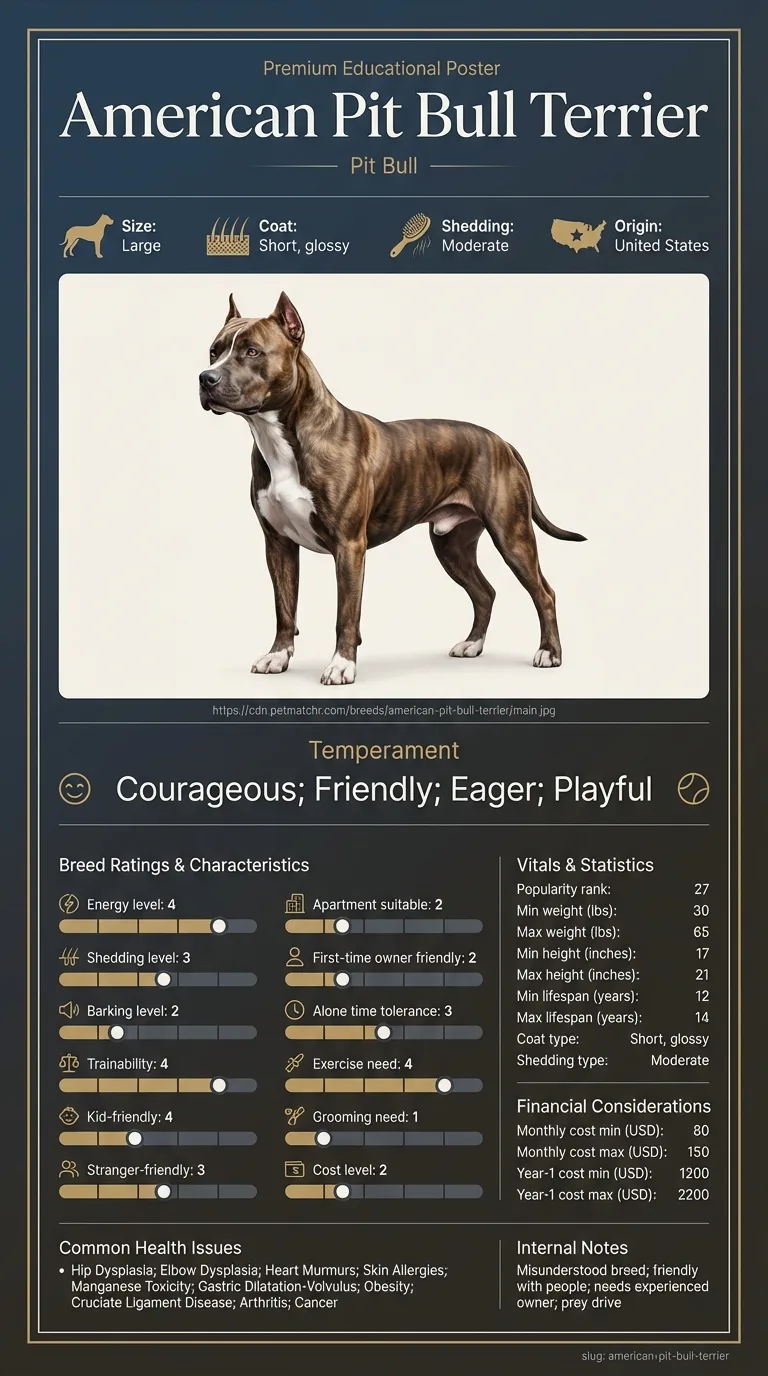
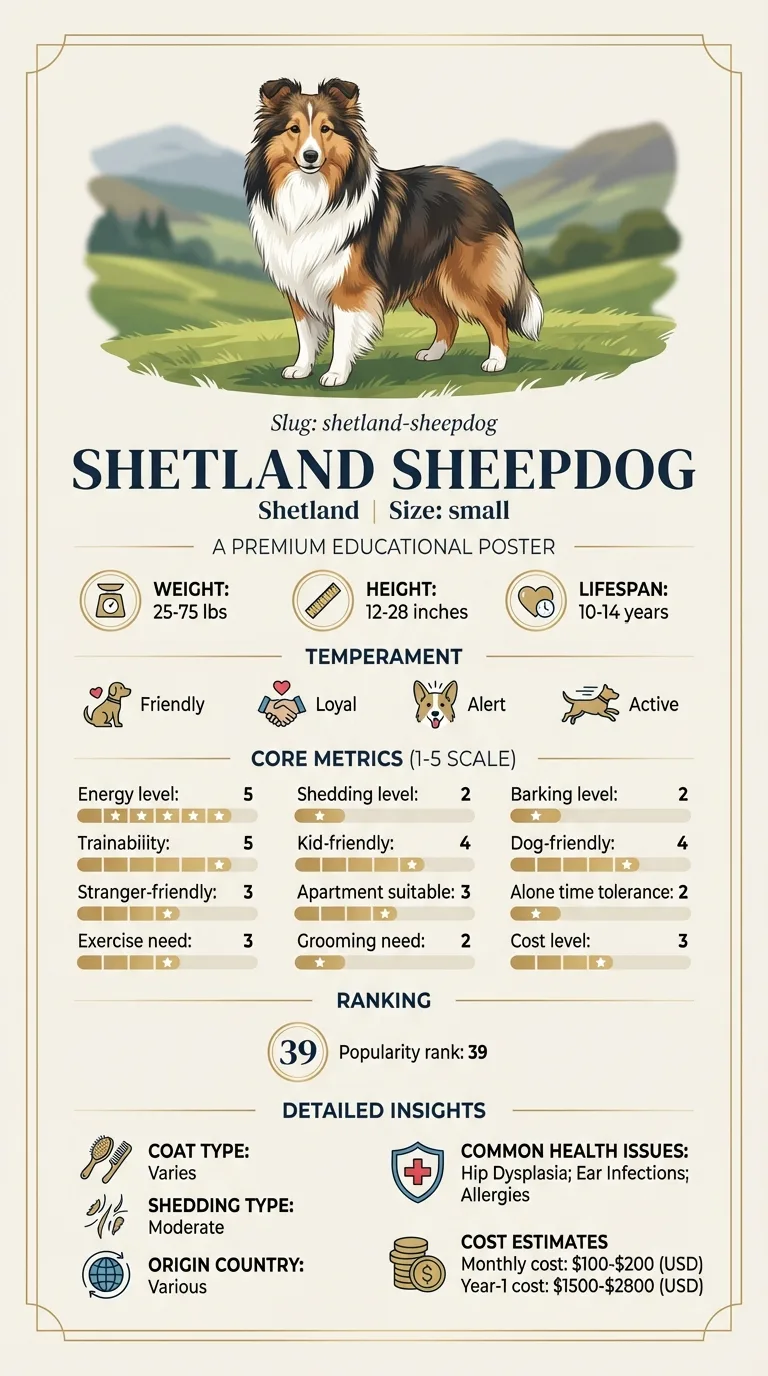
This is for someone already down to American Pit Bull Terrier and Shetland Sheepdog and deciding between them. For this pair the decision usually turns on grooming need and barking, so those are covered first and in most detail. Anyone choosing from a flat has a clear answer here: Shetland Sheepdog rates 3/5 against 2/5. Breed history is left out; what follows is what you will actually live with.
Between American Pit Bull Terrier and Shetland Sheepdog, grooming need is what separates them, and American Pit Bull Terrier is the lower-effort dog of the two to keep.
Choose American Pit Bull Terrier if you do not want a standing grooming appointment, shedding is a problem in your house and the dog will be alone during the working day.
Choose Shetland Sheepdog if you are in a flat or a smaller home, this is your first dog and you already have another dog.
| Feature | american pit bull terrier | shetland sheepdog | Winner |
|---|---|---|---|
| Size class | large | small | Equal |
| Weight | 30–65 lbs | 15–25 lbs | Equal |
| Height | 17–21 in | 13–16 in | Equal |
| Lifespan | 12–14 years | 12–14 years | Equal |
| Exercise need | High (4/5) | High (4/5) | Equal |
| Grooming need | Very low (1/5) | High (4/5) | american pit bull terrier |
| Shedding | Moderate (3/5) | High (4/5) | american pit bull terrier |
| Energy level | High (4/5) | High (4/5) | Equal |
| Barking | Low (2/5) | Very high (5/5) | american pit bull terrier |
| Apartment suitability | Low (2/5) | Moderate (3/5) | shetland sheepdog |
| Good for first-time owners | Low (2/5) | High (4/5) | shetland sheepdog |
| Tolerates being alone | Moderate (3/5) | Low (2/5) | american pit bull terrier |
| Trainability | High (4/5) | Very high (5/5) | shetland sheepdog |
| Good with kids | High (4/5) | High (4/5) | Equal |
| Good with other dogs | Low (2/5) | High (4/5) | shetland sheepdog |
| Friendly to strangers | Moderate (3/5) | Low (2/5) | american pit bull terrier |
| Cost level | Low (2/5) | Moderate (3/5) | american pit bull terrier |
| Coat | Short, glossy | Long, dense double coat | Equal |
| Origin | United States | Various | Equal |
| Typical monthly cost | $80–$150 | $80–$150 | Equal |
| Typical first-year cost | $1,200–$2,200 | $1,100–$2,300 | Equal |
The size gap here is dramatic without qualifying as giant-versus-toy: a Shetland Sheepdog runs 15-25 lbs and 13-16 inches, roughly a third of the APBT's 30-65 lbs and 17-21 inches. Both are compact enough for most homes, but you're still picking between a small dog and a genuinely large one — the labels aren't marketing, they reflect real physical difference.
Don't underestimate the Sheltie because of its size — it ties the APBT at 4 out of 5 for both exercise need and energy level. Shelties were bred to herd, and that job ethic shows up as a dog that wants purposeful movement, not just a lap around the block. Both breeds need a genuinely tired-out routine, not a token walk.
The Sheltie's long double coat demands real upkeep — high grooming need (4/5) and high shedding (4/5) — against the APBT's near-zero grooming (1/5) and moderate shedding (3/5). If brushing a full coat several times a week isn't something you want on your calendar, that's a meaningful mark against the Sheltie regardless of its other strengths.
The Sheltie is a genuine problem for anyone in close quarters with neighbors: very high barking (5/5), the loudest rating on this entire table. It edges out the APBT slightly on apartment suitability (3/5 vs. 2/5), but that barking score should override the space consideration if walls are thin. The APBT, by contrast, tolerates being alone slightly better (moderate vs. low).
The Sheltie is rated very high for trainability (5/5) and high for first-time-owner fit (4/5) — among the more approachable breeds for a new owner. The APBT trains well too (4/5) but scores low for first-timers (2/5), needing a more experienced or consistent hand. If this is your first dog, the numbers point clearly toward the Sheltie.
Both rate the same with kids (4/5), but the Sheltie pulls ahead with other dogs (4/5 vs. 2/5) while the APBT edges ahead with strangers (3/5 vs. 2/5) — the Sheltie's temperament list flags it as sensitive, which can read as reserved around new people. Multi-dog households likely do better with the Sheltie; households that host frequently may find the APBT warms up faster.
Lifespan is a wash — both average 12 to 14 years. Their health risks don't overlap much, though: the Sheltie's list includes MDR1 drug sensitivity, a real concern for medication choices, and dermatomyositis, while the APBT's runs longer and covers more joint and cardiac conditions. Ask a vet about MDR1 testing specifically if you're considering the Sheltie.
Monthly costs land almost identically — $80-150 for the APBT versus $80-150 for the Sheltie — though first-year costs tilt slightly toward the Sheltie ($1,100-2,300 vs. $1,200-2,200). Don't assume the smaller dog is automatically cheaper; the Sheltie's grooming needs offset some of the savings from eating less.
American Pit Bull Terrier weighs 30–65 lbs and lives 12–14 years; Shetland Sheepdog weighs 15–25 lbs and lives 12–14 years. The two diverge most on grooming need, barking and good for first-time owners and 1 other rated axes. They are level on energy level, exercise need and good with kids, so those cannot decide it. The comparison marks an easier option only where one exists. Facts like weight and country of origin are not scored. Both dogs are rated from the same dataset, which is what makes the numbers comparable with each other even though any individual dog sits somewhere inside its breed's range.

No — despite its size, it ties the APBT at 4 out of 5 for exercise and energy. Its herding background means it wants a job, not just a short walk, regardless of body size.
The APBT by a wide margin. The Sheltie rates a 5 out of 5 for barking, the highest score on this comparison, versus the APBT's 2 out of 5. Thin walls or close neighbors make this the deciding factor for many owners.
The Sheltie — high trainability (5/5) and a good first-time-owner rating (4/5) make it noticeably more forgiving than the APBT, which scores low (2/5) on that same measure.
Very close — both run $80-150 a month, though the Sheltie's grooming needs mean that budget gets spent differently, on brushes and occasional professional grooming rather than food volume.
The Sheltie, at high (4/5) versus the APBT's moderate (3/5) — and the Sheltie's coat is longer, so the hair itself is more noticeable around the house.
Barely — their lists don't overlap much. The Sheltie's risks, like MDR1 sensitivity and collie eye anomaly, are largely breed-specific and different from the APBT's joint- and heart-focused list.
The APBT, rated moderate (3/5) against the Sheltie's low (2/5). If your household has long work hours, that's worth factoring in alongside the barking score.
For a first-time owner in a house rather than a thin-walled apartment, the Sheltie's trainability and beginner-friendliness make it the safer choice — provided you can tolerate the barking.
Essentially tied, both $80-150 — the Sheltie's grooming costs offset its lower food needs.
Neither — they're tied at 4 out of 5. Size doesn't predict energy level here.
Neither — both average 12 to 14 years.
Secure checkout on Stripe. We never see your card.
7-day money-back guarantee. Instant access.
Health information here is general and is not veterinary advice. If your dog shows pain, sudden behaviour change, or worsening symptoms, consult a licensed veterinarian.
Some links on this site are affiliate links. We may earn a commission at no extra cost to you, and we only suggest products we believe are helpful for dog owners.
We research and check what we publish, but we do not warrant that any figure, date, price, or statement is accurate, complete, or current, and we accept no liability for any loss, cost, injury, or other harm arising from the use of this site. Use it as one reference among several. You remain responsible for your own decisions and for your dog's care - confirm anything that matters with a licensed veterinarian or another qualified professional before you act on it. Full disclaimer.
Match your lifestyle to the right dog.
Take quizNot sure which breed is right for you? Take our 2-minute quiz to find out.
Take the quiz