Health
What age is OCD most likely to appear in a Weimaraner puppy?
Most commonly between four and eight months old, during the period of most rapid growth.

Quick answer
What age is OCD most likely to appear in a Weimaraner puppy?
Most commonly between four and eight months old, during the period of most rapid growth.
This is a growth-rate problem as much as a joint problem — cartilage simply can't always keep pace with a large-breed puppy's growth spurt.
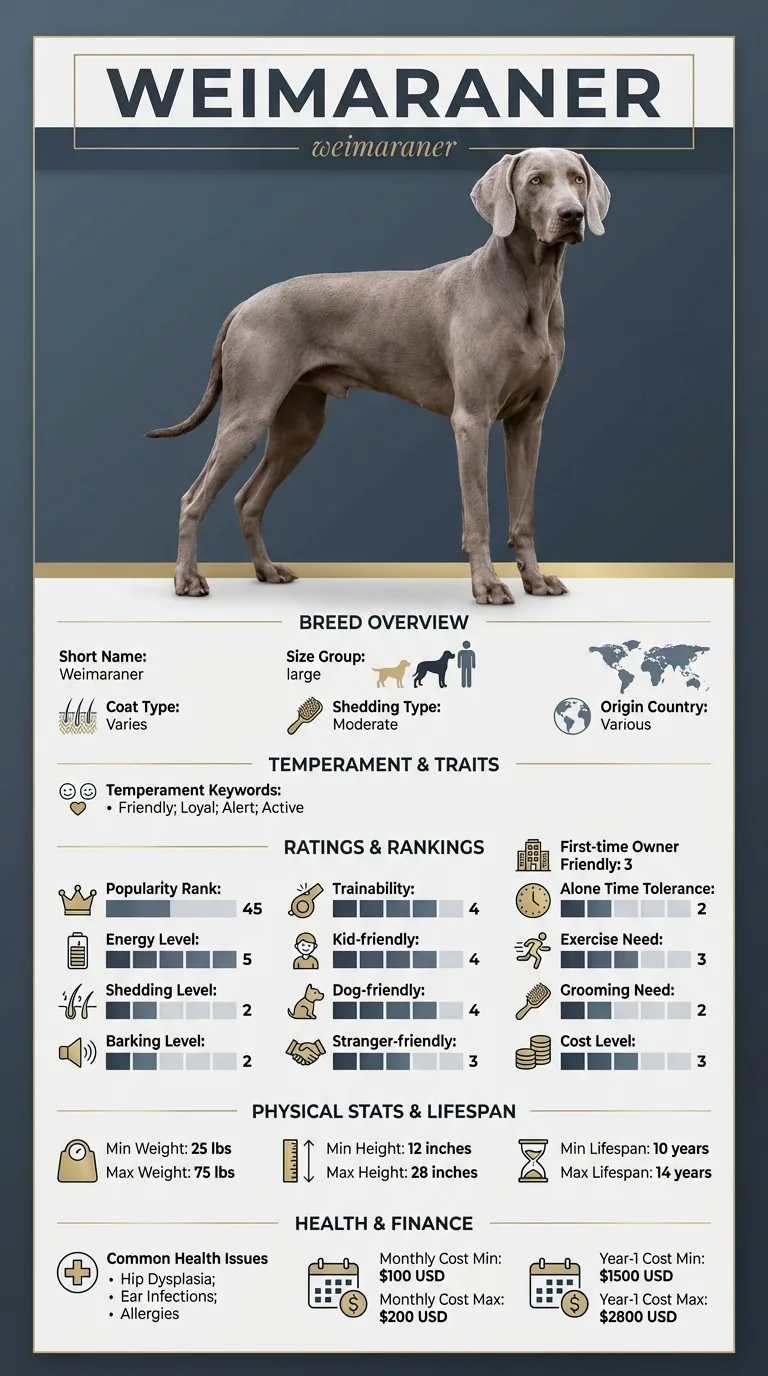
This affects young, growing Weimaraner puppies specifically, most commonly between four and eight months old, and is most relevant to owners raising a puppy through its rapid growth phase.
This guide is not medical advice. If your dog shows pain, sudden behavior change, or worsening symptoms, consult a licensed veterinarian.
Some links may be affiliate links. We may earn a commission at no extra cost to you. We only suggest products we believe are helpful for dog owners.
Osteochondritis dissecans develops when a growing puppy's cartilage fails to convert properly to bone, most often in the shoulder, creating a weak spot that can crack or detach and cause pain. It's closely tied to the speed of large-breed growth, which is why diet and feeding choices during puppyhood are among the most directly modifiable risk factors available.
OCD is a recognized developmental condition in large and giant breed puppies broadly, tied closely to rapid growth rate, and it's a relevant consideration for a large breed like the Weimaraner that packs most of its adult size into the first year of life.
As a large breed reaching 55 to 90 pounds as an adult, Weimaraner puppies undergo a rapid growth phase that places them within the size and growth-speed category where OCD is most commonly documented, since cartilage development has to keep pace with an unusually fast-growing skeleton.
Diet composition and portion size during puppyhood directly influence growth rate, and feeding practices that push growth faster than necessary are one of the most significant modifiable environmental contributors to OCD risk in a large-breed puppy.
See a vet for a limp that persists more than a few days, worsens after exercise, or favors one leg consistently. Sudden inability to bear weight or visible acute distress warrants prompt veterinary attention rather than waiting to see if it resolves.
See all Weimaraner health problems, which breeds are prone to osteochondritis dissecans ocd, or the full Weimaraner breed guide for temperament, exercise needs and ownership costs.
Diagnosis with a physical exam and X-rays typically happens within a single visit once a persistent limp is noticed. Surgical recovery, when needed, generally spans six to eight weeks of restricted activity and rehabilitation.
Success looks like a puppy who regains full, pain-free use of the affected joint after appropriate treatment, growing into an adult dog without ongoing lameness, particularly when the condition is caught and treated during the growth phase rather than left to progress.
In OCD, a piece of cartilage in a joint, most often the shoulder in large breeds, fails to properly convert to bone and can eventually crack or partially detach, creating a loose flap that causes pain and inflammation within the joint. It's fundamentally a developmental timing problem: the puppy's skeleton is growing quickly, but the cartilage-to-bone conversion process in a specific joint doesn't keep pace, leaving a weak spot exactly where mechanical stress is highest.
Symptoms typically appear in a young, otherwise healthy-looking puppy as an intermittent limp, often worse after exercise and better after rest, sometimes affecting one leg more than the other. Because puppies at this age are also going through normal growing pains and clumsiness, early OCD can be mistaken for ordinary puppy awkwardness rather than a specific joint problem, which is part of why a persistent or one-sided limp deserves an actual exam rather than a wait-and-see approach.
Diet and growth rate during puppyhood are the most directly modifiable factors in OCD risk, more so than almost any other developmental joint condition. Overfeeding a large-breed puppy, or feeding a diet with excessive calcium or calories relative to what large-breed growth actually requires, can push growth rate faster than cartilage development can keep up with, increasing OCD risk independent of genetics.
This is why large-breed-specific puppy food, with growth rate deliberately calibrated rather than maximized, is widely recommended for breeds like the Weimaraner. It's a rare case in veterinary medicine where a specific, well-supported feeding choice during a defined window of a puppy's life meaningfully shifts the odds of a developmental condition, rather than genetics being the only lever available.

If you think your Weimaraner has osteochondritis dissecans (ocd), the plan is three steps: write down what you have seen and when it started, book a veterinary appointment rather than waiting for the next flare, and take video of the behaviour or symptom before you go — the thing you are worried about rarely happens in the consulting room. Screening in the parents covers bloat (gdv), hip dysplasia, hypertrophic osteodystrophy.
What the vet visit should produce is a diagnosis and a written plan, not just reassurance: what is being ruled out, what the monitoring interval is, and which signs mean you come back sooner. Ask what the treatment costs across a year rather than per visit, because that is the number that decides whether you are managing this condition or reacting to it.
Between appointments, keep a short log — dates, what you saw, what changed. It is the single most useful thing an owner brings to a follow-up, and for osteochondritis dissecans (ocd) it is often what separates a clear pattern from a guess.
Copper, a six-month-old Weimaraner puppy, started favoring his right front leg after an energetic play session in the yard, then seemed completely normal the next morning. His owner Klaus assumed it was a minor sprain and gave it a few days, but the same pattern kept repeating — fine after rest, limping again after exercise. An exam and X-rays revealed a small OCD lesion in his shoulder. Given the fragment's size and Copper's ongoing symptoms, his vet recommended surgery to remove the loose cartilage. Copper spent six weeks on restricted activity afterward, working up gradually from short leash walks to normal play. By his first birthday, he was moving without any trace of the earlier limp.
Key takeaway: An intermittent, exercise-related limp in a growing puppy is worth an actual exam rather than assuming it's a passing sprain — catching OCD during the growth phase gives the best shot at a full recovery.
Most commonly between four and eight months old, during the period of most rapid skeletal growth, though it can occasionally present slightly outside this range.
An intermittent limp, often worse after exercise and better with rest, sometimes affecting one leg more noticeably than the other. It's easy to mistake for ordinary puppy clumsiness at first.
Through a physical exam and X-rays, sometimes supplemented with more advanced imaging like ultrasound or CT if the X-rays aren't conclusive but symptoms strongly suggest the condition.
Yes, meaningfully. Overfeeding or excessive calcium intake during rapid growth can push growth rate faster than cartilage development, increasing risk. Large-breed-specific puppy food with a controlled growth rate is a well-supported preventive step.
Many cases require surgery to remove the loose cartilage flap and smooth the joint surface, particularly if the fragment has detached. Some milder, early cases are managed conservatively with rest and activity restriction under close veterinary guidance.
Many puppies do well long-term with appropriate treatment, especially when caught relatively early. Outcomes depend on the specific joint affected and how much cartilage damage occurred before treatment.
Avoiding excessive high-impact exercise like repetitive jumping during the rapid growth phase is a reasonable precaution, though normal, moderate puppy activity is generally fine and shouldn't be eliminated out of excess caution.
Most commonly between four and eight months old, during the period of most rapid growth.
An intermittent limp, often worse after exercise and better with rest, sometimes favoring one leg.
Yes, large-breed-specific puppy food with a controlled growth rate is a well-supported way to reduce risk.
Not always, but many cases with a detached cartilage fragment do require surgical treatment for the best outcome.
Avoiding excessive high-impact activity like repetitive jumping is reasonable, though normal moderate activity is fine.
A one-page prep sheet for this condition: the signs, the questions to ask, what to get priced. Unlocks here.
You get: Vet visit prep sheet
No spam. One-click unsubscribe. See our privacy policy.
Preview page 1 before you decide.