Behavior
Which is more energetic?
The Weimaraner, rated very high (5/5) for both energy and exercise need versus the Yorkshire Terrier's low-to-moderate (2/5 exercise, 3/5 energy).

Quick answer
Which is more energetic?
The Weimaraner, rated very high (5/5) for both energy and exercise need versus the Yorkshire Terrier's low-to-moderate (2/5 exercise, 3/5 energy).
Weimaraner or Yorkshire Terrier? On paper they differ most on grooming need, and on the scales Weimaraner is the heavier at 55–90 lbs. Here is how the two compare on everything that shapes an ordinary week.
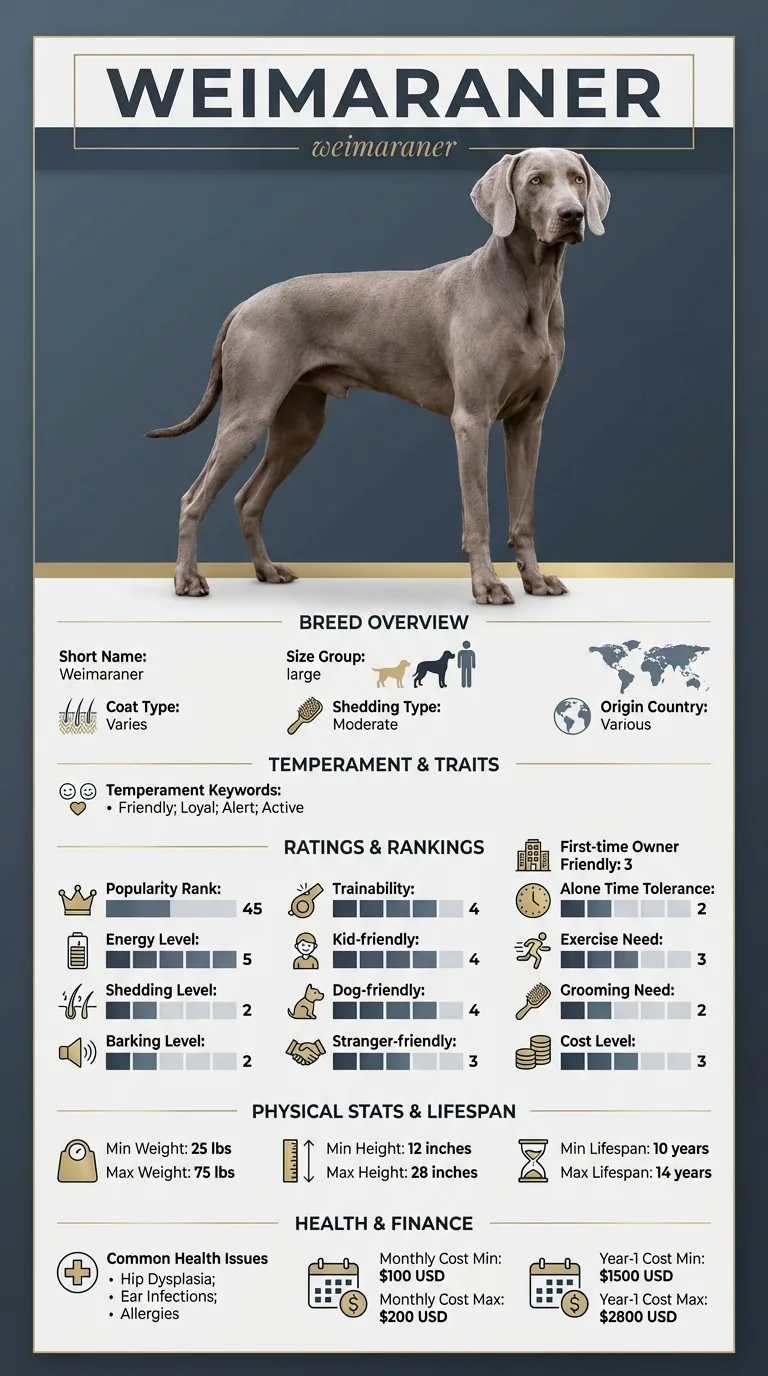
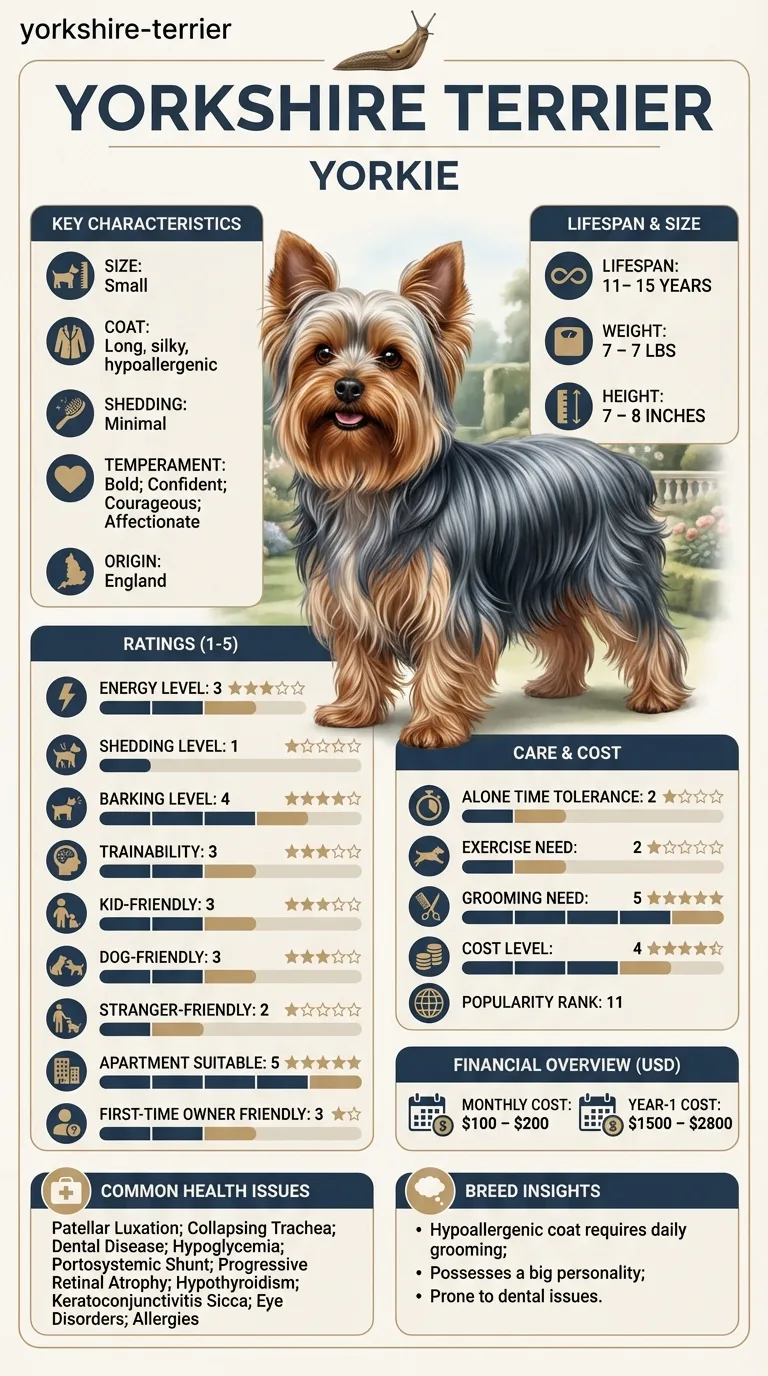
This is for someone already down to Weimaraner and Yorkshire Terrier and deciding between them. For this pair the decision usually turns on grooming need and apartment suitability, so those are covered first and in most detail. Anyone choosing from a flat has a clear answer here: Yorkshire Terrier rates 5/5 against 1/5. It is written for the decision rather than the breed history.
Between Weimaraner and Yorkshire Terrier, grooming need is what separates them, and Yorkshire Terrier is the lower-effort dog of the two to keep.
Choose Weimaraner if you do not want a standing grooming appointment, there are young children at home and you want a dog that picks up training quickly.
Choose Yorkshire Terrier if you are in a flat or a smaller home, this is your first dog and shedding is a problem in your house.
| Feature | weimaraner | yorkshire terrier | Winner |
|---|---|---|---|
| Size class | large | small | Equal |
| Weight | 55–90 lbs | 4–7 lbs | Equal |
| Height | 23–27 in | 7–8 in | Equal |
| Lifespan | 10–13 years | 11–15 years | yorkshire terrier |
| Exercise need | Very high (5/5) | Low (2/5) | yorkshire terrier |
| Grooming need | Very low (1/5) | Very high (5/5) | weimaraner |
| Shedding | Low (2/5) | Very low (1/5) | yorkshire terrier |
| Energy level | Very high (5/5) | Moderate (3/5) | Equal |
| Barking | Moderate (3/5) | High (4/5) | weimaraner |
| Apartment suitability | Very low (1/5) | Very high (5/5) | yorkshire terrier |
| Good for first-time owners | Low (2/5) | Moderate (3/5) | yorkshire terrier |
| Tolerates being alone | Very low (1/5) | Low (2/5) | yorkshire terrier |
| Trainability | High (4/5) | Moderate (3/5) | weimaraner |
| Good with kids | High (4/5) | Moderate (3/5) | weimaraner |
| Good with other dogs | Moderate (3/5) | Moderate (3/5) | Equal |
| Friendly to strangers | Moderate (3/5) | Low (2/5) | weimaraner |
| Cost level | Moderate (3/5) | High (4/5) | weimaraner |
| Coat | Short and sleek | Long, silky, hypoallergenic | Equal |
| Origin | Various | England | Equal |
| Typical monthly cost | $110–$240 | $100–$190 | Equal |
| Typical first-year cost | $1,700–$3,200 | $1,400–$2,900 | Equal |
Put a Weimaraner next to a Yorkshire Terrier and the scale alone tells the story: 55-90 lbs and 23-27 inches at the shoulder against 4-7 lbs and a mere 7-8 inches. A grown Weimaraner can weigh more than ten Yorkies combined, and a single misplaced paw during play could seriously hurt the smaller dog. This is less a size difference than a size category difference — the Weimaraner is a large, athletic hunting breed built for miles in the field, while the Yorkshire Terrier is a toy breed you could carry in a jacket pocket. Furniture, car crates, and vet scales all need to be picked with the specific breed in mind.
The Weimaraner rates a full 5/5 on both exercise need and energy level, reflecting its roots as a wide-ranging pointer bred to hunt all day. The Yorkshire Terrier sits at a low 2/5 for exercise need and a moderate 3/5 for energy — a short walk and some indoor play genuinely satisfy it. That gap matters practically: a Weimaraner left under-exercised tends to channel its drive into destructive behavior, while a Yorkie is more likely to overheat on a long run than to ask for one. Anyone comparing these two on exercise is really comparing a distance-runner's needs against a sprinter-around-the-living-room's needs.
Coat care flips the usual size assumption on its head. The Weimaraner's short, sleek coat needs almost nothing — a very low 1/5 grooming score and low 2/5 shedding, essentially wipe-and-go. The Yorkshire Terrier's long, silky, hypoallergenic coat is rated very high, 5/5, for grooming even though its shedding is very low at 1/5; that coat mats and tangles without regular brushing, and most owners either learn scissor-work or budget for a groomer every few weeks. So the bigger dog is the low-maintenance one here, and the four-pound dog is the one that will actually take up your Saturday mornings.
Apartment life exposes the Weimaraner's biggest weakness: a very low 1/5 apartment suitability score paired with a very low 1/5 tolerance for being alone, and separation anxiety shows up directly in its health and behavior profile. Left alone in a small space, this breed can become vocal and destructive. The Yorkshire Terrier scores very high, 5/5, for apartment living and copes somewhat better alone (low 2/5, still not great), though its barking is rated high at 4/5 versus the Weimaraner's moderate 3/5 — thin walls will carry a Yorkie's alert bark further than the Weimaraner's. Neither breed is a true low-supervision, all-day-alone dog, but the Yorkie fits small-space living far more comfortably.
Trainability actually favors the Weimaraner, which scores high (4/5) against the Yorkshire Terrier's moderate (3/5) — but the Weimaraner's temperament is described as headstrong alongside devoted and alert, so that intelligence comes wrapped in a will of its own. First-time owner suitability tells the real story: the Weimaraner rates a low 2/5, reflecting how much structure and exercise it demands before it settles, while the Yorkie rates a moderate 3/5. The Yorkie's bold, confident, and courageous nature can still surprise new owners — small dogs with big attitudes are a classic training trap — but the physical and mental workload of a novice Weimaraner is considerably higher.
With kids, the Weimaraner edges ahead at a high 4/5 compared to the Yorkshire Terrier's moderate 3/5, and its devoted, energetic temperament tends to translate into an enthusiastic family playmate — though its size alone means play with toddlers needs supervision. Both breeds land at a moderate 3/5 with other dogs. Strangers are where they diverge: the Weimaraner is moderate 3/5 and alert, watchful without being standoffish, while the Yorkshire Terrier drops to low 2/5, consistent with its bold, confident but reserved-around-outsiders reputation. A household that hosts frequently may find the Weimaraner warms up faster than the Yorkie will.
The Yorkshire Terrier is projected to live longer — 11-15 years against the Weimaraner's 10-13 — despite carrying a noticeably longer list of documented health issues: Patellar Luxation, Collapsing Trachea, Dental Disease, Hypoglycemia, Portosystemic Shunt, Progressive Retinal Atrophy, Hypothyroidism, Keratoconjunctivitis Sicca, Eye Disorders, and Allergies, ten conditions in total. The Weimaraner's shorter list is more acute in nature: Bloat (GDV) is a sudden, life-threatening emergency worth knowing the symptoms of, alongside Hip Dysplasia, Hypertrophic Osteodystrophy, Von Willebrand Disease (a clotting disorder), and Separation Anxiety. In short, the Yorkie's risks tend to be chronic and manageable with routine vet care, while the Weimaraner's list includes at least one condition that demands emergency awareness.
Sticker shock runs opposite to what the size difference suggests. The Weimaraner carries a moderate 3/5 cost rating with a typical monthly spend of $110-$240 and a first-year total of $1,700-$3,200, largely food and activity-related given its size and drive. The Yorkshire Terrier is rated a higher 4/5 for cost level despite lower typical dollar ranges — $100-$190 monthly and $1,400-$2,900 in year one — a gap likely explained by grooming bills, dental care, and the vet visits that its longer health-issue list implies. Budgeting for either breed means looking past the price tag on the puppy itself and toward the recurring costs each one's profile predicts.
Weimaraner weighs 55–90 lbs and lives 10–13 years; Yorkshire Terrier weighs 4–7 lbs and lives 11–15 years. The two diverge most on grooming need, apartment suitability and exercise need and 1 other rated axes. Almost every rated axis separates them at least slightly. In the table, a "winner" means easier for an ordinary household — not better. Size, coat and origin are recorded without a verdict. Because both breeds are scored the same way, the gaps are reliable even where the absolute numbers are rough.

Size alone doesn't rule it out, but a 55-90 lb Weimaraner playing with a 4-7 lb Yorkie needs close supervision, since an accidental step or rough play could seriously injure the smaller dog. Many multi-breed households manage this with separate play sessions until trust is established.
The Yorkshire Terrier rates moderate (3/5) for first-time owners versus the Weimaraner's low (2/5). The Weimaraner's very high exercise need (5/5) and very low tolerance for being alone (1/5) make it a demanding choice for someone new to dog ownership.
No — both breeds shed lightly. Weimaraner shedding is rated low (2/5) despite its short coat, and Yorkshire Terrier shedding is rated very low (1/5), consistent with its hypoallergenic reputation, though the Yorkie's coat still needs frequent brushing to prevent matting.
Not comfortably. The Weimaraner scores very low (1/5) for tolerating being alone and separation anxiety appears directly in its health profile; the Yorkshire Terrier scores only slightly better at low (2/5). Neither breed suits long stretches of solitary time.
The Yorkshire Terrier is rated high (4/5) for barking, noticeably more vocal than the Weimaraner's moderate (3/5), which matters for apartment neighbors and thin walls.
Yes. Bloat (GDV) is listed among the Weimaraner's documented health issues and is a sudden, life-threatening emergency in deep-chested large breeds. Owners typically manage risk with slow-feed bowls, smaller meals, and avoiding vigorous exercise right after eating.
By the site's cost-level rating, the Yorkshire Terrier is higher (4/5) than the Weimaraner (3/5), even though the Weimaraner's typical dollar ranges ($110-$240 monthly, $1,700-$3,200 first year) are higher than the Yorkie's ($100-$190 monthly, $1,400-$2,900 first year) — the Yorkie's cost pressure comes more from grooming and health care than food volume.
The Weimaraner, rated very high (5/5) for both energy and exercise need versus the Yorkshire Terrier's low-to-moderate (2/5 exercise, 3/5 energy).
The Yorkshire Terrier, rated very high (5/5) for apartment suitability against the Weimaraner's very low (1/5).
The Yorkshire Terrier, at very low (1/5) shedding versus the Weimaraner's low (2/5).
The Yorkshire Terrier, with a typical lifespan of 11-15 years versus the Weimaraner's 10-13 years.
Secure checkout on Stripe. We never see your card.
7-day money-back guarantee. Instant access.
Health information here is general and is not veterinary advice. If your dog shows pain, sudden behaviour change, or worsening symptoms, consult a licensed veterinarian.
Some links on this site are affiliate links. We may earn a commission at no extra cost to you, and we only suggest products we believe are helpful for dog owners.
We research and check what we publish, but we do not warrant that any figure, date, price, or statement is accurate, complete, or current, and we accept no liability for any loss, cost, injury, or other harm arising from the use of this site. Use it as one reference among several. You remain responsible for your own decisions and for your dog's care - confirm anything that matters with a licensed veterinarian or another qualified professional before you act on it. Full disclaimer.
Match your lifestyle to the right dog.
Take quizNot sure which breed is right for you? Take our 2-minute quiz to find out.
Take the quiz