Health
Why do high-energy Weimaraners still get overweight?
Their calorie needs assume high daily exercise, and when that activity drops, appetite and intake often don't adjust automatically.

Quick answer
Why do high-energy Weimaraners still get overweight?
Their calorie needs assume high daily exercise, and when that activity drops, appetite and intake often don't adjust automatically.
This isn't a low-energy breed getting predictably chunky — it's a high-energy dog whose exercise needs quietly outpaced what life could deliver.
This affects owners whose life circumstances changed — a new job, a move to a smaller home, an injury limiting the dog's own activity — more than owners who simply don't understand the breed's needs from the start.
This guide is not medical advice. If your dog shows pain, sudden behavior change, or worsening symptoms, consult a licensed veterinarian.
Some links may be affiliate links. We may earn a commission at no extra cost to you. We only suggest products we believe are helpful for dog owners.
Obesity in Weimaraners typically results from a mismatch between calorie intake calibrated for a genuinely high level of exercise and an actual activity level that's dropped, whether due to a life change, injury, or age. Because this breed is naturally lean and muscular, early weight gain is easy to miss without an objective check, which is part of why it can progress further before anyone notices.
Weight gain is a common issue across dog breeds broadly, and for a breed with unusually high exercise needs like the Weimaraner, the specific risk is less about overall prevalence and more about how easily a genuine calorie-to-activity mismatch develops when circumstances change.
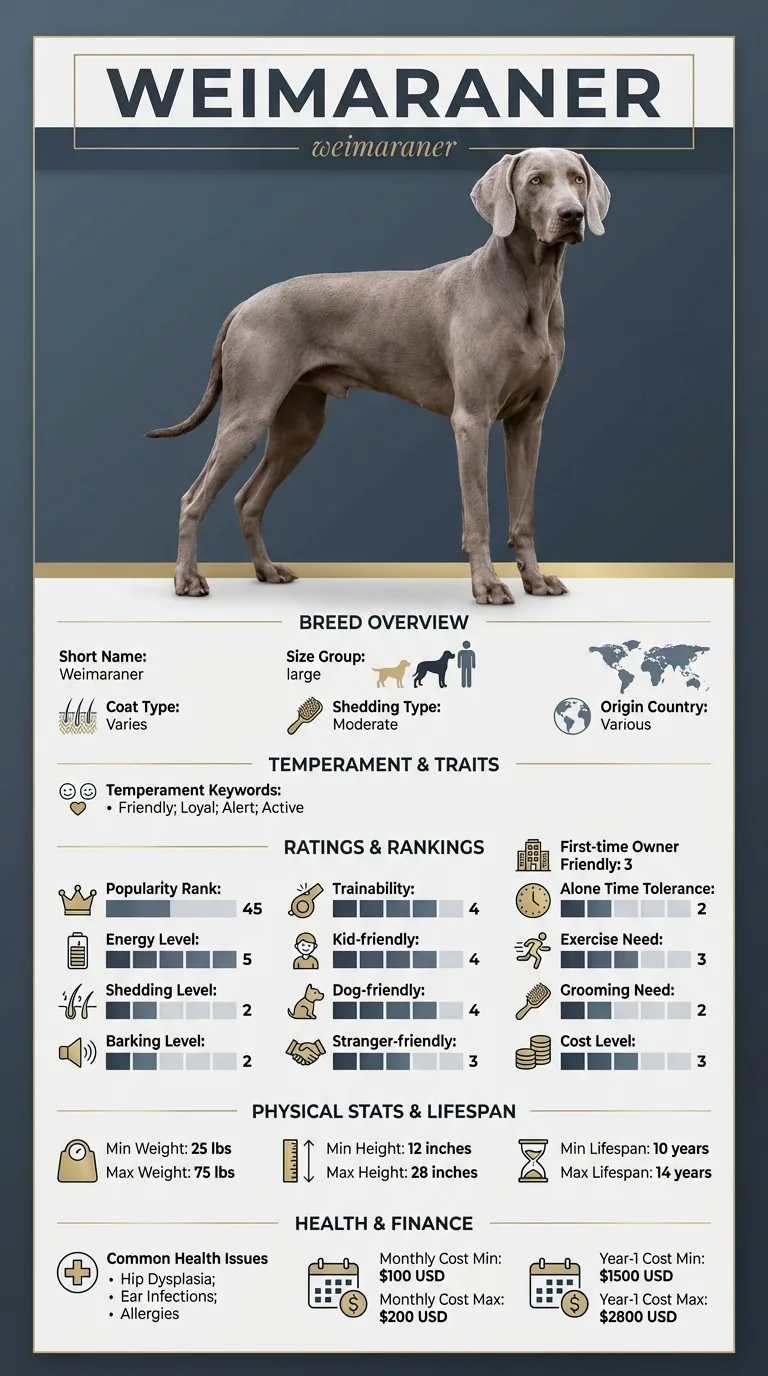
The Weimaraner rates at the top of the exercise-need scale among dog breeds, meaning its natural calorie requirements and appetite are calibrated for a substantially active lifestyle. When actual activity falls short of that baseline for any reason, the resulting calorie surplus adds up in a large-breed body more noticeably than in a naturally low-energy dog whose needs were already modest.
Living situation, particularly limited access to open space or a busy owner schedule, has an outsized effect on this breed's actual exercise level, since meeting its needs typically requires more deliberate time and effort than a lower-energy breed would.
Talk to your vet if you notice weight gain, if your dog's activity level has dropped for any reason, or before starting any weight-loss plan, so calorie targets are matched to your dog's actual needs rather than guessed at home.
See all Weimaraner health problems, which breeds are prone to obesity, or the full Weimaraner breed guide for temperament, exercise needs and ownership costs.
Sustainable weight loss in dogs is generally gradual, often taking several months depending on how much weight needs to come off, with monthly weigh-ins used to track progress and adjust the plan as needed.
Success looks like a lean body condition matched to the breed's natural athletic build, maintained through an exercise and feeding routine that's actually sustainable for your specific life circumstances, not just a temporary crash diet.
A Weimaraner's calorie needs are calibrated around an assumption of substantial daily exercise. When that exercise level drops — because of a busier schedule, a move to an apartment, an injury, or simply the gradual decline that comes with age — the dog's appetite and calorie intake often don't adjust downward automatically. The result is a mismatch: a dog eating like an athlete while living like a couch companion, and that mismatch adds up fast in a large-breed body.
Because Weimaraners are lean and muscular by nature, early weight gain can be surprisingly easy to miss under a coat this short — extra pounds show up as a thicker middle or a less defined waist rather than an obviously round shape, and owners used to seeing a naturally athletic dog may not register a 10 or 15 percent weight gain until a vet visit puts a number on it.
The goal is steady, sustainable loss matched to this specific dog's activity level and needs, not a crash approach that leaves a high-drive dog miserable.

If you think your Weimaraner has obesity, the plan is three steps: write down what you have seen and when it started, book a veterinary appointment rather than waiting for the next flare, and take video of the behaviour or symptom before you go — the thing you are worried about rarely happens in the consulting room. Screening in the parents covers bloat (gdv), hip dysplasia, hypertrophic osteodystrophy.
What the vet visit should produce is a diagnosis and a written plan, not just reassurance: what is being ruled out, what the monitoring interval is, and which signs mean you come back sooner. Ask what the treatment costs across a year rather than per visit, because that is the number that decides whether you are managing this condition or reacting to it.
Between appointments, keep a short log — dates, what you saw, what changed. It is the single most useful thing an owner brings to a follow-up, and for obesity it is often what separates a clear pattern from a guess.
Bandit had always been lean and muscular, the kind of dog people complimented at the park. When his owner Talon started a demanding new job, their daily hour-long runs shrank to occasional short walks, but Bandit's food bowl stayed exactly the same size out of habit. By the time Talon noticed at Bandit's annual checkup, he'd gained about fifteen pounds, enough that his vet flagged it as a genuine concern for his joints. Talon adjusted his portions down, added a dog walker for midday exercise on busy days, and introduced puzzle feeders to slow down mealtime and add mental engagement. Six months later, Bandit was back to his lean build, and Talon now weighs him every month rather than waiting for the yearly surprise.
Key takeaway: A high-energy dog's food needs are tied directly to actual exercise, not the breed's reputation for energy — when the exercise drops, the food has to adjust too, or the weight creeps in quietly.
Their calorie needs are calibrated for a high level of daily exercise. When that exercise drops for any reason — a schedule change, injury, or aging — appetite and food intake often don't adjust automatically, creating a gradual surplus.
Ask your vet for a body condition score at a regular visit. This breed's lean, muscular build and short coat can hide early weight gain from casual observation, so an objective assessment matters more than eyeballing it.
This breed sits at the high end of exercise needs among all dog breeds, generally requiring substantial daily activity well beyond a short leash walk to maintain a healthy weight and satisfy its natural drive.
No, a gradual calorie adjustment paired with rebuilt exercise is generally more sustainable and less likely to leave a high-energy dog frustrated or overly food-motivated than a sudden, drastic cut.
Yes, extra weight adds mechanical load to joints already at risk for hip dysplasia and adds cardiovascular strain relevant to heart health, making weight management a meaningful factor in managing several other documented breed health concerns.
Work with your vet on a calorie adjustment matched to the reduced activity level, and consider mentally engaging low-impact activities like scent games to help satisfy the dog's drive without the physical exertion.
Sustainable weight loss in dogs is generally gradual, often taking several months depending on how much weight needs to come off, with regular weigh-ins used to track progress and adjust the plan.
Their calorie needs assume high daily exercise, and when that activity drops, appetite and intake often don't adjust automatically.
Not always — their lean, muscular build and short coat can hide early gain from casual observation better than in some other breeds.
A gradual calorie adjustment combined with rebuilt, incrementally increased exercise, rather than a drastic sudden change.
Yes, it adds joint stress relevant to hip dysplasia risk and cardiovascular strain relevant to heart health.
Monthly is a reasonable interval to catch small trends early rather than waiting for the next annual vet visit.
A one-page prep sheet for this condition: the signs, the questions to ask, what to get priced. Unlocks here.
You get: Vet visit prep sheet
No spam. One-click unsubscribe. See our privacy policy.
Preview page 1 before you decide.