Living
Which is bigger?
The Siberian Husky, at 45–60 lbs versus the Shiba Inu's 17–23 lbs.

Quick answer
Which is bigger?
The Siberian Husky, at 45–60 lbs versus the Shiba Inu's 17–23 lbs.
Shiba Inu or Siberian Husky? On paper they differ most on apartment suitability, and on the scales Siberian Husky is the heavier at 45–60 lbs. Here is how the two compare on everything that shapes an ordinary week.
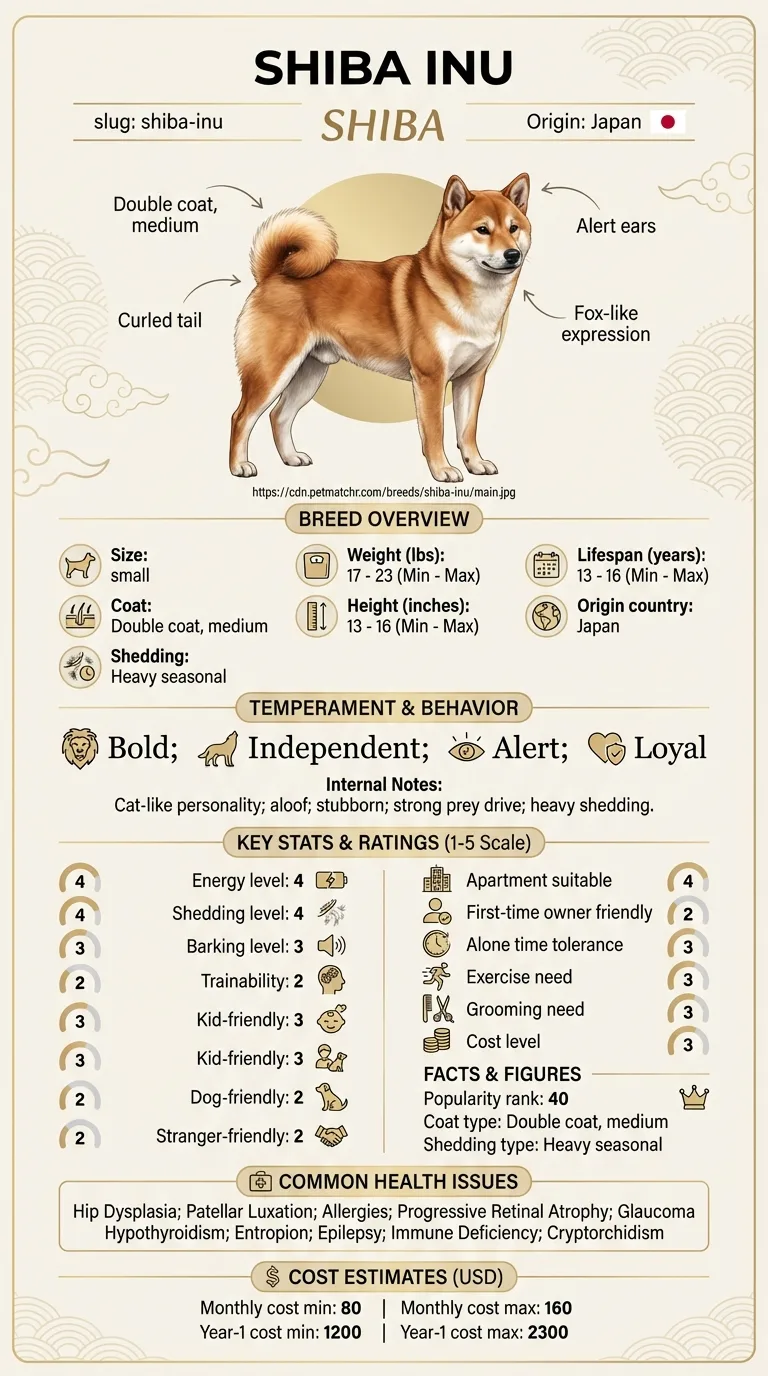
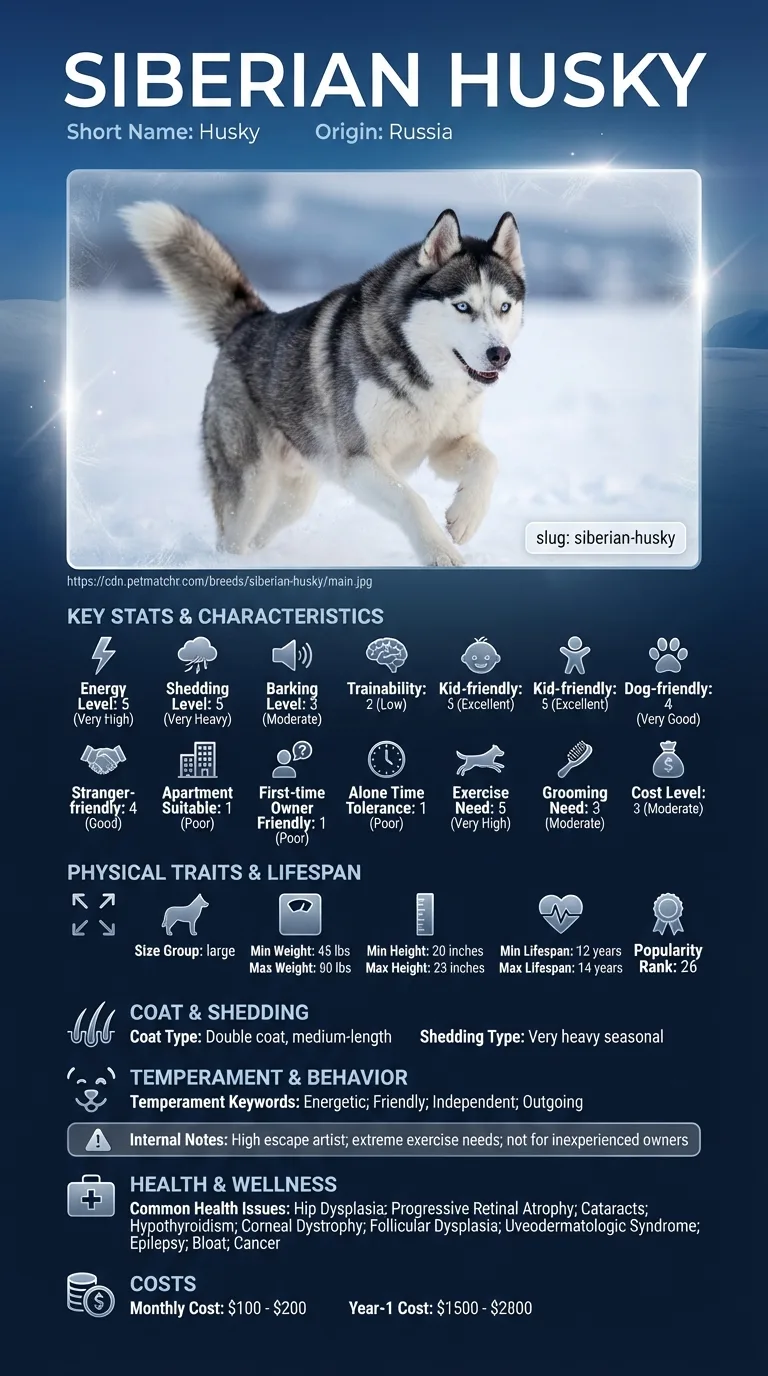
This is for someone already down to Shiba Inu and Siberian Husky and deciding between them. For this pair the decision usually turns on apartment suitability and exercise need, so those are covered first and in most detail. Anyone choosing from a flat has a clear answer here: Shiba Inu rates 4/5 against 1/5. The focus throughout is on daily consequences rather than breed background.
Between Shiba Inu and Siberian Husky, apartment suitability is what separates them, and Shiba Inu is the lower-effort dog of the two to keep.
Choose Shiba Inu if you are in a flat or a smaller home, shedding is a problem in your house and your walking routine is modest.
Choose Siberian Husky if there are young children at home, you already have another dog and you want a dog that can keep up with an active routine.
| Feature | shiba inu | siberian husky | Winner |
|---|---|---|---|
| Size class | small | large | Equal |
| Weight | 17–23 lbs | 45–60 lbs | Equal |
| Height | 13–16 in | 20–23 in | Equal |
| Lifespan | 13–16 years | 12–14 years | shiba inu |
| Exercise need | Moderate (3/5) | Very high (5/5) | shiba inu |
| Grooming need | Moderate (3/5) | Moderate (3/5) | Equal |
| Shedding | High (4/5) | Very high (5/5) | shiba inu |
| Energy level | High (4/5) | Very high (5/5) | Equal |
| Barking | Moderate (3/5) | Moderate (3/5) | Equal |
| Apartment suitability | High (4/5) | Very low (1/5) | shiba inu |
| Good for first-time owners | Low (2/5) | Very low (1/5) | shiba inu |
| Tolerates being alone | Moderate (3/5) | Very low (1/5) | shiba inu |
| Trainability | Low (2/5) | Low (2/5) | Equal |
| Good with kids | Moderate (3/5) | Very high (5/5) | siberian husky |
| Good with other dogs | Low (2/5) | High (4/5) | siberian husky |
| Friendly to strangers | Low (2/5) | High (4/5) | siberian husky |
| Cost level | Moderate (3/5) | Moderate (3/5) | Equal |
| Coat | Double coat, medium | Double coat, medium-length | Equal |
| Origin | Japan | Russia | Equal |
| Typical monthly cost | $80–$160 | $100–$200 | Equal |
| Typical first-year cost | $1,200–$2,300 | $1,500–$2,800 | Equal |
The Shiba Inu and Siberian Husky look like distant cousins — both carry dense double coats and upright ears — but the Husky is built on a much bigger frame: 45–60 lbs and 20–23 inches tall against the Shiba's 17–23 lbs and 13–16 inches. That's roughly double the weight and several inches of extra height, translating into a Husky that needs more room to move, a bigger crate, and proportionally larger food and medication doses. The Shiba's fox-like proportions make it look sturdier than a toy breed while still fitting comfortably in a small car back seat, something the sled-dog-sized Husky simply can't manage.
The Siberian Husky is in a different league physically, rated Very High (5/5) for exercise need against the Shiba Inu's Moderate (3/5) — a Husky bred to pull sleds for miles needs serious daily running, not just walks, or it will find its own outlets, usually destructive ones. The Shiba's needs are real but far more manageable, satisfied by a couple of brisk walks and some off-leash time in a secure area. Both score high on raw energy level (High 4/5 for the Shiba, Very High 5/5 for the Husky), but the Husky's stamina and drive to run genuinely outpaces what most Shiba owners will ever need to provide.
Grooming needs are tied at Moderate (3/5) for both breeds, but shedding tells a different story: the Husky rates Very High (5/5) against the Shiba's already-substantial High (4/5). Both are double-coated breeds that blow their undercoat seasonally, meaning weeks of heavy shedding twice a year, but the Husky's coat volume simply produces more hair per session. Neither breed needs professional grooming the way a continuously-growing coat would require — brushing at home covers most of it — but Husky owners should expect to own a good vacuum and possibly a dedicated de-shedding tool for the seasonal blowouts.
The Shiba Inu is dramatically better suited to small spaces, rated High (4/5) for apartment suitability against the Husky's Very Low (1/5) — a direct consequence of the Husky's very high exercise needs and its instinct to roam and vocalize (Huskies are known for a distinctive howl-like sound even though barking itself is rated Moderate 3/5 for both breeds here). Alone-time tolerance splits sharply too: the Shiba rates Moderate (3/5) while the Husky rates Very Low (1/5), reflecting the breed's pack-oriented nature and tendency toward anxious or destructive behavior when left solo for long stretches. Apartment living genuinely favors the Shiba here.
Trainability is tied at Low (2/5) for both breeds, and neither rates well for first-time owners — the Shiba at Low (2/5), the Husky slightly lower at Very Low (1/5). Both temperaments carry an Independent streak (explicitly listed for the Husky, implied by the Shiba's Bold, Independent, Alert description), meaning food and toy motivation only go so far with either breed; consistent, patient handling matters more than raw obedience drilling. The Husky's Energetic, Friendly, Outgoing nature makes it eager to engage with people even when it's ignoring commands, which can lull new owners into a false sense of progress before recall problems show up off-leash.
The Siberian Husky is the more social breed by a wide margin: Very High (5/5) with kids, High (4/5) with other dogs, and High (4/5) with strangers, against the Shiba Inu's Moderate (3/5), Low (2/5), and Low (2/5) respectively. Huskies were bred to live and work in packs, and it shows in how readily they welcome new dogs and people. The Shiba's more reserved, cat-like temperament makes it choosier about companionship on all fronts, which can actually suit households that want a lower-key, one-owner-focused dog rather than a breed that greets every visitor and every dog at the park like an old friend.
The Shiba Inu has the lifespan advantage, 13–16 years versus the Husky's 12–14. Shiba owners should watch for Hip Dysplasia, Patellar Luxation, Allergies, Progressive Retinal Atrophy, Glaucoma, and Epilepsy among a list of ten conditions. The Husky's list overlaps on Hip Dysplasia, Progressive Retinal Atrophy, Hypothyroidism, and Epilepsy, but adds breed-specific concerns like Corneal Dystrophy, Follicular Dysplasia, Uveodermatologic Syndrome (an autoimmune skin condition), and notably Bloat and Cancer. The eye-related overlap between the two breeds — both list Progressive Retinal Atrophy — means regular ophthalmologic checkups are worth budgeting for regardless of which breed a household chooses.
Both breeds land at Moderate (3/5) cost overall, with the Husky running slightly higher: $100–$200 monthly and $1,500–$2,800 in year one, against the Shiba's $80–$160 and $1,200–$2,300. The gap tracks with size — more food, larger-dose medications, and bigger boarding or daycare bills for a 45–60 lb dog compared to a 17–23 lb one. The Husky's tendency toward escape-artist behavior when under-exercised can also mean unplanned costs for reinforced fencing or containment systems, an expense that rarely shows up on a standard cost estimate but that many Husky owners end up paying anyway.
Shiba Inu weighs 17–23 lbs and lives 13–16 years; Siberian Husky weighs 45–60 lbs and lives 12–14 years. The two diverge most on apartment suitability, exercise need and tolerates being alone and 3 other rated axes. They are level on barking, cost level and grooming need, so those cannot decide it. The table below marks a winner only where one breed is genuinely easier for a typical owner; size and origin are facts rather than merits and stay level. Ratings come from one source applied to both breeds, so they are meaningful against each other rather than as absolute scores.

The Siberian Husky, rated Very High (5/5) for exercise need versus the Shiba Inu's Moderate (3/5) — a Husky needs serious daily running, not just walks.
No — it rates Very Low (1/5) for apartment suitability, well below the Shiba Inu's High (4/5), largely due to its exercise needs and dislike of being left alone.
The Siberian Husky by a wide margin, rated High (4/5) versus the Shiba Inu's Low (2/5), reflecting its pack-oriented, outgoing temperament.
Yes — both rate Low (2/5) for trainability, and neither is recommended for first-time owners, with the Husky rating even lower (Very Low 1/5) than the Shiba (Low 2/5).
The Siberian Husky, rated Very High (5/5) versus the Shiba Inu's already-notable High (4/5) — both are heavy seasonal shedders.
Yes — it rates High (4/5) with other dogs, considerably better than the Shiba Inu's Low (2/5).
Both list Hip Dysplasia and Progressive Retinal Atrophy among their known health concerns, alongside Epilepsy.
The Siberian Husky, at 45–60 lbs versus the Shiba Inu's 17–23 lbs.
The Shiba Inu, rated Moderate (3/5) for alone tolerance versus the Husky's Very Low (1/5).
The Shiba Inu, with a 13–16 year lifespan versus the Husky's 12–14 years.
The Siberian Husky, scoring higher with kids, other dogs, and strangers alike.
Secure checkout on Stripe. We never see your card.
7-day money-back guarantee. Instant access.
Health information here is general and is not veterinary advice. If your dog shows pain, sudden behaviour change, or worsening symptoms, consult a licensed veterinarian.
Some links on this site are affiliate links. We may earn a commission at no extra cost to you, and we only suggest products we believe are helpful for dog owners.
We research and check what we publish, but we do not warrant that any figure, date, price, or statement is accurate, complete, or current, and we accept no liability for any loss, cost, injury, or other harm arising from the use of this site. Use it as one reference among several. You remain responsible for your own decisions and for your dog's care - confirm anything that matters with a licensed veterinarian or another qualified professional before you act on it. Full disclaimer.
Match your lifestyle to the right dog.
Take quizNot sure which breed is right for you? Take our 2-minute quiz to find out.
Take the quiz