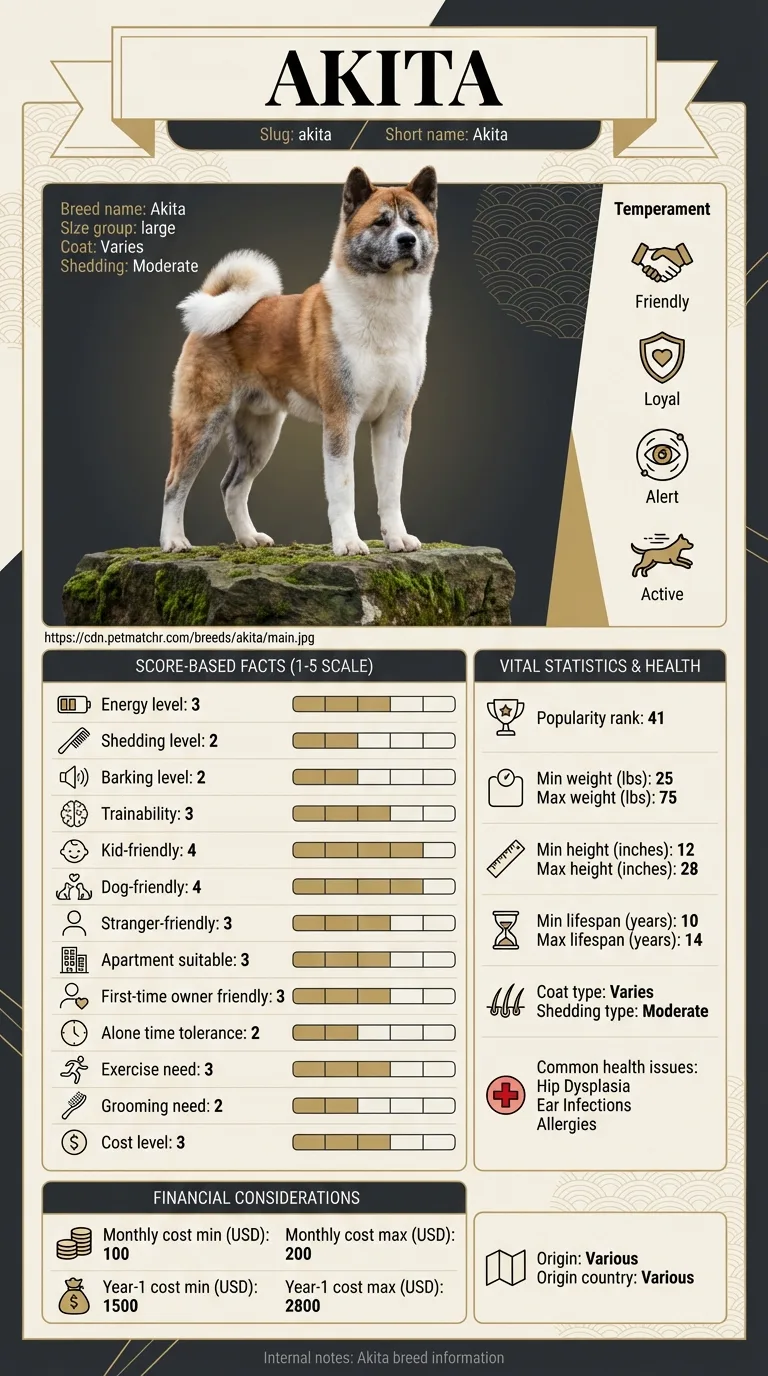
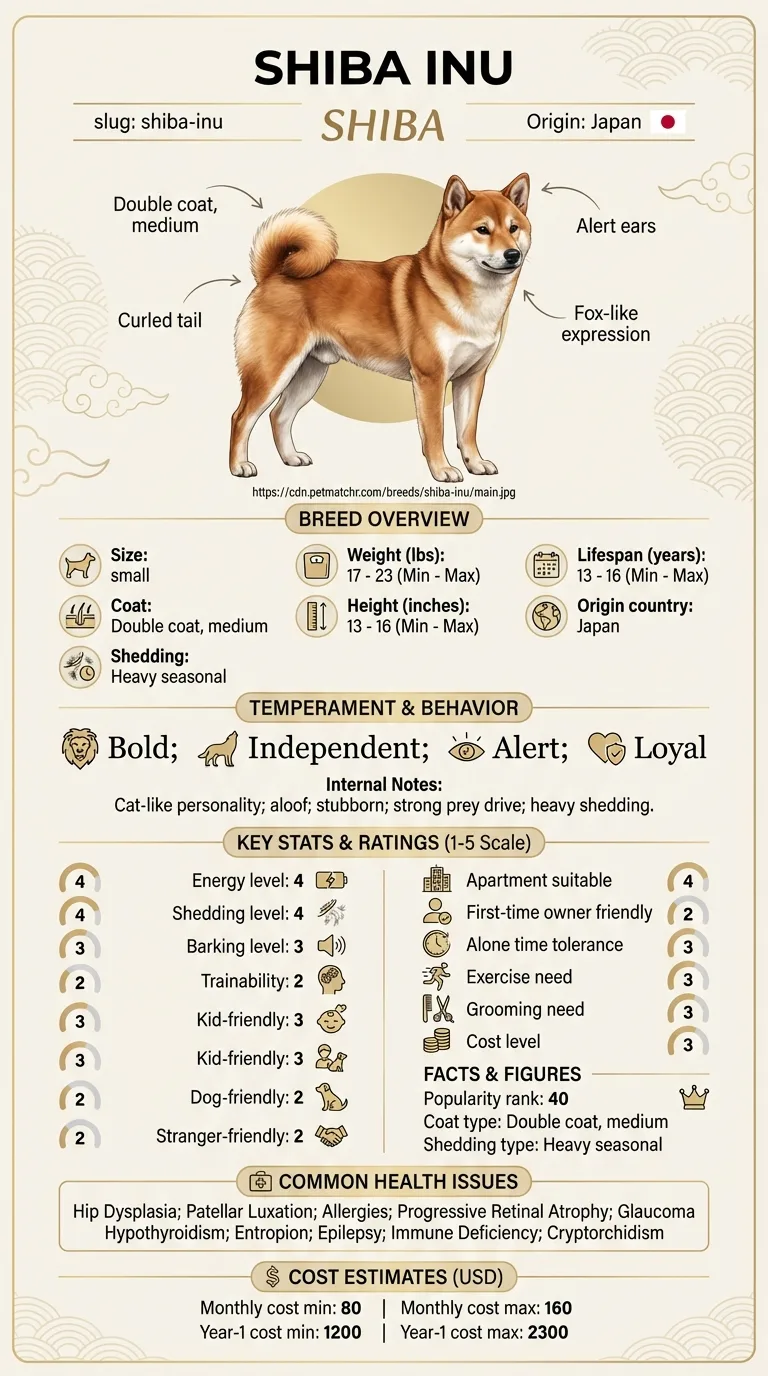
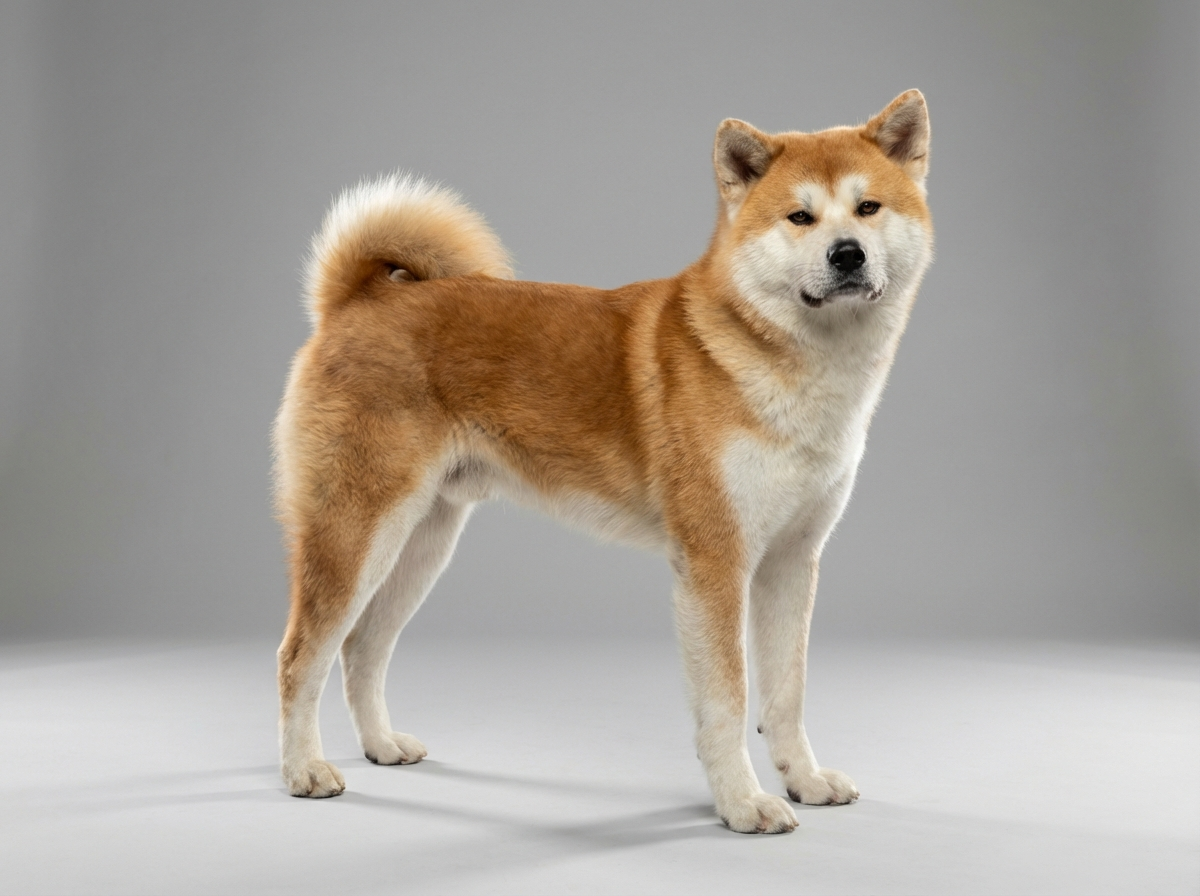
The Shiba if you want the Japanese spitz temperament in a dog you can physically manage, and you accept it will never have a reliable recall. The Akita if you want the same mind with genuine physical presence.
Seven rows on this table tie exactly. These are both Japanese spitz breeds, both selected for independence and reserve, and the Shiba is closer to a small Akita than any other dog on this site. If you like the temperament and not the size, this is the comparison that matters.
This page is for someone drawn to the Japanese breeds and deciding on size, and for anyone who has been told a Shiba is an easier Akita. It covers where the temperaments genuinely match, recall and escaping, coat work, lifespan, and cost.
Quick verdict
The Shiba gives you nearly the whole Akita temperament in a 20-pound package, at half the cost and with three to five more years of life; the size is most of what you are choosing between.
Choose akita if...
Choose the Akita if you want the physical presence of a guardian and the deterrent effect that goes with it. It trains at 3/5 against the Shiba's 2/5 and barks at 2/5 against 3/5. You are accepting up to 130 pounds, 5/5 shedding against 4/5, $110–$240 a month against $80–$160, and a shorter life.
Choose shiba inu if...
Choose the Shiba Inu if you want that temperament in a dog you can physically manage. It rates 4/5 for apartments against 2/5, lives 13 to 16 years against 10 to 13, and costs roughly half as much to keep. You are accepting 2/5 trainability, a recall that may never be reliable, and a serious escape instinct.
Head-to-head comparison
Feature
akita
shiba inu
Winner
Weight
70–130 lbs
17–23 lbs
Equal
Height
24–28 in
13–16 in
Equal
Lifespan
10–13 years
13–16 years
shiba inu
Coat
Dense double coat
Medium double coat
Equal
Grooming need
Moderate (3/5)
Moderate (3/5)
Equal
Shedding
Very high (5/5)
High (4/5)
shiba inu
Energy level
Moderate (3/5)
High (4/5)
Equal
Exercise need
Moderate (3/5)
Moderate (3/5)
Equal
Trainability
Moderate (3/5)
Low (2/5)
akita
Barking
Low (2/5)
Moderate (3/5)
akita
Good with kids
Moderate (3/5)
Moderate (3/5)
Equal
Good with other dogs
Low (2/5)
Low (2/5)
Equal
Friendly to strangers
Low (2/5)
Low (2/5)
Equal
Apartment suitability
Low (2/5)
High (4/5)
shiba inu
Good for first-time owners
Very low (1/5)
Low (2/5)
shiba inu
Tolerates being alone
Moderate (3/5)
Moderate (3/5)
Equal
Typical monthly cost
$110–$240
$80–$160
shiba inu
Typical first-year cost
$1,700–$3,200
$1,200–$2,300
shiba inu
Deep dive
The same mind at two scales
The Shiba's 2/5 trainability is the lowest in this pairing and it is not a measure of intelligence. Shibas learn very fast and comply selectively — they understand the request, evaluate what is in it for them, and act accordingly. Drilling produces boredom and refusal.
What works for both breeds is the same: short sessions, food, absolute consistency, and no correction. Neither has a desire to please that can be leaned on, and both respond to heavy-handedness by disengaging.
Both are strongly territorial about resources — food, toys, sleeping spots — and both benefit from early, calm work on trading and handling rather than confrontation.
Socialisation is identical in requirement: from eight weeks, sustained past two years, with calm exposure rather than enthusiastic greeting. In both breeds the adult opinion of unfamiliar dogs arrives at maturity and catches out owners who had an easy puppy.
The difference is what happens when it goes wrong. A 20-pound Shiba that has decided about another dog is a problem you can pick up. A 110-pound Akita is not.
Recall, escaping and the fence question
Neither of these breeds should be trusted off-lead in an unfenced area, and the Shiba is the worse of the two.
A Shiba was bred to hunt independently in mountain terrain. Its prey drive is high, its recall is unreliable in the presence of anything interesting, and a loose Shiba typically does not come back — it runs, and it is fast enough that catching it is not an option. Most Shiba rescue organisations will tell you this before anything else.
Escape is the related problem. Shibas climb, squeeze, and test fences persistently, and a garden that holds an ordinary dog frequently does not hold one.
The practical rules are the same for both breeds: a securely fenced garden with the perimeter checked, a lead or long line in open ground, and a recall treated as a bonus rather than a safety measure.
Both also carry serious prey drive toward cats and small animals, which does not reliably fade with familiarity.
The Akita's failure mode is a decision. The Shiba's is a departure.
Coat, the scream, and daily life
Grooming ties at 3/5 and the work is the same in kind: a weekly brush for most of the year, then two intensive periods when the undercoat comes out in handfuls. The Akita is 5/5 and the Shiba 4/5, which at their respective sizes evens out less than you would think — a blowing Shiba produces a startling quantity of hair.
Neither coat should ever be clipped. A double coat insulates against heat as well as cold, and clipped coats often regrow with a coarser, less functional texture.
On noise the Akita is quieter at 2/5 against 3/5, but the Shiba's reputation is not about frequency. It is about the sound — a high, drawn-out shriek produced when the dog objects to something, most reliably nail clipping, restraint or a bath. It is startling, it is not distress, and it is a genuine part of owning the breed.
Both are clean, both are close to odourless, and both are straightforward to house-train.
Both cope with a working day at 3/5, which is unusual for a small breed and one of the Shiba's underrated advantages.
Health, lifespan and money
The Shiba runs $80–$160 a month against the Akita's $110–$240, and $1,200–$2,300 against $1,700–$3,200 in the first year. It also lives 13 to 16 years against 10 to 13.
On health the lists overlap in shape. Both carry hip dysplasia, hypothyroidism and progressive retinal atrophy. The Shiba adds patellar luxation, glaucoma, entropion, allergies, epilepsy, immune deficiency and cryptorchidism. The Akita's autoimmune burden is the heavier of the two.
Glaucoma deserves a note: rising pressure inside the eye destroys sight quickly and a suddenly painful, cloudy or red eye is a same-day emergency in either breed.
Skin allergies are the Shiba's most common everyday complaint — itching, recurrent ear trouble and paw licking — and they are managed rather than cured.
Both breeds are known for anaesthetic sensitivities worth flagging to a vet before any procedure, and the Akita is deep-chested enough for bloat to be a real risk in a way the Shiba is not.
Akita vs Shiba Inu: seven ties and one obvious difference
Grooming, exercise, children, other dogs, strangers, time alone and coat structure all tie. Energy is 4/5 against 3/5 and everything else that differs comes back to size.
The temperament match is real rather than an artefact of scoring. Both breeds are described in the same terms by their owners: catlike, clean, dignified, undemonstrative, and entirely uninterested in performing affection on demand. Both are reserved with strangers at 2/5 and frequently intolerant of same-sex dogs at 2/5, with the adult position arriving at social maturity rather than in puppyhood.
Both are also unusually clean and easy to house-train, which is a shared trait of the Japanese breeds and rarely mentioned.
Where they differ practically: the Shiba rates 4/5 for apartments against 2/5, lives three to five years longer, costs roughly half as much, and can be picked up. The Akita is more trainable at 3/5 against 2/5 and quieter at 2/5 against 3/5.
And the Akita is a genuine deterrent. A Shiba is not, whatever it thinks.
Akita or Shiba Inu: One Temperament, Two Sizes - Akita vs Shiba Inu: seven ties and one obvious difference
Frequently asked questions
Is a Shiba Inu just a small Akita?
Temperamentally it is very close — seven ratings tie, including reserve with strangers, tolerance of other dogs, children, time alone, exercise and grooming. Both are Japanese spitz breeds with the same independence. The differences are size, a 2/5 trainability against 3/5, and the fact that only one of them deters anybody.
Can a Shiba Inu be let off the lead?
In most cases, no. It was bred to hunt independently in mountain country, its prey drive is high and its recall is unreliable around anything interesting. A loose Shiba usually runs rather than returns, and it is fast. Treat recall as a bonus and secure fencing as a requirement — the same rule applies to the Akita.
Which is easier to train?
The Akita at 3/5 against the Shiba's 2/5, though neither is eager to please. Shibas learn very quickly and comply selectively — they evaluate the request rather than accepting it. Short sessions, food and absolute consistency work for both; correction works for neither.
What is the Shiba scream?
A high, drawn-out shriek produced when the dog objects to something — nail clipping, restraint and baths are the classic triggers. It is startling and it is not distress. Frequency-wise the Shiba is only 3/5 for barking against the Akita's 2/5; the reputation is about the sound, not the amount.
Which lives longer?
The Shiba Inu, at 13 to 16 years against the Akita's 10 to 13 — three to five more years, which is a substantial difference over a life. Size accounts for most of it, along with the Akita's heavier autoimmune disease burden.
Do both breeds shed heavily?
Yes. The Akita rates 5/5 and the Shiba 4/5, and both blow their undercoat twice a year over two or three weeks. The volume from a 20-pound Shiba surprises everyone. Grooming effort ties at 3/5 and neither coat should ever be clipped.
Which is cheaper to keep?
The Shiba, at $80–$160 a month against the Akita's $110–$240, and $1,200–$2,300 against $1,700–$3,200 in the first year — roughly half. Its ongoing costs skew toward skin and allergy management, which is the breed's most common everyday complaint.
The Shiba if you want the Japanese spitz temperament in a dog you can physically manage, and you accept it will never have a reliable recall. The Akita if you want the same mind with genuine physical presence.
Costs
How much does each cost per month?
The Shiba runs $80–$160 a month and the Akita $110–$240, with first-year totals of $1,200–$2,300 and $1,700–$3,200 — and the Shiba lives three to five years longer.
Behavior
Are either good with other dogs?
Neither — both rate 2/5, and both are frequently intolerant of same-sex dogs. In both breeds the adult position arrives at social maturity around two years old, in a dog that was fine as a puppy.
Living
Which is better for a flat?
The Shiba at 4/5 against the Akita's 2/5 — small, clean, quiet enough at 3/5 barking, and content with the same 3/5 exercise. It also copes with a working day at 3/5, which is unusual for a small breed.
Related DogBreedCompass guides
Akita breed guide – The Akita profile covers guardian temperament and the long socialisation window the breed needs.
Shiba Inu breed guide – The Shiba Inu profile covers recall, escaping and the breed's independence.
Akita vs Alaskan Malamute – The Alaskan Malamute is the large northern spitz alternative to the Akita.
Akita vs Chow Chow – The Chow Chow is the other reserved Asian breed most often weighed against these two.
Shiba Inu skin allergies – Skin allergies are the Shiba's most common everyday health complaint.
Akita autoimmune diseases – Autoimmune disease is the Akita's most distinctive burden and the first question for a breeder.
Health information here is general and is not veterinary advice. If your dog shows pain, sudden behaviour change, or worsening symptoms, consult a licensed veterinarian.
Some links on this site are affiliate links. We may earn a commission at no extra cost to you, and we only suggest products we believe are helpful for dog owners.
We research and check what we publish, but we do not warrant that any figure, date, price, or statement is accurate, complete, or current, and we accept no liability for any loss, cost, injury, or other harm arising from the use of this site. Use it as one reference among several. You remain responsible for your own decisions and for your dog's care - confirm anything that matters with a licensed veterinarian or another qualified professional before you act on it. Full disclaimer.