Living
Which is smaller?
The Pomeranian, weighing just 3-7 lbs versus the Golden's 55-75 lbs.

Quick answer
Which is smaller?
The Pomeranian, weighing just 3-7 lbs versus the Golden's 55-75 lbs.
Golden Retriever or Pomeranian? On paper they differ most on apartment suitability, and on the scales Golden Retriever is the heavier at 55–75 lbs. Here is how the two compare on everything that shapes an ordinary week.
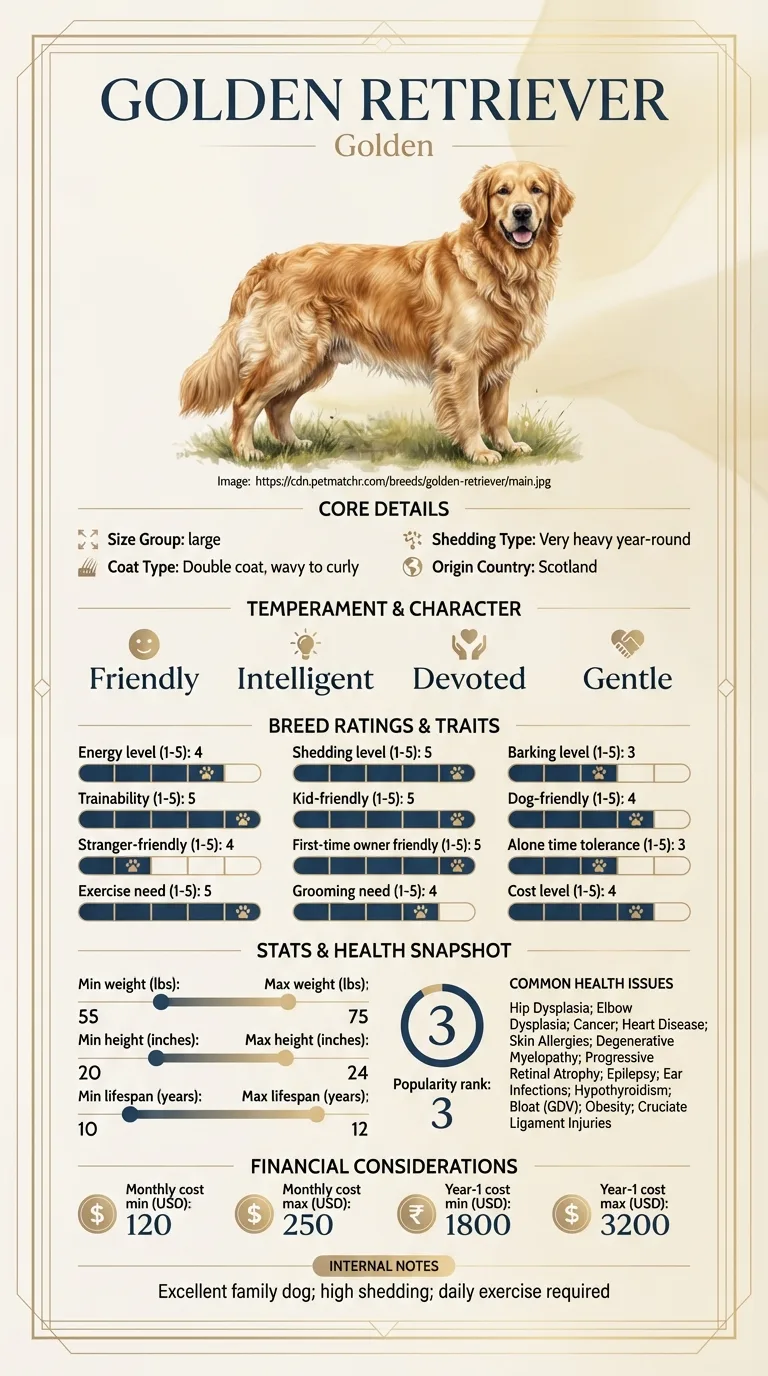
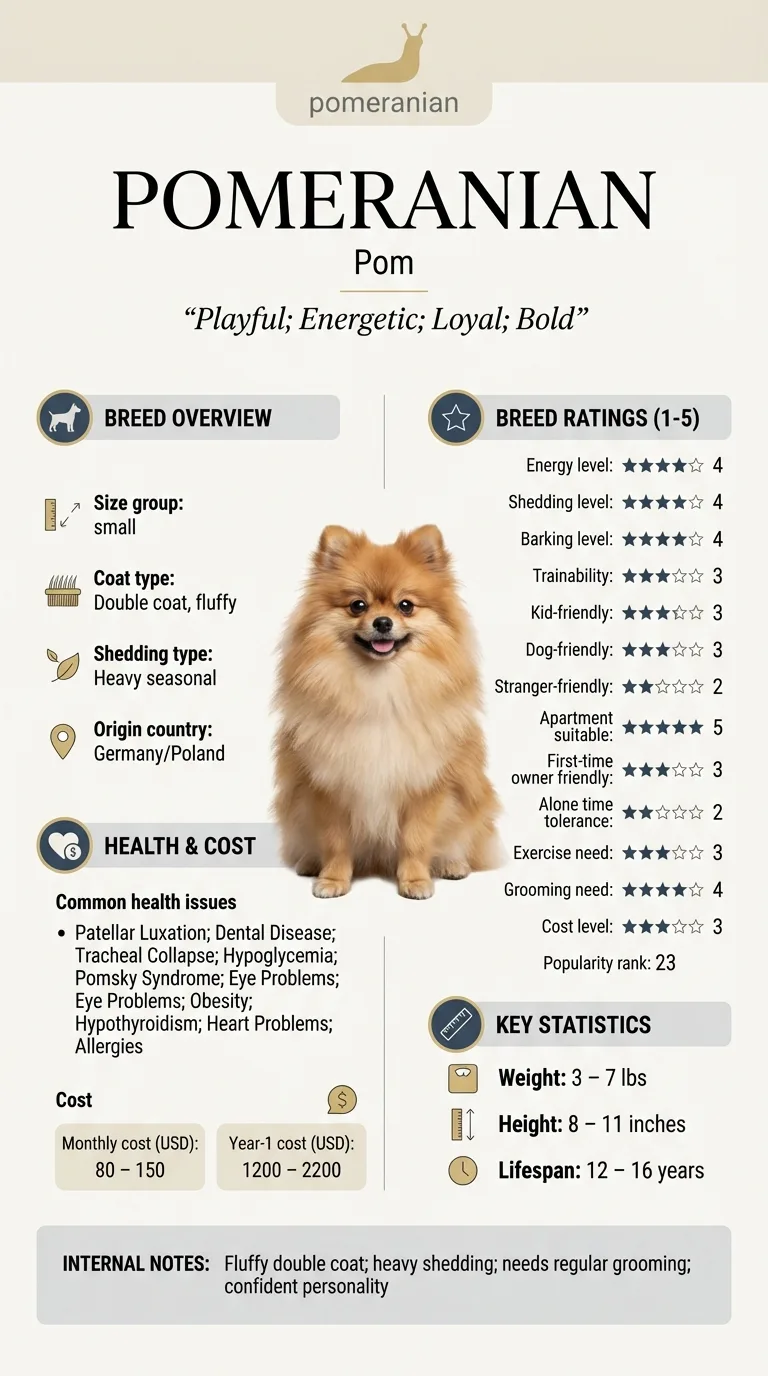
This is for someone already down to Golden Retriever and Pomeranian and deciding between them. For this pair the decision usually turns on apartment suitability and exercise need, so those are covered first and in most detail. Anyone choosing from a flat has a clear answer here: Pomeranian rates 5/5 against 2/5. There is no origin story here — only what changes about your week.
Between Golden Retriever and Pomeranian, apartment suitability is what separates them, and Pomeranian is the lower-effort dog of the two to keep.
Choose Golden Retriever if this is your first dog, the dog will be alone during the working day and there are young children at home.
Choose Pomeranian if you are in a flat or a smaller home, shedding is a problem in your house and your walking routine is modest.
| Feature | golden retriever | pomeranian | Winner |
|---|---|---|---|
| Size class | large | small | Equal |
| Weight | 55–75 lbs | 3–7 lbs | Equal |
| Height | 20–24 in | 8–11 in | Equal |
| Lifespan | 10–12 years | 12–16 years | pomeranian |
| Exercise need | Very high (5/5) | Moderate (3/5) | pomeranian |
| Grooming need | High (4/5) | High (4/5) | Equal |
| Shedding | Very high (5/5) | High (4/5) | pomeranian |
| Energy level | High (4/5) | High (4/5) | Equal |
| Barking | Moderate (3/5) | High (4/5) | golden retriever |
| Apartment suitability | Low (2/5) | Very high (5/5) | pomeranian |
| Good for first-time owners | Very high (5/5) | Moderate (3/5) | golden retriever |
| Tolerates being alone | Moderate (3/5) | Low (2/5) | golden retriever |
| Trainability | Very high (5/5) | Moderate (3/5) | golden retriever |
| Good with kids | Very high (5/5) | Moderate (3/5) | golden retriever |
| Good with other dogs | High (4/5) | Moderate (3/5) | golden retriever |
| Friendly to strangers | High (4/5) | Low (2/5) | golden retriever |
| Cost level | High (4/5) | Moderate (3/5) | pomeranian |
| Coat | Double coat, wavy to curly | Double coat, fluffy | Equal |
| Origin | Scotland | Germany/Poland | Equal |
| Typical monthly cost | $120–$250 | $80–$150 | Equal |
| Typical first-year cost | $1,800–$3,200 | $1,200–$2,200 | Equal |
At the extremes of this comparison sits a 55-75 lb Golden Retriever against a Pomeranian that can weigh as little as 3 lbs — one of the largest gaps in size class the site tracks. The Pomeranian's fluffy double coat and 8-11 inch height mean it's often mistaken for a plush toy rather than a working-line descendant of larger sled dogs, while the Golden's double coat is functional, wavy-to-curly, and built for retrieving in cold water. Both breeds actually carry a double coat structure, just at wildly different scales, which explains why grooming need lands closer together than the size numbers alone would suggest.
Energy level is rated High (4/5) for both breeds, a genuinely useful data point since it means the tiny Pomeranian is not the low-key lapdog its size implies — Playful and Energetic are two of its four listed temperament traits. Exercise need still separates them, with the Golden at Very High (5/5) against the Pomeranian's Moderate (3/5), because the Pomeranian's small frame reaches its physical limits faster even at full intensity. In practice, a Pomeranian's zoomies around a living room can satisfy much of its daily energy budget, while a Golden needs sustained, larger-scale activity to reach the same state of contentment.
Grooming need actually ties at High (4/5) for both breeds — surprising, since the Pomeranian's fluffy double coat requires nearly as much brushing time as the Golden's longer coat to prevent matting around the neck ruff and hindquarters. Shedding is close too: Very High (5/5) for the Golden versus a still-substantial High (4/5) for the Pomeranian, meaning neither breed suits someone hoping to avoid regular vacuuming. The main practical difference is scale — a Pomeranian sheds proportionally less hair simply because there's less dog, even if the coat itself blows out seasonally in a similar pattern to the Golden's.
The Pomeranian rates Very High (5/5) for apartment suitability against the Golden's Low (2/5), but that convenience comes with a tradeoff: the Pomeranian also rates High (4/5) on barking versus the Golden's Moderate (3/5), a trait tied to its Bold, alert nature and small-dog vigilance. Alone-time tolerance favors the Golden clearly, Moderate (3/5) against the Pomeranian's Low (2/5) — Pomeranians can become anxious and vocal when left solo for extended periods. A Pomeranian suits a small home with someone present most of the day; a Golden needs the space more than it minds the solitude.
The Golden Retriever holds a clear trainability edge, Very High (5/5) against the Pomeranian's Moderate (3/5), and the same pattern shows in first-time-owner suitability — Very High (5/5) versus Moderate (3/5). Pomeranians are intelligent and Loyal but also independent and prone to small-dog syndrome if boundaries aren't set early, which can frustrate a first-time owner who assumes a tiny dog needs less structured training than a large one. Owners drawn to the Pomeranian's Bold personality should plan on consistent, patient obedience work from puppyhood, ideally with some prior dog-handling experience, rather than assuming its size makes training optional.
Family fit tilts toward the Golden across the board: Very High (5/5) good-with-kids against the Pomeranian's Moderate (3/5), High (4/5) good-with-other-dogs against Moderate (3/5), and High (4/5) friendly-to-strangers against the Pomeranian's Low (2/5). None of this makes the Pomeranian a bad pet, but its small size and Bold, sometimes snappish reactions to boisterous handling make it a better match for adult households or families with older, gentler children. The Golden's Friendly, Gentle, Devoted temperament is purpose-built for exactly the chaotic, visitor-heavy, multi-pet households where the Pomeranian's instincts are more likely to cause friction.
The Pomeranian's 12-16 year lifespan comfortably outpaces the Golden's 10-12 years, and its health list, while long at ten conditions, leans toward manageable issues like Patellar Luxation, Dental Disease, and Hypoglycemia rather than the Golden's mix of Cancer, Heart Disease, and Degenerative Myelopathy across thirteen conditions. Tracheal Collapse is a Pomeranian-specific concern worth a harness instead of a collar, and both breeds share Obesity and Hypothyroidism risk, meaning weight management and thyroid screening matter for either choice. The overlap in Obesity risk is a useful reminder that portion control applies just as much to a 5 lb Pomeranian as a 70 lb Golden.
The Pomeranian is the more budget-friendly choice on paper, rated Moderate (3/5) cost against the Golden's High (4/5), with a $80-$150 monthly range and $1,200-$2,200 first-year cost versus the Golden's $120-$250 and $1,800-$3,200. Food costs scale down dramatically with the Pomeranian's tiny size, though grooming appointments to manage its dense double coat can offset some of that savings if an owner isn't doing the brushing themselves. Across a full year, a Pomeranian owner should still expect real recurring costs, just consistently lower ones than a Golden Retriever household would face at every stage.
Golden Retriever weighs 55–75 lbs and lives 10–12 years; Pomeranian weighs 3–7 lbs and lives 12–16 years. The two diverge most on apartment suitability, exercise need and good for first-time owners and 3 other rated axes. They are level on energy level and grooming need, so those cannot decide it. Where the table declares a winner it means less work for the owner, nothing more; descriptive rows are left as ties on purpose. The value here is in the differences between the two columns; treat any single score as approximate.

In terms of energy level, yes — both rate High (4/5) — but the Pomeranian's Moderate (3/5) exercise need means that energy burns off in shorter, lower-impact bursts rather than the sustained activity a Golden requires.
The Golden Retriever, rated Moderate (3/5) on barking against the Pomeranian's High (4/5); Pomeranians are known for alert, frequent barking at small sounds.
They rate Moderate (3/5) on good-with-kids, notably lower than the Golden's Very High (5/5), largely due to their small size and tendency toward snappish reactions if handled roughly.
The Pomeranian, rated High (4/5) versus the Golden's Very High (5/5) — still a real shedder, just slightly less than the Golden.
No — despite its size it rates only Moderate (3/5) trainability against the Golden's Very High (5/5), and benefits from consistent early obedience work to prevent small-dog behavior issues.
The Golden Retriever, rated Very High (5/5) for first-time owners against the Pomeranian's Moderate (3/5).
About two to six years longer — Pomeranians average 12-16 years against the Golden's 10-12 years.
The Pomeranian, weighing just 3-7 lbs versus the Golden's 55-75 lbs.
The Pomeranian, rated High (4/5) barking versus the Golden's Moderate (3/5).
The Pomeranian, rated Moderate (3/5) cost versus the Golden's High (4/5).
The Golden Retriever, rated High (4/5) versus the Pomeranian's Low (2/5).
Secure checkout on Stripe. We never see your card.
7-day money-back guarantee. Instant access.

Health information here is general and is not veterinary advice. If your dog shows pain, sudden behaviour change, or worsening symptoms, consult a licensed veterinarian.
Some links on this site are affiliate links. We may earn a commission at no extra cost to you, and we only suggest products we believe are helpful for dog owners.
We research and check what we publish, but we do not warrant that any figure, date, price, or statement is accurate, complete, or current, and we accept no liability for any loss, cost, injury, or other harm arising from the use of this site. Use it as one reference among several. You remain responsible for your own decisions and for your dog's care - confirm anything that matters with a licensed veterinarian or another qualified professional before you act on it. Full disclaimer.
Match your lifestyle to the right dog.
Take quizNot sure which breed is right for you? Take our 2-minute quiz to find out.
Take the quiz