Training
Which is more trainable?
The Standard Poodle, rating very high (5/5) versus the GWP's high (4/5).

Quick answer
Which is more trainable?
The Standard Poodle, rating very high (5/5) versus the GWP's high (4/5).
German Wirehaired Pointer or Poodle (Standard)? On paper they differ most on grooming need, and on the scales German Wirehaired Pointer is the heavier at 60–70 lbs. Here is how the two compare on everything that shapes an ordinary week.
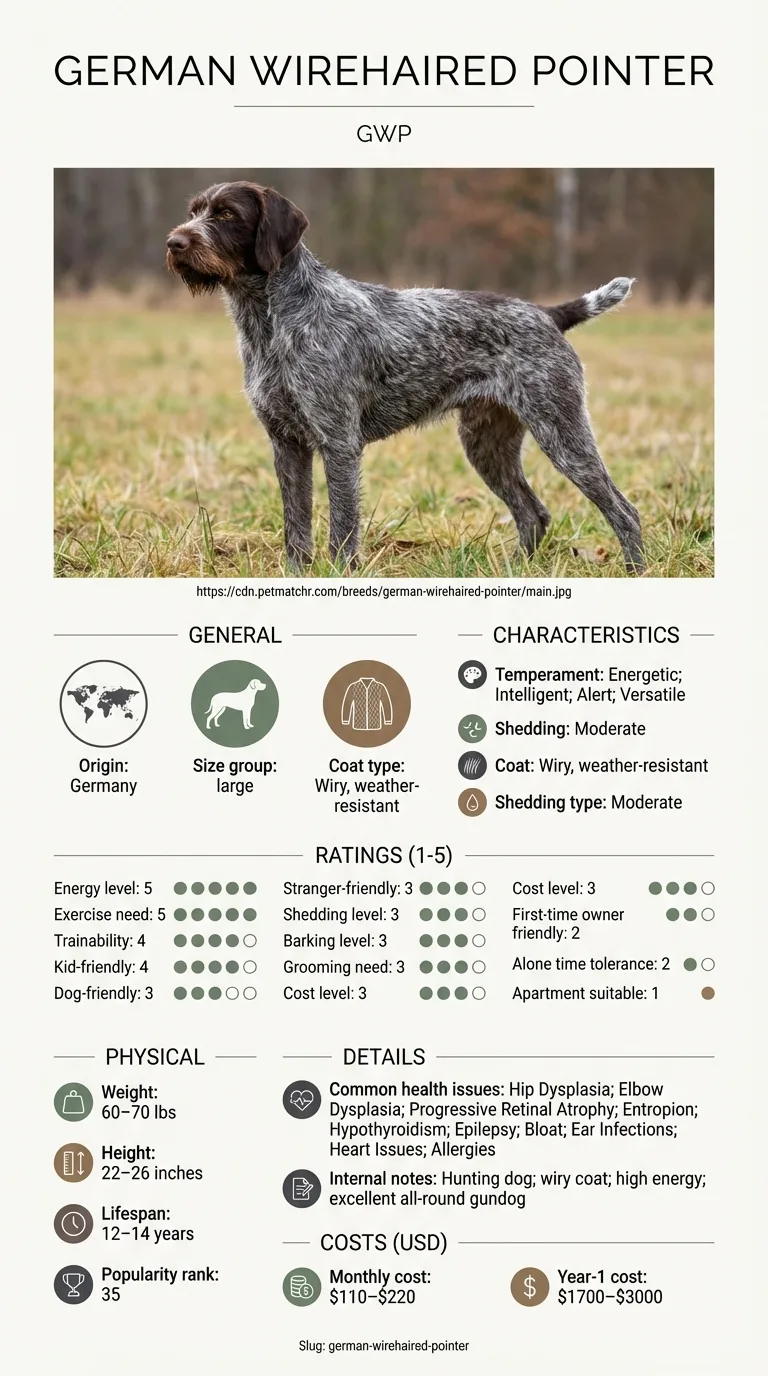
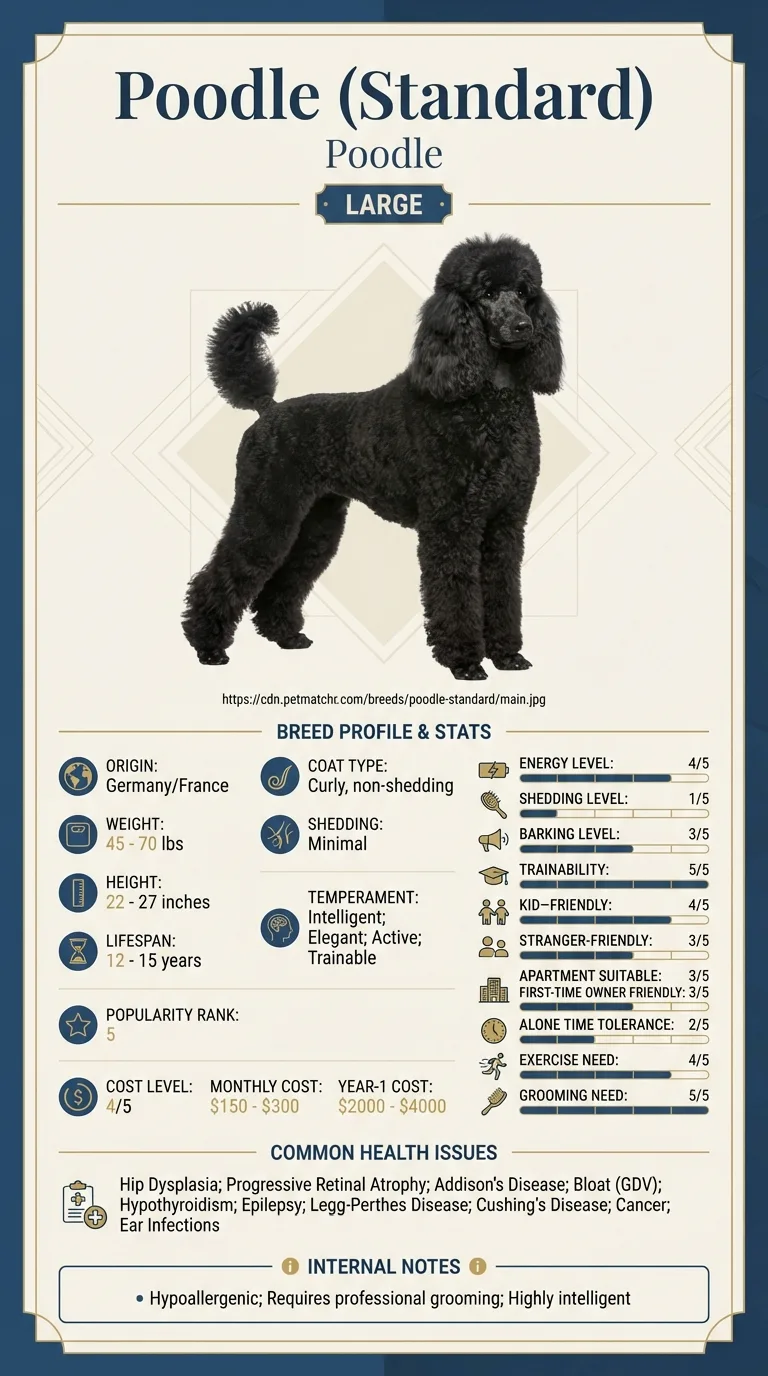
This is for someone already down to German Wirehaired Pointer and Poodle (Standard) and deciding between them. For this pair the decision usually turns on grooming need and apartment suitability, so those are covered first and in most detail. Anyone choosing from a flat has a clear answer here: Poodle (Standard) rates 3/5 against 1/5. The focus throughout is on daily consequences rather than breed background.
Between German Wirehaired Pointer and Poodle (Standard), grooming need is what separates them, and Poodle (Standard) is the lower-effort dog of the two to keep.
Choose German Wirehaired Pointer if you do not want a standing grooming appointment and you want a dog that can keep up with an active routine.
Choose Poodle (Standard) if you are in a flat or a smaller home, this is your first dog and shedding is a problem in your house.
| Feature | german wirehaired pointer | poodle standard | Winner |
|---|---|---|---|
| Size class | large | large | Equal |
| Weight | 60–70 lbs | 45–70 lbs | Equal |
| Height | 22–26 in | 22–27 in | Equal |
| Lifespan | 12–14 years | 12–15 years | poodle standard |
| Exercise need | Very high (5/5) | High (4/5) | poodle standard |
| Grooming need | Moderate (3/5) | Very high (5/5) | german wirehaired pointer |
| Shedding | Moderate (3/5) | Very low (1/5) | poodle standard |
| Energy level | Very high (5/5) | High (4/5) | Equal |
| Barking | Moderate (3/5) | Moderate (3/5) | Equal |
| Apartment suitability | Very low (1/5) | Moderate (3/5) | poodle standard |
| Good for first-time owners | Low (2/5) | Moderate (3/5) | poodle standard |
| Tolerates being alone | Low (2/5) | Low (2/5) | Equal |
| Trainability | High (4/5) | Very high (5/5) | poodle standard |
| Good with kids | High (4/5) | High (4/5) | Equal |
| Good with other dogs | Moderate (3/5) | High (4/5) | poodle standard |
| Friendly to strangers | Moderate (3/5) | Moderate (3/5) | Equal |
| Cost level | Moderate (3/5) | High (4/5) | german wirehaired pointer |
| Coat | Wiry, weather-resistant | Curly, non-shedding | Equal |
| Origin | Germany | Germany/France | Equal |
| Typical monthly cost | $110–$220 | $150–$300 | Equal |
| Typical first-year cost | $1,700–$3,000 | $2,000–$4,000 | Equal |
Unlike the size gap seen with smaller Poodle varieties, the Standard Poodle actually matches the German Wirehaired Pointer in scale: both are large dogs, with the Poodle's 45-70 lb range overlapping the GWP's 60-70 lbs and its 22-27 inch height nearly identical to the Pointer's 22-26 inches. A big Standard Poodle can outweigh a lean GWP entirely. The real distinction isn't stature but structure -- the Pointer's dense, broad-chested hunting build versus the Poodle's leaner, athletic frame originally shaped for water retrieving. Prospective owners choosing based on size alone will find little separating these two; temperament and coat matter far more here.
Both breeds bring serious drive: the GWP's exercise need sits at very high (5/5), just above the Standard Poodle's high (4/5), and energy levels are close too (5/5 vs 4/5, rated a tie). Neither is a couch companion. The Poodle, despite its elegant reputation, was originally a working water retriever and needs genuine daily exertion -- swimming, fetch, or long walks -- not just a stroll around the block. The GWP pushes further still, wanting field-style activity like retrieving drills or off-leash runs in secure areas. Anyone weighing these two on exercise alone should plan for at least an hour of activity regardless of which one they pick.
The Standard Poodle demands very high (5/5) grooming for its curly, non-shedding coat -- regular clips, brushing, and salon visits -- while shedding very low (1/5). The GWP flips the equation: moderate (3/5) grooming for its wiry, weather-resistant coat, but moderate (3/5) shedding that means regular fur around the house. For owners with allergies, the Poodle's coat is the safer bet despite the higher grooming bill; for owners who'd rather hand-strip a coat occasionally than book monthly salon appointments, the GWP is less demanding overall, just messier in the shedding department.
Both breeds score low for close-quarters living, but not equally: the GWP rates very low (1/5) for apartment suitability while the Standard Poodle manages a moderate (3/5), helped by its trainability and calmer indoor demeanor once exercised. Barking is tied at moderate (3/5) for both. Tolerance for being alone is also tied, and low (2/5) for each -- a real consideration since both breeds were bred to work alongside people and don't do well left to their own devices for long stretches. Large-breed apartment living is a stretch for either dog, but the Poodle adapts somewhat more gracefully than the field-driven Pointer.
Trainability tilts toward the Standard Poodle at very high (5/5), consistently ranked among the most trainable breeds, compared to the GWP's high (4/5). That edge carries into first-time owner suitability: the Poodle rates moderate (3/5) while the GWP sits at low (2/5), reflecting its independent, versatile hunting instincts that can frustrate an inexperienced handler expecting quick compliance. Both are highly intelligent -- trainable and elegant describe the Poodle's temperament, while energetic and versatile describe the GWP's -- but the Pointer's drive is bred for field decision-making, not obedience-ring precision, so novice owners typically find the Poodle the gentler learning curve.
Good with kids ties at high (4/5) for both breeds, so either can suit a family home. The gap shows with other dogs: the Poodle rates high (4/5) for sociability, the GWP moderate (3/5), again reflecting its more independent, hunting-focused temperament. Friendliness to strangers ties at moderate (3/5) -- neither breed is instantly outgoing with new people, nor is either aloof. Multi-dog households or families who host frequently may find the Poodle's more even, trainable temperament smooths social situations a bit more easily than the Pointer's alert, versatile disposition.
Lifespan gives the Standard Poodle a modest edge, 12-15 years against the GWP's 12-14. Their health lists overlap substantially: both face hip dysplasia, progressive retinal atrophy, hypothyroidism, epilepsy, and bloat (GDV). Beyond that shared ground, the GWP adds elbow dysplasia, entropion, ear infections, heart issues, and allergies, while the Standard Poodle's list includes Addison's disease, Legg-Perthes disease, Cushing's disease, cancer, and ear infections. The overlap on bloat is worth flagging specifically for both breeds -- both are deep-chested and should be fed accordingly, with slow-feed bowls and split meals a common precaution owners of either breed use.
Costs favor the GWP on paper: a moderate (3/5) overall cost level against the Standard Poodle's high (4/5), with monthly costs of $110-$220 versus $150-$300 and first-year costs of $1,700-$3,000 versus $2,000-$4,000. Grooming is the main driver of that gap -- a Standard Poodle's coat maintenance adds up fast at a groomer, while the GWP's wiry coat needs only occasional hand-stripping or trimming. Owners budgeting for either breed should factor in that a large dog's food costs alone are substantial, but the Poodle's styling requirements push its long-run expenses noticeably higher.
German Wirehaired Pointer weighs 60–70 lbs and lives 12–14 years; Poodle (Standard) weighs 45–70 lbs and lives 12–15 years. The two diverge most on grooming need, apartment suitability and shedding. They are level on tolerates being alone, barking and good with kids, so those cannot decide it. The table below marks a winner only where one breed is genuinely easier for a typical owner; size and origin are facts rather than merits and stay level. Ratings come from one source applied to both breeds, so they are meaningful against each other rather than as absolute scores.

Yes -- both are large breeds with overlapping weight (45-70 lbs for the Poodle, 60-70 lbs for the GWP) and nearly identical height ranges around 22-27 inches.
The German Wirehaired Pointer edges out the Standard Poodle, rating very high (5/5) on exercise need versus the Poodle's high (4/5), though both require serious daily activity.
The Standard Poodle, whose curly coat sheds very low (1/5) versus the GWP's moderate (3/5) shedding, though the Poodle needs very high (5/5) grooming to stay that way.
The Standard Poodle, rating moderate (3/5) for first-time owners against the GWP's low (2/5) -- its higher trainability and calmer indoor temperament make the learning curve gentler.
The Standard Poodle rates high (4/5) for sociability with other dogs, somewhat ahead of the GWP's moderate (3/5).
The Standard Poodle, rating high (4/5) on overall cost against the GWP's moderate (3/5), driven largely by grooming -- its first-year cost runs $2,000-$4,000 versus $1,700-$3,000 for the Pointer.
Yes -- bloat (GDV) appears on both breeds' health lists, a real risk for deep-chested large dogs that owners of either breed should watch for and discuss feeding strategies with their vet.
The Standard Poodle, rating very high (5/5) versus the GWP's high (4/5).
The German Wirehaired Pointer, at a moderate (3/5) versus the Poodle's very low (1/5).
The Standard Poodle, typically 12-15 years versus the GWP's 12-14 years.
The German Wirehaired Pointer, at $110-$220 versus the Poodle's $150-$300.
Secure checkout on Stripe. We never see your card.
7-day money-back guarantee. Instant access.
Health information here is general and is not veterinary advice. If your dog shows pain, sudden behaviour change, or worsening symptoms, consult a licensed veterinarian.
Some links on this site are affiliate links. We may earn a commission at no extra cost to you, and we only suggest products we believe are helpful for dog owners.
We research and check what we publish, but we do not warrant that any figure, date, price, or statement is accurate, complete, or current, and we accept no liability for any loss, cost, injury, or other harm arising from the use of this site. Use it as one reference among several. You remain responsible for your own decisions and for your dog's care - confirm anything that matters with a licensed veterinarian or another qualified professional before you act on it. Full disclaimer.
Match your lifestyle to the right dog.
Take quizNot sure which breed is right for you? Take our 2-minute quiz to find out.
Take the quiz