Behavior
Springer or Husky - which fits most households better?
The Springer, mainly on trainability (5/5 vs 2/5) and first-time-owner fit (3/5 vs 1/5) - the Husky demands an experienced, very active owner.

Quick answer
Springer or Husky - which fits most households better?
The Springer, mainly on trainability (5/5 vs 2/5) and first-time-owner fit (3/5 vs 1/5) - the Husky demands an experienced, very active owner.
English Springer Spaniel or Siberian Husky? On paper they differ most on trainability, and on the scales Siberian Husky is the heavier at 45–60 lbs. Here is how the two compare on everything that shapes an ordinary week.
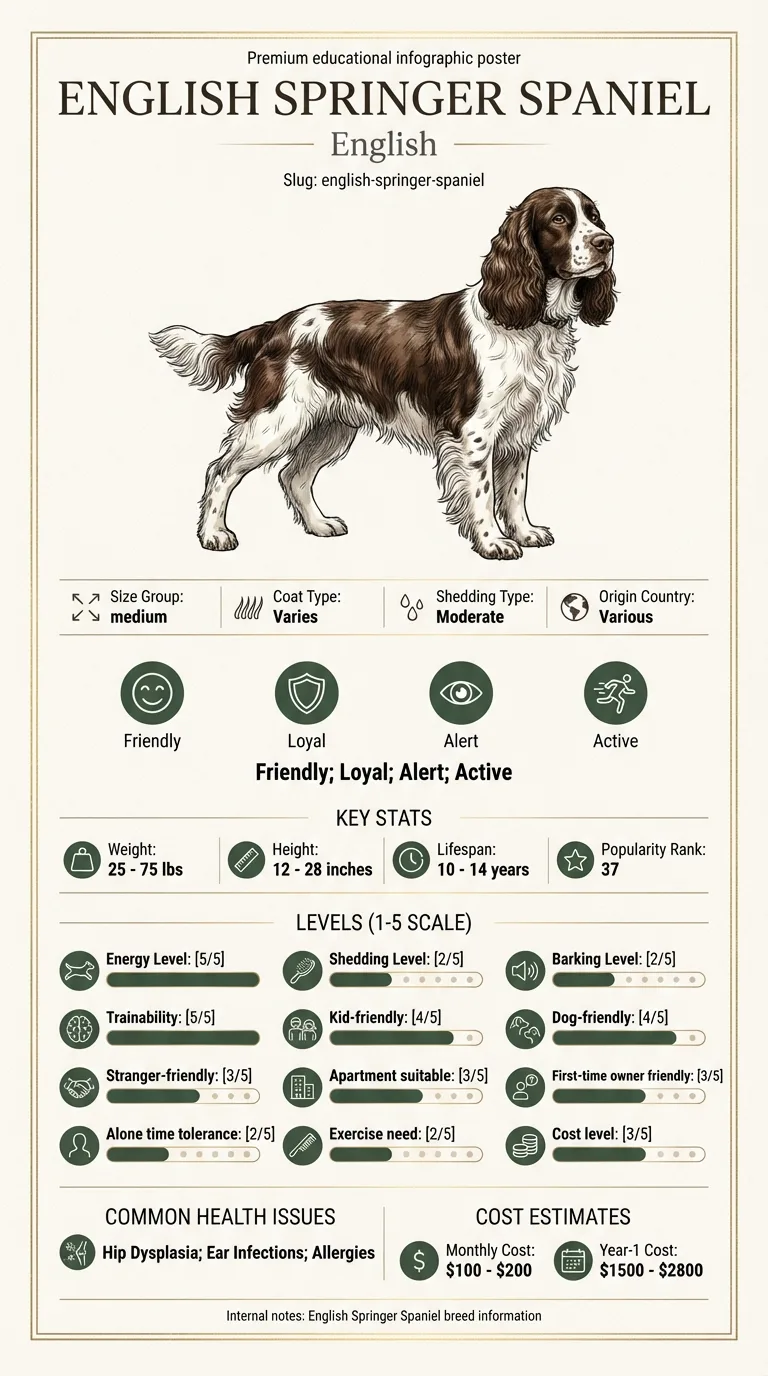
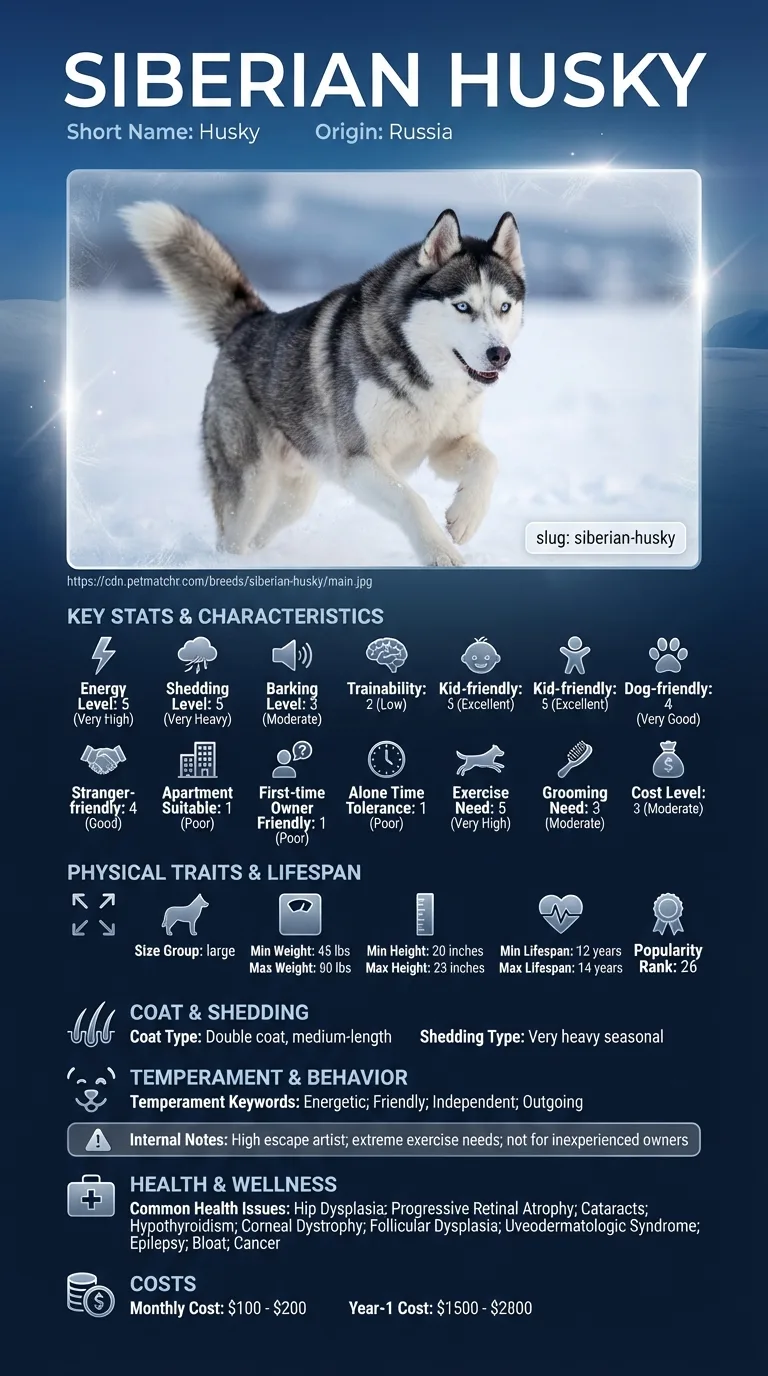
This is for someone already down to English Springer Spaniel and Siberian Husky and deciding between them. For this pair the decision usually turns on trainability and shedding, so those are covered first and in most detail. Anyone choosing from a flat has a clear answer here: English Springer Spaniel rates 2/5 against 1/5. The focus throughout is on daily consequences rather than breed background.
Between English Springer Spaniel and Siberian Husky, trainability is what separates them, and English Springer Spaniel is the lower-effort dog of the two to keep.
Choose English Springer Spaniel if this is your first dog, shedding is a problem in your house and you want a dog that picks up training quickly.
Choose Siberian Husky if you do not want a standing grooming appointment.
| Feature | english springer spaniel | siberian husky | Winner |
|---|---|---|---|
| Size class | medium | large | Equal |
| Weight | 40–50 lbs | 45–60 lbs | Equal |
| Height | 19–20 in | 20–23 in | Equal |
| Lifespan | 12–14 years | 12–14 years | Equal |
| Exercise need | Very high (5/5) | Very high (5/5) | Equal |
| Grooming need | High (4/5) | Moderate (3/5) | siberian husky |
| Shedding | Moderate (3/5) | Very high (5/5) | english springer spaniel |
| Energy level | Very high (5/5) | Very high (5/5) | Equal |
| Barking | Moderate (3/5) | Moderate (3/5) | Equal |
| Apartment suitability | Low (2/5) | Very low (1/5) | english springer spaniel |
| Good for first-time owners | Moderate (3/5) | Very low (1/5) | english springer spaniel |
| Tolerates being alone | Low (2/5) | Very low (1/5) | english springer spaniel |
| Trainability | Very high (5/5) | Low (2/5) | english springer spaniel |
| Good with kids | Very high (5/5) | Very high (5/5) | Equal |
| Good with other dogs | High (4/5) | High (4/5) | Equal |
| Friendly to strangers | High (4/5) | High (4/5) | Equal |
| Cost level | Moderate (3/5) | Moderate (3/5) | Equal |
| Coat | Medium, feathered double coat | Double coat, medium-length | Equal |
| Origin | Various | Russia | Equal |
| Typical monthly cost | $100–$200 | $100–$200 | Equal |
| Typical first-year cost | $1,400–$2,900 | $1,500–$2,800 | Equal |
The Husky has the edge in size across the board, 45-60 lbs to the Springer's 40-50, and 20-23 inches tall against 19-20. It's not a dramatic difference, more a size class up within what both breeds sit at on the medium-to-large end, but it's enough that a crate, harness, or car space sized for one won't necessarily fit the other comfortably.
Both breeds max out exercise need at 5/5, and this is a real tie, not a technicality. A Husky bred to pull sleds for hours and a Springer bred to flush and retrieve across a field for a full afternoon are both going to want considerably more than a walk around the block, and both will get restless and destructive without it.
Grooming actually favors the Husky slightly, 3/5 against the Springer's 4/5, but shedding is no contest at all - the Husky rates 5/5, the very top of the scale, while the Springer sits at a more moderate 3/5. Anyone who's lived through a Husky's seasonal coat blow knows exactly what that top score means in terms of fur on the furniture.
This is where the two breeds split hardest. Husky apartment suitability rates 1/5, the bottom of the scale, and alone tolerance is also 1/5 - a Husky left alone in a small space for long stretches is a well-known recipe for howling and destruction. The Springer isn't great either at 2/5 on both counts, but it's meaningfully less extreme than the Husky's rock-bottom numbers.
Springer trainability sits at 5/5; Husky trainability sits at just 2/5, and the first-time-owner score reflects it starkly, 3/5 for the Springer against only 1/5 for the Husky. Huskies are smart but famously uninterested in pleasing their owner, which is a fundamentally different training problem than a dog that's simply slow to learn commands, and it trips up a lot of new owners.
Both breeds score well with kids, 5/5 for each, and with other dogs, 4/5 for each, and both rate friendly to strangers at 4/5 as well. So despite the training and independence gap, neither breed is antisocial. The Husky's outgoing, independent streak just means that friendliness doesn't come bundled with the same eagerness to obey that defines the Springer's whole temperament profile.
Lifespan ties exactly at 12-14 years for both breeds. The Husky's health list runs considerably longer, though, at ten conditions including bloat and cancer, against the Springer's five. Both breeds share hip dysplasia and progressive retinal atrophy on their lists, so joint and eye screening matters regardless of which one you bring home, even beyond the conditions unique to each.
Cost levels tie at moderate, 3/5 for both, and the monthly ranges are nearly identical, $100-200 for the Springer against the same $100-200 for the Husky. First-year totals differ only slightly, $1,400-2,900 versus $1,500-2,800, so budget planning doesn't really tip toward either breed on dollars alone. Whichever you choose, the bigger cost swing will come from vet visits tied to each breed's own health list, not routine monthly upkeep.
English Springer Spaniel weighs 40–50 lbs and lives 12–14 years; Siberian Husky weighs 45–60 lbs and lives 12–14 years. The two diverge most on trainability, shedding and good for first-time owners. They are level on barking, cost level and good with other dogs, so those cannot decide it. The table below marks a winner only where one breed is genuinely easier for a typical owner; size and origin are facts rather than merits and stay level. Ratings come from one source applied to both breeds, so they are meaningful against each other rather than as absolute scores.

Fairly close - the Husky is a bit bigger at 45-60 lbs and 20-23 inches against the Springer's 40-50 lbs and 19-20 inches, but both sit in the medium-to-large range.
The Husky, by a lot - it rates 5/5 on shedding, the maximum, against the Springer's 3/5. Expect a heavy seasonal coat blow with the Husky.
The Springer is the safer choice at 3/5 versus the Husky's 1/5, the lowest score on this table. Huskies combine high exercise needs with low trainability and low tolerance for being alone, a difficult combination for a beginner.
Neither is a great fit, but the Husky is worse - 1/5 on apartment suitability against the Springer's 2/5, plus the Husky's 1/5 tolerance for being left alone.
They're essentially tied - $100-200 for the Springer, the same $100-200 for the Husky.
Yes, on hip dysplasia and progressive retinal atrophy. Beyond that the Husky's list is longer and includes bloat and cancer, conditions not listed for the Springer.
The Springer, clearly - 5/5 against the Husky's 2/5. Huskies are intelligent but independent-minded, which shows up as resistance rather than an inability to learn.
The Springer, mainly on trainability (5/5 vs 2/5) and first-time-owner fit (3/5 vs 1/5) - the Husky demands an experienced, very active owner.
Neither - both run $100-200 a month.
Tied, both rated 5/5 - neither breed is low-maintenance on activity.
Tied at 12-14 years for both.
Secure checkout on Stripe. We never see your card.
7-day money-back guarantee. Instant access.
Health information here is general and is not veterinary advice. If your dog shows pain, sudden behaviour change, or worsening symptoms, consult a licensed veterinarian.
Some links on this site are affiliate links. We may earn a commission at no extra cost to you, and we only suggest products we believe are helpful for dog owners.
We research and check what we publish, but we do not warrant that any figure, date, price, or statement is accurate, complete, or current, and we accept no liability for any loss, cost, injury, or other harm arising from the use of this site. Use it as one reference among several. You remain responsible for your own decisions and for your dog's care - confirm anything that matters with a licensed veterinarian or another qualified professional before you act on it. Full disclaimer.
Match your lifestyle to the right dog.
Take quizNot sure which breed is right for you? Take our 2-minute quiz to find out.
Take the quiz