Living
Which handles apartment life better?
The Pomeranian rates very high (5/5) for apartments against the Collie's low (2/5), though it barks more and dislikes being left alone.

Quick answer
Which handles apartment life better?
The Pomeranian rates very high (5/5) for apartments against the Collie's low (2/5), though it barks more and dislikes being left alone.
Collie (Rough Collie) or Pomeranian? On paper they differ most on apartment suitability, and on the scales Collie (Rough Collie) is the heavier at 50–75 lbs. Here is how the two compare on everything that shapes an ordinary week.
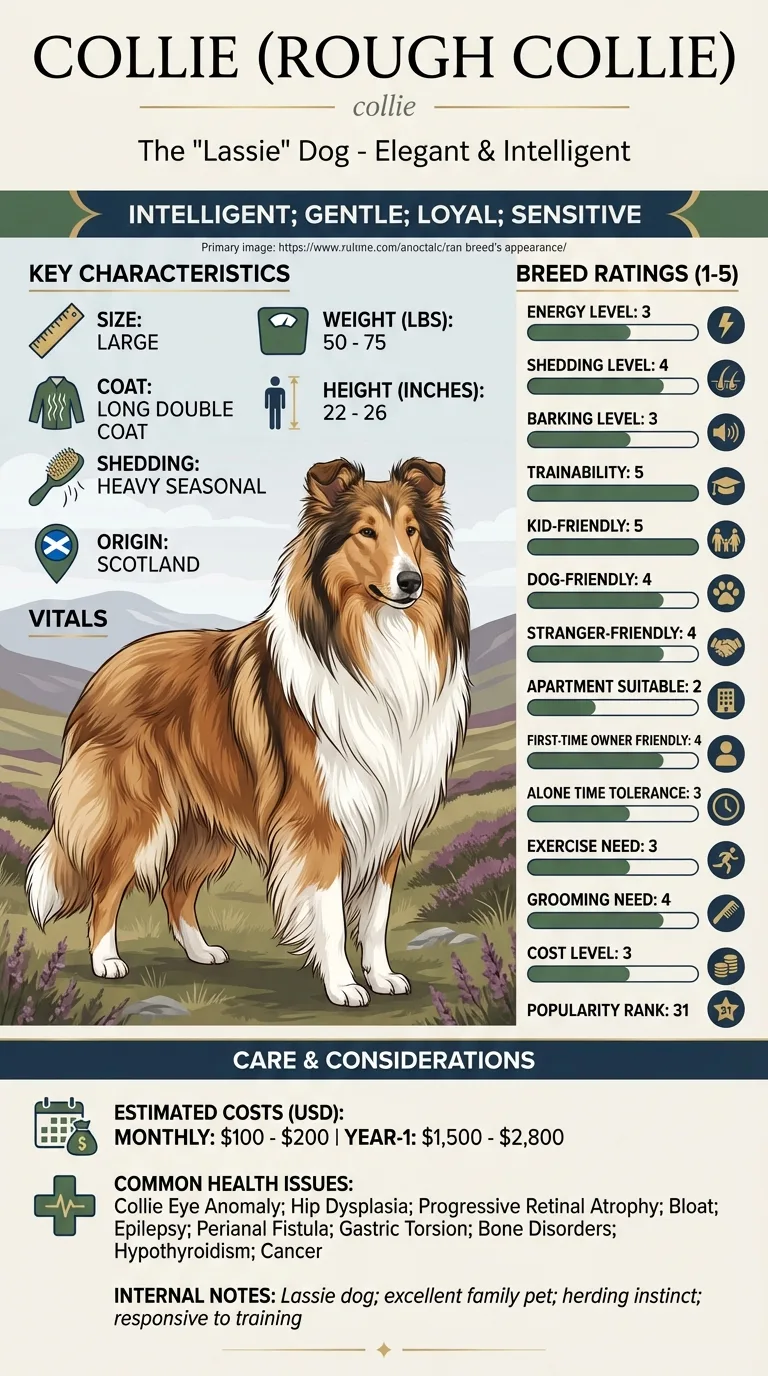
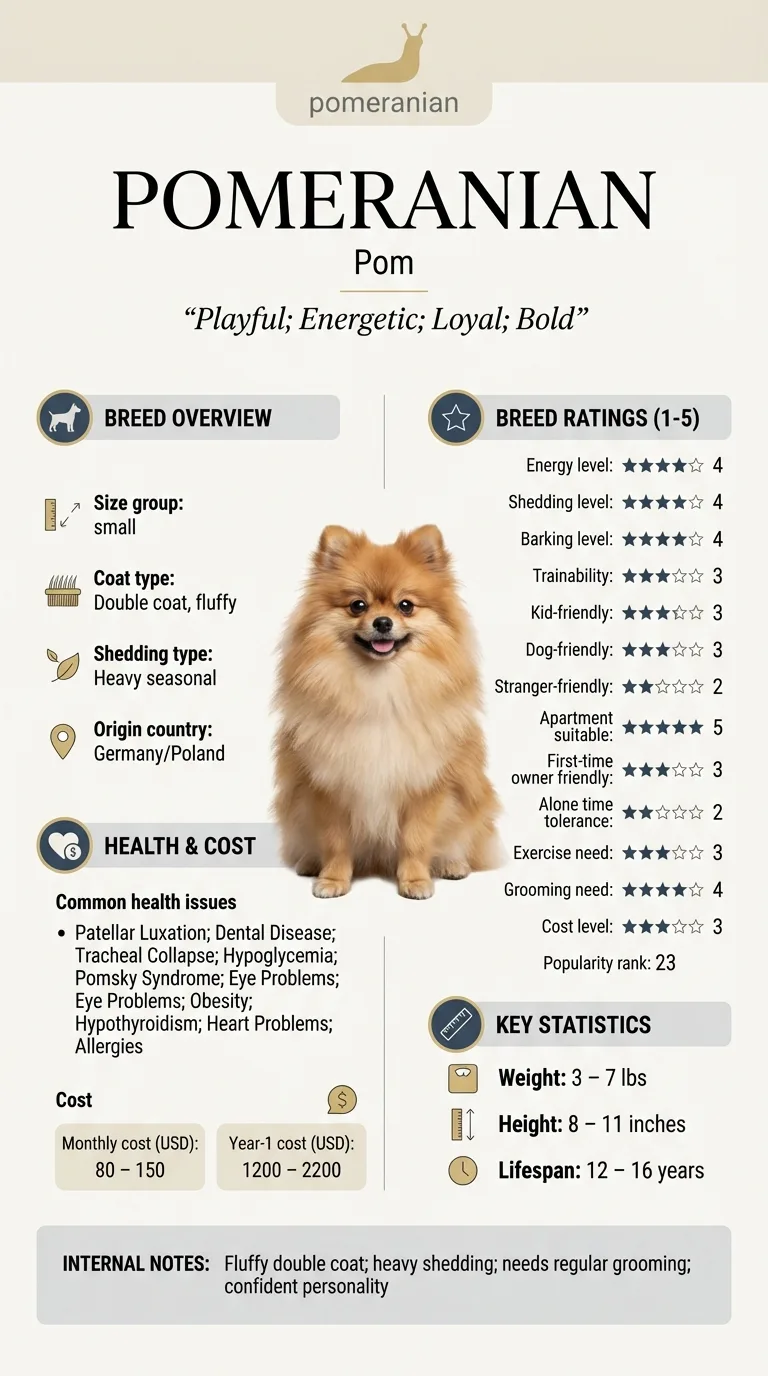
This is for someone already down to Collie (Rough Collie) and Pomeranian and deciding between them. For this pair the decision usually turns on apartment suitability and good with kids, so those are covered first and in most detail. Anyone choosing from a flat has a clear answer here: Pomeranian rates 5/5 against 2/5. The focus throughout is on daily consequences rather than breed background.
Between Collie (Rough Collie) and Pomeranian, apartment suitability is what separates them, and Pomeranian is the lower-effort dog of the two to keep.
Choose Collie (Rough Collie) if this is your first dog, the dog will be alone during the working day and there are young children at home.
Choose Pomeranian if you are in a flat or a smaller home, a smaller dog suits your car, your home or your back and you want a dog that is more watchful with visitors.
| Feature | collie | pomeranian | Winner |
|---|---|---|---|
| Size class | large | small | Equal |
| Weight | 50–75 lbs | 3–7 lbs | Equal |
| Height | 22–26 in | 8–11 in | Equal |
| Lifespan | 11–14 years | 12–16 years | pomeranian |
| Exercise need | Moderate (3/5) | Moderate (3/5) | Equal |
| Grooming need | High (4/5) | High (4/5) | Equal |
| Shedding | High (4/5) | High (4/5) | Equal |
| Energy level | Moderate (3/5) | High (4/5) | Equal |
| Barking | Moderate (3/5) | High (4/5) | collie |
| Apartment suitability | Low (2/5) | Very high (5/5) | pomeranian |
| Good for first-time owners | High (4/5) | Moderate (3/5) | collie |
| Tolerates being alone | Moderate (3/5) | Low (2/5) | collie |
| Trainability | Very high (5/5) | Moderate (3/5) | collie |
| Good with kids | Very high (5/5) | Moderate (3/5) | collie |
| Good with other dogs | High (4/5) | Moderate (3/5) | collie |
| Friendly to strangers | High (4/5) | Low (2/5) | collie |
| Cost level | Moderate (3/5) | Moderate (3/5) | Equal |
| Coat | Long double coat | Double coat, fluffy | Equal |
| Origin | Scotland | Germany/Poland | Equal |
| Typical monthly cost | $100–$200 | $80–$150 | Equal |
| Typical first-year cost | $1,500–$2,800 | $1,200–$2,200 | Equal |
Put a Pomeranian next to a Rough Collie and the size difference borders on comical: 3-7 pounds and 8-11 inches versus 50-75 pounds and 22-26 inches. The Pomeranian is one of the smallest breeds on this site, small enough that careless handling is a real injury risk, while the Collie is a genuinely large dog that needs room to turn around. Pick based on how much physical dog you actually want in your house.
Energy levels are closer than the size gap suggests -- the Collie sits at moderate (3/5) and the Pomeranian at high (4/5), meaning the smaller dog is proportionally the more restless one. Because the Pomeranian is tiny, though, that higher energy burns off in a living room in a way a Collie's moderate energy can't. Expect the Collie to need actual outdoor exercise, and the Pomeranian to need indoor engagement instead.
Don't assume the small dog is the low-maintenance one here. Both breeds rate high (4/5) for grooming and shedding -- the Pomeranian's fluffy double coat sheds just as much as the Collie's long double coat, pound for pound arguably more. If you were hoping the smaller breed would mean less vacuuming, this pairing won't deliver that. Budget for a regular brushing routine no matter which one comes home with you.
The Pomeranian rates very high (5/5) for apartment suitability against the Collie's low (2/5), and it also barks more -- high (4/5) versus the Collie's moderate (3/5). It tolerates being alone worse too, rating low (2/5) against the Collie's moderate (3/5). So while the Pomeranian fits a small space physically, it's the more demanding roommate when you're out at work all day.
This is a category where the Collie pulls ahead across the board: trainability very high (5/5) versus the Pomeranian's moderate (3/5), and first-time-owner suitability high (4/5) versus moderate (3/5). Pomeranians are intelligent but can be stubborn and prone to small-dog behavioral issues if training is skipped because "it's just a small dog." A first-time owner will likely have an easier time with the Collie.
With kids, other dogs, and strangers, the Collie rates higher on every single line -- very high (5/5) with kids versus moderate (3/5), high (4/5) with other dogs versus moderate (3/5), and high (4/5) with strangers versus low (2/5) for the Pomeranian. None of that makes the Pomeranian a bad dog, but a busier household with kids, guests, or other pets leans clearly toward the Collie.
The Pomeranian typically lives 12-16 years against the Collie's 11-14, giving it a slight edge on longevity, especially at the upper end. Both share hypothyroidism on their health lists. Beyond that they diverge: the Pomeranian's ten tracked conditions include tracheal collapse, hypoglycemia, and heart problems, while the Collie's list leans toward Collie Eye Anomaly, hip dysplasia, and bloat. Neither list is short -- budget for regular vet checkups either way.
Both breeds land at moderate (3/5) on overall cost level, and their monthly figures are close -- $100-$200 for the Collie, $80-$150 for the Pomeranian. First-year costs run $1,500-$2,800 versus $1,200-$2,200. The gap narrows here compared to other size mismatches on this site, mainly because Pomeranian grooming demands more than you'd expect from a dog that small.
Collie (Rough Collie) weighs 50–75 lbs and lives 11–14 years; Pomeranian weighs 3–7 lbs and lives 12–16 years. The two diverge most on apartment suitability, good with kids and trainability and 1 other rated axes. They are level on cost level, exercise need and grooming need, so those cannot decide it. The table below marks a winner only where one breed is genuinely easier for a typical owner; size and origin are facts rather than merits and stay level. Ratings come from one source applied to both breeds, so they are meaningful against each other rather than as absolute scores.

Yes -- a Pomeranian weighs 3-7 pounds, which is roughly a tenth of a Collie's 50-75 pounds. It's one of the more extreme size gaps you'll find on a breed comparison.
Not in this case. Both breeds rate high (4/5) for shedding -- the Pomeranian's dense double coat sheds just as heavily as the Collie's, so don't buy a Pomeranian expecting a low-shed dog.
The Collie rates high (4/5) for first-time owners against the Pomeranian's moderate (3/5), and it also beats the Pomeranian on trainability. If this is your first dog, the Collie is the statistically easier route.
The Pomeranian, by a wide margin -- very high (5/5) versus the Collie's low (2/5). It does bark more and tolerates being alone less well, so pair it with a plan for daytime company.
$80-$150 for a Pomeranian or $100-$200 for a Collie, with both landing at a moderate (3/5) overall cost level despite the size difference.
Hypothyroidism appears on both lists, so it's worth asking a breeder or vet about thyroid screening regardless of which breed you choose. Otherwise their risk profiles are distinct -- the Pomeranian runs more toward tracheal and cardiac issues, the Collie toward eye and orthopedic conditions.
The Collie again -- high (4/5) with strangers and high (4/5) with other dogs, against the Pomeranian's low (2/5) and moderate (3/5). The Pomeranian tends to be more reserved outside its immediate household.
The Pomeranian rates very high (5/5) for apartments against the Collie's low (2/5), though it barks more and dislikes being left alone.
Modest -- $80-$150 for a Pomeranian versus $100-$200 for a Collie. Both rate moderate (3/5) on overall cost level.
The Collie, rating very high (5/5) on trainability against the Pomeranian's moderate (3/5) -- a meaningful gap for a new owner.
The Collie scores higher across the board -- high with strangers and other dogs, where the Pomeranian rates low to moderate on the same measures.
Secure checkout on Stripe. We never see your card.
7-day money-back guarantee. Instant access.
Health information here is general and is not veterinary advice. If your dog shows pain, sudden behaviour change, or worsening symptoms, consult a licensed veterinarian.
Some links on this site are affiliate links. We may earn a commission at no extra cost to you, and we only suggest products we believe are helpful for dog owners.
We research and check what we publish, but we do not warrant that any figure, date, price, or statement is accurate, complete, or current, and we accept no liability for any loss, cost, injury, or other harm arising from the use of this site. Use it as one reference among several. You remain responsible for your own decisions and for your dog's care - confirm anything that matters with a licensed veterinarian or another qualified professional before you act on it. Full disclaimer.
Match your lifestyle to the right dog.
Take quizNot sure which breed is right for you? Take our 2-minute quiz to find out.
Take the quiz