This comes down to size and grooming tolerance more than temperament -- the two breeds behave almost identically on paper. Pick the shiba if you want a smaller, cheaper-to-maintain dog with the same independent streak.
Chow Chow or Shiba Inu? On paper they differ most on grooming need, and on the scales Chow Chow is the heavier at 45–70 lbs. Here is how the two compare on everything that shapes an ordinary week.
This is for someone already down to Chow Chow and Shiba Inu and deciding between them. For this pair the decision usually turns on grooming need and energy level, so those are covered first and in most detail. Both rate 4/5 for flats, so housing does not settle this one. It is written for the decision rather than the breed history.
Quick verdict
Between Chow Chow and Shiba Inu, grooming need is what separates them, and Shiba Inu is the lower-effort dog of the two to keep.
Choose chow chow if...
Choose Chow Chow if your walking routine is modest.
Choose shiba inu if...
Choose Shiba Inu if you do not want a standing grooming appointment, a smaller dog suits your car, your home or your back and you want a dog that can keep up with an active routine.
Head-to-head comparison
Feature
chow chow
shiba inu
Winner
Size class
medium
small
Equal
Weight
45–70 lbs
17–23 lbs
Equal
Height
17–20 in
13–16 in
Equal
Lifespan
9–15 years
13–16 years
shiba inu
Exercise need
Low (2/5)
Moderate (3/5)
chow chow
Grooming need
Very high (5/5)
Moderate (3/5)
shiba inu
Shedding
High (4/5)
High (4/5)
Equal
Energy level
Low (2/5)
High (4/5)
Equal
Barking
Moderate (3/5)
Moderate (3/5)
Equal
Apartment suitability
High (4/5)
High (4/5)
Equal
Good for first-time owners
Low (2/5)
Low (2/5)
Equal
Tolerates being alone
Moderate (3/5)
Moderate (3/5)
Equal
Trainability
Low (2/5)
Low (2/5)
Equal
Good with kids
Moderate (3/5)
Moderate (3/5)
Equal
Good with other dogs
Low (2/5)
Low (2/5)
Equal
Friendly to strangers
Low (2/5)
Low (2/5)
Equal
Cost level
High (4/5)
Moderate (3/5)
shiba inu
Coat
Thick double coat
Double coat, medium
Equal
Origin
China
Japan
Equal
Typical monthly cost
$120–$250
$80–$160
Equal
Typical first-year cost
$1,600–$3,000
$1,200–$2,300
Equal
Deep dive
Size and build
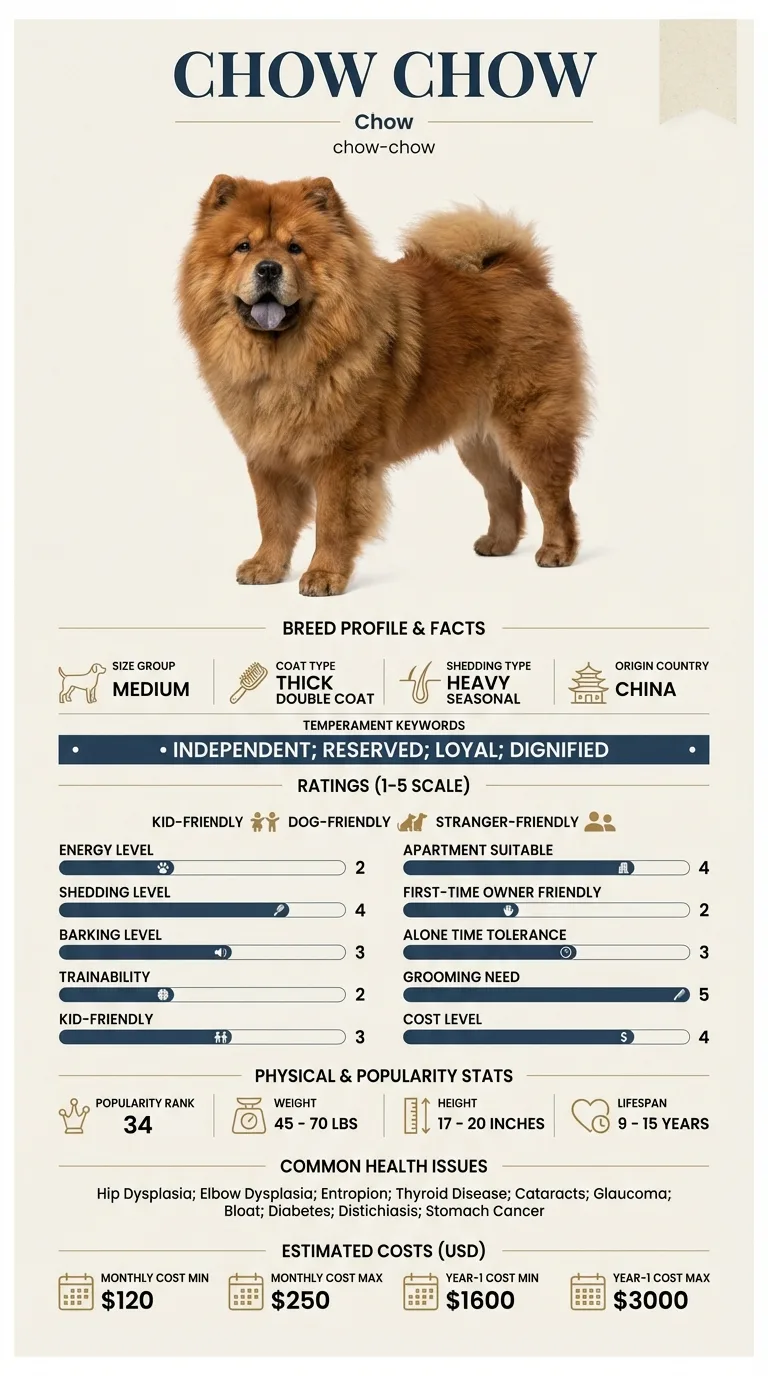
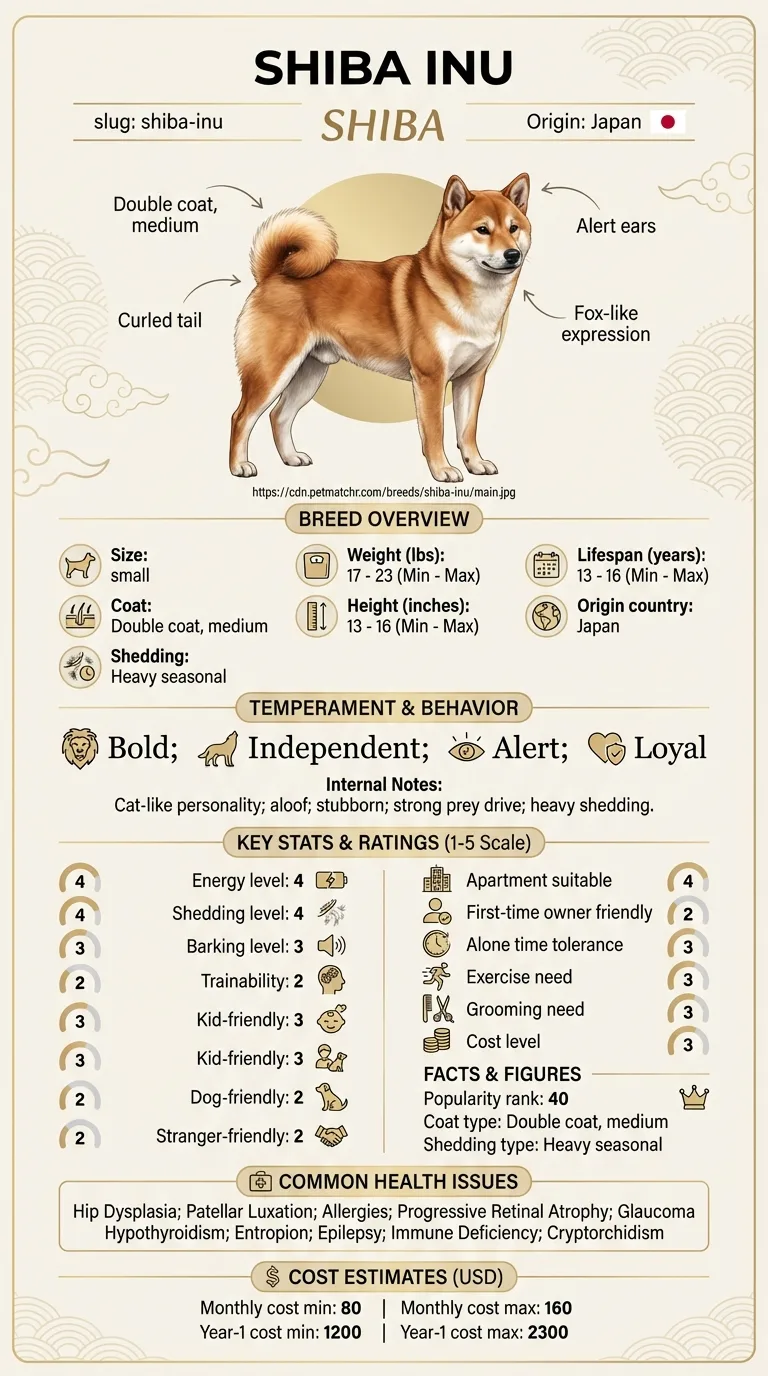
These two are closer in spirit than in scale. Chow chow runs 45-70 lbs and stands 17-20 in; shiba inu is barely half that weight at 17-23 lbs and 13-16 in tall. Both are classed by build rather than bulk -- chow medium, shiba small -- but side by side, the chow's dense coat and heavier frame make the size gap look even bigger than the numbers alone suggest.
Energy and exercise
Both are relatively easygoing by breed standards -- chow low (2/5), shiba moderate (3/5) -- a smaller gap than you'd see against a working breed. Energy level is rated a tie despite the shiba nominally reading higher; in practice neither dog needs marathon exercise, though the shiba benefits from more consistent daily activity than the chow does. A short daily walk plus some yard time keeps both breeds satisfied.
Grooming and shedding
Grooming is where they separate. Chow chow sits at very high (5/5) -- that thick double coat needs real, regular attention -- while the shiba is moderate (3/5), a coat that mostly takes care of itself between baths. Shedding, though, is a tie: both rate high (4/5), and shiba owners will tell you the seasonal "blow" rivals anything a chow produces.
Apartment living, noise and time alone
Nearly identical here -- both rate high (4/5) on apartment suitability and moderate (3/5) on barking, with moderate (3/5) tolerance for alone time each. Neither breed is naturally yappy, and both can settle into a smaller home given their low-to-moderate exercise needs. This is one of the few sections where the data gives you almost no reason to prefer one over the other.
Training and owner experience
Both breeds rate low (2/5) on trainability and low (2/5) as a first-time-owner pick -- and the shared temperament words explain why. Chow chow is listed as independent and reserved; shiba inu is listed as bold and independent. Two independent-minded breeds means two dogs that won't hand you an easy obedience class, regardless of which one ends up on your leash.
Kids, other dogs and visitors
Another near-tie: moderate (3/5) with kids, low (2/5) with other dogs, low (2/5) with strangers -- identical scores for both breeds. If household sociability is your deciding factor, this comparison won't settle it for you; look instead at size, grooming, and cost, where the two breeds actually diverge. Neither is naturally the dog that greets a stranger at the door like an old friend, so socialization work matters early with either one.
Health and lifespan
Shiba inu's lifespan edges longer, 13-16 years versus the chow's 9-15. The two share real health overlap too: both lists include hip dysplasia, entropion and glaucoma, so eye and joint screening is worth budgeting for regardless of which breed you choose. Past that they split -- chow adds bloat, diabetes and stomach cancer, while the shiba's list includes patellar luxation, epilepsy and immune deficiency.
Cost to keep
Shiba is the cheaper breed to keep -- cost level moderate (3/5) against the chow's high (4/5), monthly $80-160 versus $120-250, first-year $1,200-2,300 versus $1,600-3,000. The chow's heavier grooming schedule accounts for most of that gap; feeding a smaller shiba costs less too, given the weight difference. Over several years, that gap compounds into real savings even before factoring in either breed's vet visits.
Chow Chow vs Shiba Inu at a glance
Chow Chow weighs 45–70 lbs and lives 9–15 years; Shiba Inu weighs 17–23 lbs and lives 13–16 years. The two diverge most on grooming need and energy level. They are level on tolerates being alone, apartment suitability and barking, so those cannot decide it. In the table, a "winner" means easier for an ordinary household — not better. Size, coat and origin are recorded without a verdict. Because both breeds are scored the same way, the gaps are reliable even where the absolute numbers are rough.
Chow Chow vs Shiba Inu: Which Suits Your Home? - Chow Chow vs Shiba Inu at a glance
Frequently asked questions
Are chow chows and shiba inus actually similar dogs?
In temperament, yes -- both are described as independent, and both rate identically on trainability (low, 2/5), first-time-owner fit (low, 2/5), and sociability with kids, other dogs and strangers. The real differences are size, coat maintenance, and cost.
Which is bigger?
The chow chow, by a wide margin -- 45-70 lbs versus the shiba's 17-23 lbs. The shiba is classified small, the chow medium.
Which sheds more?
Neither -- both rate high (4/5) on shedding. Shiba owners often underestimate this; the breed's seasonal coat blow is just as heavy as a chow's, just over a smaller surface area.
Is either good for a first-time owner?
Not especially -- both rate low (2/5) for first-time owners and low (2/5) on trainability. These are independent-minded breeds that test a beginner's patience about equally.
Which costs less to keep?
The shiba inu -- $80-160 a month versus $120-250 for the chow, and $1,200-2,300 in year one versus $1,600-3,000. Less coat to maintain and less dog to feed both factor in.
Do they share health risks?
Yes, more than most pairings -- both breeds carry hip dysplasia, entropion and glaucoma risk. The shiba adds patellar luxation and epilepsy; the chow adds bloat and stomach cancer.
Which lives longer?
The shiba inu, typically 13-16 years against the chow's 9-15. It's one of the more consistent lifespan gaps in this comparison.
This comes down to size and grooming tolerance more than temperament -- the two breeds behave almost identically on paper. Pick the shiba if you want a smaller, cheaper-to-maintain dog with the same independent streak.
Health information here is general and is not veterinary advice. If your dog shows pain, sudden behaviour change, or worsening symptoms, consult a licensed veterinarian.
Some links on this site are affiliate links. We may earn a commission at no extra cost to you, and we only suggest products we believe are helpful for dog owners.
We research and check what we publish, but we do not warrant that any figure, date, price, or statement is accurate, complete, or current, and we accept no liability for any loss, cost, injury, or other harm arising from the use of this site. Use it as one reference among several. You remain responsible for your own decisions and for your dog's care - confirm anything that matters with a licensed veterinarian or another qualified professional before you act on it. Full disclaimer.