Living
Which breed is smaller?
The Brittany, at 30-40 lbs, is somewhat lighter than the English Springer Spaniel's 40-50 lbs.

Quick answer
Which breed is smaller?
The Brittany, at 30-40 lbs, is somewhat lighter than the English Springer Spaniel's 40-50 lbs.
Brittany Spaniel or English Springer Spaniel? On paper they differ most on grooming need, and on the scales English Springer Spaniel is the heavier at 40–50 lbs. Here is how the two compare on everything that shapes an ordinary week.
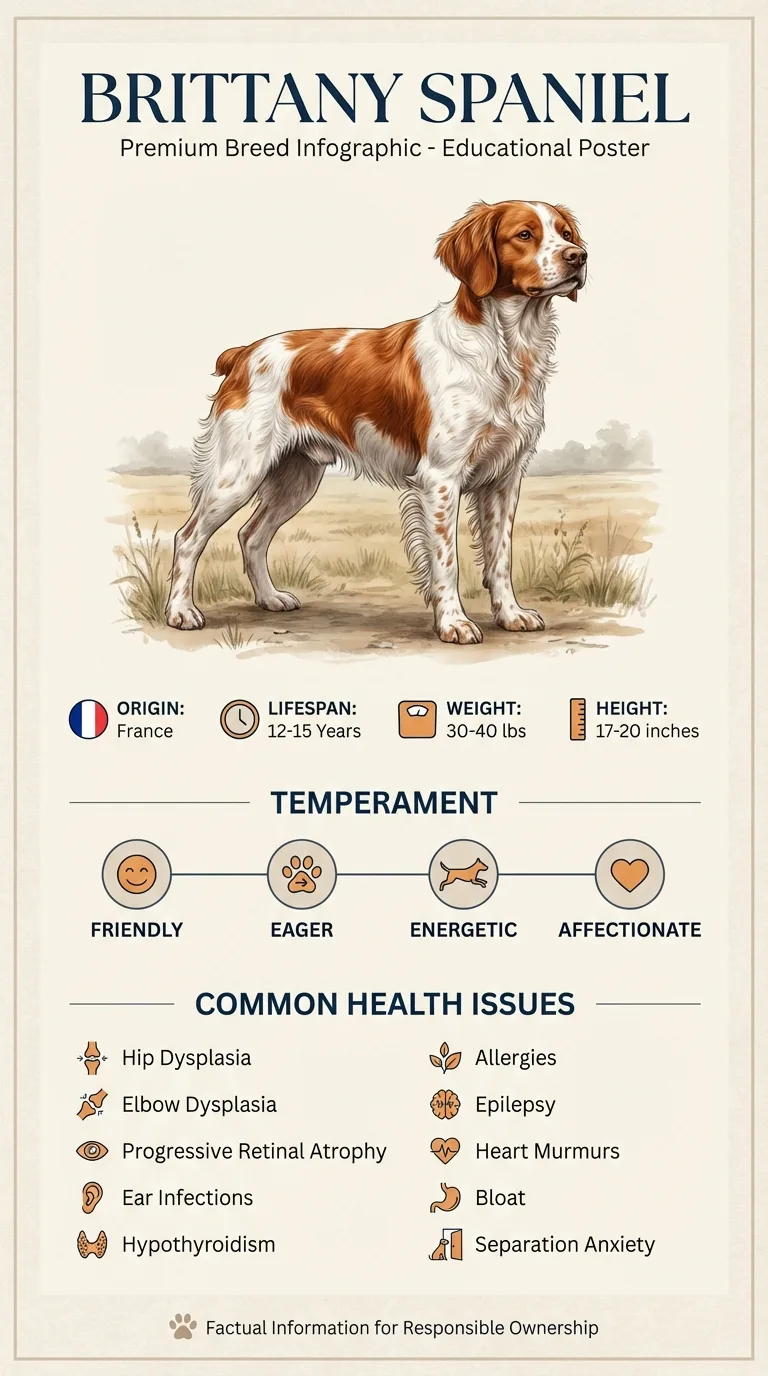
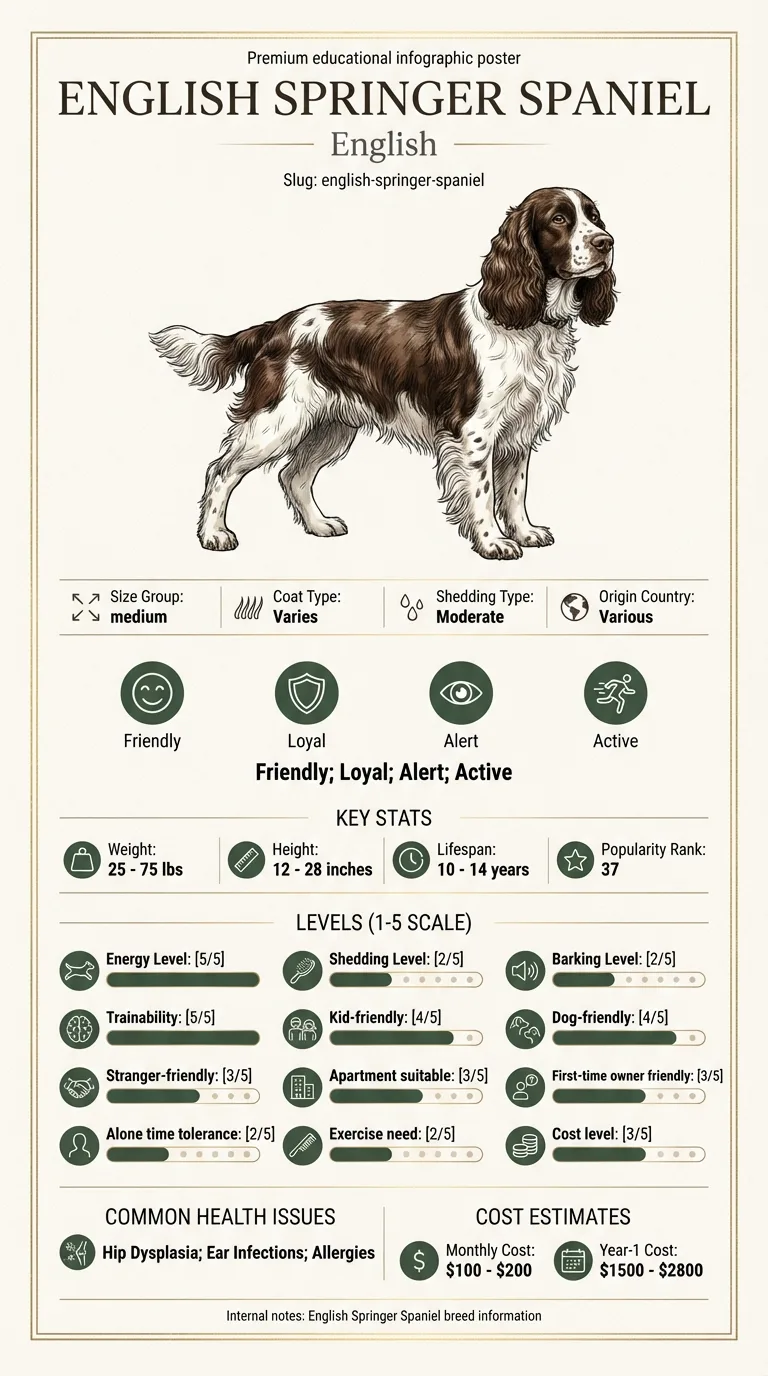
This is for someone already down to Brittany Spaniel and English Springer Spaniel and deciding between them. For this pair the decision usually turns on grooming need, so those are covered first and in most detail. Anyone choosing from a flat has a clear answer here: Brittany Spaniel rates 3/5 against 2/5. It is written for the decision rather than the breed history.
Between Brittany Spaniel and English Springer Spaniel, grooming need is what separates them, and Brittany Spaniel is the lower-effort dog of the two to keep.
Choose Brittany Spaniel if you are in a flat or a smaller home, this is your first dog and you do not want a standing grooming appointment.
Choose English Springer Spaniel if you want a dog that can keep up with an active routine.
| Feature | brittany | english springer spaniel | Winner |
|---|---|---|---|
| Size class | medium | medium | Equal |
| Weight | 30–40 lbs | 40–50 lbs | Equal |
| Height | 17–20 in | 19–20 in | Equal |
| Lifespan | 12–15 years | 12–14 years | brittany |
| Exercise need | High (4/5) | Very high (5/5) | brittany |
| Grooming need | Low (2/5) | High (4/5) | brittany |
| Shedding | Moderate (3/5) | Moderate (3/5) | Equal |
| Energy level | High (4/5) | Very high (5/5) | Equal |
| Barking | Low (2/5) | Moderate (3/5) | brittany |
| Apartment suitability | Moderate (3/5) | Low (2/5) | brittany |
| Good for first-time owners | High (4/5) | Moderate (3/5) | brittany |
| Tolerates being alone | Low (2/5) | Low (2/5) | Equal |
| Trainability | Very high (5/5) | Very high (5/5) | Equal |
| Good with kids | Very high (5/5) | Very high (5/5) | Equal |
| Good with other dogs | Very high (5/5) | High (4/5) | brittany |
| Friendly to strangers | High (4/5) | High (4/5) | Equal |
| Cost level | Moderate (3/5) | Moderate (3/5) | Equal |
| Coat | Medium, wavy coat | Medium, feathered double coat | Equal |
| Origin | France | Various | Equal |
| Typical monthly cost | $90–$180 | $100–$200 | Equal |
| Typical first-year cost | $1,300–$2,500 | $1,400–$2,900 | Equal |
Thirty to forty pounds against forty to fifty, seventeen to twenty inches against nineteen to twenty - the Brittany is the smaller of these two sporting dogs, but not by a huge margin. Both were developed as bird dogs, and it shows in their similarly lean, athletic builds; neither carries excess bulk. The Brittany's slightly more compact frame makes it marginally easier to lift into a vehicle or carry over rough terrain, a small but real practical difference for hunters or hikers. Visually the two can look almost like size variants of the same general type of dog, and in the field both move with the same quick, purposeful energy.
High 4/5 for the Brittany against very high 5/5 for the Springer Spaniel - close scores, but the extra notch matters for owners weighing their actual daily time commitment. Both breeds were bred for sustained field work and both carry that drive into pet life; neither does well with a single short walk per day. The temperament lists overlap heavily here too, both describing eager, friendly and energetic dogs. Where they diverge slightly is stamina ceiling: the Springer's very-high rating suggests it can absorb even more activity than the Brittany before settling, making it the marginally more demanding choice for owners without serious daily exercise time.
Low 2/5 for the Brittany's short, wavy coat against high 4/5 for the Springer's feathered double coat is one of the clearer differences in this comparison. Shedding ties at moderate 3/5 for both, so the grooming gap is really about coat length and the feathering around the Springer's ears, chest and legs that mats without regular brushing. A Brittany owner can usually get by with an occasional brush and bath; a Springer owner should plan on a more consistent weekly routine. For anyone choosing between two otherwise similar sporting breeds, coat maintenance time may end up being the deciding factor.
Moderate 3/5 apartment suitability for the Brittany edges out the Springer's low 2/5, and barking follows the same direction - low 2/5 for the Brittany against moderate 3/5 for the Springer. Both breeds tolerate being alone poorly, tied at 2/5, so neither suits an empty-house-all-day lifestyle regardless of unit size. The Brittany's slightly better apartment score likely reflects its marginally lower exercise ceiling and quieter disposition rather than any real difference in confinement tolerance - both are working gun dogs at heart and both do best with a yard, frequent outings, and genuine daily engagement rather than four walls and a leash walk.
Both breeds tie at a very high 5/5 for trainability, a rare full match in this dataset, and both share biddable-adjacent traits despite different exact temperament words - Brittany lists affectionate, the Springer lists biddable directly. First-time-owner suitability tips toward the Brittany though, high 4/5 against the Springer's moderate 3/5, likely reflecting the Brittany's somewhat lower overall exercise demand rather than any training difference. Both breeds respond well to positive reinforcement and clear structure; owners who enjoy training as an activity in itself will likely find either dog rewarding, while owners hoping training alone will satisfy the dog's energy needs will find neither is quite enough on its own.
Kids scores tie at very high 5/5, and strangers scores tie at high 4/5 - two breeds that are, on paper, almost equally welcoming to family life and visitors. The one gap is with other dogs, where the Brittany edges ahead at very high 5/5 against the Springer's high 4/5. Both temperament lists share the words eager, friendly and energetic, underlining just how similar these two sporting breeds are in disposition. For households deciding purely on social compatibility with children, other pets and guests, this comparison offers less of a clear winner than most - both breeds are built to be genuinely good company.
Twelve to fifteen years for the Brittany against twelve to fourteen for the Springer is close enough to call a wash, with the Brittany holding a slight edge. Health lists diverge more than lifespan does: the Brittany's ten conditions include heart murmurs, epilepsy and separation anxiety alongside hip and elbow dysplasia, while the Springer's shorter five-item list carries phosphofructokinase deficiency, a breed-specific enzyme disorder, plus its own elbow and hip dysplasia risk. Progressive retinal atrophy and ear infections show up on both lists, so eye and ear screening are worth prioritizing regardless of which sporting breed a household chooses.
Cost level ties at moderate 3/5, and the numbers land close: $1,300-2,500 for the Brittany's first year against $1,400-2,900 for the Springer, with monthly ranges of $90-180 versus $100-200. The Springer's higher grooming needs likely account for most of the gap, since the two breeds are similar enough in size and exercise requirements that food and general care costs should track closely. Neither breed represents a budget outlier in either direction - both fall solidly into the moderate range that most mid-sized sporting dogs occupy, making cost a minor factor in choosing between them compared with grooming time or living space.
Brittany Spaniel weighs 30–40 lbs and lives 12–15 years; English Springer Spaniel weighs 40–50 lbs and lives 12–14 years. The two diverge most on grooming need. They are level on tolerates being alone, cost level and good with kids, so those cannot decide it. In the table, a "winner" means easier for an ordinary household — not better. Size, coat and origin are recorded without a verdict. Because both breeds are scored the same way, the gaps are reliable even where the absolute numbers are rough.

Very - both temperament lists include eager, friendly and energetic, reflecting their shared history as sporting and flushing dogs.
The Brittany, rated low 2/5 against the Springer's high 4/5, thanks to its shorter, less feathered coat.
Both tie at a very high 5/5 for trainability - neither has an edge here.
The English Springer Spaniel edges ahead at a very high 5/5 versus the Brittany's high 4/5, though both need substantial daily activity.
Yes, twelve to fifteen years for the Brittany and twelve to fourteen for the Springer Spaniel.
The Brittany, at a high 4/5 for first-time-owner suitability against the Springer's moderate 3/5.
Phosphofructokinase deficiency, a breed-associated enzyme disorder affecting red blood cells, appears on the Springer's list but not the Brittany's.
The Brittany, at 30-40 lbs, is somewhat lighter than the English Springer Spaniel's 40-50 lbs.
The Brittany, scoring low 2/5 for grooming versus the Springer's high 4/5.
The Brittany, at very high 5/5 against the Springer's high 4/5.
The Brittany, estimated at $1,300-2,500 versus the Springer's $1,400-2,900.
Secure checkout on Stripe. We never see your card.
7-day money-back guarantee. Instant access.
Health information here is general and is not veterinary advice. If your dog shows pain, sudden behaviour change, or worsening symptoms, consult a licensed veterinarian.
Some links on this site are affiliate links. We may earn a commission at no extra cost to you, and we only suggest products we believe are helpful for dog owners.
We research and check what we publish, but we do not warrant that any figure, date, price, or statement is accurate, complete, or current, and we accept no liability for any loss, cost, injury, or other harm arising from the use of this site. Use it as one reference among several. You remain responsible for your own decisions and for your dog's care - confirm anything that matters with a licensed veterinarian or another qualified professional before you act on it. Full disclaimer.
Match your lifestyle to the right dog.
Take quizNot sure which breed is right for you? Take our 2-minute quiz to find out.
Take the quiz