Living
Which breed is the better overall choice?
The Boxer is the more forgiving choice for most households; the Pointer needs an experienced owner with serious outdoor space and a plan to keep it working.

Quick answer
Which breed is the better overall choice?
The Boxer is the more forgiving choice for most households; the Pointer needs an experienced owner with serious outdoor space and a plan to keep it working.
Boxer or German Wirehaired Pointer? On paper they differ most on grooming need, and on the scales Boxer is the heavier at 60–70 lbs. Here is how the two compare on everything that shapes an ordinary week.
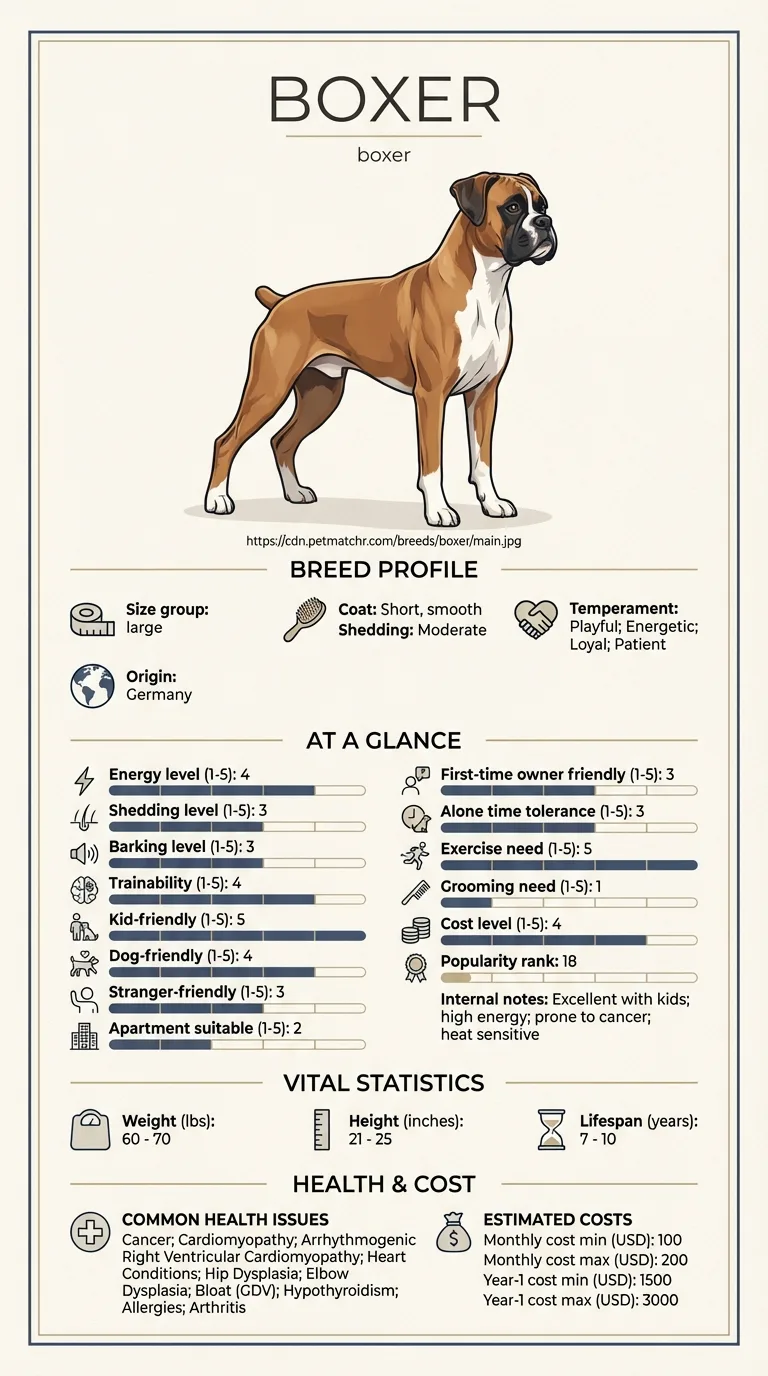
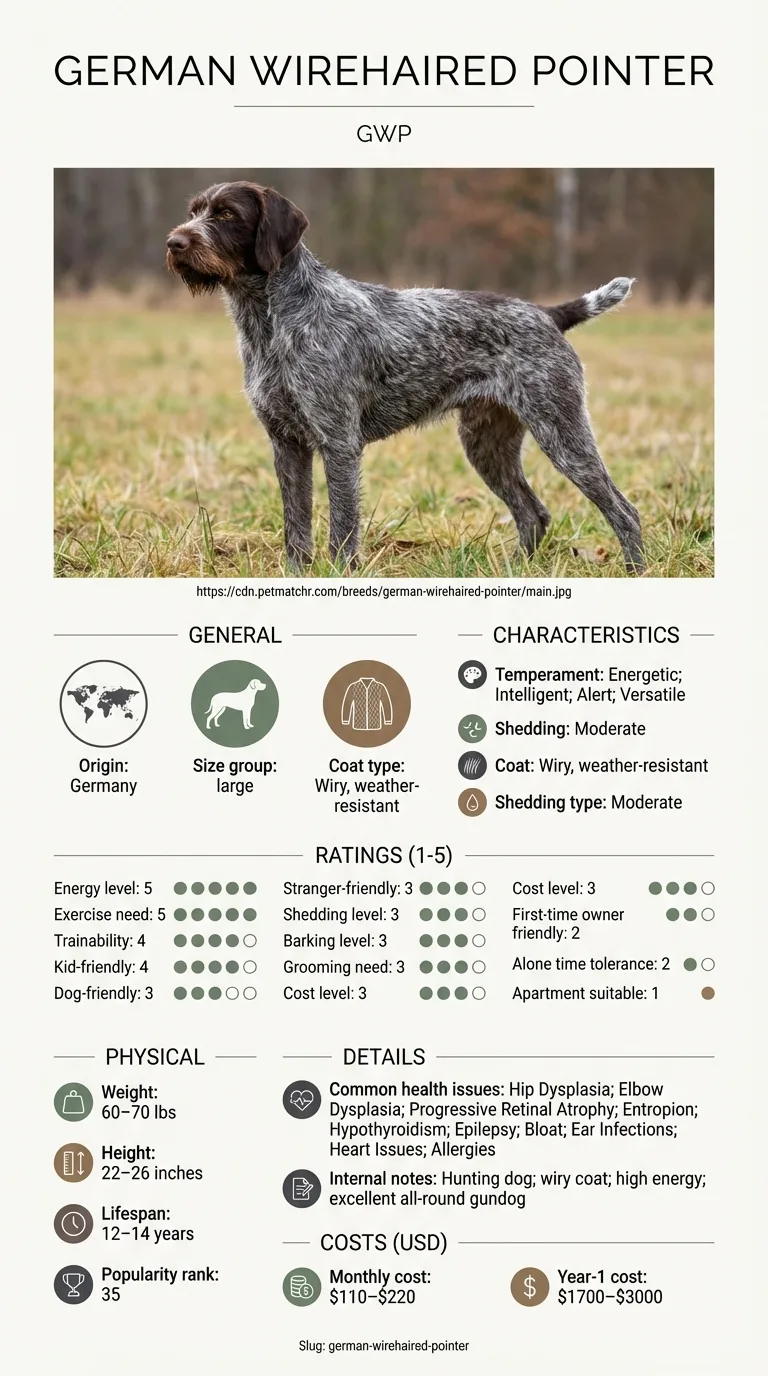
This is for someone already down to Boxer and German Wirehaired Pointer and deciding between them. For this pair the decision usually turns on grooming need, so those are covered first and in most detail. Anyone choosing from a flat has a clear answer here: Boxer rates 2/5 against 1/5. It is written for the decision rather than the breed history.
Between Boxer and German Wirehaired Pointer, grooming need is what separates them, and Boxer is the lower-effort dog of the two to keep.
Choose Boxer if this is your first dog, you do not want a standing grooming appointment and the dog will be alone during the working day.
Choose German Wirehaired Pointer if its temperament and look are what you want; on the measurable axes it gives up nothing to the other.
| Feature | boxer | german wirehaired pointer | Winner |
|---|---|---|---|
| Size class | large | large | Equal |
| Weight | 60–70 lbs | 60–70 lbs | Equal |
| Height | 21–25 in | 22–26 in | Equal |
| Lifespan | 7–10 years | 12–14 years | german wirehaired pointer |
| Exercise need | Very high (5/5) | Very high (5/5) | Equal |
| Grooming need | Very low (1/5) | Moderate (3/5) | boxer |
| Shedding | Moderate (3/5) | Moderate (3/5) | Equal |
| Energy level | High (4/5) | Very high (5/5) | Equal |
| Barking | Moderate (3/5) | Moderate (3/5) | Equal |
| Apartment suitability | Low (2/5) | Very low (1/5) | boxer |
| Good for first-time owners | Moderate (3/5) | Low (2/5) | boxer |
| Tolerates being alone | Moderate (3/5) | Low (2/5) | boxer |
| Trainability | High (4/5) | High (4/5) | Equal |
| Good with kids | Very high (5/5) | High (4/5) | boxer |
| Good with other dogs | High (4/5) | Moderate (3/5) | boxer |
| Friendly to strangers | Moderate (3/5) | Moderate (3/5) | Equal |
| Cost level | High (4/5) | Moderate (3/5) | german wirehaired pointer |
| Coat | Short, smooth | Wiry, weather-resistant | Equal |
| Origin | Germany | Germany | Equal |
| Typical monthly cost | $100–$200 | $110–$220 | Equal |
| Typical first-year cost | $1,500–$3,000 | $1,700–$3,000 | Equal |
These two share more than almost any other pairing on the site: both are large breeds, both weigh 60-70 lbs, and both come from Germany. Height nudges slightly in the Pointer's favor (22-26 inches vs 21-25). If you're choosing based on size and build alone, this comparison won't give you much to go on - they're nearly identical. The real differences show up once you get past the tape measure.
Exercise need ties at the maximum, 5/5 for both, and the Pointer actually edges ahead on energy level - very high (5/5) against the Boxer's high (4/5). German Wirehaired Pointers are working hunting dogs bred for long days afield, and that heritage means this may be the one breed on the site that can out-exercise a Boxer.
The Pointer's wiry, weather-resistant coat pushes grooming need to a moderate 3/5, against the Boxer's minimal 1/5, though shedding ties at moderate (3/5) for both. Hand-stripping is sometimes recommended for the Pointer's coat to maintain its texture, which is a level of coat care the Boxer's owners never have to think about.
Neither breed belongs in a small space - the Boxer scores a low 2/5 for apartment suitability, and the Pointer scores even lower at 1/5, the single lowest score in this entire batch. Barking ties at moderate (3/5). If you don't have a yard and significant outdoor access, this comparison probably isn't the right one for your situation regardless of which breed you'd otherwise prefer.
First-time-owner suitability favors the Boxer here, 3/5 against the Pointer's 2/5, even though trainability ties at a strong 4/5 for both. German Wirehaired Pointers are intelligent working dogs that need a job to stay satisfied, and that intensity can overwhelm a first-time owner even when the dog is, technically, quite trainable. An experienced hunting-dog household will get more out of the Pointer's drive than a first-time owner typically can.
The Boxer edges ahead on every household-fit metric: 5/5 versus 4/5 with kids, 4/5 versus 3/5 with other dogs, and both tie at moderate (3/5) with strangers. The Pointer's alert, versatile temperament is built more for work than for socializing, which tracks with its slightly lower people-and-pet scores across the board. None of these gaps are dramatic, but they add up consistently in the Boxer's favor.
The lifespan gap is significant - 12-14 years for the Pointer against 7-10 for the Boxer, potentially half again as long. Its health list runs ten conditions, including epilepsy, bloat, and heart issues, overlapping with the Boxer's hip dysplasia, elbow dysplasia, and allergies. Both lists are substantial; the Pointer's just comes with several more years to manage them.
Monthly costs land close together - $100-200 for the Boxer, $110-220 for the Pointer - and first-year totals track similarly: $1,500-3,000 versus $1,700-3,000. Cost level tips slightly toward the Boxer as higher (4/5 vs 3/5) despite the near-identical dollar figures, which suggests the rating accounts for more than just the sticker price.
Boxer weighs 60–70 lbs and lives 7–10 years; German Wirehaired Pointer weighs 60–70 lbs and lives 12–14 years. The two diverge most on grooming need. They are level on barking, exercise need and shedding, so those cannot decide it. In the table, a "winner" means easier for an ordinary household — not better. Size, coat and origin are recorded without a verdict. Because both breeds are scored the same way, the gaps are reliable even where the absolute numbers are rough.

Yes, unusually so - both weigh 60-70 lbs, and both are classified as large breeds from Germany. Height differs only slightly, 21-25 inches for the Boxer versus 22-26 for the Pointer.
They tie at the maximum 5/5 exercise need, though the Pointer edges ahead on raw energy level (5/5 vs 4/5). Both need serious, sustained daily activity.
Not especially - it rates 2/5 for first-time-owner suitability, below the Boxer's 3/5, despite both breeds training equally well (4/5). Its working-dog intensity needs an owner ready to give it a job.
Not comfortably - the Boxer scores a low 2/5, and the Pointer scores even lower at 1/5, the lowest apartment score in this entire comparison batch.
Very close - $100-200 for the Boxer and $110-220 for the Pointer, with first-year totals of $1,500-3,000 and $1,700-3,000 respectively.
The German Wirehaired Pointer, notably - 12-14 years against the Boxer's 7-10 years.
Yes - hip dysplasia, elbow dysplasia, and allergies appear on both lists. The Pointer's list also includes epilepsy, bloat, and heart issues not flagged for the Boxer.
The Boxer is the more forgiving choice for most households; the Pointer needs an experienced owner with serious outdoor space and a plan to keep it working.
Nearly identical - $100-200 for the Boxer and $110-220 for the Pointer.
The maximum - 5/5, tying the Boxer, with an even higher raw energy level. This is a working hunting breed that needs a real daily job.
The German Wirehaired Pointer, at 12-14 years compared to the Boxer's 7-10 years.
Secure checkout on Stripe. We never see your card.
7-day money-back guarantee. Instant access.
Health information here is general and is not veterinary advice. If your dog shows pain, sudden behaviour change, or worsening symptoms, consult a licensed veterinarian.
Some links on this site are affiliate links. We may earn a commission at no extra cost to you, and we only suggest products we believe are helpful for dog owners.
We research and check what we publish, but we do not warrant that any figure, date, price, or statement is accurate, complete, or current, and we accept no liability for any loss, cost, injury, or other harm arising from the use of this site. Use it as one reference among several. You remain responsible for your own decisions and for your dog's care - confirm anything that matters with a licensed veterinarian or another qualified professional before you act on it. Full disclaimer.
Match your lifestyle to the right dog.
Take quizNot sure which breed is right for you? Take our 2-minute quiz to find out.
Take the quiz