Boston Terrier vs Doberman Pinscher: Which Suits Your Home?
Quick answer
Boston Terrier or Doberman - which fits your life?
If you're new to dogs, live in an apartment, or don't have time for serious daily exercise, the Boston Terrier fits clearly better. The Doberman suits an experienced, active owner who wants a highly trainable guardian breed.
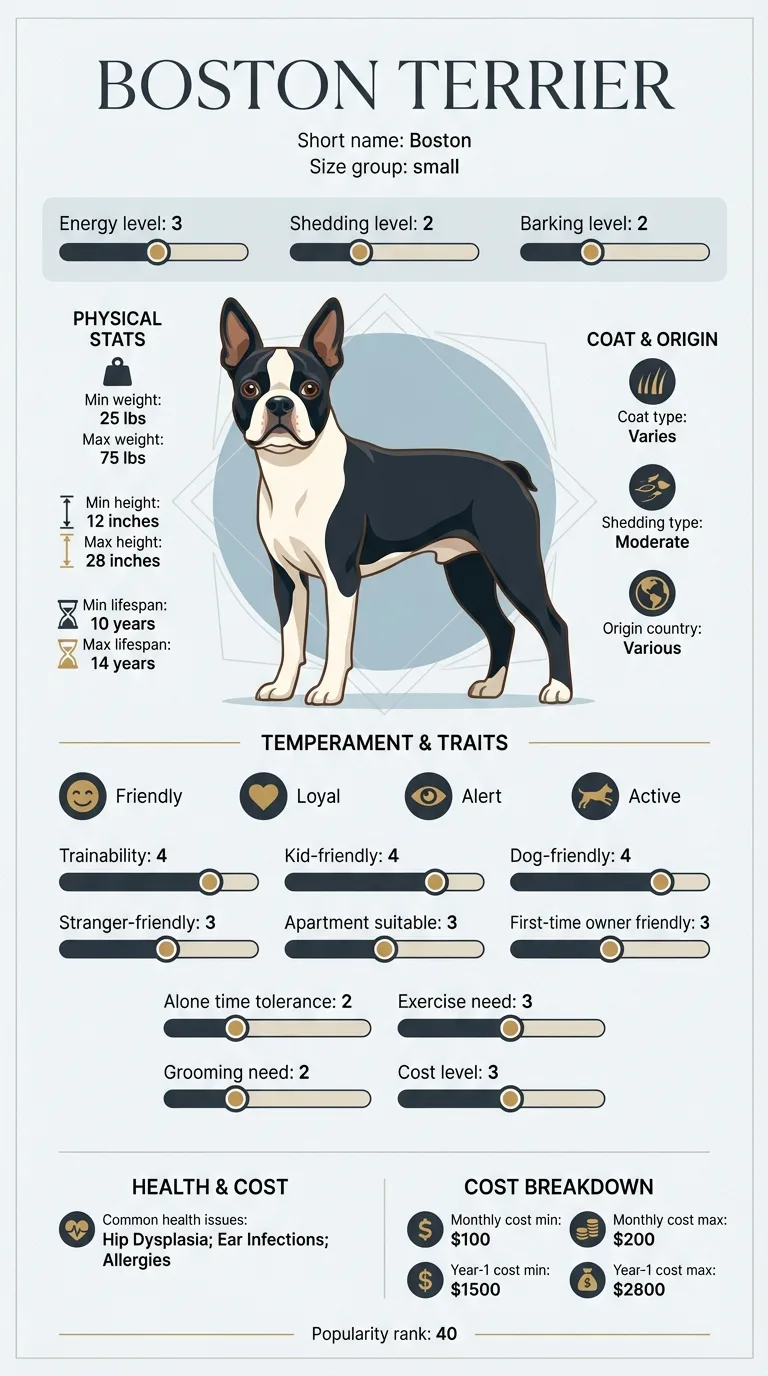
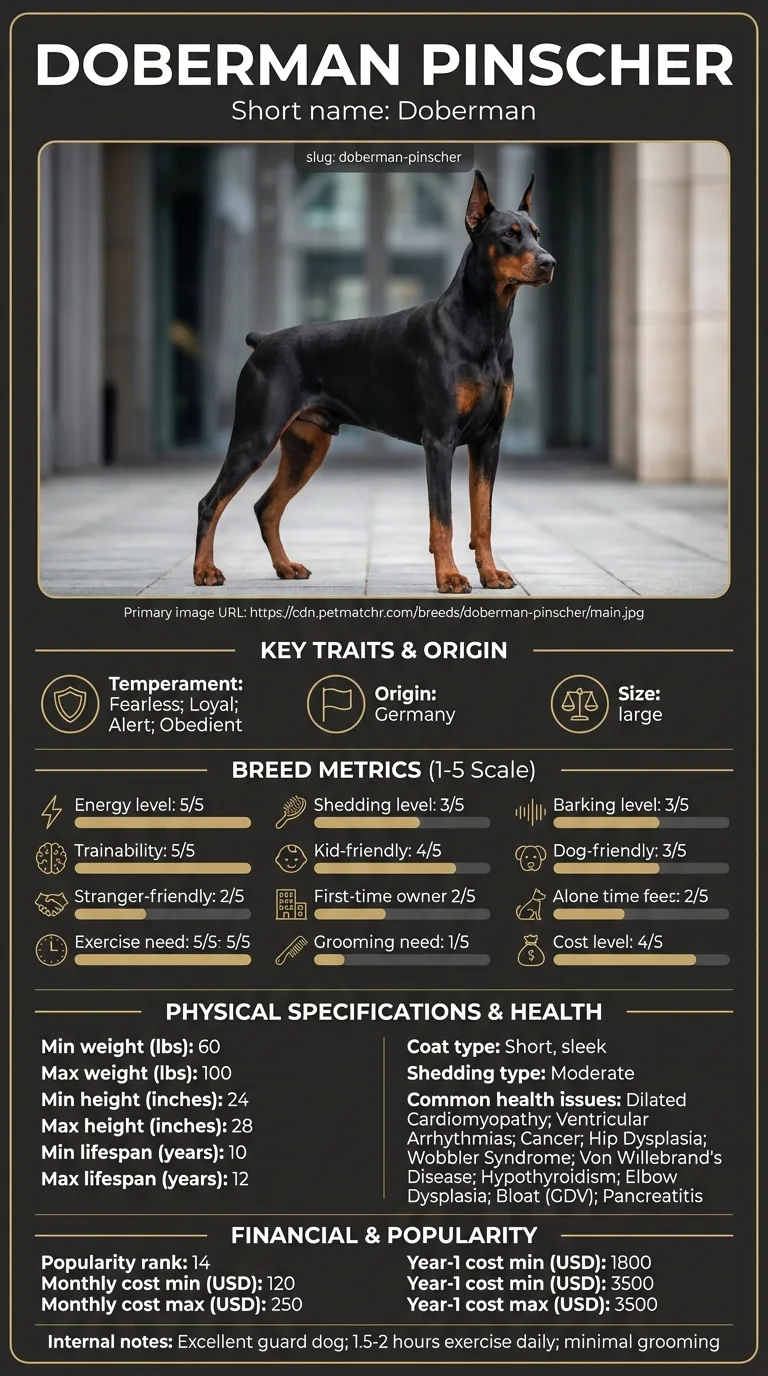
Boston Terrier or Doberman Pinscher? On paper they differ most on exercise need, and on the scales Doberman Pinscher is the heavier at 60–100 lbs. Here is how the two compare on everything that shapes an ordinary week.
This is for someone already down to Boston Terrier and Doberman Pinscher and deciding between them. For this pair the decision usually turns on exercise need and apartment suitability, so those are covered first and in most detail. Anyone choosing from a flat has a clear answer here: Boston Terrier rates 5/5 against 2/5. There is no origin story here — only what changes about your week.
Quick verdict
Between Boston Terrier and Doberman Pinscher, exercise need is what separates them, and Boston Terrier is the lower-effort dog of the two to keep.
Choose boston terrier if...
Choose Boston Terrier if you are in a flat or a smaller home, this is your first dog and shedding is a problem in your house.
Choose doberman pinscher if...
Choose Doberman Pinscher if you want a dog that picks up training quickly, you want a dog that can keep up with an active routine and you want a dog that is more watchful with visitors.
Head-to-head comparison
Feature
boston terrier
doberman pinscher
Winner
Size class
small
large
Equal
Weight
12–25 lbs
60–100 lbs
Equal
Height
15–17 in
24–28 in
Equal
Lifespan
11–13 years
10–12 years
boston terrier
Exercise need
Low (2/5)
Very high (5/5)
boston terrier
Grooming need
Very low (1/5)
Very low (1/5)
Equal
Shedding
Low (2/5)
Moderate (3/5)
boston terrier
Energy level
Moderate (3/5)
Very high (5/5)
Equal
Barking
Low (2/5)
Moderate (3/5)
boston terrier
Apartment suitability
Very high (5/5)
Low (2/5)
boston terrier
Good for first-time owners
Very high (5/5)
Low (2/5)
boston terrier
Tolerates being alone
Moderate (3/5)
Low (2/5)
boston terrier
Trainability
High (4/5)
Very high (5/5)
doberman pinscher
Good with kids
Very high (5/5)
High (4/5)
boston terrier
Good with other dogs
High (4/5)
Moderate (3/5)
boston terrier
Friendly to strangers
High (4/5)
Low (2/5)
boston terrier
Cost level
Moderate (3/5)
High (4/5)
boston terrier
Coat
Short and smooth
Short, sleek
Equal
Origin
Various
Germany
Equal
Typical monthly cost
$80–$150
$120–$250
Equal
Typical first-year cost
$1,100–$2,300
$1,800–$3,500
Equal
Deep dive
Size and build
The Doberman is a large, athletic breed at 60-100 lbs and 24-28 inches, dwarfing the Boston's 12-25 lbs and 15-17 inches. This is one of the larger size gaps in the comparison, on par with matching the Boston against a giant breed, so a Doberman needs real room to move around your home comfortably day to day without knocking things over.
Energy and exercise
The Doberman needs very high exercise (5/5) against the Boston's low (2/5) - the widest gap on this specific measure across the comparison. Energy level follows suit: very high (5/5) for the Doberman versus moderate (3/5) for the Boston. A Doberman without serious daily exercise tends to develop behavior problems fast, so this is a breed that requires a genuine daily commitment from you, not an occasional one.
Grooming and shedding
Grooming needs tie at very low (1/5) for both - neither breed needs a groomer. Shedding runs a bit higher for the Doberman (moderate 3/5) against the Boston (low 2/5), a modest gap given how different these dogs are in every other respect, so coat care is genuinely one of the easier parts of owning either of these two breeds.
Apartment living, noise and time alone
The Boston scores a perfect 5/5 for apartment suitability; the Doberman scores low (2/5), reflecting its exercise needs and size. Barking runs slightly higher for the Doberman too (moderate 3/5 vs. low 2/5). A Doberman can adapt to apartment life with serious daily exercise, but it isn't the natural fit the Boston is, and a small space paired with an under-exercised Doberman is a combination worth avoiding.
Training and owner experience
The Doberman actually trains a notch better than the Boston - very high (5/5) versus high (4/5) - it's one of the most trainable breeds around. But first-time-owner fit flips sharply the other way: very high (5/5) for the Boston against low (2/5) for the Doberman, whose size, drive, and protective instincts ask more of a new handler than its trainability score alone suggests.
Kids, other dogs and visitors
The Boston outscores the Doberman with kids (5/5 vs. 4/5), other dogs (4/5 vs. 3/5), and strangers (4/5 vs. 2/5). The Doberman's low score with strangers reflects its guardian instincts - a trait many owners want, but one that requires structured socialization and isn't the same as the Boston's naturally outgoing nature, so plan on more deliberate introductions when visitors come over.
Health and lifespan
The Boston lives slightly longer, 11-13 years against the Doberman's 10-12, and the Doberman's health list includes some of the more serious conditions in this whole comparison: Dilated Cardiomyopathy, ventricular arrhythmias, cancer, and Wobbler Syndrome, a neurological condition tied to its long neck. That's a heavier veterinary monitoring load than the Boston's airway-and-eye-centered risks, and regular cardiac screening is worth budgeting for specifically.
Cost to keep
Monthly cost runs $80-$150 for the Boston and $120-$250 for the Doberman, with first-year costs of $1,100-$2,300 versus $1,800-$3,500. Between the larger food volume and the breed's serious cardiac health risks, a Doberman is a meaningfully more expensive dog to keep over its lifetime, especially once cardiac screening and any related treatment enter the picture down the line as it ages.
Boston Terrier vs Doberman Pinscher at a glance
Boston Terrier weighs 12–25 lbs and lives 11–13 years; Doberman Pinscher weighs 60–100 lbs and lives 10–12 years. The two diverge most on exercise need, apartment suitability and good for first-time owners and 2 other rated axes. Almost every rated axis separates them at least slightly. Where the table declares a winner it means less work for the owner, nothing more; descriptive rows are left as ties on purpose. The value here is in the differences between the two columns; treat any single score as approximate.
Boston Terrier vs Doberman Pinscher: Which Suits Your Home? - Boston Terrier vs Doberman Pinscher at a glance
Frequently asked questions
Is a Doberman good for a first-time owner?
Not according to the data - it rates low (2/5) for first-time owners, well below the Boston Terrier's 5/5, despite being highly trainable (5/5) in its own right.
How much exercise does a Doberman need?
A lot - it rates very high (5/5), the maximum score, against the Boston Terrier's low (2/5). This is the single widest gap in the whole comparison.
What's the biggest Doberman health concern?
Dilated Cardiomyopathy, a heart condition common enough in the breed to warrant regular cardiac screening, alongside cancer and Wobbler Syndrome, a spinal condition.
Is a Doberman good with strangers?
It rates low (2/5), against the Boston Terrier's high (4/5) - a reflection of its guardian instincts, which need structured socialization to manage well.
What's the monthly cost difference?
$80-$150 for the Boston Terrier versus $120-$250 for the Doberman - driven by size and the breed's more serious health risks.
Which is easier to train?
The Doberman actually edges ahead, rated very high (5/5) against the Boston's high (4/5) - though its size and drive mean training matters more for managing it safely.
Which breed lives longer?
The Boston Terrier, at 11-13 years against the Doberman's 10-12.
Boston Terrier or Doberman - which fits your life?
If you're new to dogs, live in an apartment, or don't have time for serious daily exercise, the Boston Terrier fits clearly better. The Doberman suits an experienced, active owner who wants a highly trainable guardian breed.
Costs
What's the monthly cost for each?
$80-$150 for the Boston Terrier, $120-$250 for the Doberman.
Behavior
How much exercise does each need?
The Doberman needs very high exercise (5/5), the maximum rating; the Boston needs low exercise (2/5) - the widest exercise gap in this comparison.
Health
Which breed lives longer?
The Boston Terrier, at 11-13 years versus the Doberman's 10-12 years.
Related DogBreedCompass guides
Boston Terrier breed guide – Readers comparing the two usually want the full profile of Boston Terrier before deciding.
Doberman Pinscher breed guide – The same for Doberman Pinscher, so the comparison can be checked against the detail.
Boston Terrier vs Pug – Pug is the closest breed to Boston Terrier on the measured axes, so it is the natural next comparison.
Doberman Pinscher vs Weimaraner – Weimaraner sits closest to Doberman Pinscher, which makes it the alternative worth ruling out.
Boston Terrier vs Weimaraner – Weimaraner is the other breed Doberman Pinscher is most often weighed against.
Doberman Pinscher health problems – The health pages set out what each breed is actually screened for.
Health information here is general and is not veterinary advice. If your dog shows pain, sudden behaviour change, or worsening symptoms, consult a licensed veterinarian.
Some links on this site are affiliate links. We may earn a commission at no extra cost to you, and we only suggest products we believe are helpful for dog owners.
We research and check what we publish, but we do not warrant that any figure, date, price, or statement is accurate, complete, or current, and we accept no liability for any loss, cost, injury, or other harm arising from the use of this site. Use it as one reference among several. You remain responsible for your own decisions and for your dog's care - confirm anything that matters with a licensed veterinarian or another qualified professional before you act on it. Full disclaimer.