Behavior
Which breed needs more exercise?
The French Spaniel, rated Very high (5/5) versus the Bernese's Moderate (3/5).

Quick answer
Which breed needs more exercise?
The French Spaniel, rated Very high (5/5) versus the Bernese's Moderate (3/5).
Bernese Mountain Dog or French Spaniel? On paper they differ most on exercise need, and on the scales Bernese Mountain Dog is the heavier at 70–115 lbs. Here is how the two compare on everything that shapes an ordinary week.
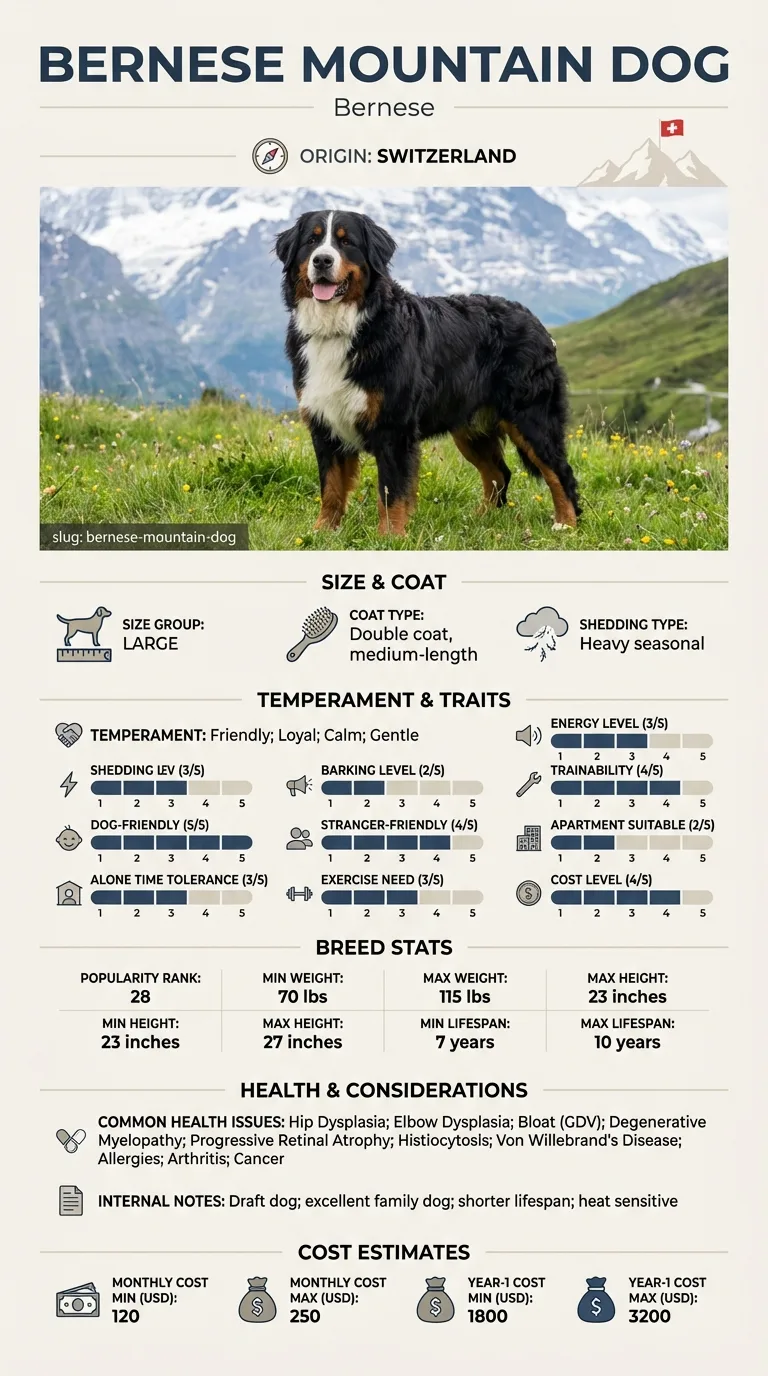
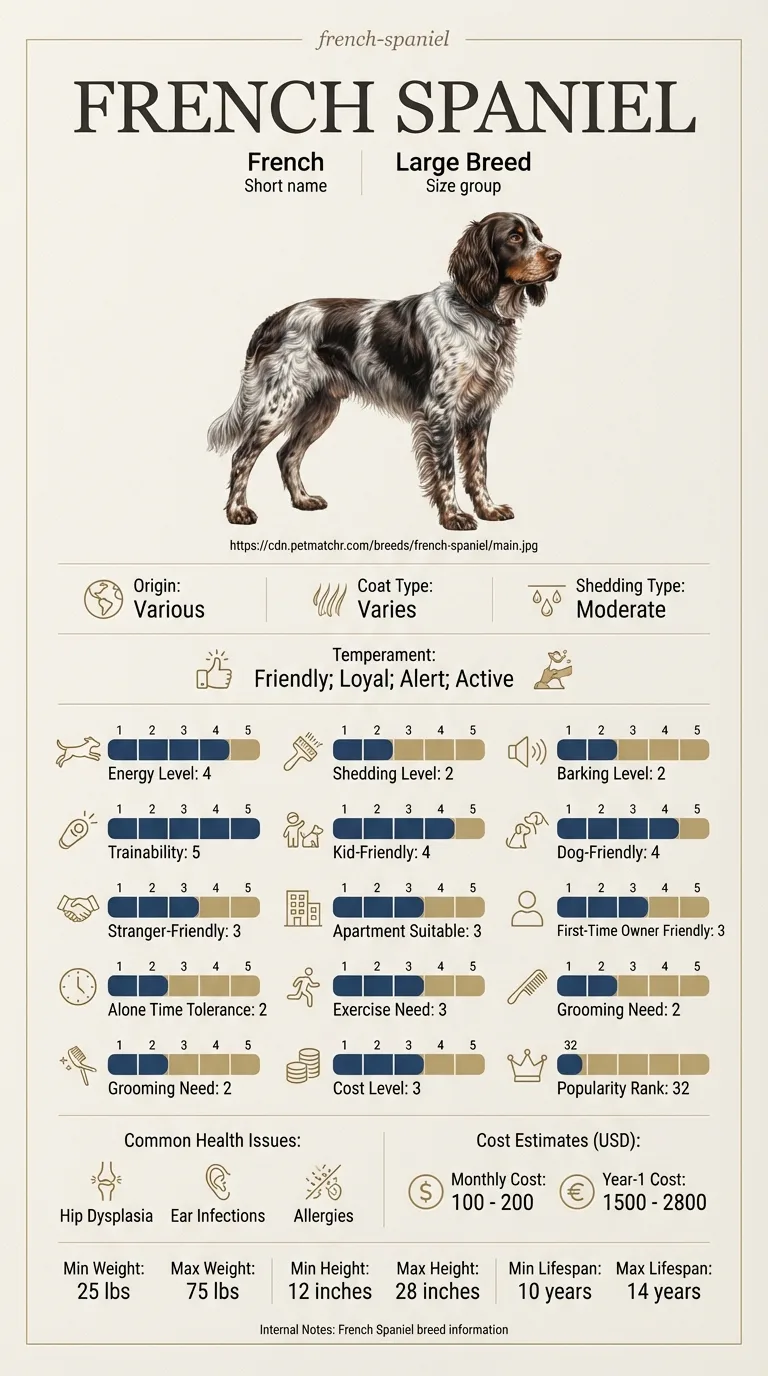
This is for someone already down to Bernese Mountain Dog and French Spaniel and deciding between them. For this pair the decision usually turns on exercise need, so those are covered first and in most detail. Both rate 2/5 for flats, so housing does not settle this one. The focus throughout is on daily consequences rather than breed background.
Between Bernese Mountain Dog and French Spaniel, exercise need is what separates them, and Bernese Mountain Dog is the lower-effort dog of the two to keep.
Choose Bernese Mountain Dog if this is your first dog, your walking routine is modest and the dog will be alone during the working day.
Choose French Spaniel if shedding is a problem in your house, a smaller dog suits your car, your home or your back and you want a dog that can keep up with an active routine.
| Feature | bernese mountain dog | french spaniel | Winner |
|---|---|---|---|
| Size class | large | medium | Equal |
| Weight | 70–115 lbs | 45–60 lbs | Equal |
| Height | 23–27 in | 21–24 in | Equal |
| Lifespan | 7–10 years | 10–12 years | french spaniel |
| Exercise need | Moderate (3/5) | Very high (5/5) | bernese mountain dog |
| Grooming need | Moderate (3/5) | Moderate (3/5) | Equal |
| Shedding | High (4/5) | Moderate (3/5) | french spaniel |
| Energy level | Moderate (3/5) | High (4/5) | Equal |
| Barking | Low (2/5) | Low (2/5) | Equal |
| Apartment suitability | Low (2/5) | Low (2/5) | Equal |
| Good for first-time owners | High (4/5) | Moderate (3/5) | bernese mountain dog |
| Tolerates being alone | Moderate (3/5) | Low (2/5) | bernese mountain dog |
| Trainability | High (4/5) | High (4/5) | Equal |
| Good with kids | Very high (5/5) | High (4/5) | bernese mountain dog |
| Good with other dogs | Very high (5/5) | High (4/5) | bernese mountain dog |
| Friendly to strangers | High (4/5) | High (4/5) | Equal |
| Cost level | High (4/5) | Moderate (3/5) | french spaniel |
| Coat | Double coat, medium-length | Medium, flat and feathered | Equal |
| Origin | Switzerland | Various | Equal |
| Typical monthly cost | $120–$250 | $100–$200 | Equal |
| Typical first-year cost | $1,800–$3,200 | $1,400–$2,900 | Equal |
The French Spaniel, a lesser-known gundog at 45–60 lbs and 21–24 inches, sits closer in size to the Bernese Mountain Dog than most spaniels on this site, still smaller than the Bernese's 70–115 lbs and 23–27 inches, but by a narrower margin than the English or American Cocker comparisons. Both are classified with substantial builds, though the French Spaniel's frame is leaner and more field-oriented, built for endurance hunting across varied terrain, while the Bernese's heavier bone structure reflects its draft-and-farm-dog origins in the Swiss Alps. The height gap of just two to six inches is the smallest in this batch of Bernese comparisons.
Exercise need favors the French Spaniel at Very high (5/5) against the Bernese's Moderate (3/5), yet its temperament list includes the notable trait Calm indoors alongside Energetic, a combination that means this is a breed that works hard outside and settles well once its needs are met. The Bernese's own Calm, Gentle temperament keeps things simple with a steady moderate routine. A French Spaniel denied its Very high exercise allotment won't necessarily match the Bernese's easygoing baseline; its Sociable, Energetic drive needs a real outlet, likely daily hikes, swimming, or field work rather than a casual walk.
Grooming ties at Moderate (3/5) for both breeds, an unusual match given their different coat types, the Bernese's dense double coat versus the French Spaniel's medium, flat, feathered coat. Shedding tilts toward the French Spaniel being tidier at Moderate (3/5) against the Bernese's High (4/5). Both coats benefit from weekly brushing, with the French Spaniel needing extra attention to its feathering around the ears and legs after outdoor work, similar to other spaniel breeds, while the Bernese's grooming effort goes mostly toward managing seasonal blowouts of its heavier coat.
Both breeds tie at Low (2/5) for apartment suitability and Low (2/5) for barking, making this one of the more consistent pairings in terms of daily-life noise and space needs. The French Spaniel's Low apartment score is driven by its Very high exercise requirement rather than size, since it's a smaller dog than the Bernese but a far more physically demanding one. Tolerating being alone favors the Bernese, Moderate (3/5) versus Low (2/5) for the French Spaniel, whose Sociable nature makes it more reliant on companionship throughout the day.
Trainability ties at High (4/5), but first-time-owner suitability favors the Bernese, High (4/5) against Moderate (3/5) for the French Spaniel, again the gap traces back to exercise commitment rather than trainability itself. A French Spaniel's Gentle, Sociable temperament makes it responsive and cooperative in training sessions, but a first-time owner unfamiliar with a Very high-energy gundog's daily needs may struggle to keep up even with a well-behaved dog. The Bernese's more modest exercise bar makes it the gentler on-ramp into dog ownership overall.
The Bernese edges out the French Spaniel with both kids, Very high (5/5) versus High (4/5), and other dogs, Very high (5/5) versus High (4/5), while friendliness to strangers ties at High (4/5). The French Spaniel's Gentle, Sociable temperament still makes it a warm, people-oriented companion, just slightly behind the Bernese's near-perfect family scores. For households prioritizing the single highest-scoring family dog, the Bernese has a slight statistical edge, though the French Spaniel's Calm-indoors trait means it can still be a relaxed presence once its exercise needs are met.
Lifespan favors the French Spaniel, 10–12 years against the Bernese's 7–10, a smaller gap than in the spaniel comparisons but still meaningful. The French Spaniel's five-item list includes Acral Mutilation Syndrome, a rare inherited nerve condition specific to this breed, alongside Hip Dysplasia, Ear Infections, Epilepsy, and general Eye Conditions. The Bernese's longer ten-item list remains anchored by Cancer and Bloat (GDV). Because the French Spaniel is a less common breed in North America, prospective owners should ask breeders directly about health testing given the limited gene pool and the presence of a rare condition like Acral Mutilation Syndrome on its list.
Monthly costs run $120–$250 for the Bernese versus $100–$200 for the French Spaniel, with first-year totals at $1,800–$3,200 against $1,400–$2,900, cost level rated High (4/5) for the Bernese and Moderate (3/5) for the French Spaniel. Because the French Spaniel is a rarer breed, prospective owners may face higher upfront acquisition costs or a longer wait for a puppy than these ranges reflect, even though ongoing monthly costs stay lower than the Bernese's. The Bernese's premium is driven by its larger size and correspondingly higher food and vet-visit costs.
Bernese Mountain Dog weighs 70–115 lbs and lives 7–10 years; French Spaniel weighs 45–60 lbs and lives 10–12 years. The two diverge most on exercise need. They are level on apartment suitability, barking and grooming need, so those cannot decide it. The table below marks a winner only where one breed is genuinely easier for a typical owner; size and origin are facts rather than merits and stay level. Ratings come from one source applied to both breeds, so they are meaningful against each other rather than as absolute scores.

The French Spaniel is a less common gundog breed at 45–60 lbs, larger than most Cocker types, with a Very high (5/5) exercise need and a distinctive Gentle, Sociable, Calm-indoors temperament.
It's a rare inherited nerve condition on the French Spaniel's health list, not shared with the Bernese Mountain Dog, so owners considering this breed should ask breeders about health testing.
The French Spaniel, rated Very high (5/5) versus the Bernese's Moderate (3/5), despite the French Spaniel being the smaller of the two.
Yes, rated High (4/5), just slightly behind the Bernese's Very high (5/5) — both are solid family choices.
The French Spaniel, typically 10–12 years versus 7–10 for the Bernese Mountain Dog.
The breed is less common in North America than the Bernese, so expect a longer search or waitlist even though the data-driven cost estimates are lower.
Both can be calm indoors once exercised, but the French Spaniel's temperament list specifically notes Calm indoors as a trait, meaning it settles well after its Very high exercise needs are met.
The French Spaniel, rated Very high (5/5) versus the Bernese's Moderate (3/5).
The French Spaniel, typically 10–12 years versus 7–10 for the Bernese.
The French Spaniel, rated Moderate (3/5) versus the Bernese's High (4/5).
The Bernese Mountain Dog, rated High (4/5) versus Moderate (3/5) for the French Spaniel.
Secure checkout on Stripe. We never see your card.
7-day money-back guarantee. Instant access.
Health information here is general and is not veterinary advice. If your dog shows pain, sudden behaviour change, or worsening symptoms, consult a licensed veterinarian.
Some links on this site are affiliate links. We may earn a commission at no extra cost to you, and we only suggest products we believe are helpful for dog owners.
We research and check what we publish, but we do not warrant that any figure, date, price, or statement is accurate, complete, or current, and we accept no liability for any loss, cost, injury, or other harm arising from the use of this site. Use it as one reference among several. You remain responsible for your own decisions and for your dog's care - confirm anything that matters with a licensed veterinarian or another qualified professional before you act on it. Full disclaimer.
Match your lifestyle to the right dog.
Take quizNot sure which breed is right for you? Take our 2-minute quiz to find out.
Take the quiz