Living
Malinois or Welsh Springer Spaniel, which is the easier dog overall?
The Welsh Springer, for nearly every household. It scores better for first-time owners, apartment life, and getting along with kids, other dogs, and strangers.

Quick answer
Malinois or Welsh Springer Spaniel, which is the easier dog overall?
The Welsh Springer, for nearly every household. It scores better for first-time owners, apartment life, and getting along with kids, other dogs, and strangers.
Belgian Malinois or Welsh Springer Spaniel? On paper they differ most on good for first-time owners, and on the scales Belgian Malinois is the heavier at 55–65 lbs. Here is how the two compare on everything that shapes an ordinary week.
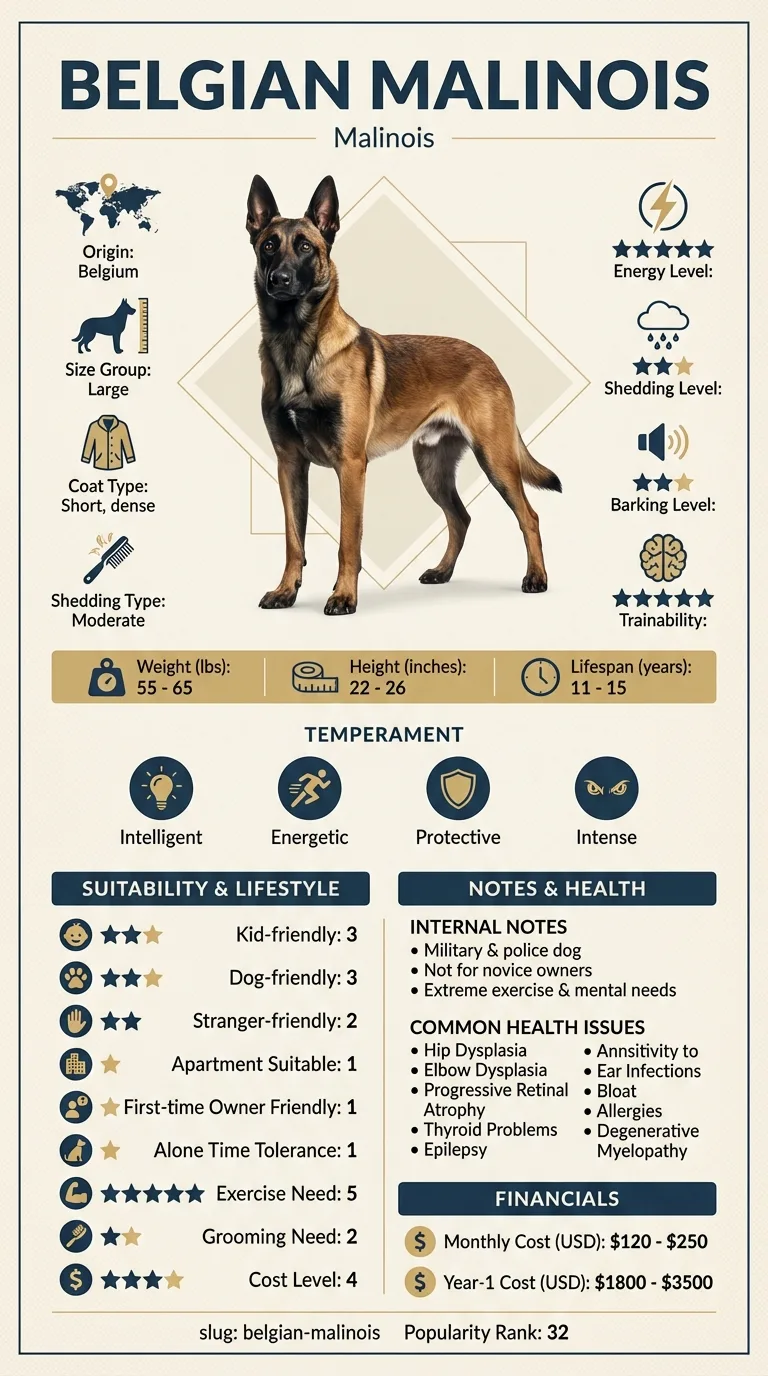
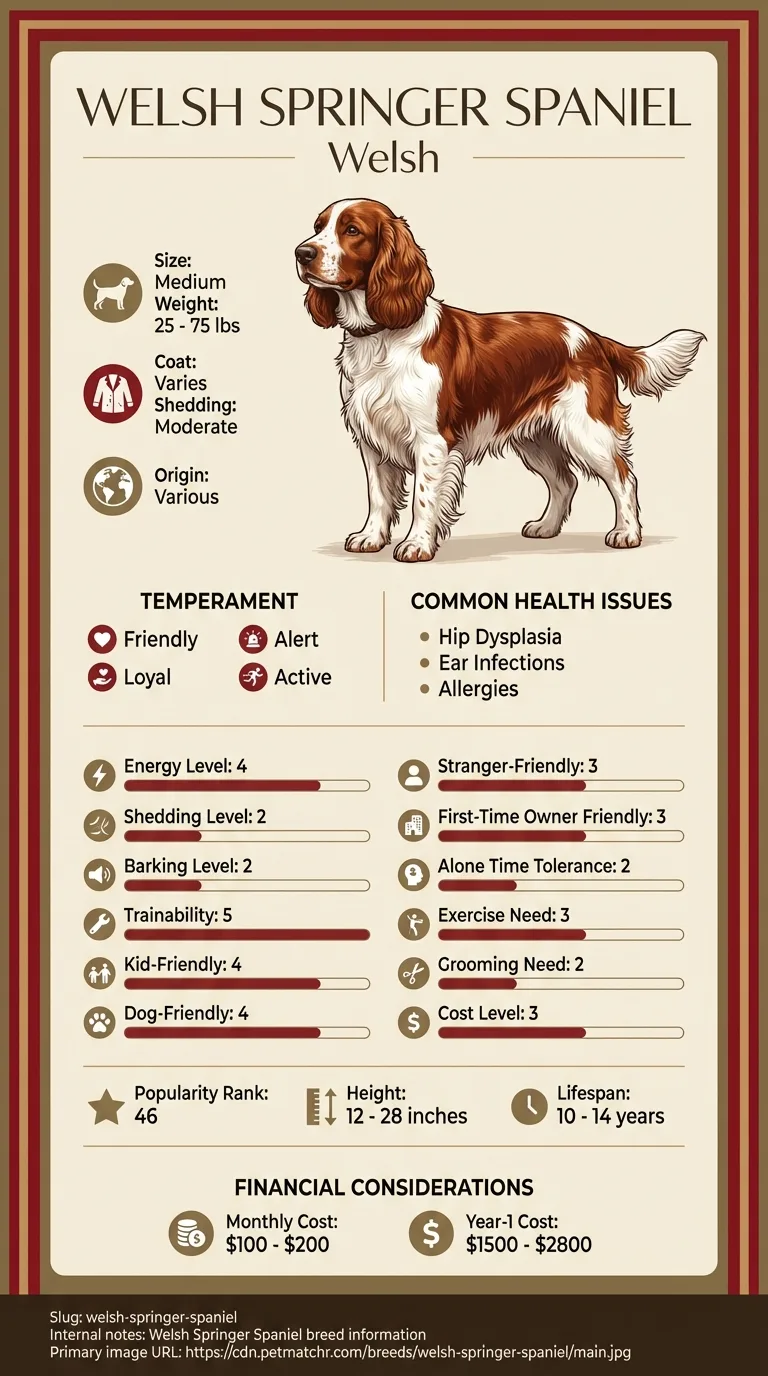
This is for someone already down to Belgian Malinois and Welsh Springer Spaniel and deciding between them. For this pair the decision usually turns on good for first-time owners, so those are covered first and in most detail. Anyone choosing from a flat has a clear answer here: Welsh Springer Spaniel rates 2/5 against 1/5. There is no origin story here — only what changes about your week.
Between Belgian Malinois and Welsh Springer Spaniel, good for first-time owners is what separates them, and Welsh Springer Spaniel is the lower-effort dog of the two to keep.
Choose Belgian Malinois if you do not want a standing grooming appointment, you want a dog that picks up training quickly and you want a dog that can keep up with an active routine.
Choose Welsh Springer Spaniel if this is your first dog, your walking routine is modest and there are young children at home.
| Feature | belgian malinois | welsh springer spaniel | Winner |
|---|---|---|---|
| Size class | large | medium | Equal |
| Weight | 55–65 lbs | 35–55 lbs | Equal |
| Height | 22–26 in | 17–19 in | Equal |
| Lifespan | 11–15 years | 12–15 years | welsh springer spaniel |
| Exercise need | Very high (5/5) | High (4/5) | welsh springer spaniel |
| Grooming need | Low (2/5) | Moderate (3/5) | belgian malinois |
| Shedding | Moderate (3/5) | Moderate (3/5) | Equal |
| Energy level | Very high (5/5) | High (4/5) | Equal |
| Barking | Moderate (3/5) | Moderate (3/5) | Equal |
| Apartment suitability | Very low (1/5) | Low (2/5) | welsh springer spaniel |
| Good for first-time owners | Very low (1/5) | Moderate (3/5) | welsh springer spaniel |
| Tolerates being alone | Very low (1/5) | Low (2/5) | welsh springer spaniel |
| Trainability | Very high (5/5) | High (4/5) | belgian malinois |
| Good with kids | Moderate (3/5) | High (4/5) | welsh springer spaniel |
| Good with other dogs | Moderate (3/5) | High (4/5) | welsh springer spaniel |
| Friendly to strangers | Low (2/5) | Moderate (3/5) | welsh springer spaniel |
| Cost level | High (4/5) | Moderate (3/5) | welsh springer spaniel |
| Coat | Short, dense | Medium, straight and water-resistant | Equal |
| Origin | Belgium | Various | Equal |
| Typical monthly cost | $120–$250 | $100–$200 | Equal |
| Typical first-year cost | $1,800–$3,500 | $1,400–$2,900 | Equal |
This is a genuine size mismatch: the Malinois is large at 55 to 65 pounds and 22 to 26 inches, while the Welsh Springer Spaniel is medium at 35 to 55 pounds and just 17 to 19 inches tall. Stand them side by side and the Malinois is close to a foot taller and can weigh nearly twice as much. If raw size and presence matter to you, that gap alone may settle the decision before you get to temperament.
The Malinois needs more than the Welsh Springer, but not by a wide margin, 5 out of 5 against the Springer's 4 out of 5. A springer spaniel bred for flushing game all day is still a serious athlete; it just tops out a notch below the Malinois's working-dog ceiling. Neither is satisfied with a short walk, but the Springer gives you a little more room for an off day.
The Malinois actually wins the grooming comparison here, 2 out of 5 against the Welsh Springer's 3 out of 5, since the Springer's medium, water-resistant coat needs more regular brushing to avoid matting, especially around the ears and feathering. Shedding is even between them at 3 out of 5. It's a rare case in this matchup where the larger dog is the lower-maintenance one.
Both score similarly on barking, 3 out of 5 each, but the Welsh Springer is meaningfully more livable in tight quarters: 2 out of 5 for apartment suitability against the Malinois's 1 out of 5, and 3 out of 5 for first-time owners against the Malinois's rock-bottom 1 out of 5. Neither is an ideal apartment dog, but the Springer at least gives a first-timer in a smaller home a fighting chance.
The Malinois keeps its usual edge in trainability, 5 out of 5 against the Welsh Springer's 4 out of 5, still a strong score for the Springer, just not in the same tier as a breed built for police and military work. The Springer's temperament is described as reserved with strangers but even-tempered, which tends to make training sessions calmer and less high-stakes than working with a Malinois's intensity.
The Welsh Springer is the more sociable dog across the board: 4 out of 5 with kids and other dogs against the Malinois's 3 out of 5, and 3 out of 5 with strangers against 2 out of 5. That said, its temperament list notes it's reserved with strangers, so don't expect an instantly outgoing dog, just a calmer, less intense one than the Malinois around a full house.
The Welsh Springer actually edges out the Malinois on lifespan, 12 to 15 years against 11 to 15. Its health list is shorter too, five conditions against the Malinois's ten, with hip dysplasia, ear infections, and epilepsy the shared risks between them. The Springer adds glaucoma and hypothyroidism to watch for; the Malinois carries the longer list, including elbow dysplasia, bloat, and degenerative myelopathy.
The Welsh Springer is the cheaper dog to own by this site's scale, 3 out of 5 against the Malinois's 4 out of 5, with a monthly range of $100 to $200 versus $120 to $250 and a first-year range of $1,400 to $2,900 versus $1,800 to $3,500. Smaller size means less food and typically lower medication dosing, which adds up over a dog's lifetime.
Belgian Malinois weighs 55–65 lbs and lives 11–15 years; Welsh Springer Spaniel weighs 35–55 lbs and lives 12–15 years. The two diverge most on good for first-time owners. They are level on barking and shedding, so those cannot decide it. Where the table declares a winner it means less work for the owner, nothing more; descriptive rows are left as ties on purpose. The value here is in the differences between the two columns; treat any single score as approximate.

Considerably. The Malinois runs 55 to 65 pounds and 22 to 26 inches tall, while the Welsh Springer tops out around 55 pounds and stands only 17 to 19 inches. Expect the Malinois to be close to a foot taller.
Neither is ideal, but the Welsh Springer is the more workable option, 2 out of 5 for apartment suitability against the Malinois's 1 out of 5, and better tolerance for time alone too.
Better than the Malinois, at least. It scores 3 out of 5 for first-time owners against the Malinois's 1 out of 5, though it's still a working-line sporting breed that needs real exercise and training.
They're tied, both score 3 out of 5 for shedding, despite very different coat types (short and dense for the Malinois, medium and water-resistant for the Springer).
The Welsh Springer runs cheaper: $100 to $200 a month and $1,400 to $2,900 in year one, versus the Malinois's $120 to $250 a month and $1,800 to $3,500 in year one.
Hip dysplasia, ear infections, and epilepsy appear on both lists. The Malinois's list is roughly twice as long, adding elbow dysplasia, bloat, and thyroid problems; the Springer's shorter list adds glaucoma.
The Welsh Springer, slightly, 12 to 15 years against the Malinois's 11 to 15.
The Welsh Springer, for nearly every household. It scores better for first-time owners, apartment life, and getting along with kids, other dogs, and strangers.
About $50 at the low end, $100 to $200 for the Springer versus $120 to $250 for the Malinois.
The Malinois tops the scale at 5 out of 5; the Welsh Springer is close behind at 4 out of 5. Both need serious daily activity, just not identical amounts.
The Welsh Springer, by a hair, 12 to 15 years versus the Malinois's 11 to 15.
Secure checkout on Stripe. We never see your card.
7-day money-back guarantee. Instant access.
Health information here is general and is not veterinary advice. If your dog shows pain, sudden behaviour change, or worsening symptoms, consult a licensed veterinarian.
Some links on this site are affiliate links. We may earn a commission at no extra cost to you, and we only suggest products we believe are helpful for dog owners.
We research and check what we publish, but we do not warrant that any figure, date, price, or statement is accurate, complete, or current, and we accept no liability for any loss, cost, injury, or other harm arising from the use of this site. Use it as one reference among several. You remain responsible for your own decisions and for your dog's care - confirm anything that matters with a licensed veterinarian or another qualified professional before you act on it. Full disclaimer.
Match your lifestyle to the right dog.
Take quizNot sure which breed is right for you? Take our 2-minute quiz to find out.
Take the quiz