Belgian Malinois vs Vizsla: Which Suits Your Home?
Quick answer
Vizsla or Malinois, which fits most households better?
The Vizsla, if most households means families with kids, other pets, and visitors. The Malinois is the better fit only for an owner specifically wanting a protection-oriented working dog.
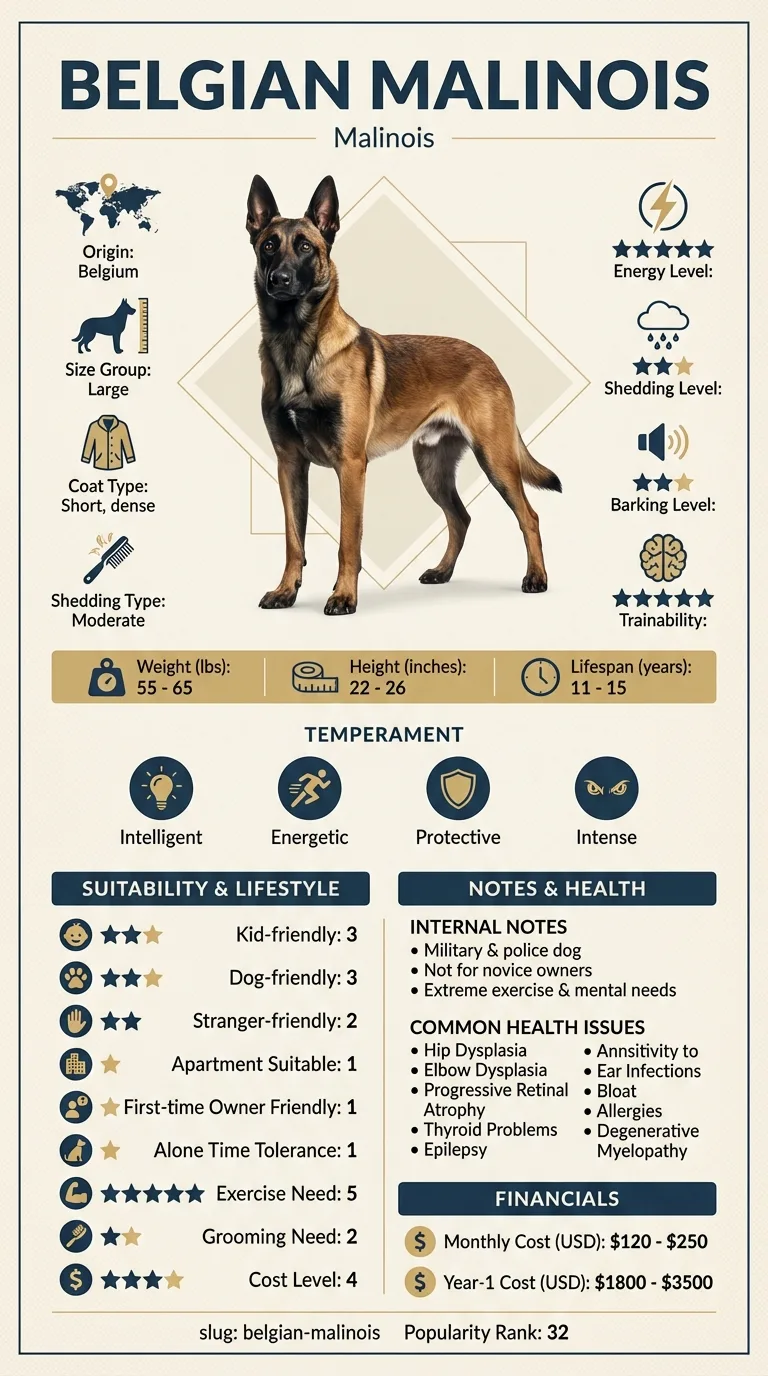
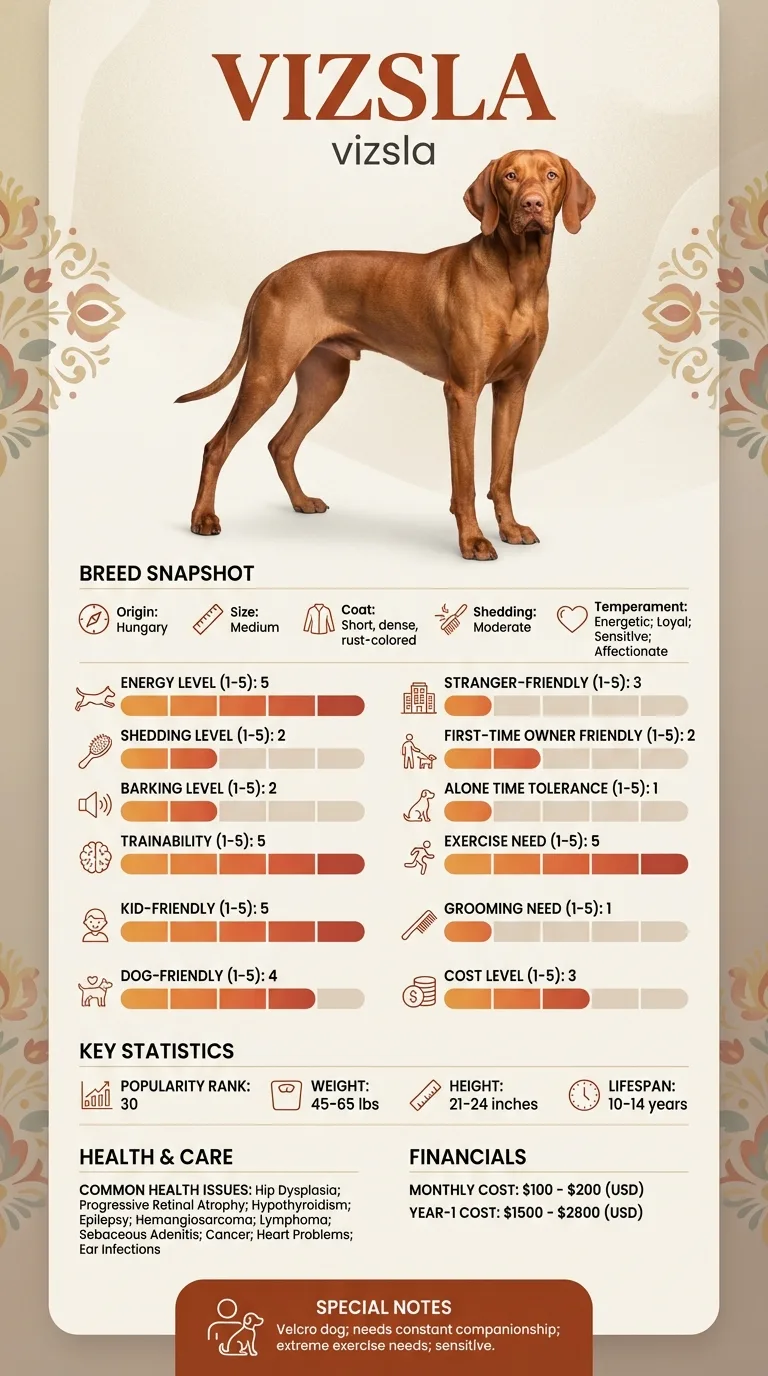
Belgian Malinois or Vizsla? On paper they differ most on good with kids, and on the scales Belgian Malinois is the heavier at 55–65 lbs. Here is how the two compare on everything that shapes an ordinary week.
This is for someone already down to Belgian Malinois and Vizsla and deciding between them. For this pair the decision usually turns on good with kids, so those are covered first and in most detail. Both rate 1/5 for flats, so housing does not settle this one. The focus throughout is on daily consequences rather than breed background.
Quick verdict
Between Belgian Malinois and Vizsla, good with kids is what separates them, and Vizsla is the lower-effort dog of the two to keep.
Choose belgian malinois if...
Choose Belgian Malinois if you want a dog that is more watchful with visitors.
Choose vizsla if...
Choose Vizsla if you do not want a standing grooming appointment, shedding is a problem in your house and there are young children at home.
Head-to-head comparison
Feature
belgian malinois
vizsla
Winner
Size class
large
medium
Equal
Weight
55–65 lbs
45–65 lbs
Equal
Height
22–26 in
21–24 in
Equal
Lifespan
11–15 years
10–14 years
belgian malinois
Exercise need
Very high (5/5)
Very high (5/5)
Equal
Grooming need
Low (2/5)
Very low (1/5)
vizsla
Shedding
Moderate (3/5)
Low (2/5)
vizsla
Energy level
Very high (5/5)
Very high (5/5)
Equal
Barking
Moderate (3/5)
Low (2/5)
vizsla
Apartment suitability
Very low (1/5)
Very low (1/5)
Equal
Good for first-time owners
Very low (1/5)
Low (2/5)
vizsla
Tolerates being alone
Very low (1/5)
Very low (1/5)
Equal
Trainability
Very high (5/5)
Very high (5/5)
Equal
Good with kids
Moderate (3/5)
Very high (5/5)
vizsla
Good with other dogs
Moderate (3/5)
High (4/5)
vizsla
Friendly to strangers
Low (2/5)
Moderate (3/5)
vizsla
Cost level
High (4/5)
Moderate (3/5)
vizsla
Coat
Short, dense
Short, dense, rust-colored
Equal
Origin
Belgium
Hungary
Equal
Typical monthly cost
$120–$250
$100–$200
Equal
Typical first-year cost
$1,800–$3,500
$1,500–$2,800
Equal
Deep dive
Size and build
The Vizsla is the smaller of the two on paper, medium-sized at 45 to 65 pounds and 21 to 24 inches, against the Malinois's large-breed 55 to 65 pounds and 22 to 26 inches, though the weight ranges actually overlap at the top end. Build-wise they're both lean and muscular working dogs with no extra bulk. A big male Vizsla can outweigh a smaller female Malinois; the real-world size gap is closer than the size-class labels suggest.
Energy and exercise
Don't let the Vizsla's reputation as a velcro dog fool you into thinking it's low-key. It matches the Malinois at 5 out of 5 for exercise need. Both were built to work for hours: the Malinois in herding and protection work, the Vizsla as an all-day hunting companion. Skimping on exercise with either breed tends to show up as anxiety or destructiveness rather than just a bored dog on the couch.
Grooming and shedding
The Vizsla is the lower-maintenance coat of the two: a 1 out of 5 grooming need and 2 out of 5 shedding, against the Malinois's 2 out of 5 and 3 out of 5. Both have short, dense coats with no undercoat to speak of, so neither demands professional grooming. The difference here is a matter of degree rather than kind, and a weekly brush covers either dog.
Apartment living, noise and time alone
Both breeds are poor apartment candidates and score 1 out of 5 for tolerating time alone, but the Vizsla edges out the Malinois slightly for first-time owners, 2 out of 5 versus 1 out of 5, and barks less, 2 out of 5 versus 3 out of 5. Neither difference is large enough to change the underlying fact: put either dog in a small space with long unsupervised hours and you're building a behavior problem, not raising a pet.
Training and owner experience
Both score a full 5 out of 5 for trainability, unusual company for the Malinois, since most breeds it's compared against fall well short. Where they differ is temperament under training: the Vizsla is noted as sensitive, so harsh correction backfires fast, while the Malinois is described as intense and responds well to structured, high-repetition work. Either rewards a consistent handler; neither forgives an inconsistent one.
Kids, other dogs and visitors
The Vizsla is the friendlier all-around choice: 5/5 with kids against the Malinois's 3/5, 4/5 with other dogs against 3/5, and 3/5 with strangers against the Malinois's 2/5. That tracks with the temperament lists: the Vizsla is flagged as affectionate and loyal, while the Malinois is flagged as protective and intense, traits that serve it well in working roles but less well at a crowded backyard barbecue.
Health and lifespan
The Malinois edges the Vizsla on lifespan, 11 to 15 years against 10 to 14. The overlap in health risk is real but not huge: both lists include hip dysplasia, progressive retinal atrophy, and epilepsy. Past that they split. The Malinois's list adds elbow dysplasia and bloat, while the Vizsla's carries more cancer-related risk, including hemangiosarcoma and lymphoma, along with heart problems worth discussing with a vet or breeder.
Cost to keep
The Vizsla is the cheaper dog to keep on this site's scale, 3 out of 5 versus the Malinois's 4 out of 5, and it shows in the ranges: $100 to $200 a month against $120 to $250, and $1,500 to $2,800 in the first year against $1,800 to $3,500. Food volume is similar given the comparable size; the gap is mostly training and veterinary spend.
Belgian Malinois vs Vizsla at a glance
Belgian Malinois weighs 55–65 lbs and lives 11–15 years; Vizsla weighs 45–65 lbs and lives 10–14 years. The two diverge most on good with kids. They are level on tolerates being alone, apartment suitability and energy level, so those cannot decide it. The table below marks a winner only where one breed is genuinely easier for a typical owner; size and origin are facts rather than merits and stay level. Ratings come from one source applied to both breeds, so they are meaningful against each other rather than as absolute scores.
Belgian Malinois vs Vizsla: Which Suits Your Home? - Belgian Malinois vs Vizsla at a glance
Frequently asked questions
Is a Vizsla smaller than a Belgian Malinois?
On paper, yes. The Vizsla is classed medium at 45 to 65 lbs and 21 to 24 in versus the Malinois's large 55 to 65 lbs and 22 to 26 in, but the top of the Vizsla's weight range actually matches the Malinois, so the real-world size gap is smaller than the labels imply.
Which is easier to train?
They're tied at 5 out of 5 for trainability, which puts the Vizsla in rare company. The practical difference is technique: the Vizsla is sensitive and needs a gentle hand, while the Malinois is intense and takes structured, repetitive work well.
Which is the better family dog?
The Vizsla, by the data. It scores higher with kids (5/5 vs 3/5), other dogs (4/5 vs 3/5), and strangers (3/5 vs 2/5). The Malinois's protective streak makes it a less relaxed presence around a house full of guests and children's friends.
Do they cost the same to own?
Not quite. The Vizsla runs a bit cheaper, at $100 to $200 a month and $1,500 to $2,800 in year one, against the Malinois's $120 to $250 a month and $1,800 to $3,500 in year one.
Are these good apartment dogs?
No, neither is. Both score 1 out of 5 for tolerating time alone and neither is suited to small spaces without serious daily exercise; the Vizsla scores marginally better for first-time owners, but that's a small edge, not a green light.
What health issues overlap between them?
Hip dysplasia, progressive retinal atrophy, and epilepsy show up on both lists. Beyond that the Vizsla carries more cancer-related risk, including hemangiosarcoma and lymphoma, while the Malinois's list adds elbow dysplasia and bloat.
Which lives longer?
The Malinois has a slight edge, 11 to 15 years versus the Vizsla's 10 to 14, though both are respectable lifespans for dogs of this size and activity level.
Vizsla or Malinois, which fits most households better?
The Vizsla, if most households means families with kids, other pets, and visitors. The Malinois is the better fit only for an owner specifically wanting a protection-oriented working dog.
Costs
What's the monthly cost difference?
About $20 a month at minimum, $100 to $200 for the Vizsla versus $120 to $250 for the Malinois, with a similar gap in first-year costs.
Living
How active do I need to be for either dog?
Very. Both need 5 out of 5-level daily exercise, an hour-plus of real activity, not a walk around the block, for the dog's entire working life.
Health
Which breed lives longer on average?
The Malinois, by about a year at each end of the range, 11 to 15 years versus the Vizsla's 10 to 14.
Related DogBreedCompass guides
Belgian Malinois breed guide – Readers comparing the two usually want the full profile of Belgian Malinois before deciding.
Vizsla breed guide – The same for Vizsla, so the comparison can be checked against the detail.
Belgian Malinois vs German Shorthaired Pointer – German Shorthaired Pointer is the closest breed to Belgian Malinois on the measured axes, so it is the natural next comparison.
Health information here is general and is not veterinary advice. If your dog shows pain, sudden behaviour change, or worsening symptoms, consult a licensed veterinarian.
Some links on this site are affiliate links. We may earn a commission at no extra cost to you, and we only suggest products we believe are helpful for dog owners.
We research and check what we publish, but we do not warrant that any figure, date, price, or statement is accurate, complete, or current, and we accept no liability for any loss, cost, injury, or other harm arising from the use of this site. Use it as one reference among several. You remain responsible for your own decisions and for your dog's care - confirm anything that matters with a licensed veterinarian or another qualified professional before you act on it. Full disclaimer.