Living
Which breed is the better everyday pick?
The Standard Poodle for most households - similar size, comparable trainability, but far friendlier with kids, other dogs, and strangers, and more workable for a first-time owner.

Quick answer
Which breed is the better everyday pick?
The Standard Poodle for most households - similar size, comparable trainability, but far friendlier with kids, other dogs, and strangers, and more workable for a first-time owner.
Belgian Malinois or Poodle (Standard)? On paper they differ most on grooming need, and on the scales Belgian Malinois is the heavier at 55–65 lbs. Here is how the two compare on everything that shapes an ordinary week.
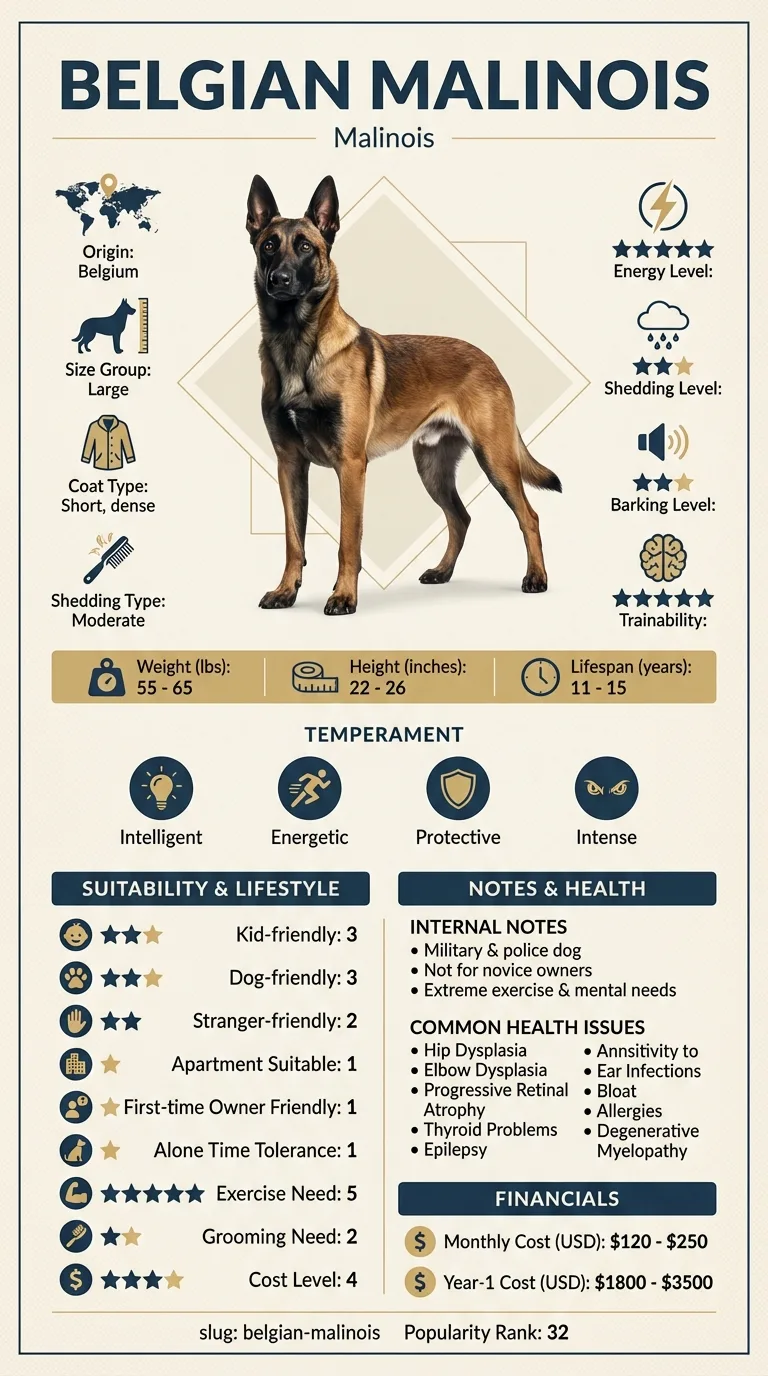
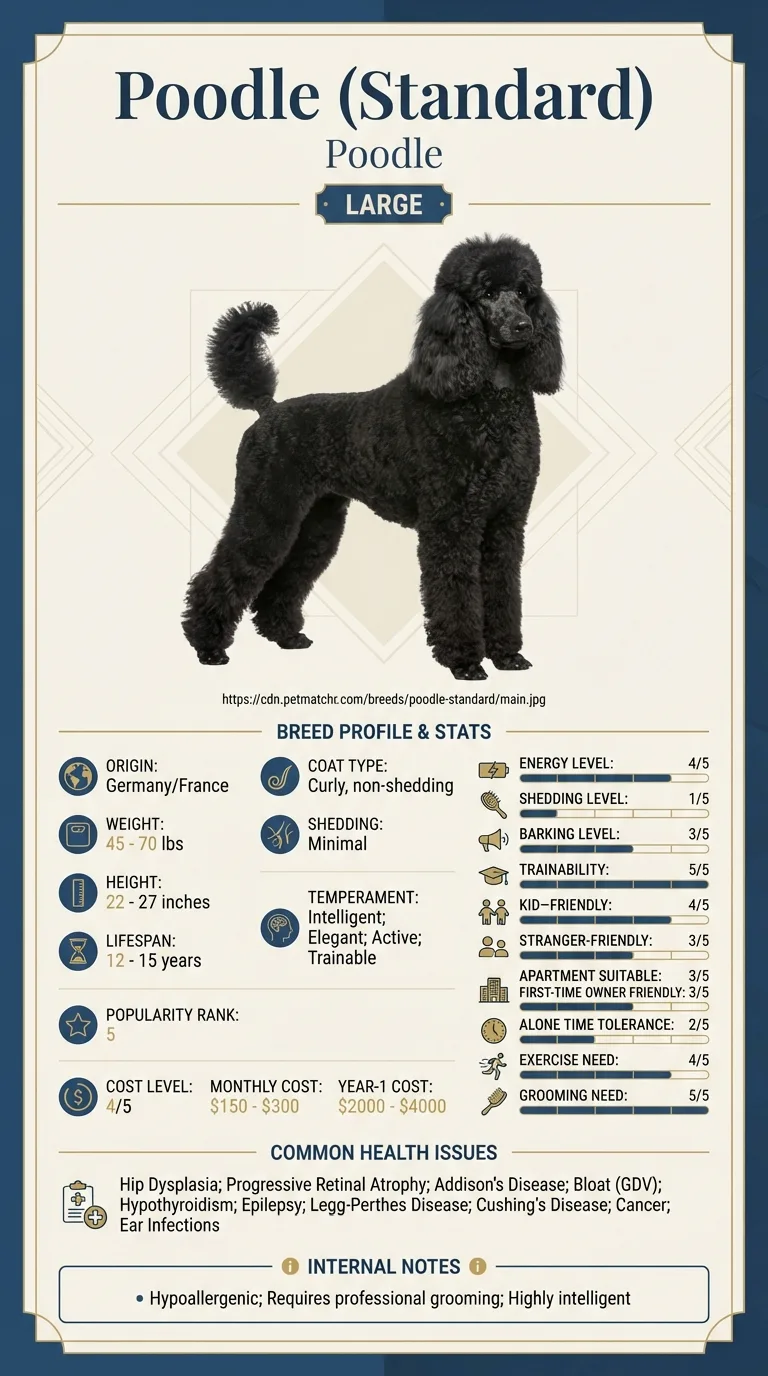
This is for someone already down to Belgian Malinois and Poodle (Standard) and deciding between them. For this pair the decision usually turns on grooming need and apartment suitability, so those are covered first and in most detail. Anyone choosing from a flat has a clear answer here: Poodle (Standard) rates 3/5 against 1/5. There is no origin story here — only what changes about your week.
Between Belgian Malinois and Poodle (Standard), grooming need is what separates them, and Poodle (Standard) is the lower-effort dog of the two to keep.
Choose Belgian Malinois if you do not want a standing grooming appointment, you want a dog that can keep up with an active routine and you want a dog that is more watchful with visitors.
Choose Poodle (Standard) if you are in a flat or a smaller home, this is your first dog and shedding is a problem in your house.
| Feature | belgian malinois | poodle standard | Winner |
|---|---|---|---|
| Size class | large | large | Equal |
| Weight | 55–65 lbs | 45–70 lbs | Equal |
| Height | 22–26 in | 22–27 in | Equal |
| Lifespan | 11–15 years | 12–15 years | poodle standard |
| Exercise need | Very high (5/5) | High (4/5) | poodle standard |
| Grooming need | Low (2/5) | Very high (5/5) | belgian malinois |
| Shedding | Moderate (3/5) | Very low (1/5) | poodle standard |
| Energy level | Very high (5/5) | High (4/5) | Equal |
| Barking | Moderate (3/5) | Moderate (3/5) | Equal |
| Apartment suitability | Very low (1/5) | Moderate (3/5) | poodle standard |
| Good for first-time owners | Very low (1/5) | Moderate (3/5) | poodle standard |
| Tolerates being alone | Very low (1/5) | Low (2/5) | poodle standard |
| Trainability | Very high (5/5) | Very high (5/5) | Equal |
| Good with kids | Moderate (3/5) | High (4/5) | poodle standard |
| Good with other dogs | Moderate (3/5) | High (4/5) | poodle standard |
| Friendly to strangers | Low (2/5) | Moderate (3/5) | poodle standard |
| Cost level | High (4/5) | High (4/5) | Equal |
| Coat | Short, dense | Curly, non-shedding | Equal |
| Origin | Belgium | Germany/France | Equal |
| Typical monthly cost | $120–$250 | $150–$300 | Equal |
| Typical first-year cost | $1,800–$3,500 | $2,000–$4,000 | Equal |
This is the closest size match in the lineup: 45-70 lbs and 22-27 inches for the Standard Poodle against 55-65 lbs and 22-26 for the Malinois. Side by side, height is nearly identical and weight ranges overlap heavily. If you've pictured the Malinois as a big dog, know that a Standard Poodle can match or exceed it - the elegant show coat hides a genuinely large-breed frame.
The Standard Poodle isn't the low-key lapdog people sometimes assume - it rates 4/5 on exercise need, one tier below the Malinois's max 5/5. Both were originally working breeds (retrieving for the Poodle, herding and protection work for the Malinois), and both still carry that expectation of a real daily job, not just a lap around the block. Skip that daily work and both breeds tend to show it as restlessness or unwanted chewing.
Coat care is the sharpest divide in this comparison. The Malinois needs almost nothing - 2/5, short dense fur, occasional brushing. The Standard Poodle needs the most this site rates, 5/5, with regular professional trims to manage a curly coat that mats if ignored. In exchange, the Poodle sheds almost nothing (1/5) against the Malinois's moderate 3/5 - a real consideration if allergies are part of the decision.
Neither breed is a natural apartment dog, but the Standard Poodle does better at 3/5 versus the Malinois's 1/5. Alone-time tolerance is weak for both - 2/5 for the Poodle, 1/5 for the Malinois - so a small space paired with long solo hours is a stretch for either dog, just a smaller stretch with the Poodle. A midday dog walker or daycare closes some of that gap for both.
Trainability ties at the top for both, 5/5 apiece - these are two of the most consistently trainable breeds on this site. The split comes down to who should be holding the leash: the Malinois rates 1/5 for first-time owners, while the Standard Poodle rates a workable 3/5. Poodles get an undeserved reputation as fussy show dogs, but underneath that coat is a working retriever that takes direction well.
The Standard Poodle scores higher across the board here - 4/5 with kids and other dogs against the Malinois's 3/5 on both, and 3/5 with strangers versus 2/5. A household expecting a lot of guests, playdates, or a dog-park routine will likely find the Poodle the easier fit day to day, even though the Malinois isn't unsafe with proper socialization.
Lifespans sit close - 12-15 years for the Standard Poodle, 11-15 for the Malinois. Shared risks include hip dysplasia, progressive retinal atrophy, bloat, epilepsy, and ear infections. The Malinois adds elbow dysplasia, thyroid problems, and degenerative myelopathy to its list; the Standard Poodle's includes Addison's disease, Cushing's disease, and cancer. Both lists are long enough that breeder health testing matters more here than the breed choice itself.
Costs actually favor the Malinois slightly here - $120-250 monthly against $150-300 for the Standard Poodle, and $1,800-3,500 versus $2,000-4,000 in the first year. Both rate 4/5 on this site's cost scale, but the Poodle's grooming bills push its range higher than the Malinois's food-and-training-driven costs, even though the Malinois needs more structured activity to stay sane. Budget accordingly if regular professional grooming isn't something you plan to do yourself.
Belgian Malinois weighs 55–65 lbs and lives 11–15 years; Poodle (Standard) weighs 45–70 lbs and lives 12–15 years. The two diverge most on grooming need, apartment suitability and shedding and 1 other rated axes. They are level on barking, cost level and trainability, so those cannot decide it. Where the table declares a winner it means less work for the owner, nothing more; descriptive rows are left as ties on purpose. The value here is in the differences between the two columns; treat any single score as approximate.

Yes, more than most pairings on this site - 45-70 lbs and 22-27 inches for the Standard Poodle versus 55-65 lbs and 22-26 for the Malinois. Weight and height ranges overlap substantially.
The Standard Poodle, somewhat - $150-300 monthly versus $120-250 for the Malinois, and a first-year range of $2,000-4,000 against $1,800-3,500. Grooming is the main driver of the difference.
The Standard Poodle, rated 3/5 for first-time owners versus the Malinois's 1/5. Both are highly trainable (5/5 each), but the Malinois expects an experienced handler who can meet its exercise and structure needs.
A lot - it rates 5/5, the top of this site's scale, requiring regular professional trims and brushing to prevent matting. The Malinois sits at the opposite end, 2/5, with a coat that mostly takes care of itself.
The Malinois sheds moderately (3/5); the Standard Poodle barely sheds at all (1/5), which is why it's often recommended for allergy-sensitive households despite its heavier grooming needs.
Hip dysplasia, progressive retinal atrophy, bloat, epilepsy, and ear infections appear on both lists. The Poodle's list additionally includes Addison's, Cushing's, and cancer; the Malinois adds elbow dysplasia, thyroid problems, and degenerative myelopathy.
The Standard Poodle, at 3/5 versus the Malinois's 1/5 - though neither is an ideal apartment dog, and both have below-average tolerance for being left alone.
The Standard Poodle for most households - similar size, comparable trainability, but far friendlier with kids, other dogs, and strangers, and more workable for a first-time owner.
About $30-50 more on average - $150-300 versus $120-250 for the Malinois - driven mostly by professional grooming.
The Malinois, at 5/5 versus the Standard Poodle's 4/5 - both are genuinely active breeds, just one notch apart.
Close - 12-15 years for the Standard Poodle, 11-15 for the Malinois, with substantial overlap in the low-to-mid teens.
Secure checkout on Stripe. We never see your card.
7-day money-back guarantee. Instant access.
Health information here is general and is not veterinary advice. If your dog shows pain, sudden behaviour change, or worsening symptoms, consult a licensed veterinarian.
Some links on this site are affiliate links. We may earn a commission at no extra cost to you, and we only suggest products we believe are helpful for dog owners.
We research and check what we publish, but we do not warrant that any figure, date, price, or statement is accurate, complete, or current, and we accept no liability for any loss, cost, injury, or other harm arising from the use of this site. Use it as one reference among several. You remain responsible for your own decisions and for your dog's care - confirm anything that matters with a licensed veterinarian or another qualified professional before you act on it. Full disclaimer.
Match your lifestyle to the right dog.
Take quizNot sure which breed is right for you? Take our 2-minute quiz to find out.
Take the quiz