Belgian Malinois vs Poodle (All Sizes): Which Suits Your Home?
Quick answer
Which breed should most households pick?
For most households, the Poodle - it's more apartment-friendly, better with strangers and other dogs, and easier for a first-time owner. The Malinois makes sense mainly for active, experienced handlers with space and a training plan.
Belgian Malinois or Poodle (All Sizes)? On paper they differ most on grooming need, and on the scales Belgian Malinois is the heavier at 55–65 lbs. Here is how the two compare on everything that shapes an ordinary week.
This is for someone already down to Belgian Malinois and Poodle (All Sizes) and deciding between them. For this pair the decision usually turns on grooming need and apartment suitability, so those are covered first and in most detail. Anyone choosing from a flat has a clear answer here: Poodle (All Sizes) rates 4/5 against 1/5. It is written for the decision rather than the breed history.
Quick verdict
Between Belgian Malinois and Poodle (All Sizes), grooming need is what separates them, and Poodle (All Sizes) is the lower-effort dog of the two to keep.
Choose belgian malinois if...
Choose Belgian Malinois if you do not want a standing grooming appointment, you want a dog that can keep up with an active routine and you want a dog that is more watchful with visitors.
Choose poodle general if...
Choose Poodle (All Sizes) if you are in a flat or a smaller home, this is your first dog and shedding is a problem in your house.
Head-to-head comparison
Feature
belgian malinois
poodle general
Winner
Size class
large
varies
Equal
Weight
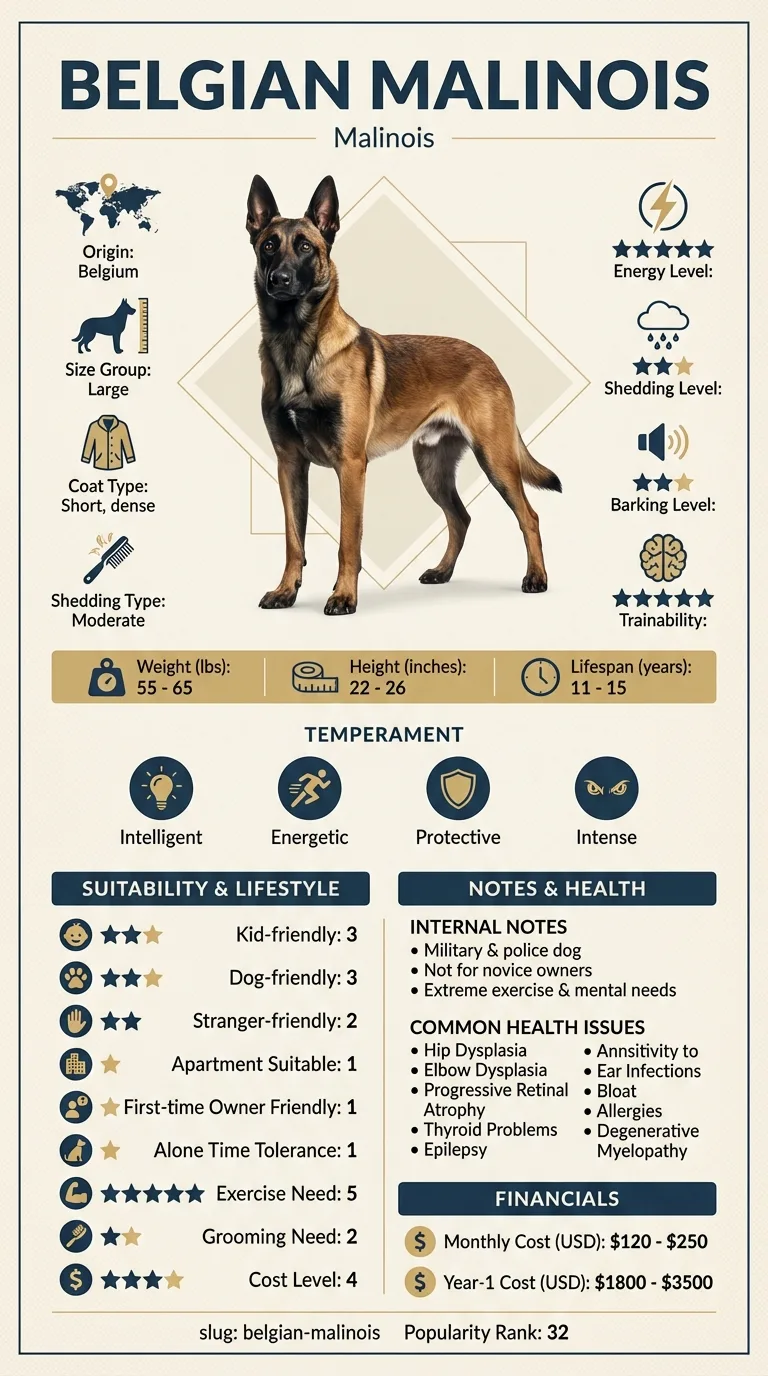
55–65 lbs
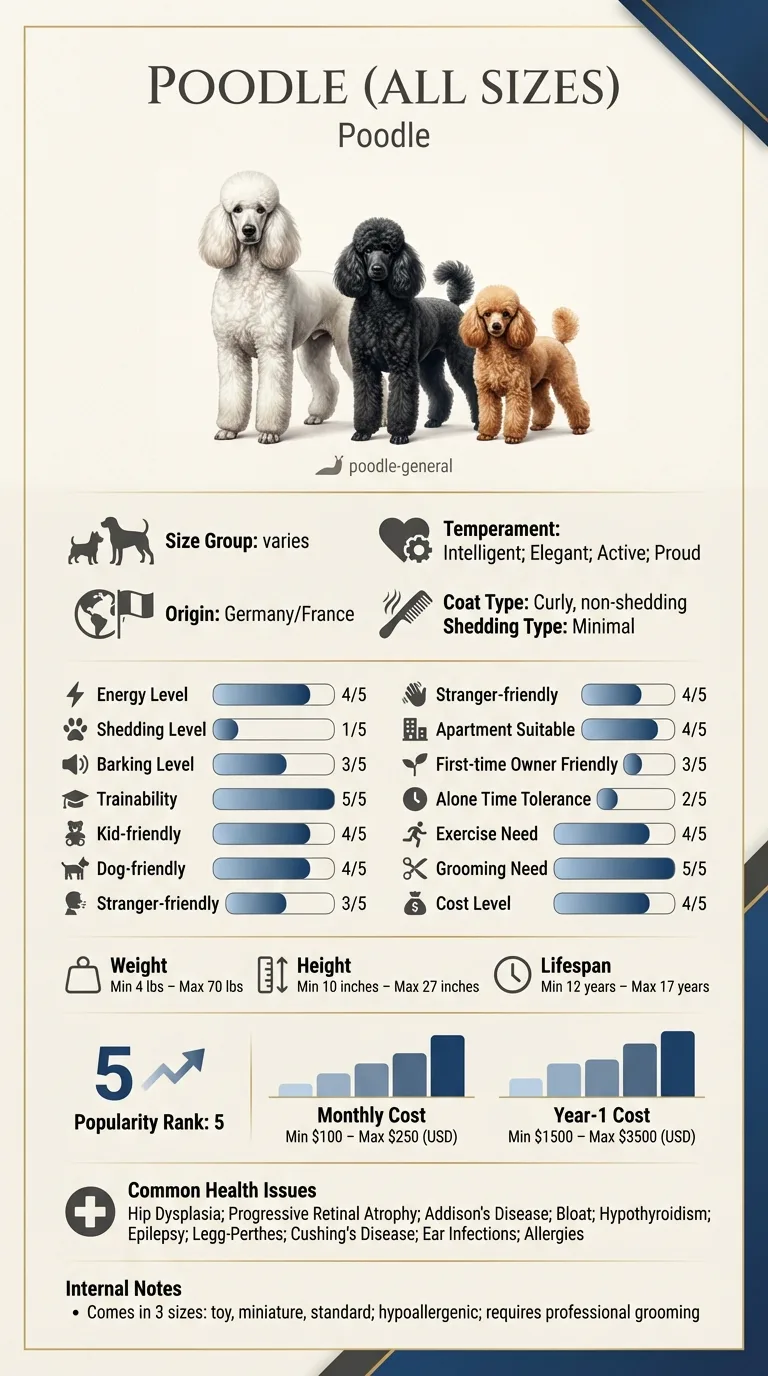
4–70 lbs
Equal
Height
22–26 in
10–27 in
Equal
Lifespan
11–15 years
12–17 years
poodle general
Exercise need
Very high (5/5)
High (4/5)
poodle general
Grooming need
Low (2/5)
Very high (5/5)
belgian malinois
Shedding
Moderate (3/5)
Very low (1/5)
poodle general
Energy level
Very high (5/5)
High (4/5)
Equal
Barking
Moderate (3/5)
Moderate (3/5)
Equal
Apartment suitability
Very low (1/5)
High (4/5)
poodle general
Good for first-time owners
Very low (1/5)
Moderate (3/5)
poodle general
Tolerates being alone
Very low (1/5)
Low (2/5)
poodle general
Trainability
Very high (5/5)
Very high (5/5)
Equal
Good with kids
Moderate (3/5)
High (4/5)
poodle general
Good with other dogs
Moderate (3/5)
High (4/5)
poodle general
Friendly to strangers
Low (2/5)
Moderate (3/5)
poodle general
Cost level
High (4/5)
High (4/5)
Equal
Coat
Short, dense
Curly, non-shedding
Equal
Origin
Belgium
Germany/France
Equal
Typical monthly cost
$120–$250
$100–$250
Equal
Typical first-year cost
$1,800–$3,500
$1,500–$3,500
Equal
Deep dive
Size and build
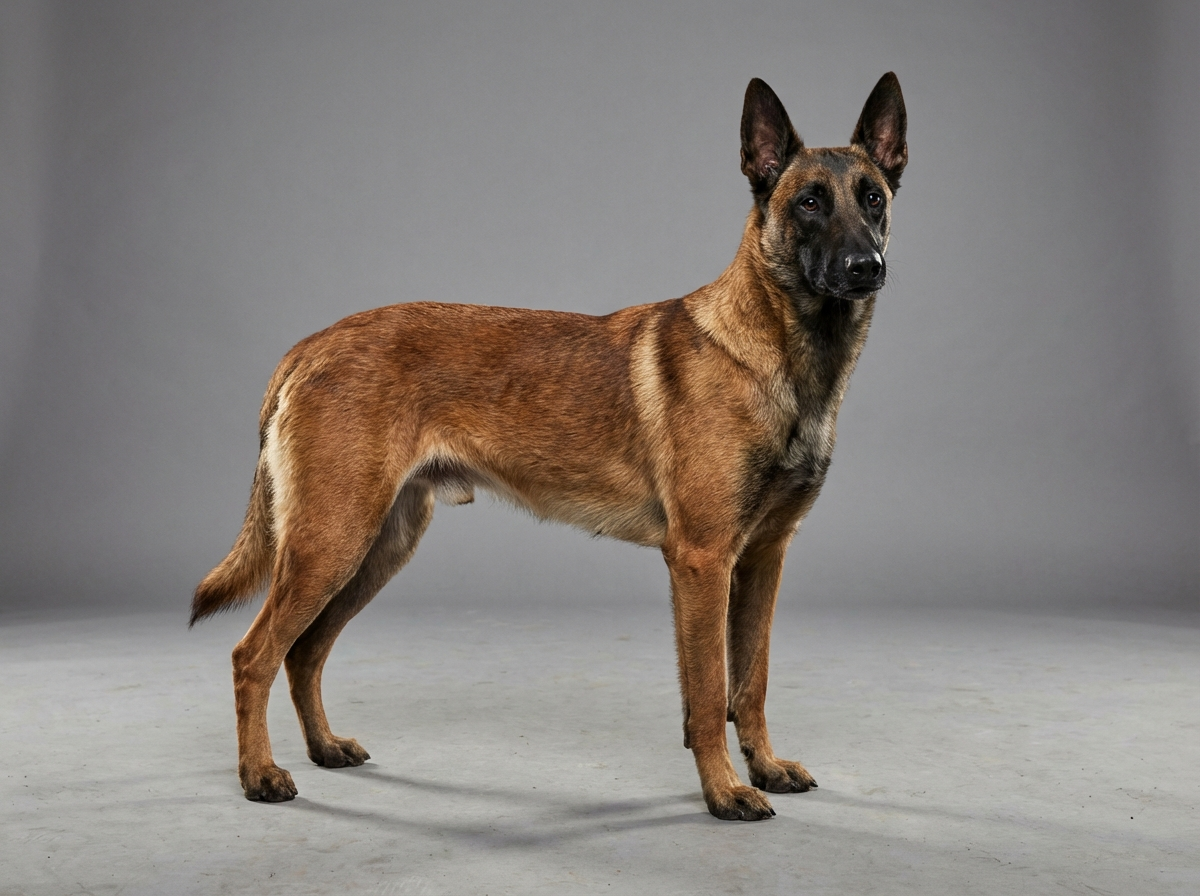
"Poodle" here spans the whole family, so the size comparison is really apples to a fruit basket: a toy Poodle might be 4 pounds and a standard nearly 70. The Malinois holds steady at 55-65 lbs and 22-26 inches, a solid working-dog frame built for speed rather than bulk. If you're picturing a specific Poodle size, match it against the Malinois numbers directly rather than the "varies" line - a toy or miniature will look and feel like a completely different animal next to this dog.
Energy and exercise
Both breeds want to move. The Malinois rates a 5/5 on exercise need, the kind of dog bred for hours of structured work, while Poodles (regardless of size) still sit at 4/5 - genuinely active, just not built to patrol a property line. A Malinois left under-exercised gets destructive; a Poodle left under-exercised gets restless but is more forgiving of a missed day. Neither is a couch-only breed, but only one of them needs a job.
Grooming and shedding
This is where the two breeds trade places. The Malinois needs almost nothing - a 2/5 grooming score and a short, dense coat you brush occasionally. The Poodle flips that entirely: 5/5 grooming, curly non-shedding fur that mats without regular trims and professional appointments. On shedding itself, though, the Poodle wins outright at 1/5 versus the Malinois's moderate 3/5 - less hair on your couch, more money at the groomer.
Apartment living, noise and time alone
The Malinois scores a 1/5 for apartment suitability, about as low as this site's ratings go, and a 1/5 for tolerating time alone. That's not a breed you leave in a one-bedroom for eight-hour workdays. The Poodle rates 4/5 for apartments and handles cramped spaces far better, though its own alone-tolerance score (2/5) is still low - both breeds want company, just at very different scales of space and structure.
Training and owner experience
Trainability is a dead heat: both breeds score 5/5, and both are smart enough to learn fast and bored enough to misbehave without mental work. Where they split is beginner-friendliness. The Malinois sits at 1/5 for first-time owners - it's a working line dog that expects a job and a firm, experienced handler. The Poodle rates a moderate 3/5, forgiving enough for a committed new owner willing to keep up with training and grooming both.
Kids, other dogs and visitors
Across kids, other dogs, and strangers, the Poodle edges ahead on every line: 4/5 with kids versus the Malinois's 3/5, 4/5 with other dogs versus 3/5, and 3/5 with strangers versus a wary 2/5. None of this makes the Malinois unsafe with a well-socialized upbringing, but it does mean a busier household - visitors, playdates, a dog park routine - will generally run smoother with the Poodle.
Health and lifespan
Lifespans overlap but the Poodle edges longer at 12-17 years versus 11-15 for the Malinois. Both share several risks - hip dysplasia, progressive retinal atrophy, epilepsy, ear infections, and allergies show up on both lists. The Malinois carries some working-dog-specific concerns like elbow dysplasia and degenerative myelopathy; the Poodle's list adds Addison's disease and Cushing's disease, both hormonal conditions worth screening for with a reputable breeder.
Cost to keep
Both breeds land in the same "high" cost bracket (4/5) with nearly identical monthly ranges - $120-250 for the Malinois, $100-250 for the Poodle. First-year costs are close too, $1,800-3,500 versus $1,500-3,500. The real cost divergence isn't in the base numbers but in where the money goes: Malinois owners spend more on training and enrichment, Poodle owners spend more at the grooming salon.
Belgian Malinois vs Poodle (All Sizes) at a glance
Belgian Malinois weighs 55–65 lbs and lives 11–15 years; Poodle (All Sizes) weighs 4–70 lbs and lives 12–17 years. The two diverge most on grooming need, apartment suitability and shedding and 1 other rated axes. They are level on barking, cost level and trainability, so those cannot decide it. In the table, a "winner" means easier for an ordinary household — not better. Size, coat and origin are recorded without a verdict. Because both breeds are scored the same way, the gaps are reliable even where the absolute numbers are rough.
Belgian Malinois vs Poodle (All Sizes): Which Suits Your Home? - Belgian Malinois vs Poodle (All Sizes) at a glance
Frequently asked questions
How big does each breed get?
The Malinois is a consistent 55-65 lbs and 22-26 inches. Poodles vary enormously by size variety - anywhere from 4 to 70 lbs and 10 to 27 inches - so "Poodle" alone doesn't tell you much; you need to know which size you're comparing.
Which one sheds less?
The Poodle, by a wide margin - it rates 1/5 on shedding versus the Malinois's moderate 3/5. That's the tradeoff for the Poodle's much heavier grooming schedule (5/5) against the Malinois's low-maintenance coat (2/5).
Is either breed a good fit for a first-time owner?
The Poodle is the more realistic choice at 3/5 for first-time owners. The Malinois scores 1/5 - it's a working-line breed that expects structured training and enough physical outlet to earn its keep, a steep learning curve for someone new to dogs.
Can either live in an apartment?
The Poodle can, scoring 4/5 for apartment living. The Malinois scores 1/5 and also struggles with alone time (1/5), so a small space paired with a normal workday is a hard combination for this breed specifically.
What will monthly costs look like?
Very similar - $120-250 for the Malinois and $100-250 for the Poodle, both landing in the "high" cost tier. First-year costs run $1,800-3,500 and $1,500-3,500 respectively.
Do they share health risks?
Yes, several: hip dysplasia, progressive retinal atrophy, epilepsy, ear infections, and allergies appear on both lists. The Malinois adds elbow dysplasia and degenerative myelopathy; the Poodle adds Addison's and Cushing's disease, both endocrine conditions.
Which is easier around other dogs and new people?
The Poodle again, scoring higher on both counts - 4/5 with other dogs and 3/5 with strangers, against the Malinois's 3/5 and 2/5. Early socialization narrows this gap for either breed but doesn't erase it.
For most households, the Poodle - it's more apartment-friendly, better with strangers and other dogs, and easier for a first-time owner. The Malinois makes sense mainly for active, experienced handlers with space and a training plan.
Costs
What's the monthly cost difference?
Barely any - $120-250 for the Malinois versus $100-250 for the Poodle, both "high" cost breeds. Grooming bills push the Poodle's number around; training and food push the Malinois's.
Training
How much exercise does each need?
The Malinois rates 5/5, needing serious daily work. The Poodle rates 4/5 - still genuinely active but with more tolerance for a lighter day.
Health
Which breed lives longer?
The Poodle, at 12-17 years versus 11-15 for the Malinois. Both ranges overlap in the low-to-mid teens, but the Poodle's upper end runs noticeably longer.
Related DogBreedCompass guides
Belgian Malinois breed guide – Readers comparing the two usually want the full profile of Belgian Malinois before deciding.
Belgian Malinois vs German Shorthaired Pointer – German Shorthaired Pointer is the closest breed to Belgian Malinois on the measured axes, so it is the natural next comparison.
Poodle (All Sizes) vs Poodle (Standard) – Poodle (Standard) sits closest to Poodle (All Sizes), which makes it the alternative worth ruling out.
Health information here is general and is not veterinary advice. If your dog shows pain, sudden behaviour change, or worsening symptoms, consult a licensed veterinarian.
Some links on this site are affiliate links. We may earn a commission at no extra cost to you, and we only suggest products we believe are helpful for dog owners.
We research and check what we publish, but we do not warrant that any figure, date, price, or statement is accurate, complete, or current, and we accept no liability for any loss, cost, injury, or other harm arising from the use of this site. Use it as one reference among several. You remain responsible for your own decisions and for your dog's care - confirm anything that matters with a licensed veterinarian or another qualified professional before you act on it. Full disclaimer.