Behavior
Better for allergy-prone households?
The Poodle, thanks to its very low 1/5 shedding rating versus the Cocker's moderate 3/5.

Quick answer
Better for allergy-prone households?
The Poodle, thanks to its very low 1/5 shedding rating versus the Cocker's moderate 3/5.
Cocker Spaniel or Poodle (All Sizes)? On paper they differ most on shedding, and on the scales Poodle (All Sizes) is the heavier at 4–70 lbs. Here is how the two compare on everything that shapes an ordinary week.
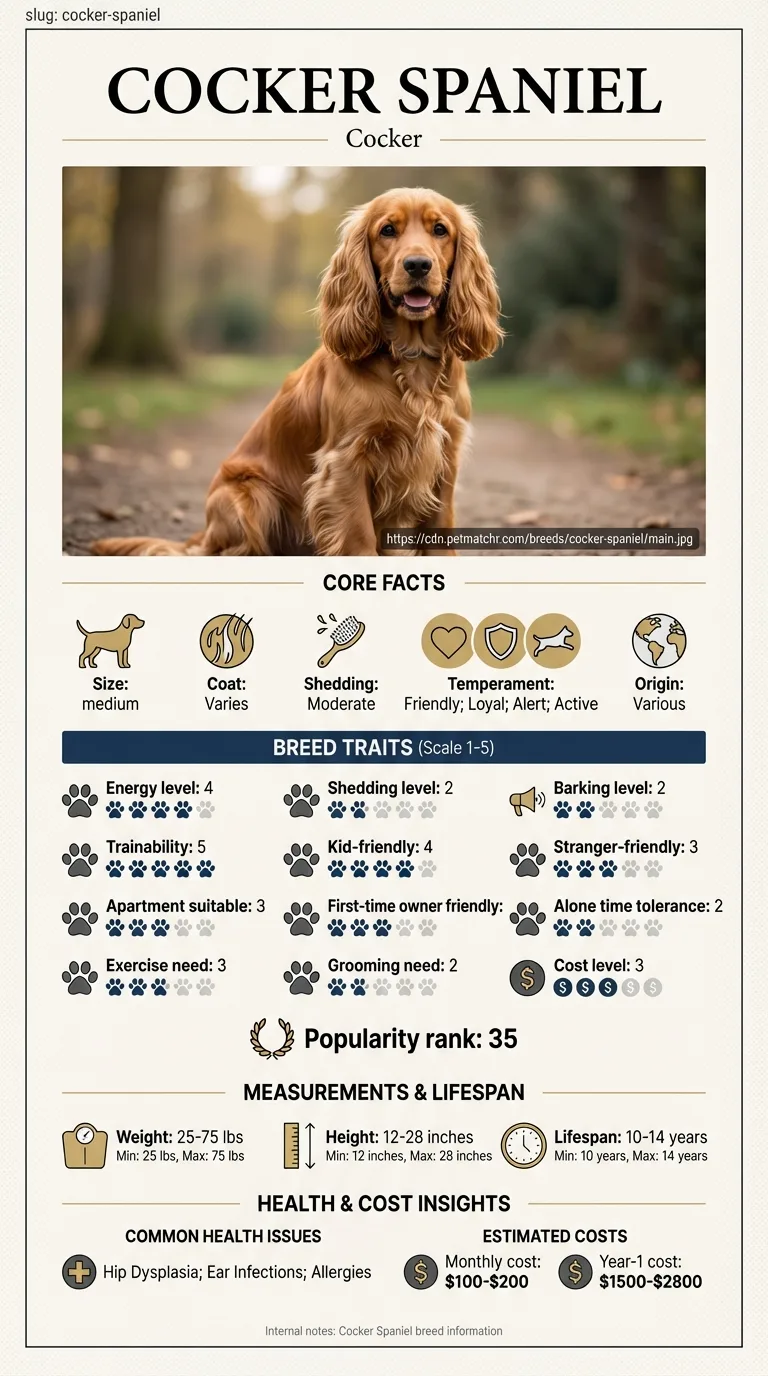
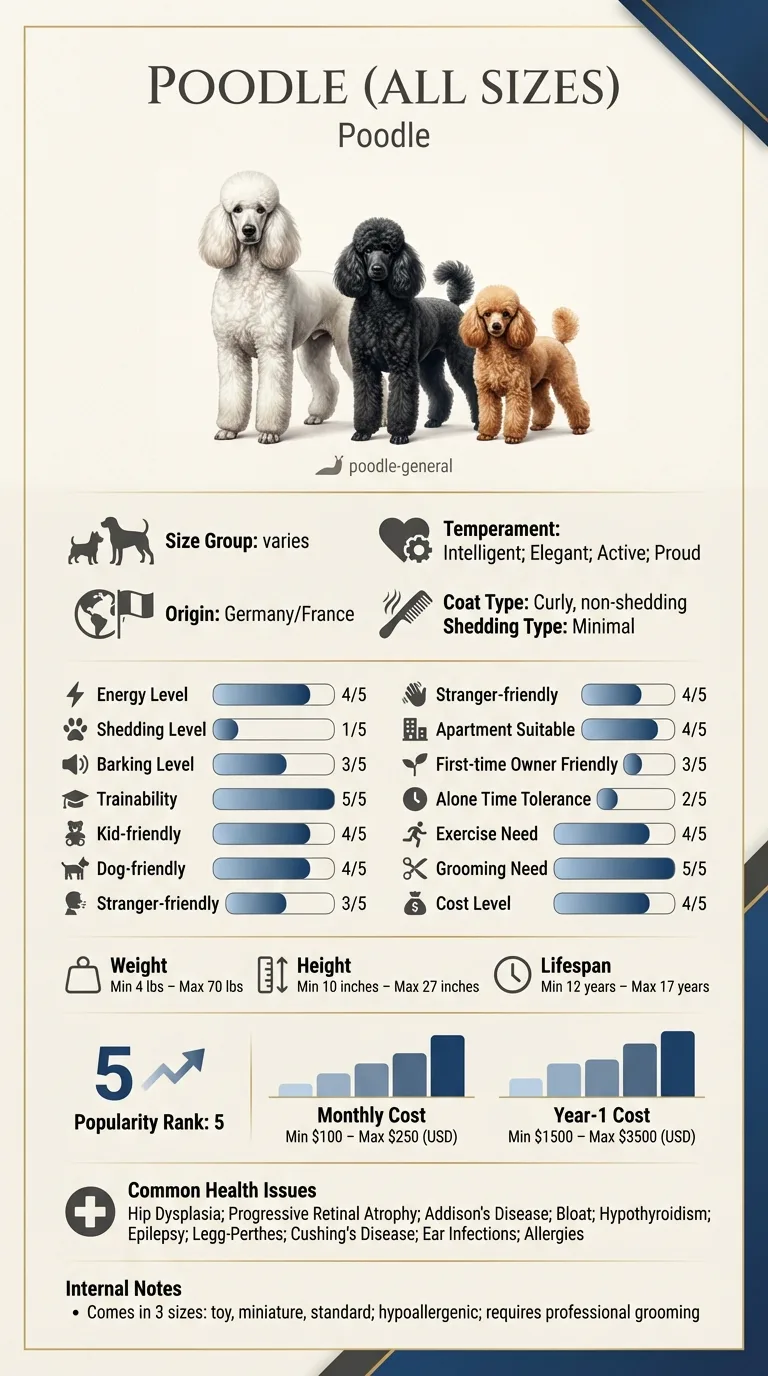
This is for someone already down to Cocker Spaniel and Poodle (All Sizes) and deciding between them. For this pair the decision usually turns on shedding, so those are covered first and in most detail. Both rate 4/5 for flats, so housing does not settle this one. The focus throughout is on daily consequences rather than breed background.
Between Cocker Spaniel and Poodle (All Sizes), shedding is what separates them, and Cocker Spaniel is the lower-effort dog of the two to keep.
Choose Cocker Spaniel if this is your first dog, your walking routine is modest and there are young children at home.
Choose Poodle (All Sizes) if shedding is a problem in your house, you want a dog that picks up training quickly and you want a dog that can keep up with an active routine.
| Feature | cocker spaniel | poodle general | Winner |
|---|---|---|---|
| Size class | small | varies | Equal |
| Weight | 20–30 lbs | 4–70 lbs | Equal |
| Height | 13–16 in | 10–27 in | Equal |
| Lifespan | 10–14 years | 12–17 years | poodle general |
| Exercise need | Moderate (3/5) | High (4/5) | cocker spaniel |
| Grooming need | Very high (5/5) | Very high (5/5) | Equal |
| Shedding | Moderate (3/5) | Very low (1/5) | poodle general |
| Energy level | Moderate (3/5) | High (4/5) | Equal |
| Barking | Moderate (3/5) | Moderate (3/5) | Equal |
| Apartment suitability | High (4/5) | High (4/5) | Equal |
| Good for first-time owners | High (4/5) | Moderate (3/5) | cocker spaniel |
| Tolerates being alone | Low (2/5) | Low (2/5) | Equal |
| Trainability | High (4/5) | Very high (5/5) | poodle general |
| Good with kids | Very high (5/5) | High (4/5) | cocker spaniel |
| Good with other dogs | High (4/5) | High (4/5) | Equal |
| Friendly to strangers | High (4/5) | Moderate (3/5) | cocker spaniel |
| Cost level | Moderate (3/5) | High (4/5) | cocker spaniel |
| Coat | Silky and feathered | Curly, non-shedding | Equal |
| Origin | Various | Germany/France | Equal |
| Typical monthly cost | $80–$150 | $100–$250 | Equal |
| Typical first-year cost | $1,100–$2,300 | $1,500–$3,500 | Equal |
"Poodle" as a category is less a single size than a spectrum: 4 to 70 pounds, 10 to 27 inches at the shoulder, spanning toy, miniature, and standard varieties in one entry. A Cocker Spaniel, by contrast, sits in a tight 20-to-30-pound, 13-to-16-inch band with no size varieties to sort through. The real size comparison depends entirely on which Poodle a buyer means — a Toy Poodle will be smaller than any Cocker, while a Standard Poodle can outweigh one by more than double. Anyone comparing these two breeds should pin down the Poodle size first; the general entry can't answer that alone.
Exercise need favors the Cocker as the lower-commitment option, moderate 3/5 against the Poodle's high 4/5, and energy level follows the same pattern, moderate versus high. The temperament lists explain why: the Poodle is described as active and proud, a dog historically bred as a working retriever regardless of size, while the Cocker's merry, affectionate nature suits a calmer daily rhythm. A Standard or Miniature Poodle in particular wants real mental and physical work — retrieving games, agility, structured training — not just a walk around the block, and boredom in a Poodle tends to surface as mischief rather than settling quietly.
Both breeds tie at very high, 5/5, for grooming need, but the payoff differs: the Poodle's curly, non-shedding coat rates very low, 1/5, for shedding, while the Cocker's silky, feathered coat still sheds moderately at 3/5. In plain terms, a Poodle owner trades regular professional grooming for a nearly hair-free home, while a Cocker owner pays the same grooming-time cost without that shedding benefit. For allergy-sensitive households this single row of the table — shedding — often decides the comparison outright, since neither breed lets an owner skip grooming altogether.
Apartment suitability ties at high, 4/5, for both, and barking scores match too, at moderate 3/5 — so neither breed has a built-in noise or space advantage on paper. The differentiator is exercise: a Poodle's high 4/5 activity need means apartment living works only if daily walks or play sessions are non-negotiable, whereas a Cocker's moderate 3/5 need is more forgiving of an off day. Both dogs tolerate being alone poorly, low 2/5 each, so crate training and a midday break matter for either breed in a small home.
Trainability gives the Poodle a real edge — very high, 5/5, against the Cocker's still-solid high, 4/5 — reflecting the Poodle's long history as one of the most consistently trainable breeds in any size class. But first-time-owner suitability flips the other way: the Cocker rates high, 4/5, the Poodle only moderate, 3/5, largely because a Poodle's intelligence demands consistent engagement a less experienced owner may not sustain. A Cocker's eager-to-please nature forgives more training inconsistency; a bored, under-stimulated Poodle is more likely to develop its own opinions about the rules.
Good with kids leans slightly Cocker, very high 5/5 against the Poodle's high 4/5, and friendly-to-strangers does too, high 4/5 versus moderate 3/5 — the Poodle's proud, somewhat reserved streak shows up here. Good with other dogs ties at high 4/5 for both. Families prioritizing an outgoing dog that greets every visitor warmly likely lean Cocker; those who don't mind a more discerning, dignified house guest — the Poodle's elegant and proud traits, per the table — won't see the difference as a downside so much as a different personality.
The Poodle wins decisively on lifespan, 12 to 17 years against the Cocker's 10 to 14, but pays for it with a longer list of known health risks — ten conditions including Addison's disease, bloat, Cushing's disease, and hypothyroidism, versus five for the Cocker, which shares hip dysplasia, progressive retinal atrophy, and ear infections with the Poodle but adds cataracts and autoimmune hemolytic anemia as its own distinct concerns. A longer health list partly reflects how thoroughly-studied a breed is rather than pure risk, but Poodle buyers should still ask breeders about Addison's and bloat prevention specifically.
Cost level itself favors the Cocker, moderate 3/5 against the Poodle's high 4/5, and the dollar figures confirm it: $80–$150 monthly and $1,100–$2,300 first-year for the Cocker, versus $100–$250 monthly and $1,500–$3,500 first-year for the Poodle. Grooming is the biggest line item for both, tied at very high 5/5 need, but a Poodle's larger size variants and longer 12-to-17-year lifespan mean the higher yearly spend compounds over more years of ownership than a Cocker's shorter run.
Cocker Spaniel weighs 20–30 lbs and lives 10–14 years; Poodle (All Sizes) weighs 4–70 lbs and lives 12–17 years. The two diverge most on shedding. They are level on tolerates being alone, apartment suitability and barking, so those cannot decide it. The table below marks a winner only where one breed is genuinely easier for a typical owner; size and origin are facts rather than merits and stay level. Ratings come from one source applied to both breeds, so they are meaningful against each other rather than as absolute scores.

This entry covers all Poodle sizes, 4 to 70 pounds — for a size-matched comparison, a Miniature Poodle (10–15 lbs) is closer to a Cocker's 20–30 lbs than a Standard (45–70 lbs) is.
The Poodle, by a wide margin — very low 1/5 shedding versus the Cocker's moderate 3/5, thanks to its curly, non-shedding coat.
The Poodle rates very high, 5/5, for trainability against the Cocker's high 4/5 — a small but real edge from generations of working-retriever breeding.
The Poodle, 12–17 years, well ahead of the Cocker's 10–14 — though the Poodle's health list also runs longer, at ten known conditions versus five.
No — the Cocker rates high 4/5 for friendliness to strangers, the Poodle only moderate 3/5, matching its more reserved, proud temperament.
The Cocker, on both counts — lower cost-level rating (moderate vs high) and a lower first-year estimate, $1,100–$2,300 versus $1,500–$3,500.
The Cocker is rated the easier of the two, high 4/5 versus the Poodle's moderate 3/5, mainly because the Poodle's intelligence needs more consistent engagement.
The Poodle, thanks to its very low 1/5 shedding rating versus the Cocker's moderate 3/5.
Both tie at very high 5/5 grooming need, so professional grooming costs run similar for either.
The Poodle, rated very high 5/5 for trainability against the Cocker's high 4/5.
The Cocker Spaniel, rated high 4/5 versus the Poodle's moderate 3/5.
Secure checkout on Stripe. We never see your card.
7-day money-back guarantee. Instant access.
Health information here is general and is not veterinary advice. If your dog shows pain, sudden behaviour change, or worsening symptoms, consult a licensed veterinarian.
Some links on this site are affiliate links. We may earn a commission at no extra cost to you, and we only suggest products we believe are helpful for dog owners.
We research and check what we publish, but we do not warrant that any figure, date, price, or statement is accurate, complete, or current, and we accept no liability for any loss, cost, injury, or other harm arising from the use of this site. Use it as one reference among several. You remain responsible for your own decisions and for your dog's care - confirm anything that matters with a licensed veterinarian or another qualified professional before you act on it. Full disclaimer.
Match your lifestyle to the right dog.
Take quizNot sure which breed is right for you? Take our 2-minute quiz to find out.
Take the quiz