Living
Which is the better fit for most households?
The Beagle, for its higher first-time-owner score (4/5 vs. 1/5) and better tolerance of average routines.

Quick answer
Which is the better fit for most households?
The Beagle, for its higher first-time-owner score (4/5 vs. 1/5) and better tolerance of average routines.
Beagle or Belgian Malinois? On paper they differ most on good for first-time owners, and on the scales Belgian Malinois is the heavier at 55–65 lbs. Here is how the two compare on everything that shapes an ordinary week.
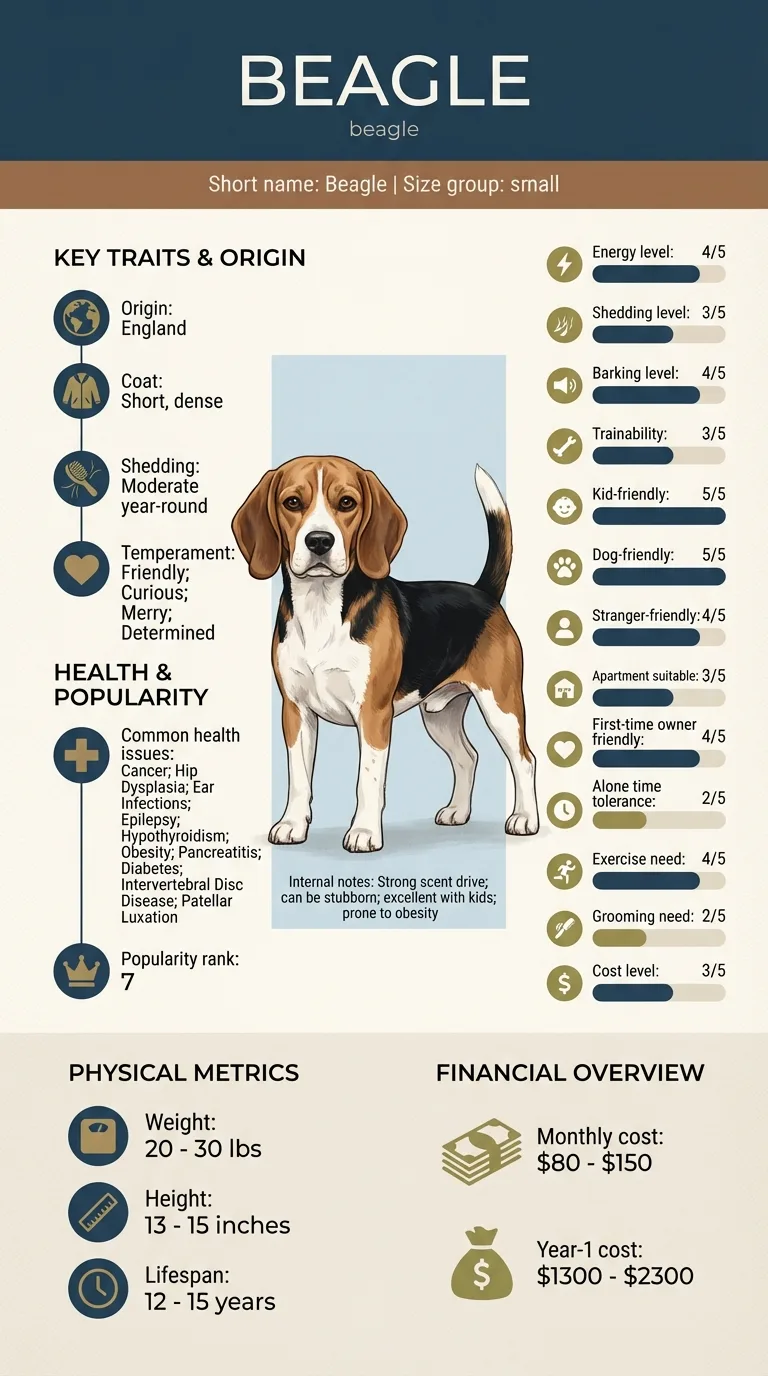
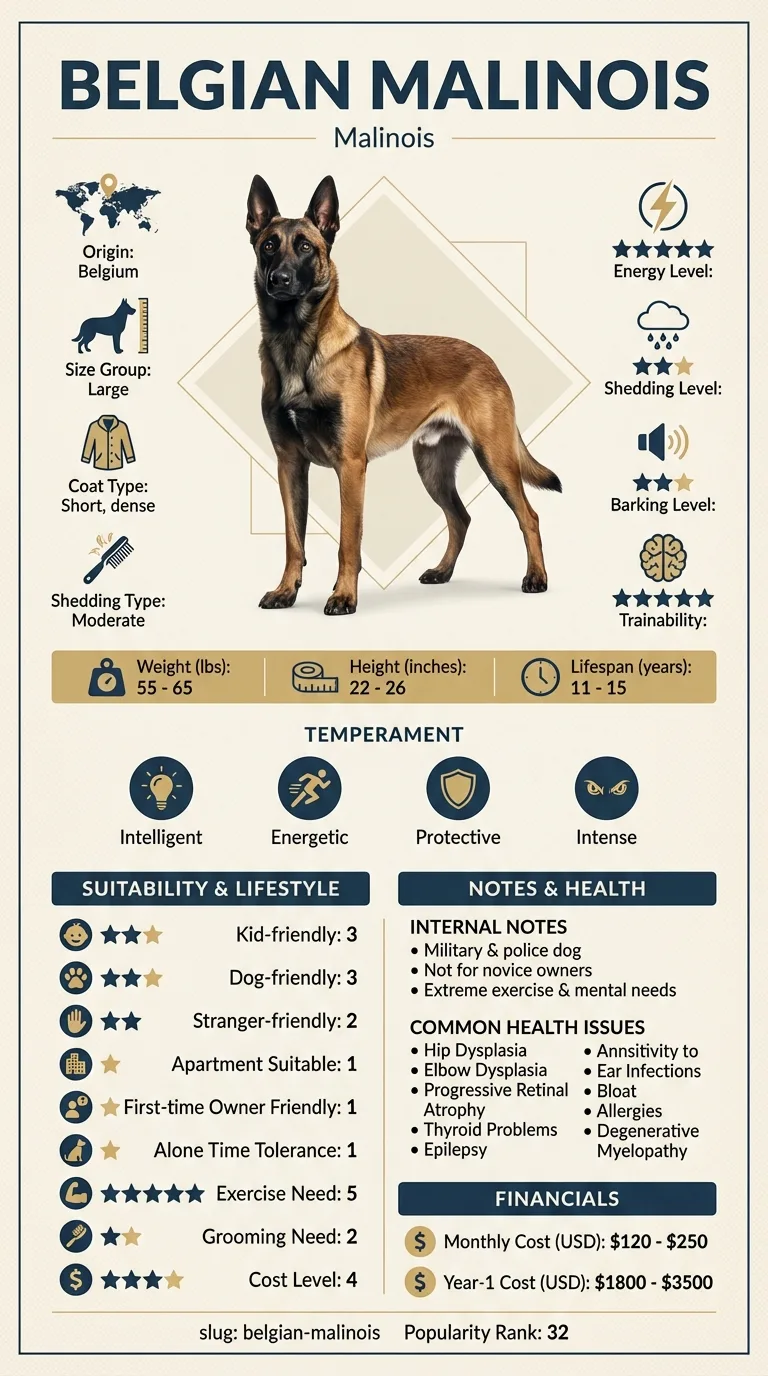
This is for someone already down to Beagle and Belgian Malinois and deciding between them. For this pair the decision usually turns on good for first-time owners and apartment suitability, so those are covered first and in most detail. Anyone choosing from a flat has a clear answer here: Beagle rates 3/5 against 1/5. Breed history is left out; what follows is what you will actually live with.
Between Beagle and Belgian Malinois, good for first-time owners is what separates them, and Beagle is the lower-effort dog of the two to keep.
Choose Beagle if you are in a flat or a smaller home, this is your first dog and your walking routine is modest.
Choose Belgian Malinois if you want a dog that picks up training quickly, you want a dog that can keep up with an active routine and you want a dog that is more watchful with visitors.
| Feature | beagle | belgian malinois | Winner |
|---|---|---|---|
| Size class | small | large | Equal |
| Weight | 20–30 lbs | 55–65 lbs | Equal |
| Height | 13–15 in | 22–26 in | Equal |
| Lifespan | 12–15 years | 11–15 years | beagle |
| Exercise need | High (4/5) | Very high (5/5) | beagle |
| Grooming need | Low (2/5) | Low (2/5) | Equal |
| Shedding | Moderate (3/5) | Moderate (3/5) | Equal |
| Energy level | High (4/5) | Very high (5/5) | Equal |
| Barking | High (4/5) | Moderate (3/5) | belgian malinois |
| Apartment suitability | Moderate (3/5) | Very low (1/5) | beagle |
| Good for first-time owners | High (4/5) | Very low (1/5) | beagle |
| Tolerates being alone | Low (2/5) | Very low (1/5) | beagle |
| Trainability | Moderate (3/5) | Very high (5/5) | belgian malinois |
| Good with kids | Very high (5/5) | Moderate (3/5) | beagle |
| Good with other dogs | Very high (5/5) | Moderate (3/5) | beagle |
| Friendly to strangers | High (4/5) | Low (2/5) | beagle |
| Cost level | Moderate (3/5) | High (4/5) | beagle |
| Coat | Short, dense | Short, dense | Equal |
| Origin | England | Belgium | Equal |
| Typical monthly cost | $80–$150 | $120–$250 | Equal |
| Typical first-year cost | $1,300–$2,300 | $1,800–$3,500 | Equal |
The Belgian Malinois is built like a Beagle scaled up and re-engineered for work: 55 to 65 pounds and 22 to 26 inches tall, versus the Beagle's compact 20 to 30 pounds and 13 to 15 inches. Both are athletic, muscular breeds for their size, but the Malinois is the one you'll see on a K9 unit or a military base -- its frame is built for sustained physical work, not just field trotting after a scent.
Both breeds run hot, but the Malinois runs hotter: 5/5 exercise need and energy against the Beagle's already-high 4/5 on both. A tired Beagle naps. A tired Malinois often just needs a job to do next -- this is a breed developed for police and military work, and physical exercise alone doesn't fully satisfy it without mental tasks layered in.
Coat care is a tie -- both rate 2/5 for grooming and 3/5 for shedding, short double coats that need regular brushing but no professional trims. If low-maintenance fur is your priority, either breed clears that bar equally well; the real maintenance difference between them shows up in exercise and training time, not brushing.
The Beagle is the more forgiving apartment dog at 3/5 apartment suitability against the Malinois's very low 1/5, though the Beagle's 4/5 barking rating means noise complaints are still a real risk. The Malinois barks somewhat less (3/5) but its exercise needs and near-zero tolerance for being alone (1/5, versus the Beagle's 2/5) make small-space living genuinely unsuitable rather than just inconvenient.
The Malinois is highly trainable (5/5) but this is not a beginner's dog -- it rates just 1/5 for first-time owners, the lowest score in this entire comparison, reflecting the intensity and structure this breed needs from an experienced handler. The Beagle, despite more moderate trainability (3/5), rates 4/5 for first-timers because its independence is stubbornness rather than the drive-heavy intensity that makes an under-managed Malinois a real handful.
The Beagle is the more universally social dog here: 5/5 with kids and other dogs, 4/5 with strangers, against the Malinois's 3/5, 3/5, and notably low 2/5. None of this makes the Malinois a bad dog -- it's a protective, focused breed by design -- but that design doesn't translate to the relaxed, everybody's-friend energy a Beagle brings to a crowded backyard or a dog park.
Both breeds share hip dysplasia, epilepsy, and ear infections on their health lists. Beyond that, the Malinois carries some working-breed-specific risks -- elbow dysplasia and degenerative myelopathy among them -- while the Beagle's list leans toward metabolic issues like diabetes and pancreatitis. Lifespans are close, 12-15 years for the Beagle against 11-15 for the Malinois, though the Malinois's range dips a year lower at the bottom end.
The Malinois costs more to keep at every stage: $120-$250 monthly against the Beagle's $80-$150, and $1,800-$3,500 in year one versus $1,300-$2,300. Some of that is size, but a lot of it is the Malinois's need for structured training, secure fencing, and often professional obedience work -- costs that a lower-drive breed like the Beagle simply doesn't generate as often.
Beagle weighs 20–30 lbs and lives 12–15 years; Belgian Malinois weighs 55–65 lbs and lives 11–15 years. The two diverge most on good for first-time owners, apartment suitability and good with kids and 3 other rated axes. They are level on grooming need and shedding, so those cannot decide it. The comparison marks an easier option only where one exists. Facts like weight and country of origin are not scored. Both dogs are rated from the same dataset, which is what makes the numbers comparable with each other even though any individual dog sits somewhere inside its breed's range.

No -- it rates just 1/5 for first-time owners, the lowest score in this comparison, due to its intensity and need for experienced, structured handling.
The Malinois, at 55-65 lbs and 22-26 inches, well ahead of the Beagle's 20-30 lbs and 13-15 inches.
Neither has an edge -- both rate 3/5 for shedding.
The Beagle, rating 3/5 for apartment suitability against the Malinois's 1/5, though the Beagle's barking (4/5) is still worth planning around.
Meaningful -- $80-$150 for a Beagle versus $120-$250 for a Malinois.
Yes -- hip dysplasia, epilepsy, and ear infections appear on both lists.
The Beagle by a wide margin -- 4/5 versus the Malinois's 2/5, which tends toward reserved or protective around new people.
The Beagle, for its higher first-time-owner score (4/5 vs. 1/5) and better tolerance of average routines.
Roughly $40-$100 more monthly ($120-$250 vs. $80-$150) and $500-$1,200 more in year one.
Close -- 12-15 years for the Beagle, 11-15 for the Malinois.
The Malinois, rating 5/5 versus the Beagle's 3/5, but it needs an experienced handler to use that trainability well.
Secure checkout on Stripe. We never see your card.
7-day money-back guarantee. Instant access.
Health information here is general and is not veterinary advice. If your dog shows pain, sudden behaviour change, or worsening symptoms, consult a licensed veterinarian.
Some links on this site are affiliate links. We may earn a commission at no extra cost to you, and we only suggest products we believe are helpful for dog owners.
We research and check what we publish, but we do not warrant that any figure, date, price, or statement is accurate, complete, or current, and we accept no liability for any loss, cost, injury, or other harm arising from the use of this site. Use it as one reference among several. You remain responsible for your own decisions and for your dog's care - confirm anything that matters with a licensed veterinarian or another qualified professional before you act on it. Full disclaimer.
Match your lifestyle to the right dog.
Take quizNot sure which breed is right for you? Take our 2-minute quiz to find out.
Take the quiz