Living
Which is the better overall choice?
The AmStaff, for most households -- better trainability, a longer lifespan, and an easier fit for first-time owners. The Bloodhound suits an experienced owner specifically wanting a scent-tracking dog.

Quick answer
Which is the better overall choice?
The AmStaff, for most households -- better trainability, a longer lifespan, and an easier fit for first-time owners. The Bloodhound suits an experienced owner specifically wanting a scent-tracking dog.
American Staffordshire Terrier or Bloodhound? On paper they differ most on trainability, and on the scales Bloodhound is the heavier at 90–110 lbs. Here is how the two compare on everything that shapes an ordinary week.
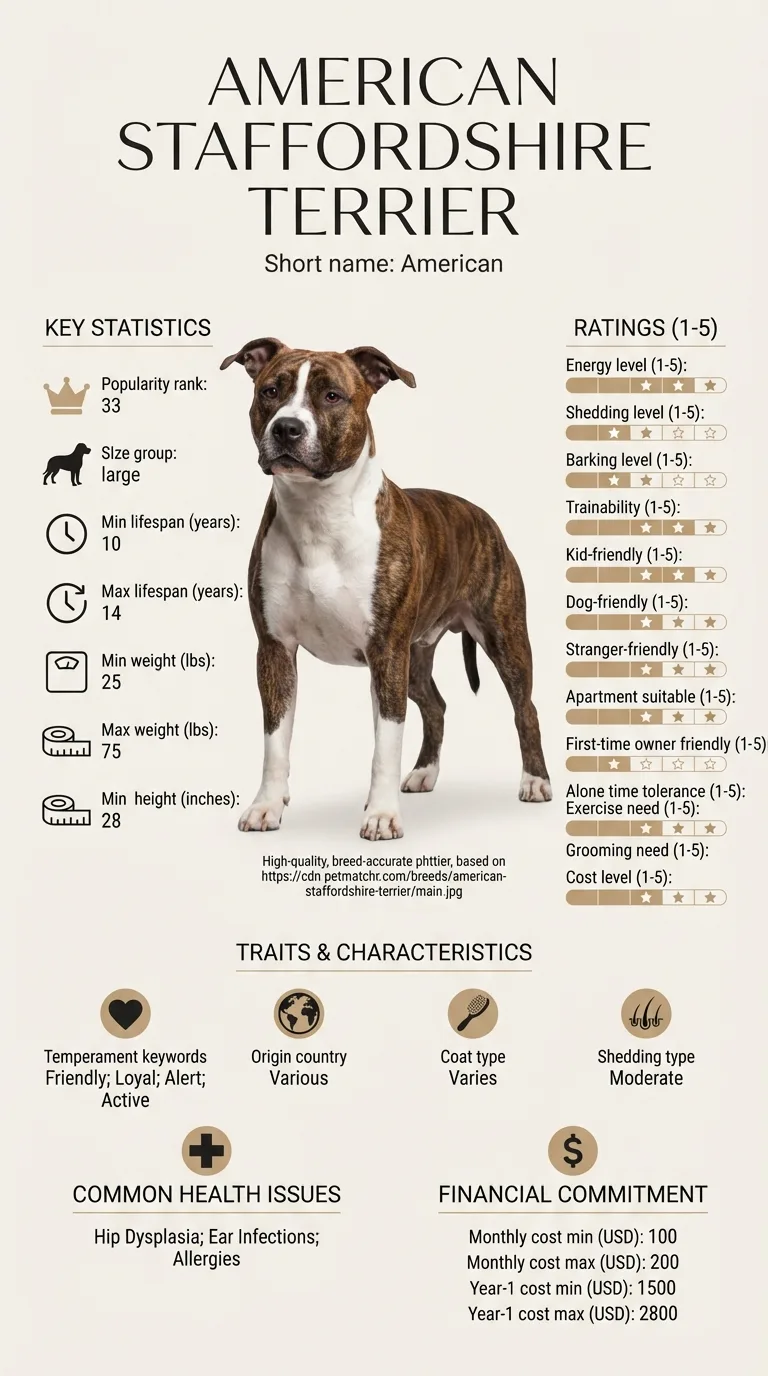
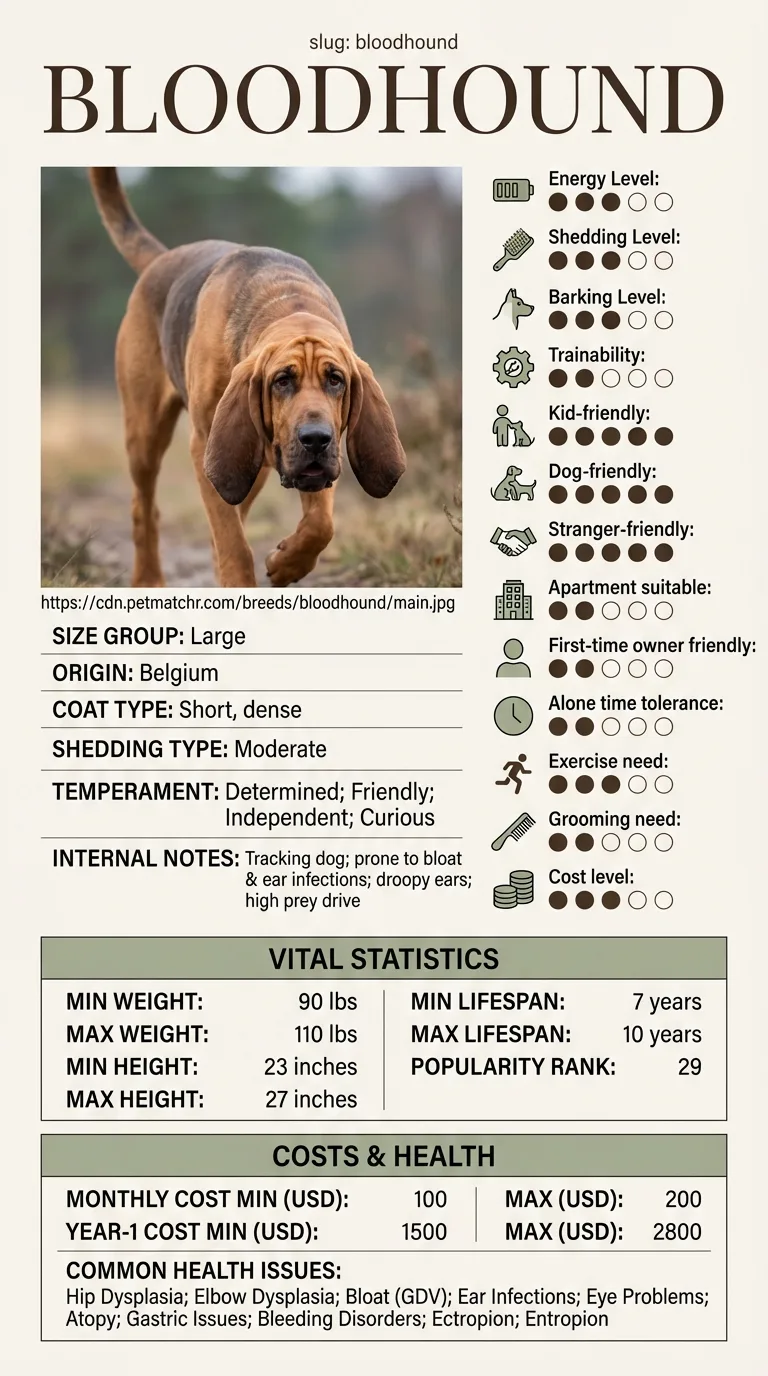
This is for someone already down to American Staffordshire Terrier and Bloodhound and deciding between them. For this pair the decision usually turns on trainability and good with other dogs, so those are covered first and in most detail. Anyone choosing from a flat has a clear answer here: American Staffordshire Terrier rates 3/5 against 2/5. It is written for the decision rather than the breed history.
Between American Staffordshire Terrier and Bloodhound, trainability is what separates them, and American Staffordshire Terrier is the lower-effort dog of the two to keep.
Choose American Staffordshire Terrier if you are in a flat or a smaller home, this is your first dog and you do not want a standing grooming appointment.
Choose Bloodhound if your walking routine is modest and you already have another dog.
| Feature | american staffordshire terrier | bloodhound | Winner |
|---|---|---|---|
| Size class | medium | large | Equal |
| Weight | 40–70 lbs | 90–110 lbs | Equal |
| Height | 17–19 in | 23–27 in | Equal |
| Lifespan | 12–16 years | 7–10 years | american staffordshire terrier |
| Exercise need | High (4/5) | Moderate (3/5) | bloodhound |
| Grooming need | Very low (1/5) | Low (2/5) | american staffordshire terrier |
| Shedding | Moderate (3/5) | Moderate (3/5) | Equal |
| Energy level | High (4/5) | Moderate (3/5) | Equal |
| Barking | Low (2/5) | Moderate (3/5) | american staffordshire terrier |
| Apartment suitability | Moderate (3/5) | Low (2/5) | american staffordshire terrier |
| Good for first-time owners | Moderate (3/5) | Low (2/5) | american staffordshire terrier |
| Tolerates being alone | Moderate (3/5) | Low (2/5) | american staffordshire terrier |
| Trainability | High (4/5) | Low (2/5) | american staffordshire terrier |
| Good with kids | High (4/5) | High (4/5) | Equal |
| Good with other dogs | Low (2/5) | High (4/5) | bloodhound |
| Friendly to strangers | High (4/5) | High (4/5) | Equal |
| Cost level | Moderate (3/5) | Moderate (3/5) | Equal |
| Coat | Short, stiff and glossy | Short, dense | Equal |
| Origin | Various | Belgium | Equal |
| Typical monthly cost | $100–$200 | $100–$200 | Equal |
| Typical first-year cost | $1,400–$2,900 | $1,500–$2,800 | Equal |
The Bloodhound is a big, heavy dog -- 90-110 lbs and 23-27 inches -- well beyond the AmStaff's 40-70 lbs and 17-19 inches. That's nearly double the AmStaff's upper weight limit, on a breed built for tracking scent over long distances rather than agility or speed, and its loose skin and long ears add to the sense of sheer bulk on a leash.
Energy level ties at moderate (3/5) for the Bloodhound against the AmStaff's high (4/5), and exercise need follows suit -- moderate (3/5) against high (4/5). Don't read that as low-key: a Bloodhound on a scent trail can pull hard and range far, even if its day-to-day energy indoors runs calmer than the AmStaff's.
The Bloodhound's short coat keeps grooming at low (2/5), just a step above the AmStaff's very low (1/5), and shedding ties at moderate (3/5) for both. The bigger grooming consideration with a Bloodhound isn't the coat -- it's the skin folds and long ears, which tie into some of the breed's listed health risks.
The AmStaff handles apartment life better, moderate (3/5) against the Bloodhound's low (2/5) -- size alone makes a 100-lb dog harder to manage in a small unit. Barking favors the AmStaff too, low (2/5) versus moderate (3/5) for the Bloodhound, and tolerating time alone also favors the AmStaff, moderate (3/5) against the Bloodhound's low (2/5).
Trainability is a clear win for the AmStaff, high (4/5) against the Bloodhound's low (2/5) -- a nose-driven breed like the Bloodhound is notoriously difficult to pull off a scent once it's locked on. First-time-owner suitability follows the same pattern, moderate (3/5) for the AmStaff against low (2/5) for the Bloodhound, making the Bloodhound one of the more demanding choices for someone new to dogs.
Kids and strangers both tie at high (4/5) for the two breeds, so both make reasonably social family dogs. Other dogs favors the Bloodhound, high (4/5) against the AmStaff's low (2/5) -- a real point in its favor for households already keeping dogs, or planning to add a second one down the line.
Lifespan is a significant gap: 12-16 years for the AmStaff against just 7-10 for the Bloodhound. The Bloodhound's ten-item health list includes bloat, bleeding disorders, and two eyelid conditions -- ectropion and entropion -- tied to its loose, droopy facial structure, on top of hip and elbow dysplasia. The AmStaff's shorter five-item list doesn't overlap much beyond hip dysplasia, giving it a notably lower documented risk profile.
Cost level ties at moderate (3/5) for both, and the monthly range is identical -- $100-200 for each. First-year costs sit close too, $1,400-2,900 for the AmStaff and $1,500-2,800 for the Bloodhound, so cost isn't much of a deciding factor between these two; the choice really comes down to trainability and how you feel about a much bigger dog.
American Staffordshire Terrier weighs 40–70 lbs and lives 12–16 years; Bloodhound weighs 90–110 lbs and lives 7–10 years. The two diverge most on trainability and good with other dogs. They are level on cost level, good with kids and shedding, so those cannot decide it. In the table, a "winner" means easier for an ordinary household — not better. Size, coat and origin are recorded without a verdict. Because both breeds are scored the same way, the gaps are reliable even where the absolute numbers are rough.

Substantially -- 90-110 lbs against the AmStaff's 40-70, nearly double at the top end.
The AmStaff, rated high (4/5) against the Bloodhound's low (2/5) -- a scent-driven breed is hard to redirect once it's on a trail.
The AmStaff, clearly -- 12-16 years against just 7-10 for the Bloodhound.
The AmStaff, moderate (3/5) versus low (2/5) for the Bloodhound.
The AmStaff, moderate (3/5) against low (2/5) for the Bloodhound -- size is the main factor.
Hip dysplasia is shared. The Bloodhound's list runs twice as long and includes bloat, bleeding disorders, and eyelid conditions (ectropion, entropion) linked to its loose facial skin.
Nearly identical -- both moderate (3/5) cost level, $100-200 a month, and first-year costs within about $100 of each other.
The AmStaff, for most households -- better trainability, a longer lifespan, and an easier fit for first-time owners. The Bloodhound suits an experienced owner specifically wanting a scent-tracking dog.
About the same -- both run roughly $100-200 a month.
The AmStaff, high (4/5) against the Bloodhound's moderate (3/5).
The AmStaff, 12-16 years versus just 7-10 for the Bloodhound.
Secure checkout on Stripe. We never see your card.
7-day money-back guarantee. Instant access.
Health information here is general and is not veterinary advice. If your dog shows pain, sudden behaviour change, or worsening symptoms, consult a licensed veterinarian.
Some links on this site are affiliate links. We may earn a commission at no extra cost to you, and we only suggest products we believe are helpful for dog owners.
We research and check what we publish, but we do not warrant that any figure, date, price, or statement is accurate, complete, or current, and we accept no liability for any loss, cost, injury, or other harm arising from the use of this site. Use it as one reference among several. You remain responsible for your own decisions and for your dog's care - confirm anything that matters with a licensed veterinarian or another qualified professional before you act on it. Full disclaimer.
Match your lifestyle to the right dog.
Take quizNot sure which breed is right for you? Take our 2-minute quiz to find out.
Take the quiz