Behavior
Which is the better overall choice?
For most owners, especially first-timers or households with kids and other pets, the Saint Bernard's temperament numbers make the stronger case — if you can handle the cost and space it needs.

Quick answer
Which is the better overall choice?
For most owners, especially first-timers or households with kids and other pets, the Saint Bernard's temperament numbers make the stronger case — if you can handle the cost and space it needs.
American Pit Bull Terrier or Saint Bernard? On paper they differ most on cost level, and on the scales Saint Bernard is the heavier at 120–180 lbs. Here is how the two compare on everything that shapes an ordinary week.
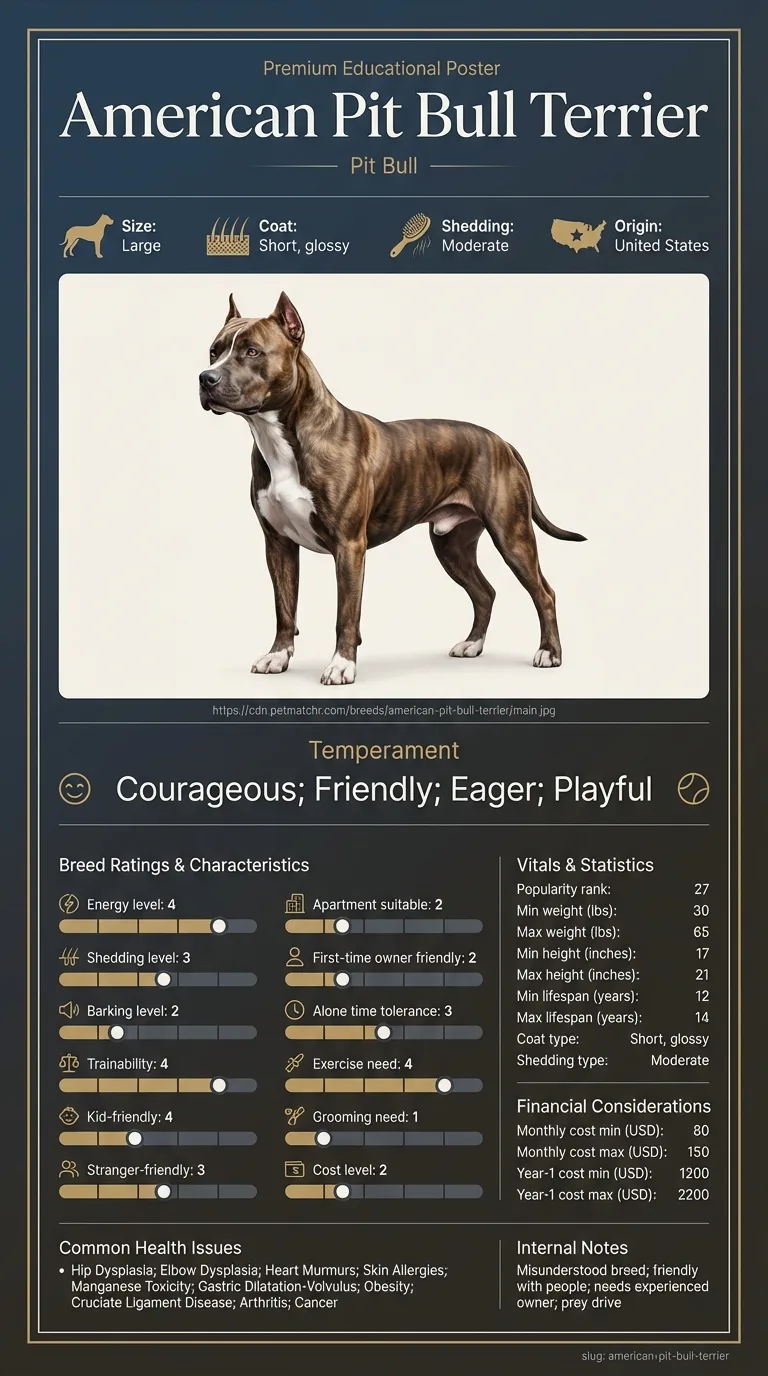
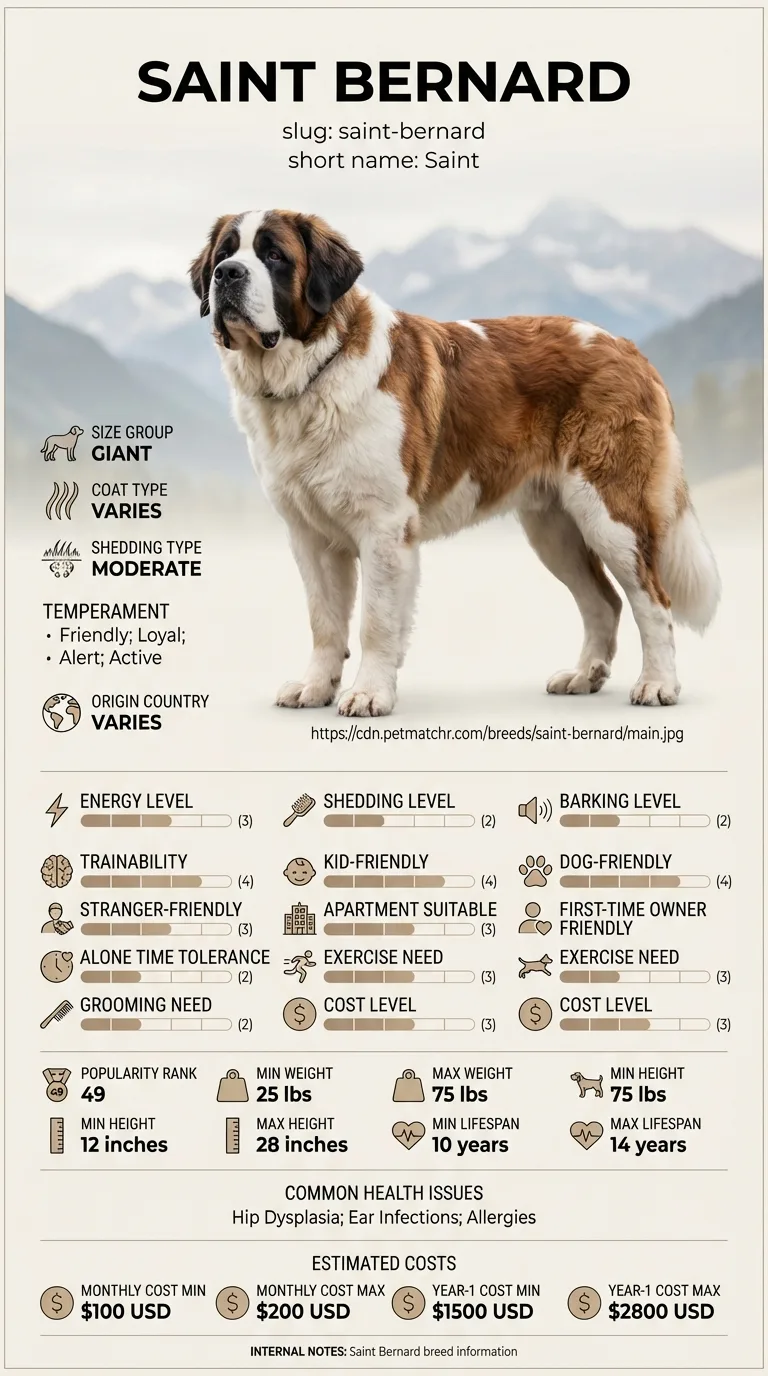
This is for someone already down to American Pit Bull Terrier and Saint Bernard and deciding between them. For this pair the decision usually turns on cost level and exercise need, so those are covered first and in most detail. Anyone choosing from a flat has a clear answer here: American Pit Bull Terrier rates 2/5 against 1/5. The focus throughout is on daily consequences rather than breed background.
Between American Pit Bull Terrier and Saint Bernard, cost level is what separates them; neither is the lower-effort dog overall.
Choose American Pit Bull Terrier if you do not want a standing grooming appointment, shedding is a problem in your house and you want a dog that picks up training quickly.
Choose Saint Bernard if this is your first dog, your walking routine is modest and there are young children at home.
| Feature | american pit bull terrier | saint bernard | Winner |
|---|---|---|---|
| Size class | large | giant | Equal |
| Weight | 30–65 lbs | 120–180 lbs | Equal |
| Height | 17–21 in | 26–30 in | Equal |
| Lifespan | 12–14 years | 8–10 years | american pit bull terrier |
| Exercise need | High (4/5) | Low (2/5) | saint bernard |
| Grooming need | Very low (1/5) | Moderate (3/5) | american pit bull terrier |
| Shedding | Moderate (3/5) | High (4/5) | american pit bull terrier |
| Energy level | High (4/5) | Low (2/5) | Equal |
| Barking | Low (2/5) | Low (2/5) | Equal |
| Apartment suitability | Low (2/5) | Very low (1/5) | american pit bull terrier |
| Good for first-time owners | Low (2/5) | Moderate (3/5) | saint bernard |
| Tolerates being alone | Moderate (3/5) | Moderate (3/5) | Equal |
| Trainability | High (4/5) | Moderate (3/5) | american pit bull terrier |
| Good with kids | High (4/5) | Very high (5/5) | saint bernard |
| Good with other dogs | Low (2/5) | High (4/5) | saint bernard |
| Friendly to strangers | Moderate (3/5) | High (4/5) | saint bernard |
| Cost level | Low (2/5) | Very high (5/5) | american pit bull terrier |
| Coat | Short, glossy | Short or long double coat | Equal |
| Origin | United States | Various | Equal |
| Typical monthly cost | $80–$150 | $150–$310 | Equal |
| Typical first-year cost | $1,200–$2,200 | $2,200–$4,200 | Equal |
Nothing about these two breeds is close. A Saint Bernard is a genuine giant — 120 to 180 lbs, up to 30 inches at the shoulder — while the APBT caps out at 65 lbs and 21 inches. That's not a size difference, it's a size-category difference: giant versus large. Everything downstream, from crate size to how much space a sleeping dog takes up on your floor, follows from that gap.
Here's a reversal worth noting: despite being enormous, the Saint Bernard needs less exercise than the APBT — a 2 out of 5 versus the APBT's 4. Saint Bernards were bred for slow, deliberate work, not sprinting, and their size means high-impact exercise can strain their joints anyway. The APBT, by contrast, wants to move and needs an outlet for it daily.
The APBT's coat is nearly maintenance-free (1/5). The Saint Bernard is a different story — moderate grooming (3/5) and high shedding (4/5), whether it's carrying a short or long double coat. Add drooling to the list, which the APBT doesn't have to offer. If hair and slobber management isn't your idea of a good time, the numbers point one direction.
Both breeds score low for apartment living, but the Saint Bernard is worse off — 1 out of 5 versus the APBT's 2. That's a giant-breed problem more than a temperament one: even a calm Saint Bernard takes up an apartment's worth of floor space by itself. Barking is low for both, so it's square footage, not noise, that rules the Saint Bernard out of small spaces.
The APBT actually trains easier — 4 out of 5 versus the Saint Bernard's 3 — but the Saint Bernard is rated friendlier to first-time owners (3/5 versus 2/5). That's a real tradeoff: a slightly less trainable dog that's more forgiving of a new owner's mistakes, against a sharper dog that needs a more experienced hand from day one.
The Saint Bernard wins every household-fit metric on this table — kids (5/5 vs. 4/5), other dogs (4/5 vs. 2/5), and strangers (4/5 vs. 3/5). Its temperament list backs this up: gentle, patient, friendly. If you're weighing this pair for a busy household with kids, pets and visitors coming and going, the data leans firmly toward the Saint Bernard.
Giant breeds pay for their size in years, and the Saint Bernard shows it — 8 to 10 years against 12 to 14 for the APBT, a gap of up to six years. The Saint Bernard's health list includes bloat (GDV) and dilated cardiomyopathy, both serious large-breed conditions. The APBT's list is longer overall but includes more manageable issues like skin allergies alongside the same GDV risk.
The Saint Bernard is the priciest breed in this comparison — cost level 5 out of 5, $150-310 a month, and $2,200-4,200 in year one alone. The APBT runs $80-150 a month and $1,200-2,200 for year one. Over a decade, that gap compounds into thousands of dollars, mostly from food volume, larger medication doses, and bigger everything else.
American Pit Bull Terrier weighs 30–65 lbs and lives 12–14 years; Saint Bernard weighs 120–180 lbs and lives 8–10 years. The two diverge most on cost level, exercise need and grooming need and 2 other rated axes. They are level on tolerates being alone and barking, so those cannot decide it. The table below marks a winner only where one breed is genuinely easier for a typical owner; size and origin are facts rather than merits and stay level. Ratings come from one source applied to both breeds, so they are meaningful against each other rather than as absolute scores.

Breeding purpose, not size. Saint Bernards were built for slow, sustained work like mountain rescue, not speed or high-drive play, and their joints do better with lower-impact activity. The APBT's terrier lineage means it wants to run and needs a daily outlet for that energy.
The Saint Bernard rates higher (3/5 vs. 2/5) for first-time owners, largely on temperament — it's patient and forgiving. The APBT's higher trainability doesn't offset its lower first-time-owner score; it still needs a confident, consistent handler.
Substantially more — $150-310 monthly against $80-150 for the APBT, and roughly $1,000-2,000 more in the first year. Its size drives food, medication and vet-visit costs up across the board.
Yes — both carry hip dysplasia, elbow dysplasia, and gastric dilatation-volvulus (bloat) risk. The Saint Bernard adds dilated cardiomyopathy and entropion; the APBT's list runs longer with things like manganese toxicity and cruciate ligament disease.
The APBT, clearly — moderate (3/5) versus the Saint Bernard's high (4/5) shedding, on top of a grooming need three points higher. Budget more brushing time and more lint-roller runs for the Saint Bernard.
The Saint Bernard by a wide margin — 4 out of 5 versus the APBT's 2 out of 5. If a multi-dog household or frequent dog-park visits are the plan, that gap matters.
Yes. A Saint Bernard's lower weight bound (120 lbs) already exceeds the APBT's upper bound (65 lbs). You're comparing a large breed to a genuine giant, not two dogs of similar scale.
For most owners, especially first-timers or households with kids and other pets, the Saint Bernard's temperament numbers make the stronger case — if you can handle the cost and space it needs.
$150-310 for the Saint Bernard against $80-150 for the APBT — nearly double at the low end.
The APBT, at 4 out of 5 versus the Saint Bernard's 2 out of 5 — a genuine role reversal given the size difference.
The APBT, averaging 12-14 years against 8-10 for the Saint Bernard.
Secure checkout on Stripe. We never see your card.
7-day money-back guarantee. Instant access.
Health information here is general and is not veterinary advice. If your dog shows pain, sudden behaviour change, or worsening symptoms, consult a licensed veterinarian.
Some links on this site are affiliate links. We may earn a commission at no extra cost to you, and we only suggest products we believe are helpful for dog owners.
We research and check what we publish, but we do not warrant that any figure, date, price, or statement is accurate, complete, or current, and we accept no liability for any loss, cost, injury, or other harm arising from the use of this site. Use it as one reference among several. You remain responsible for your own decisions and for your dog's care - confirm anything that matters with a licensed veterinarian or another qualified professional before you act on it. Full disclaimer.
Match your lifestyle to the right dog.
Take quizNot sure which breed is right for you? Take our 2-minute quiz to find out.
Take the quiz