Health
What's an early sign of heatstroke to watch for?
Panting that doesn't ease within 10 to 15 minutes of rest, shade, and water.

Quick answer
What's an early sign of heatstroke to watch for?
Panting that doesn't ease within 10 to 15 minutes of rest, shade, and water.
Of everything covered about this breed's heat sensitivity, this is the version where minutes genuinely matter — recognizing true heatstroke quickly, rather than assuming it's ordinary heavy panting, can be the difference that counts.
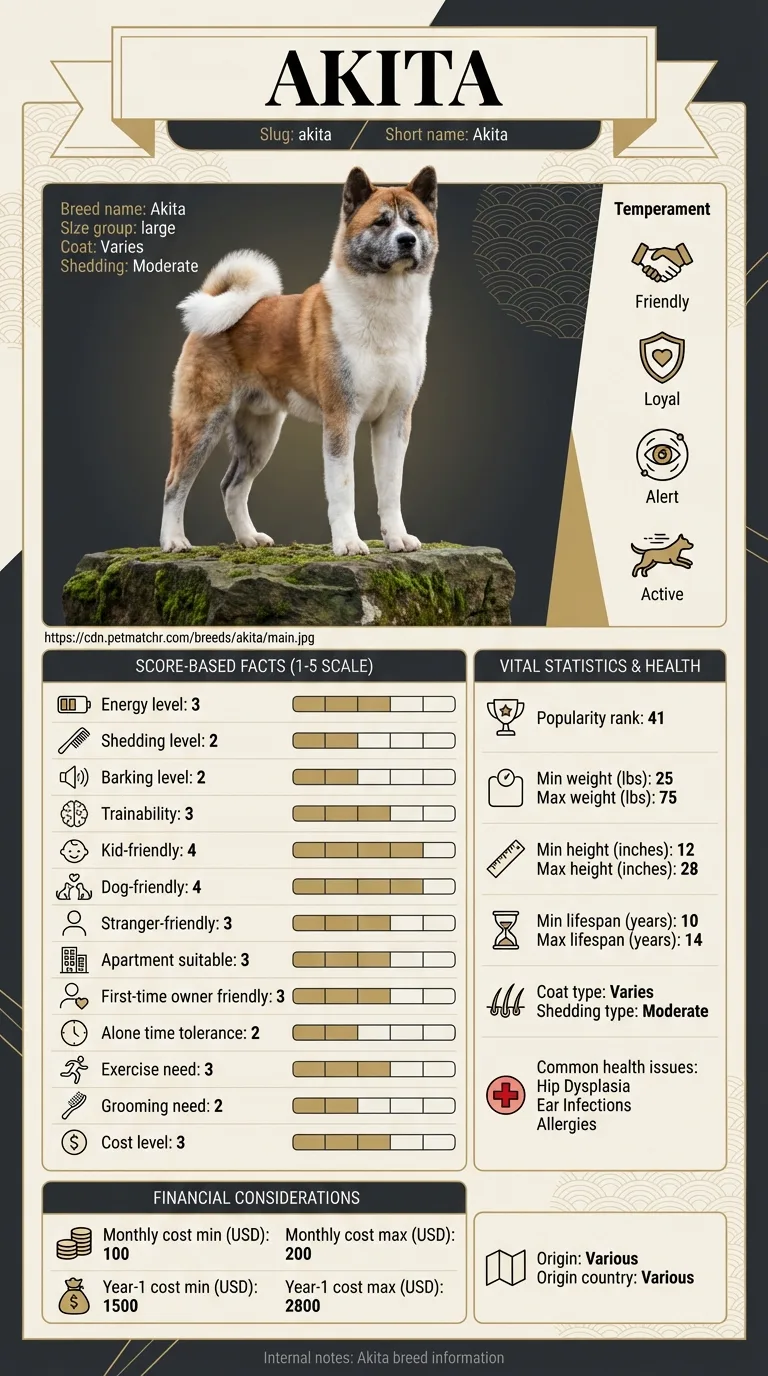
Every Akita owner is the intended audience here, particularly during summer months or in warm climates, since this breed's coat-driven vulnerability applies to any individual dog regardless of fitness level or age.
This guide is not medical advice. If your dog shows pain, sudden behavior change, or worsening symptoms, consult a licensed veterinarian.
Some links may be affiliate links. We may earn a commission at no extra cost to you. We only suggest products we believe are helpful for dog owners.
We research and check what we publish, but we do not warrant that any figure, date, price, or statement is accurate, complete, or current, and we accept no liability for any loss, cost, injury, or other harm arising from the use of this site. Use it as one reference among several. You remain responsible for your own decisions and for your dog's care - confirm anything that matters with a licensed veterinarian or another qualified professional before you act on it. Full disclaimer.
Check this first
Collapse, disorientation or wobbliness, vomiting, extremely rapid or labored breathing, bright red or blue-tinged gums, or a body that feels hot to the touch together mean immediate action: move your dog to shade or air conditioning, apply cool (not ice-cold) water to the body, especially the belly and paw pads, and get to an emergency vet immediately.
Do not wait to see if these signs improve on their own — heatstroke can cause organ damage and can be fatal within a short time if not treated promptly. Begin cooling measures while arranging transport rather than waiting until you arrive at the vet to start addressing the elevated temperature.
Heavy panting that eases within 10 to 15 minutes of rest, shade, and water, without any of the more severe signs above, is the normal cooling process and doesn't require emergency care, but should still prompt you to move your dog somewhere cooler right away.
If any of these apply, call your vet or an emergency clinic now. The rest of this page is for the cases that are not an emergency.
Heatstroke is the dangerous escalation of the Akita's baseline coat-driven heat sensitivity into a true medical emergency, where rising core body temperature can damage organs. Recognizing the early warning signs quickly, rather than assuming heavy panting is always normal, is the single most important thing an Akita owner can do given how fast this can progress.
Heatstroke risk is a genuine, elevated concern for this breed specifically because of its coat, making it more relevant to Akita owners than to owners of short, single-coated breeds under otherwise identical conditions, particularly in warm climates or during summer months.
The same dense double coat that insulates the Akita effectively against cold temperatures works directly against it in heat, retaining body heat rather than releasing it efficiently. This isn't a minor increase in risk — it's a substantial, well-understood mechanism that makes heatstroke a genuinely elevated concern for this breed compared to breeds with coats developed for warmer climates.
Heat, humidity, exercise intensity, and confinement (particularly in vehicles) are the dominant environmental triggers. Because humidity specifically reduces the effectiveness of panting, it deserves as much attention as raw temperature when deciding whether conditions are safe for outdoor activity.
Any combination of collapse, disorientation, vomiting, labored breathing, or gum color changes in warm weather means immediate emergency veterinary care, with active cooling started right away rather than waiting to see if it improves.
Heatstroke's early signs can look similar to normal heavy panting for the first few minutes, which is exactly when a delay in recognition costs the most.
See all Akita health problems, which breeds are prone to heat sensitivity hyperthermia, or the full Akita breed guide for temperament, exercise needs and ownership costs.
Heatstroke can progress from early signs to a life-threatening emergency within a short window, particularly during vigorous activity in hot, humid conditions, which is why immediate action rather than a wait-and-see approach is essential.
Success is recognizing early warning signs immediately and acting on them — cooling and seeking veterinary care right away — which is strongly associated with better outcomes compared to delayed recognition.
During an early-afternoon hike in Redding, Corey noticed his Akita, Storm, panting heavily and starting to lag behind, seeking out shade whenever it appeared. Rather than assuming Storm just needed a short break, Corey recognized these as early heat-distress signs given what he'd learned about the breed. He immediately moved Storm to full shade, applied cool water to his belly and paws, and headed straight to the vet rather than continuing the hike. Storm's temperature was elevated but hadn't progressed to full heatstroke, and prompt cooling combined with vet-supervised monitoring meant a full, uneventful recovery.
Key takeaway: Recognizing early heat-distress signs and acting immediately, rather than waiting to see if a dog 'shakes it off,' is what keeps a dangerous situation for this breed from progressing to full heatstroke.
Panting that doesn't ease within 10 to 15 minutes of rest, shade, and water, especially if it's accompanied by excessive drooling or a dog that seems to be slowing down or seeking shade on its own, are early warning signs worth taking seriously.
Their dense double coat, developed for a cold climate, retains heat effectively but dissipates it poorly, meaning this breed's core temperature can climb faster and higher during heat exposure than a short, single-coated breed's would under the same conditions.
It can progress from early signs to a life-threatening emergency within a relatively short window, especially during vigorous exercise in hot, humid conditions, which is why prompt recognition and action matter so much.
Move to shade or air conditioning and apply cool, not ice-cold, water to the body, particularly the belly and paw pads, while arranging transport to a vet — ice-cold water can actually trap heat by constricting blood vessels near the skin.
Yes, with prompt veterinary treatment including active cooling, IV fluids, and monitoring for complications like organ damage or clotting problems, many dogs recover well, though outcomes are significantly better the faster treatment begins.
Yes, particularly if humidity is high, since humidity reduces how effectively panting cools a dog down regardless of the actual temperature reading.
Avoiding vigorous exercise or extended outdoor exposure during the hottest, most humid parts of the day is the most effective single prevention step, given how directly this breed's coat works against efficient heat dissipation.
Panting that doesn't ease within 10 to 15 minutes of rest, shade, and water.
Move to shade, apply cool (not ice-cold) water to the body, and get to a vet immediately.
Always — it can be fatal without prompt treatment and cooling.
Yes — high humidity reduces panting's cooling effectiveness regardless of the exact temperature.
Avoid vigorous exercise or extended outdoor time during the hottest, most humid parts of the day.
A one-page prep sheet for this condition: the signs, the questions to ask, what to get priced. Unlocks here.
You get: Vet visit prep sheet
No spam. One-click unsubscribe. See our privacy policy.
Preview page 1 before you decide.