Costs
German Shorthaired Pointer cost in Burlington
About $115–$225/month, $1,650–$2,850 for year one — near average, in a small market where planning bulk food orders ahead genuinely matters for this breed.

See German Shorthaired Pointer price across all cities →
Quick answer
German Shorthaired Pointer cost in Burlington
About $115–$225/month, $1,650–$2,850 for year one — near average, in a small market where planning bulk food orders ahead genuinely matters for this breed.
A German Shorthaired Pointer in Burlington costs about $115–$225 a month, with the first year around $1,650–$2,850 — close to the national average, in a small Vermont market where planning food orders ahead genuinely matters for a breed that eats this much.
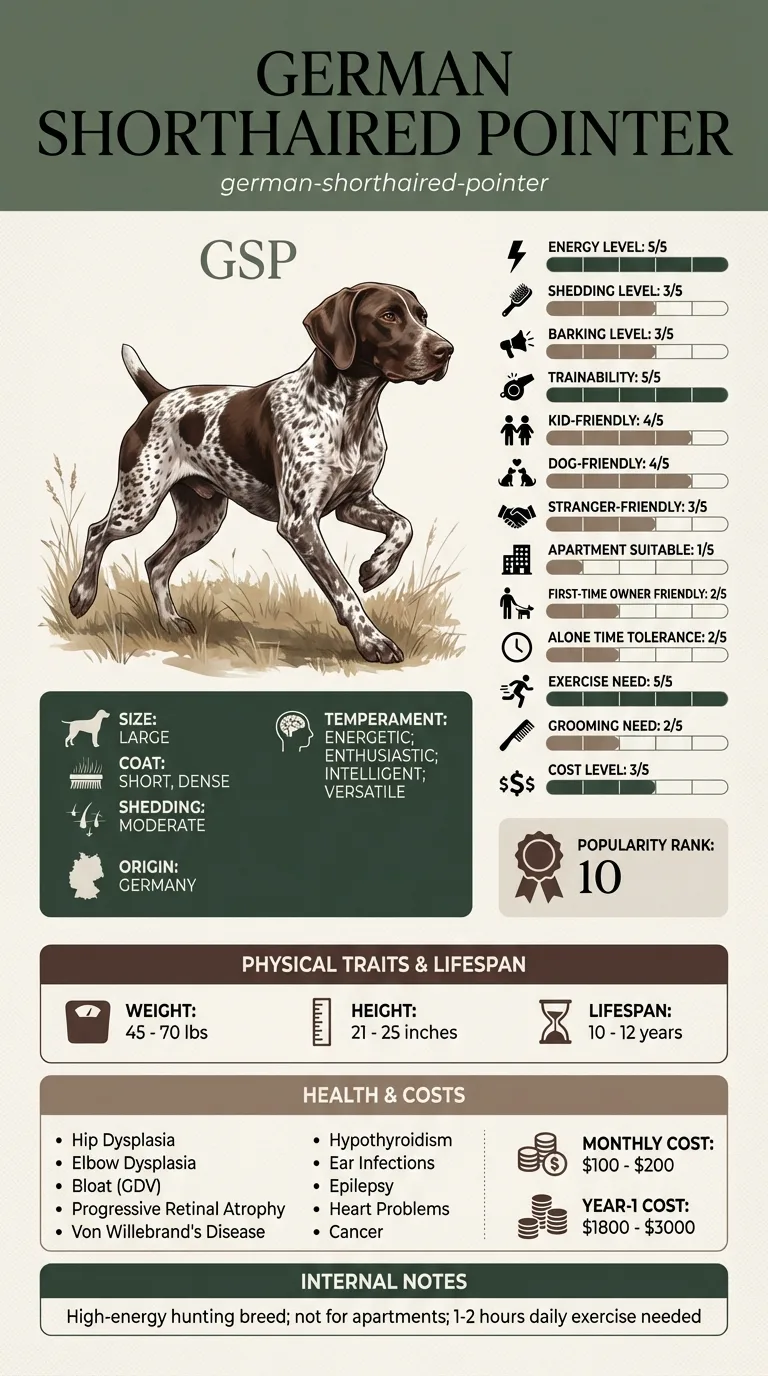
Bloat is a sudden emergency risk given this breed's deep chest — no warning, immediate surgery needed. Hip and elbow dysplasia are the separate, ongoing joint risks worth budgeting real, recurring vet attention for.
These figures reflect Burlington's near-national-average pricing, with a note on the real, low-cost habit of planning food orders ahead given this breed's substantial needs and the market's small retail footprint.
Estimate · source: estimation · confidence: low · updated 2026-10-06 · not a quote
| Item | Cost range |
|---|---|
Field or exercise gear A genuinely worthwhile investment given this breed's documented high exercise needs and working heritage. | $50 - $150 |
One-time setup (initial vet visit, spay/neuter, gear) Covers the first exam, vaccinations, spay/neuter if needed, and gear sized for this breed's large adult weight. | $355 - $605 |
| Item | Cost range |
|---|---|
Food Close to the national average for a large, highly active breed, consistent with Burlington's general cost of living. | $60 - $95 |
Flea & tick prevention One of the shorter active seasons this site covers, given Vermont's real, extended winters. | $8 - $16 |
Each range starts from a national baseline for this breed's size class and is then adjusted for local cost of living and veterinary pricing. The baselines, and the source each one came from, are listed on our sources page (dataset 2026.09). Two inputs, the purchase price and the emergency reserve, have no published national figure we could verify, so we leave them to you rather than invent them.
These are planning estimates, not quotes. Your own numbers will move with the individual dog, your vet and your insurer. Build a budget with your own figures.
For a German Shorthaired Pointer in Burlington, insurance is less about local pricing and more about covering the cost and logistics of a specialist referral to Boston, given this breed's documented joint and bloat risk.
Given how commonly this breed faces hip and elbow dysplasia, insurance purchased while the dog is young and healthy is one of the higher-value purchases an owner of this breed can make anywhere.
Owners who've built a genuinely large emergency fund and are comfortable managing a serious case's cost themselves can reasonably self-insure instead.
Burlington's near-average costs are straightforward; the real, practical planning here is around food supply logistics and the referral distance to Boston.
Vermont's small population means Burlington offers solid general pet supply access but genuinely fewer big-box retail options than a typical metro this site covers, and specific premium food lines aren't always in stock locally. This breed's substantial food needs, given its large adult size and documented one-to-two-hour daily exercise level, make an unexpected empty bag a real, avoidable inconvenience, and many local owners of large, active breeds here get ahead of it with a standing bulk order or subscription rather than relying on same-day restocking.
Vermont's small population also means a case requiring board-certified orthopedic surgery, relevant given this breed's documented hip and elbow dysplasia risk, would likely mean a trip toward Boston.
Burlington's general cost of living runs close to the national average, and Vermont's real winters keep flea-and-tick prevention on one of the shorter seasonal windows this site covers.

A Burlington German Shorthaired Pointer owner ran out of their dog's usual food unexpectedly on a weekend, only to find every nearby store carried a different brand entirely, forcing an abrupt diet switch that upset the dog's stomach for several days. The following month, the family set up a recurring bulk order online, timed to arrive a week before they'd typically run low. The switch eliminated the scramble entirely and turned out to be cheaper per pound than the local retail price anyway.
Key takeaway: In Burlington specifically, this breed's real food volume needs are easier to manage with advance planning than with the assumption that local stores will always have what's needed.
About $115–$225, close to the national average, consistent with Burlington's broader cost-of-living profile.
Roughly $1,650–$2,850, including the initial vet exam, spay/neuter if needed, and gear on top of ongoing monthly costs.
Not impossible, but Vermont's small population means genuinely fewer big-box retail options, so planning a bulk order or subscription in advance is worth doing given how much food this breed goes through.
General veterinary care is solid, but a case requiring board-certified orthopedic surgery, relevant given this breed's documented joint risk, would likely mean a trip toward Boston.
Worth pricing out given the breed's documented bloat and joint risk, bought while the dog is young and before anything is on record.
Around $760 covers a typical local emergency vet visit. If a referral out of the area becomes necessary, plan for a larger fund to cover both the procedure and the travel involved.
About $115–$225/month, $1,650–$2,850 for year one — near average, in a small market where planning bulk food orders ahead genuinely matters for this breed.
This guide is not medical advice. If your dog shows pain, sudden behavior change, or worsening symptoms, consult a licensed veterinarian.
Some links may be affiliate links. We may earn a commission at no extra cost to you. We only suggest products we believe are helpful for dog owners.
We research and check what we publish, but we do not warrant that any figure, date, price, or statement is accurate, complete, or current, and we accept no liability for any loss, cost, injury, or other harm arising from the use of this site. Use it as one reference among several. You remain responsible for your own decisions and for your dog's care - confirm anything that matters with a licensed veterinarian or another qualified professional before you act on it. Full disclaimer.
One sheet with every line item, the emergency fund and when insurance pays off - unlocks on this page.
You get: 12-month budget sheet
No spam. One-click unsubscribe. See our privacy policy.
See a sample page before you decide.