Costs
Akita cost in Baltimore
About $110–$215/month, $1,650–$3,000 for year one.

See Akita price across all cities →
Quick answer
Akita cost in Baltimore
About $110–$215/month, $1,650–$3,000 for year one.
Budget around $110–$215 a month for an Akita in Baltimore, with the first year landing near $1,650–$3,000 once setup costs are factored in.
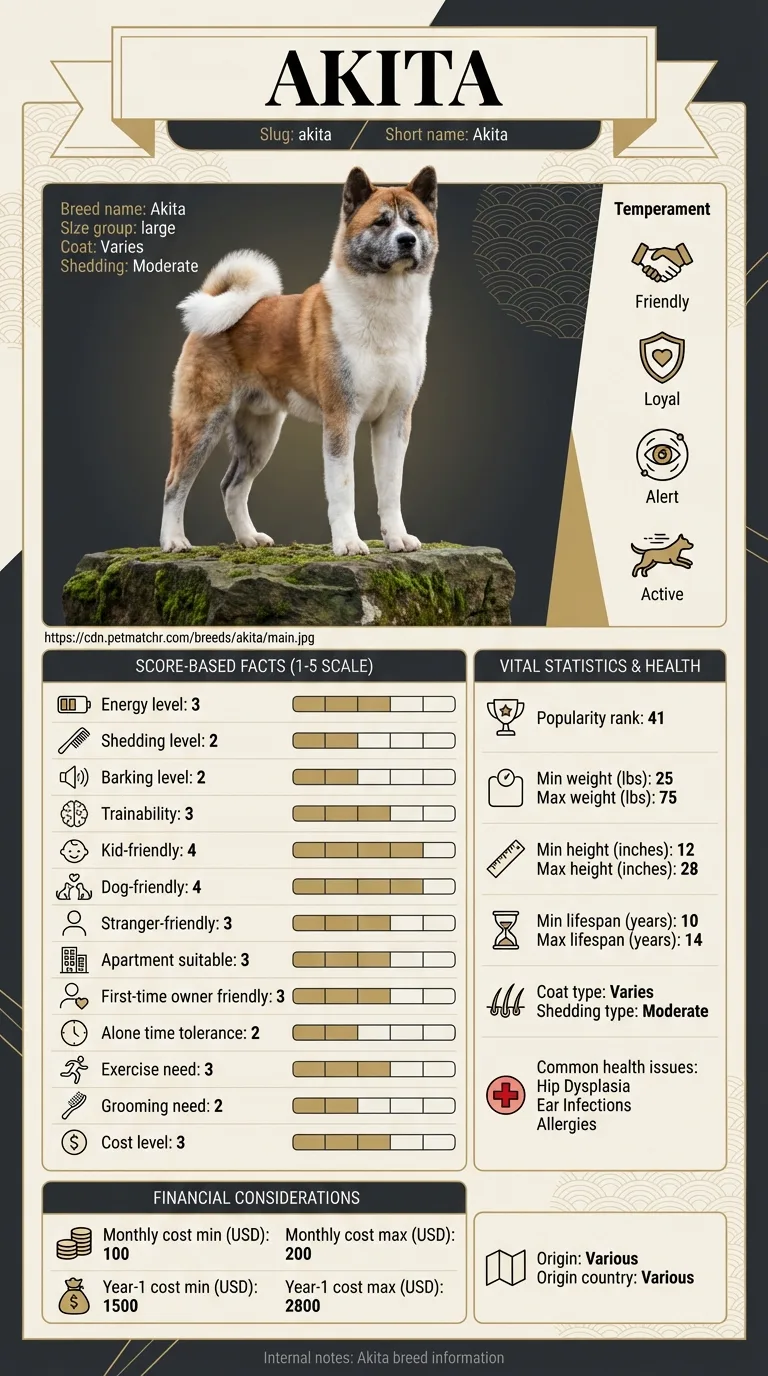
A true four-season climate means Baltimore doesn't get the cost relief of a short parasite season the way a colder city does, nor the full year-round burden of a Gulf Coast city — it lands in the middle. What actually spikes a budget here is more likely to be the breed's own health profile: hip dysplasia and the ear infections common in the breed are the two most likely sources of an unplanned vet bill.
These figures adjust the Akita's typical national cost range for Baltimore specifically — a market that runs somewhat above the national average, shaped by its closeness to the higher-cost D.C. metro area, without reaching D.C.'s own price level.
Estimate · source: estimation · confidence: medium · updated 2026-09-05 · not a quote
| Item | Cost range |
|---|---|
One-time setup (initial vet visit, spay/neuter, large-breed gear) Covers the first exam, vaccinations, spay/neuter if needed, and a crate, bed and bowls sized for the breed's adult weight range. | $400 - $700 |
| Item | Cost range |
|---|---|
Food Portioned for the breed's large adult size; a quality food meeting AAFCO adult-maintenance standards matters more than a specific brand. | $50 - $85 |
Grooming Akitas mostly self-groom; regular at-home brushing through the spring and fall coat-blow seasons covers most of what the breed needs here. | $10 - $25 |
Flea, tick & heartworm prevention A genuine four-season climate keeps this active for a solid seasonal stretch rather than the full year, landing between a northern city's short window and a Gulf Coast city's near-constant one. | $15 - $30 |
Dog walking Optional but common in rowhouse neighborhoods without private yard access — owners with consistent free time in the morning or evening can skip this entirely. | $0 - $150 |
Each range starts from a national baseline for this breed's size class and is then adjusted for local cost of living and veterinary pricing. The baselines, and the source each one came from, are listed on our sources page (dataset 2026.09). Two inputs, the purchase price and the emergency reserve, have no published national figure we could verify, so we leave them to you rather than invent them.
These are planning estimates, not quotes. Your own numbers will move with the individual dog, your vet and your insurer. Build a budget with your own figures.
For an Akita in Baltimore, insurance mostly comes down to whether the household has already set aside enough to cover a hip-related procedure at regional vet rates without a policy.
Since hip dysplasia is a well-documented breed risk and Baltimore's vet pricing sits above the national average, buying a policy while the dog is still young — before anything is on record — offers real protection against the largest plausible bill.
If a dedicated emergency fund in the $2,000+ range is already in place and the household would rather self-manage a major bill than pay a recurring premium, skipping insurance is a reasonable, deliberate choice.
The realistic savings in Baltimore come from routine-care choices and taking advantage of the city's milder climate, not from cutting anything the dog actually needs.
A large share of Baltimore's housing stock is rowhouses — narrow, attached homes with little or no private yard, especially in the city's denser neighborhoods. That matters more for an Akita than for a smaller breed: this is a large, independent-minded dog that needs real daily exercise, and without a yard to let the dog out on its own, that exercise has to come from scheduled walks, which takes more owner time (or, for owners without the time, a paid dog-walker) than it would in a suburban home with fenced outdoor space.
Some Baltimore rowhouse neighborhoods and rental buildings also carry breed-specific restrictions in their leases or condo bylaws, more often aimed at large or guardian-type breeds than at small dogs. This is worth confirming directly with a landlord or HOA before signing anything — it's a cost that shows up as a lost housing option rather than a line item, but it's real enough that it belongs in the planning conversation alongside the vet bills.
On the positive side, Baltimore's mid-Atlantic climate is genuinely temperate for most of the year compared with either a Deep South city or a harsh northern one, which means the Akita's heavy double coat is rarely working against it the way it would in an Atlanta summer or a Phoenix one. Spring and fall coat-blow seasons still call for regular brushing, but there's no sustained multi-month heat stretch to manage around here.

A Baltimore owner adopted an adult Akita into a rowhouse with no yard, assuming daily walks around the block would be enough exercise for a dog this size. Within a few months, the dog had developed some destructive chewing and restlessness that a vet linked to under-stimulation rather than any health issue. Adding a longer structured walk each morning before work, plus a weekend trip to a fenced dog park a short drive away, resolved the behavior within a few weeks — the fix cost nothing but time, but it took recognizing that a rowhouse's lack of yard access genuinely changes what 'enough exercise' requires for this breed.
Key takeaway: In a city where a private yard isn't the default, an Akita's exercise needs have to be planned for deliberately — skipping that planning shows up as a behavior problem before it shows up as a vet bill.
Roughly $110–$215, covering food, routine vet visits, grooming and parasite prevention. Baltimore's costs run somewhat above the national average — driven partly by proximity to the D.C. metro area — without reaching D.C.'s own higher price level.
Around $1,650–$3,000, which includes the initial vet exam and vaccinations, spay or neuter if not already done, and gear sized for a large adult dog, on top of the monthly costs above.
It's workable but takes more deliberate effort than a home with a yard — without private outdoor space, daily exercise depends on scheduled walks rather than letting the dog out on its own. Some rowhouse rentals and condo buildings also carry breed restrictions worth checking before committing to a lease.
Less than a Deep South or desert city would. Baltimore's four true seasons mean parasite prevention runs for a solid stretch of the year but not the full twelve months, and the coat-blow seasons (spring and fall) call for regular brushing without the sustained heat stress a hotter climate would add.
Worth pricing out given the breed's hip dysplasia risk — a large dog's orthopedic surgery is exactly the kind of bill insurance is meant to absorb, and Baltimore's above-average vet pricing makes that bill somewhat higher than in a lower-cost city.
About $700 is a reasonable floor for a single significant vet visit. If hip dysplasia is a real concern for your specific dog, building toward $2,000 or more gets closer to what a surgical procedure would actually cost at Baltimore-area rates.
About $110–$215/month, $1,650–$3,000 for year one.
This guide is not medical advice. If your dog shows pain, sudden behavior change, or worsening symptoms, consult a licensed veterinarian.
Some links may be affiliate links. We may earn a commission at no extra cost to you. We only suggest products we believe are helpful for dog owners.
We research and check what we publish, but we do not warrant that any figure, date, price, or statement is accurate, complete, or current, and we accept no liability for any loss, cost, injury, or other harm arising from the use of this site. Use it as one reference among several. You remain responsible for your own decisions and for your dog's care - confirm anything that matters with a licensed veterinarian or another qualified professional before you act on it. Full disclaimer.
One sheet with every line item, the emergency fund and when insurance pays off - unlocks on this page.
You get: 12-month budget sheet
No spam. One-click unsubscribe. See our privacy policy.
Preview page 1 before you decide.