Costs
Akita cost in Austin
About $130–$250/month, $1,900–$3,400 for year one — above the breed average due to Austin's higher service pricing.

See Akita price across all cities →
Quick answer
Akita cost in Austin
About $130–$250/month, $1,900–$3,400 for year one — above the breed average due to Austin's higher service pricing.
Owning an Akita in Austin costs roughly $130–$250 a month once things settle into a routine, with year one landing closer to $1,900–$3,400 after setup costs.
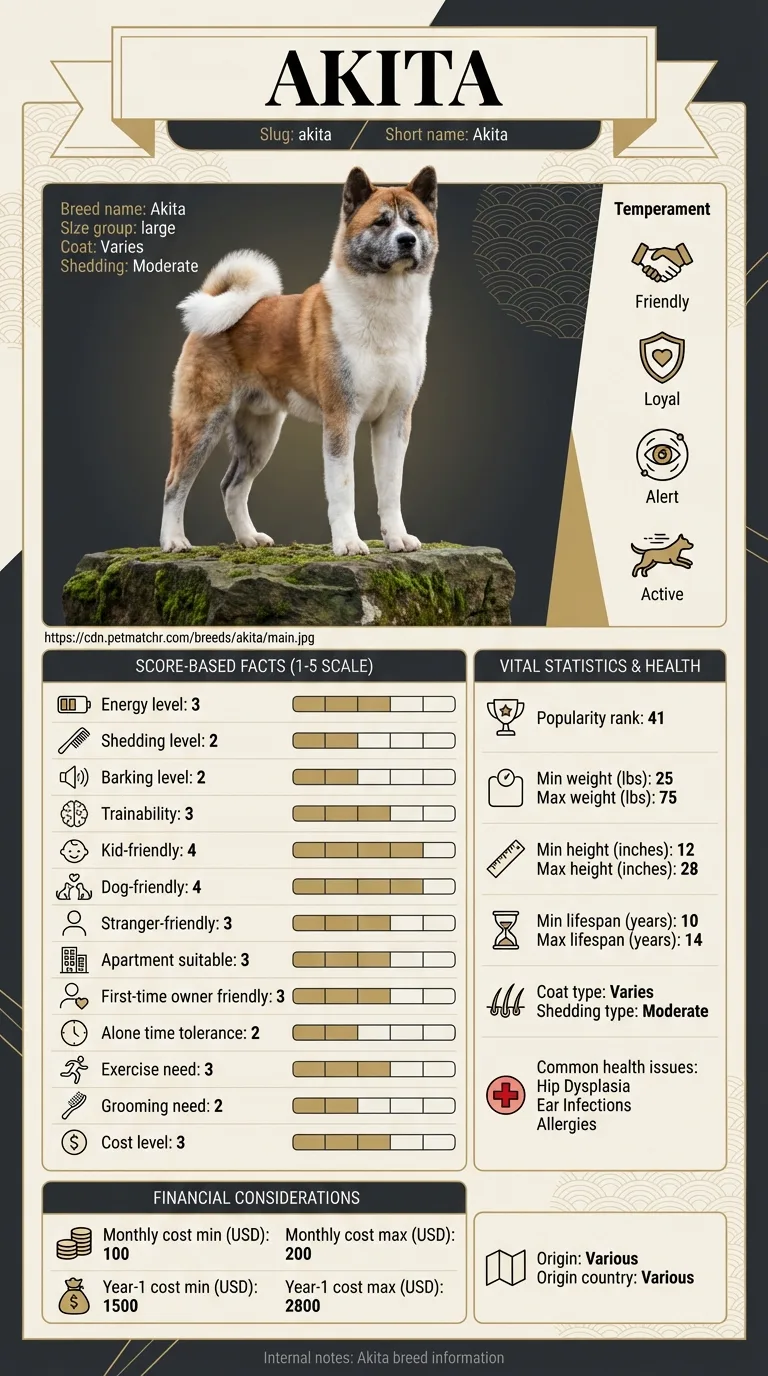
Two things push an Austin Akita budget above a bare-minimum estimate: the city's above-average service pricing generally, and the breed's own size and coat. A large, double-coated dog costs more to feed, medicate and board than a small one by default, and hip dysplasia — a known risk in the breed — is the kind of diagnosis that can turn a routine year into an expensive one without warning.
Starting from the Akita's typical national cost range, these numbers are adjusted up for Austin specifically — the city's tech-driven growth has pushed vet, boarding and grooming prices above the national average even though Texas as a whole tends to run below it.
Estimate · source: estimation · confidence: medium · updated 2026-09-05 · not a quote
| Item | Cost range |
|---|---|
One-time setup (initial vet visit, spay/neuter, large-breed gear) Priced at Austin's above-average vet rates; this is where the city's higher cost of living shows up most clearly in a first-year budget. | $500 - $850 |
| Item | Cost range |
|---|---|
Food Portioned for the breed's 65–130 lb adult range; an AAFCO-compliant adult-maintenance formula matters more than brand name once that box is checked. | $55 - $95 |
Grooming Akitas mostly self-groom and don't need frequent professional visits; at-home brushing through the coat-blow seasons is the main cost here rather than salon visits. | $15 - $30 |
Flea, tick & heartworm prevention Central Texas's long warm season keeps this close to a year-round cost, roughly nine to ten active months, shorter than the Gulf Coast but well above a northern climate's short season. | $20 - $35 |
Each range starts from a national baseline for this breed's size class and is then adjusted for local cost of living and veterinary pricing. The baselines, and the source each one came from, are listed on our sources page (dataset 2026.09). Two inputs, the purchase price and the emergency reserve, have no published national figure we could verify, so we leave them to you rather than invent them.
These are planning estimates, not quotes. Your own numbers will move with the individual dog, your vet and your insurer. Build a budget with your own figures.
In Austin, insurance for an Akita is a stronger bet than in a lower-cost city, simply because a worst-case bill here runs higher than the same procedure would cost elsewhere in Texas.
If the household doesn't already carry a dedicated emergency fund large enough to cover a surgical bill at Austin's above-average pricing, insurance purchased while the dog is young — before hip dysplasia or anything else shows up on a vet record — is the more predictable option.
Owners who have already built a genuinely separate emergency fund, and who are comfortable managing a large unplanned bill directly rather than paying a monthly premium, can reasonably skip it — the math changes less on breed risk here than on how much is already saved.
Because Austin's baseline prices run high, the realistic savings come from shopping around locally rather than assuming any one clinic reflects the market.
Austin's cost profile is unusual for Texas. Most of the state runs at or below the national average on services, but Austin's tech-driven growth over the past decade has pulled its prices — including veterinary care, boarding and grooming — up toward what you'd expect in a coastal metro rather than a Texas one. Practically, that means a routine exam or a boarding stay here costs noticeably more than the same service in, say, Houston or San Antonio, even though they're all in the same state and Texas has no state income tax to soften it.
Climate is the other Austin-specific factor, and it cuts a slightly different way than in a humid Gulf Coast city. Central Texas summers are genuinely severe — long stretches of triple-digit heat with lower humidity than Houston or New Orleans — which is a real concern for a heavy-coated breed like the Akita. Heatstroke risk during peak summer months (typically June through September) means outdoor exercise needs to shift to early morning or evening, and a dog left in a hot car or unshaded yard here faces real danger faster than in a milder climate. This isn't a line item on a budget the way parasite prevention is, but ignoring it can turn into an emergency vet bill fast.
On the upside, Austin is one of the more dog-friendly cities in the country — patios, breweries and even some retail spaces regularly welcome dogs, and the city has an unusually dense network of off-leash parks and trails. That doesn't reduce cost directly, but it does mean a large, active breed like the Akita has more low-cost exercise options here than in a city with fewer public dog spaces, which can offset some of what would otherwise go toward paid dog-walking or a private yard.

An Austin-based Akita owner had priced out food, vet visits and grooming carefully before bringing the dog home, but hadn't planned specifically for the Hill Country summer. By July, daytime walks had become genuinely risky — the dog was showing early signs of overheating on what would have been a normal-length walk in a milder climate. Shifting all exercise to before 8 a.m. or after 8 p.m., adding a cooling mat for the hottest part of the day, and cutting midday outdoor time entirely solved the immediate problem, but it also meant rethinking the daily schedule around the season in a way a generic national budget never would have flagged.
Key takeaway: In a city with genuinely severe summers, the real cost of owning a heavy-coated breed isn't just dollars — it's the schedule change needed to keep the dog safe, and skipping that adjustment risks turning into an actual emergency vet bill.
Around $130–$250 a month, covering food, routine vet care, grooming and parasite prevention. The figure runs a bit above the breed's general U.S. average mainly because Austin's own service prices — vet visits and boarding especially — sit above the national average following the city's rapid growth.
Roughly $1,900–$3,400, including the initial vet exam, spay/neuter if needed, core vaccinations and large-breed gear on top of the ongoing monthly costs. Austin's higher service pricing shows up most clearly in this initial vet-visit cost.
Austin's tech-industry growth over the last decade has driven up commercial rents and wages across the service sector, and veterinary clinics aren't exempt — staffing and facility costs that would be lower elsewhere in Texas get passed through in the price of an exam or procedure here.
It changes the care routine more than the direct cost: summer exercise needs to move to early morning or evening to avoid heatstroke risk, since Akitas carry a heavy double coat not built for Texas Hill Country heat. Left unmanaged, heat stress can turn into a genuine emergency vet visit, so the real cost risk is indirect rather than a fixed monthly line item.
Given both the breed's hip dysplasia risk and Austin's above-average vet pricing, insurance is worth pricing out early — a hip-related procedure here will likely cost more than the same procedure in a lower-cost Texas city, which raises the value of a policy relative to self-insuring.
Around $900 is a reasonable starting target, higher than a lower-cost city because emergency and specialist care here runs above average. If hip dysplasia is a known concern for your specific dog, building toward $2,500–$3,500 gives more realistic coverage for a surgical procedure priced at Austin rates.
About $130–$250/month, $1,900–$3,400 for year one — above the breed average due to Austin's higher service pricing.
This guide is not medical advice. If your dog shows pain, sudden behavior change, or worsening symptoms, consult a licensed veterinarian.
Some links may be affiliate links. We may earn a commission at no extra cost to you. We only suggest products we believe are helpful for dog owners.
We research and check what we publish, but we do not warrant that any figure, date, price, or statement is accurate, complete, or current, and we accept no liability for any loss, cost, injury, or other harm arising from the use of this site. Use it as one reference among several. You remain responsible for your own decisions and for your dog's care - confirm anything that matters with a licensed veterinarian or another qualified professional before you act on it. Full disclaimer.
One sheet with every line item, the emergency fund and when insurance pays off - unlocks on this page.
You get: 12-month budget sheet
No spam. One-click unsubscribe. See our privacy policy.
Preview page 1 before you decide.