Living
Which is bigger?
The Weimaraner, at up to 90 lbs versus the Welsh Springer's 55 lb max.

Quick answer
Which is bigger?
The Weimaraner, at up to 90 lbs versus the Welsh Springer's 55 lb max.
Weimaraner or Welsh Springer Spaniel? On paper they differ most on grooming need, and on the scales Weimaraner is the heavier at 55–90 lbs. Here is how the two compare on everything that shapes an ordinary week.
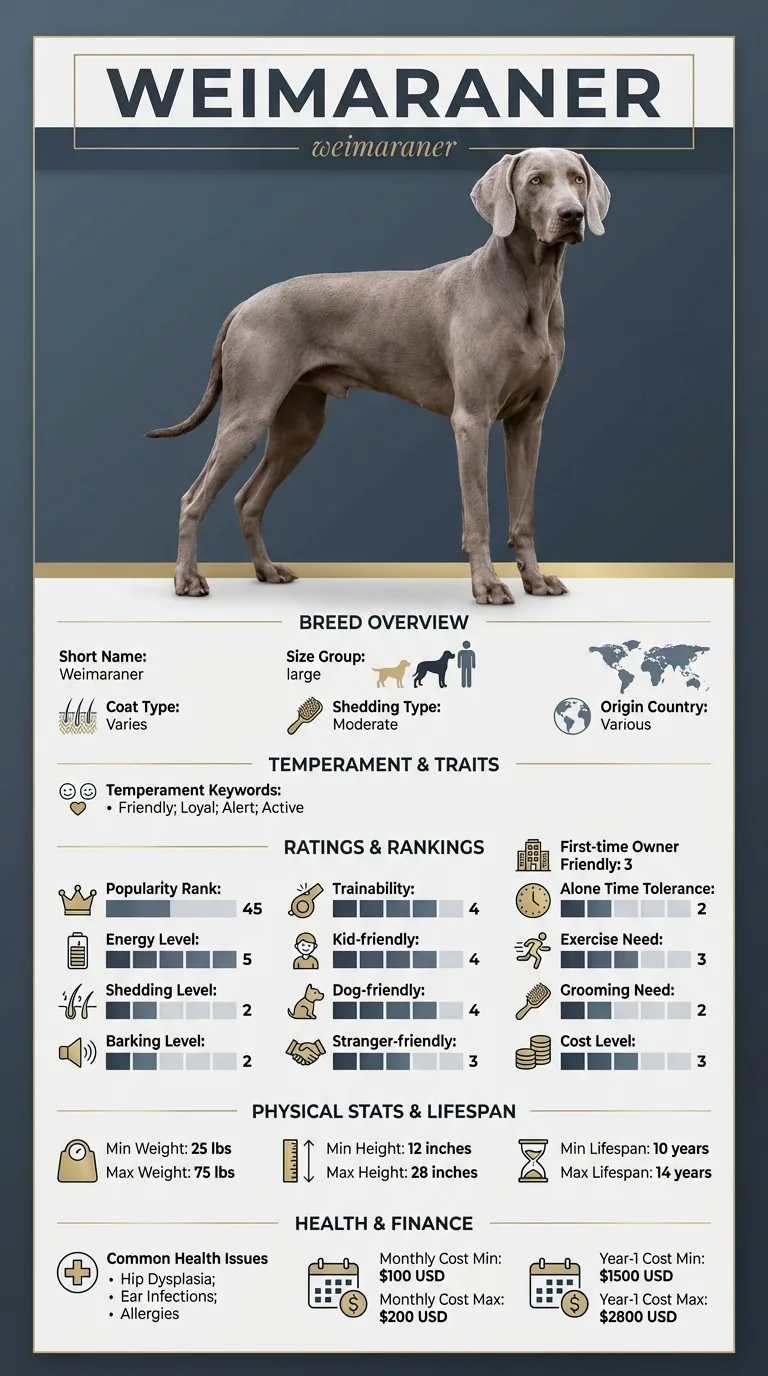
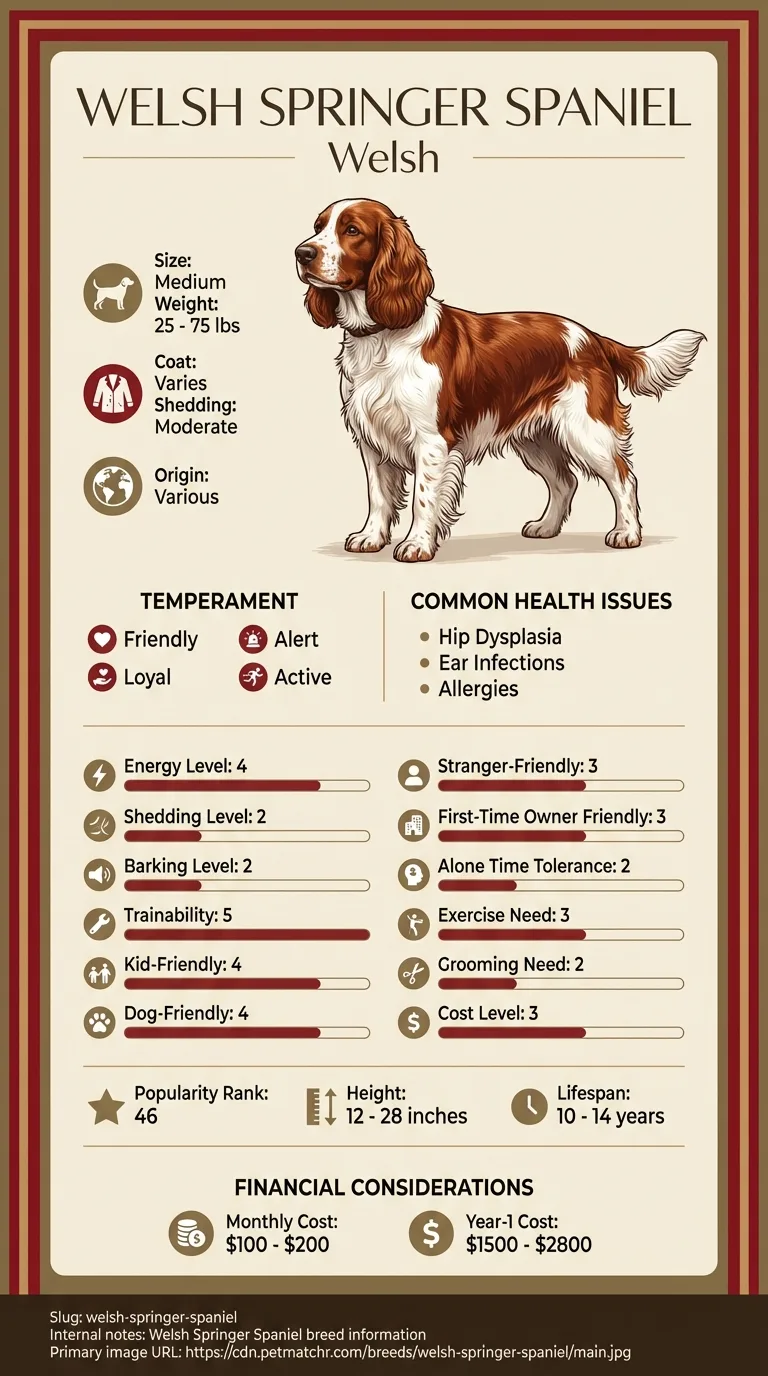
This is for someone already down to Weimaraner and Welsh Springer Spaniel and deciding between them. For this pair the decision usually turns on grooming need, so those are covered first and in most detail. Anyone choosing from a flat has a clear answer here: Welsh Springer Spaniel rates 2/5 against 1/5. There is no origin story here — only what changes about your week.
Between Weimaraner and Welsh Springer Spaniel, grooming need is what separates them, and Welsh Springer Spaniel is the lower-effort dog of the two to keep.
Choose Weimaraner if you do not want a standing grooming appointment, shedding is a problem in your house and you want a dog that can keep up with an active routine.
Choose Welsh Springer Spaniel if this is your first dog, your walking routine is modest and you already have another dog.
| Feature | weimaraner | welsh springer spaniel | Winner |
|---|---|---|---|
| Size class | large | medium | Equal |
| Weight | 55–90 lbs | 35–55 lbs | Equal |
| Height | 23–27 in | 17–19 in | Equal |
| Lifespan | 10–13 years | 12–15 years | welsh springer spaniel |
| Exercise need | Very high (5/5) | High (4/5) | welsh springer spaniel |
| Grooming need | Very low (1/5) | Moderate (3/5) | weimaraner |
| Shedding | Low (2/5) | Moderate (3/5) | weimaraner |
| Energy level | Very high (5/5) | High (4/5) | Equal |
| Barking | Moderate (3/5) | Moderate (3/5) | Equal |
| Apartment suitability | Very low (1/5) | Low (2/5) | welsh springer spaniel |
| Good for first-time owners | Low (2/5) | Moderate (3/5) | welsh springer spaniel |
| Tolerates being alone | Very low (1/5) | Low (2/5) | welsh springer spaniel |
| Trainability | High (4/5) | High (4/5) | Equal |
| Good with kids | High (4/5) | High (4/5) | Equal |
| Good with other dogs | Moderate (3/5) | High (4/5) | welsh springer spaniel |
| Friendly to strangers | Moderate (3/5) | Moderate (3/5) | Equal |
| Cost level | Moderate (3/5) | Moderate (3/5) | Equal |
| Coat | Short and sleek | Medium, straight and water-resistant | Equal |
| Origin | Various | Various | Equal |
| Typical monthly cost | $110–$240 | $100–$200 | Equal |
| Typical first-year cost | $1,700–$3,200 | $1,400–$2,900 | Equal |
The Weimaraner outsizes the Welsh Springer Spaniel across the board: 55-90 lbs and 23-27 inches versus 35-55 lbs and 17-19 inches, a gap of up to 35 pounds at the top end. Both are sporting breeds with functional, athletic builds rather than bulk, but the Weimaraner's larger frame and short, sleek, silver-grey coat give it a leaner, more imposing look, while the Welsh Springer's medium, water-resistant coat and red-and-white markings sit closer to the classic spaniel silhouette familiar from field trials. Anyone picturing these two side by side should expect the Weimaraner to need meaningfully more space in a car, crate, or on a couch.
Both breeds sit at the high-energy end of the spectrum, with the Weimaraner rating Very high (5/5) exercise need against the Welsh Springer's still-substantial High (4/5). Energy level ties despite that gap, since both are working sporting dogs at their core, the Weimaraner bred for all-day hunting versatility, the Welsh Springer for sustained flushing and retrieving work. Both share the Energetic temperament tag. The practical takeaway is similar for either breed: expect to commit real daily time to exercise, with the Weimaraner needing just a touch more volume and intensity than the already-active Welsh Springer Spaniel.
Grooming favors the Weimaraner clearly, Very low (1/5) against the Welsh Springer's Moderate (3/5), the Springer's feathered, water-resistant coat needs regular brushing that the Weimaraner's short coat doesn't. Shedding follows the same pattern, Low (2/5) for the Weimaraner versus Moderate (3/5) for the Springer. For an owner who wants a low-maintenance coat alongside high energy, the Weimaraner is the more wash-and-go option of the two, while the Welsh Springer, though far from a high-maintenance breed by toy-breed standards, still asks for a consistent weekly brushing routine to manage its longer, feathered coat.
Neither breed suits apartment living well, but the Welsh Springer edges ahead slightly, Low (2/5) versus the Weimaraner's Very low (1/5), and the same direction holds for tolerating being alone, Low (2/5) against Very low (1/5). Both share Moderate (3/5) barking. The Weimaraner's health list even flags Separation Anxiety directly, underscoring just how attached this breed becomes to its people, a Weimaraner left alone in a small space for long stretches is at real risk of anxious or destructive behavior. The Welsh Springer's slightly better alone-tolerance doesn't make it an apartment dog either, but the gap between the two is meaningful for anyone weighing daily absences.
Trainability ties at High (4/5) for both breeds, and both tie again with kids at High (4/5), genuinely close matches on paper. The gap shows up in first-time-owner suitability instead: Moderate (3/5) for the Welsh Springer versus Low (2/5) for the Weimaraner. The Weimaraner's Headstrong temperament trait explains the difference, it's just as capable of learning as the Springer, but its assertiveness demands more consistent, confident handling to avoid it taking the lead. The Welsh Springer's Even-tempered nature makes it a steadier training partner for someone still building their handling skills, even with comparable raw trainability scores.
Both breeds tie at High (4/5) with kids and Moderate (3/5) friendliness to strangers, but the Welsh Springer edges ahead with other dogs, High (4/5) versus the Weimaraner's Moderate (3/5). The temperament lists sharpen the picture: the Weimaraner is Devoted, Alert, Headstrong, intensely loyal but somewhat more guarded, while the Welsh Springer is Loyal and Even-tempered but explicitly Reserved with strangers. Both breeds bond deeply with their own families rather than being instantly outgoing with everyone they meet, so households that host frequently should plan for a proper introduction period with either breed rather than expecting immediate warmth toward guests.
The Welsh Springer Spaniel holds a real lifespan edge, 12-15 years versus the Weimaraner's 10-13. Health profiles differ in kind: the Weimaraner's list is dominated by Bloat (GDV), a sudden and life-threatening emergency in deep-chested breeds, alongside Hypertrophic Osteodystrophy and the bleeding disorder Von Willebrand Disease. The Welsh Springer's list, Hip Dysplasia, Ear Infections, Epilepsy, Glaucoma, Hypothyroidism, skews toward more manageable, monitorable conditions. Both share Hip Dysplasia. For owners weighing long-term risk, the Welsh Springer's combination of a longer typical lifespan and the absence of an emergency-prone condition like bloat may read as the comparatively lower-risk choice.
Cost level ties at Moderate (3/5), but the typical dollar figures favor the Welsh Springer somewhat: $100-$200 monthly and $1,400-$2,900 first-year, against the Weimaraner's $110-$240 monthly and $1,700-$3,200 first-year. The gap likely reflects the Weimaraner's larger average size driving up food volume and gear costs, since neither breed carries heavy grooming expenses relative to coated toy breeds. Anyone budgeting for either dog should expect similar cost categories, food, routine vet care, and activity gear, with the Weimaraner simply requiring more of each given its larger frame.
Weimaraner weighs 55–90 lbs and lives 10–13 years; Welsh Springer Spaniel weighs 35–55 lbs and lives 12–15 years. The two diverge most on grooming need. They are level on barking, cost level and good with kids, so those cannot decide it. Where the table declares a winner it means less work for the owner, nothing more; descriptive rows are left as ties on purpose. The value here is in the differences between the two columns; treat any single score as approximate.

Meaningfully bigger, the Weimaraner runs 55-90 lbs against the Welsh Springer's 35-55 lbs, a gap of up to 35 pounds at the high end.
The Welsh Springer Spaniel, rated Moderate (3/5) versus the Weimaraner's Very low (1/5), due to its longer, feathered, water-resistant coat.
The Welsh Springer Spaniel, rated High (4/5) versus the Weimaraner's Moderate (3/5).
The Weimaraner is, Separation Anxiety appears directly on its health and behavior list, consistent with its Very low (1/5) tolerance for being alone.
The Welsh Springer Spaniel, at 12-15 years, compared to the Weimaraner's 10-13 years.
Bloat (GDV), a sudden and potentially life-threatening emergency common in large, deep-chested breeds, so feeding practices and monitoring after meals matter.
The Welsh Springer Spaniel, rated Moderate (3/5) for first-time owners versus the Weimaraner's Low (2/5), thanks to its more even temperament.
The Weimaraner, at up to 90 lbs versus the Welsh Springer's 55 lb max.
The Weimaraner, rated Very low (1/5) versus the Welsh Springer's Moderate (3/5).
The Welsh Springer Spaniel, at 12-15 years versus the Weimaraner's 10-13 years.
The Welsh Springer Spaniel, rated High (4/5) versus the Weimaraner's Moderate (3/5).
Secure checkout on Stripe. We never see your card.
7-day money-back guarantee. Instant access.


Health information here is general and is not veterinary advice. If your dog shows pain, sudden behaviour change, or worsening symptoms, consult a licensed veterinarian.
Some links on this site are affiliate links. We may earn a commission at no extra cost to you, and we only suggest products we believe are helpful for dog owners.
We research and check what we publish, but we do not warrant that any figure, date, price, or statement is accurate, complete, or current, and we accept no liability for any loss, cost, injury, or other harm arising from the use of this site. Use it as one reference among several. You remain responsible for your own decisions and for your dog's care - confirm anything that matters with a licensed veterinarian or another qualified professional before you act on it. Full disclaimer.
Match your lifestyle to the right dog.
Take quizNot sure which breed is right for you? Take our 2-minute quiz to find out.
Take the quiz