Living
Which breed is bigger?
The German Wirehaired Pointer.

Quick answer
Which breed is bigger?
The German Wirehaired Pointer.
German Wirehaired Pointer or Welsh Springer Spaniel? On paper they differ most on exercise need, and on the scales German Wirehaired Pointer is the heavier at 60–70 lbs. Here is how the two compare on everything that shapes an ordinary week.
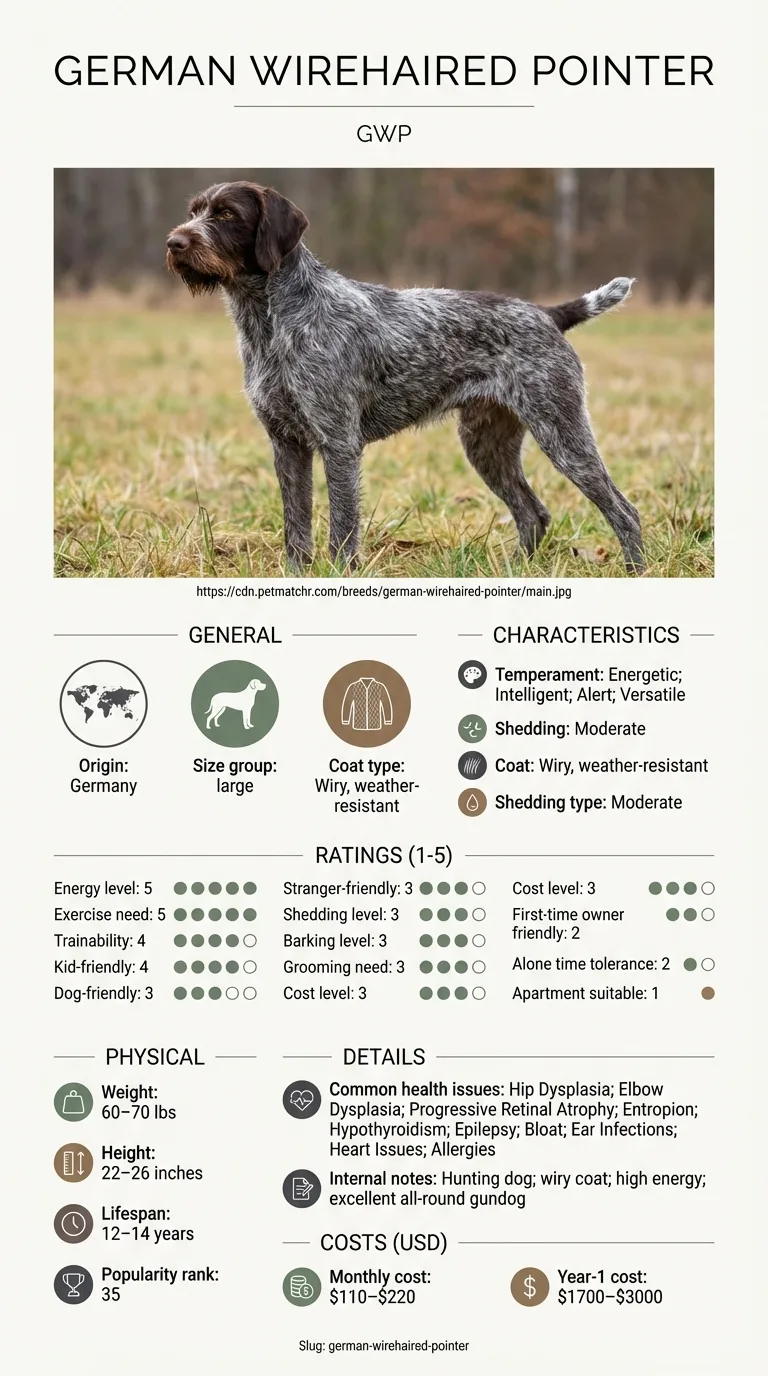
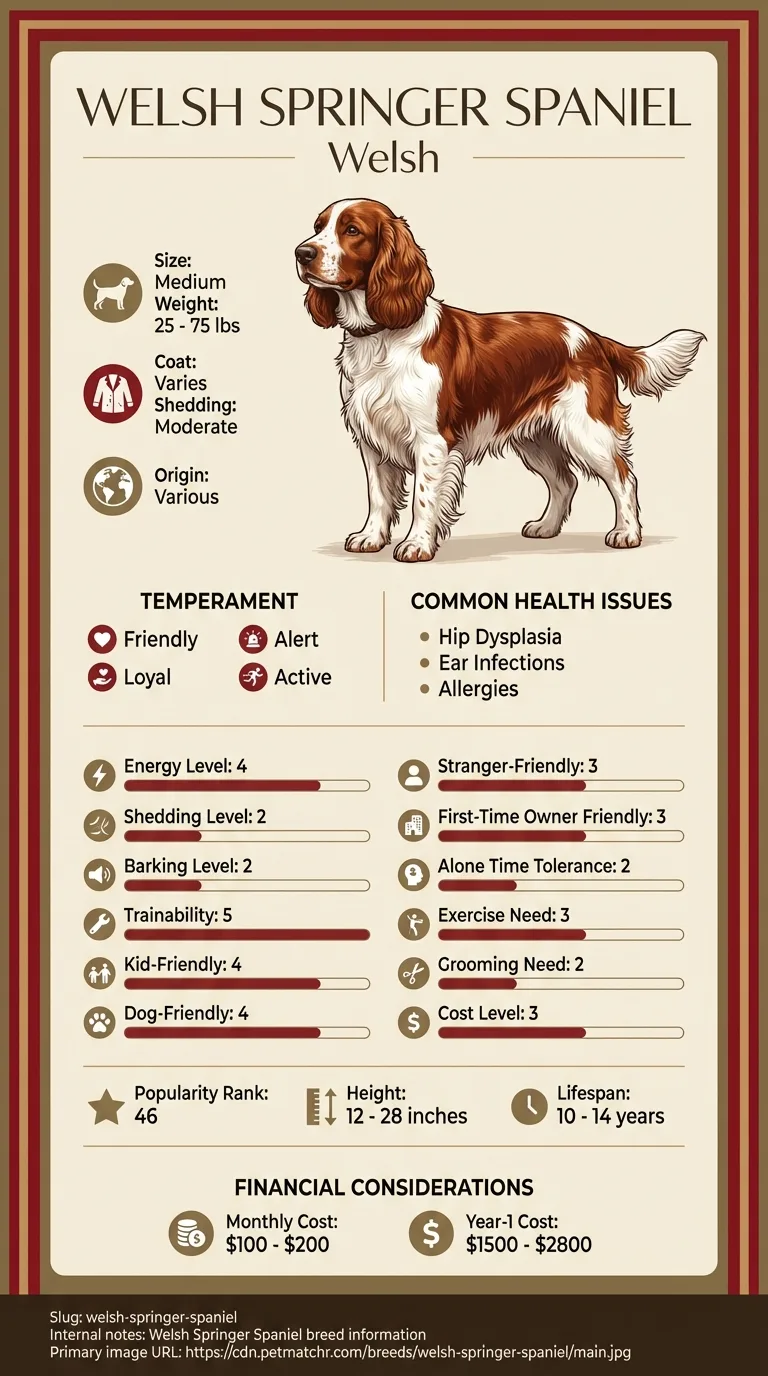
This is for someone already down to German Wirehaired Pointer and Welsh Springer Spaniel and deciding between them. Because the two are so evenly matched, the page works through every axis rather than leading with one. Anyone choosing from a flat has a clear answer here: Welsh Springer Spaniel rates 2/5 against 1/5. The focus throughout is on daily consequences rather than breed background.
Between German Wirehaired Pointer and Welsh Springer Spaniel, they are closer than most pairings, and the choice comes down to temperament, and Welsh Springer Spaniel is the lower-effort dog of the two to keep.
Choose German Wirehaired Pointer if you want a dog that can keep up with an active routine.
Choose Welsh Springer Spaniel if this is your first dog, your walking routine is modest and you already have another dog.
| Feature | german wirehaired pointer | welsh springer spaniel | Winner |
|---|---|---|---|
| Size class | large | medium | Equal |
| Weight | 60–70 lbs | 35–55 lbs | Equal |
| Height | 22–26 in | 17–19 in | Equal |
| Lifespan | 12–14 years | 12–15 years | welsh springer spaniel |
| Exercise need | Very high (5/5) | High (4/5) | welsh springer spaniel |
| Grooming need | Moderate (3/5) | Moderate (3/5) | Equal |
| Shedding | Moderate (3/5) | Moderate (3/5) | Equal |
| Energy level | Very high (5/5) | High (4/5) | Equal |
| Barking | Moderate (3/5) | Moderate (3/5) | Equal |
| Apartment suitability | Very low (1/5) | Low (2/5) | welsh springer spaniel |
| Good for first-time owners | Low (2/5) | Moderate (3/5) | welsh springer spaniel |
| Tolerates being alone | Low (2/5) | Low (2/5) | Equal |
| Trainability | High (4/5) | High (4/5) | Equal |
| Good with kids | High (4/5) | High (4/5) | Equal |
| Good with other dogs | Moderate (3/5) | High (4/5) | welsh springer spaniel |
| Friendly to strangers | Moderate (3/5) | Moderate (3/5) | Equal |
| Cost level | Moderate (3/5) | Moderate (3/5) | Equal |
| Coat | Wiry, weather-resistant | Medium, straight and water-resistant | Equal |
| Origin | Germany | Various | Equal |
| Typical monthly cost | $110–$220 | $100–$200 | Equal |
| Typical first-year cost | $1,700–$3,000 | $1,400–$2,900 | Equal |
The GWP is the bigger dog on paper, 60-70 lbs and 22-26 inches versus the Welsh Springer Spaniel's 35-55 lbs and 17-19 inches, a full size class apart even though the table lists both as tied on this metric. A Welsh Springer stands roughly five to nine inches shorter at the shoulder, more of a mid-size field spaniel frame than the GWP's rangy pointer build. Anyone cross-shopping these two because they liked a GWP's coat texture should be aware they're really choosing between a large all-purpose gundog and a considerably smaller flushing spaniel, which changes everything from crate size to how much dog needs restraining at the door.
Exercise need tilts toward the GWP, rated Very High (5/5) against the Welsh Springer's still-substantial High (4/5), and energy level follows the same pattern. Both breeds carry Energetic in their temperament list, so this is a difference of degree, not kind, a GWP wants the longer, harder outing while a Welsh Springer is satisfied with a solidly vigorous one. Given the GWP's Versatile field background and the Welsh Springer's spaniel flushing heritage, both dogs do best with a job, retrieving, hiking, scent work, rather than a leash walk around the block. First-time owners underestimating either dog's stamina will end up with a bored, destructive housemate by week two.
Grooming and shedding come out essentially tied, both breeds rate Moderate (3/5) on both counts. The GWP's wiry, weather-resistant coat needs periodic hand-stripping to maintain its texture, while the Welsh Springer's medium, straight, water-resistant coat sheds seasonally and needs regular brushing to prevent matting around the ears and feathering. Neither is a wash-and-go breed, and neither is a full-time grooming project either. Owners who dislike upkeep entirely should look past both of these; owners comparing them purely on coat care will find the decision comes down to preferred texture and whether they want to learn stripping technique or just keep up with a brush.
Apartment life suits neither breed well, but the Welsh Springer edges ahead at Low (2/5) compared to the GWP's Very Low (1/5), and it's also rated better for first-time owners, Moderate (3/5) versus the GWP's Low (2/5). Barking is a wash at Moderate (3/5) for both. The Welsh Springer's Reserved with strangers trait is worth flagging here too, since a dog that's naturally cautious around unfamiliar people can read as noise-prone in a shared building if visitors or hallway traffic aren't managed early. Both breeds tolerate being alone at a Low (2/5), so neither is a candidate for long solo days regardless of square footage.
Both breeds rate High (4/5) for trainability, but the Welsh Springer is the more forgiving pick for someone newer to dog ownership, scoring Moderate (3/5) on that metric against the GWP's Low (2/5). The GWP's Intelligent and Versatile temperament makes it quick to learn but also quick to get bored with repetition, while the Welsh Springer's Even-tempered, Loyal disposition tends to produce a steadier training partner, tempered by its Reserved-with-strangers streak that calls for early, deliberate socialization. Neither is a hands-off breed, but a first-time owner willing to put in consistent work would find the Welsh Springer the gentler on-ramp of the two.
Both breeds rate High (4/5) with kids, so families aren't choosing between safe and unsafe here. The gap shows up with other dogs, the Welsh Springer rates High (4/5) while the GWP sits at Moderate (3/5), giving the Springer an edge in multi-dog households. Strangers are where the temperament notes matter more than the numeric tie at Moderate (3/5): the Welsh Springer's Reserved-with-strangers trait means visitors should expect a dog that warms up slowly rather than greets enthusiastically, while the GWP's Versatile, Alert nature tends toward more immediate friendliness. Households that host often may prefer the GWP's temperament even though the raw scores match.
The Welsh Springer edges out a longer projected lifespan, 12-15 years against the GWP's 12-14, and its health list is shorter too, five conditions (Hip Dysplasia, Ear Infections, Epilepsy, Glaucoma, Hypothyroidism) against the GWP's ten. That said, three conditions overlap almost exactly, Hip Dysplasia, Epilepsy and Hypothyroidism appear on both lists, so buyers of either breed should ask breeders about hip screening and epilepsy history in the line. The GWP's additional risks, Bloat, Heart Issues, Progressive Retinal Atrophy and Entropion among them, reflect its larger frame and more varied gundog gene pool. Neither list includes anything unusual for a working gundog, but the GWP's is measurably longer.
The Welsh Springer is the modestly cheaper dog to keep, $100-200 monthly and $1,400-2,900 in year one, against the GWP's $110-220 and $1,700-3,000. Both land at Moderate (3/5) on overall cost level, so this isn't a dramatic gap, more a few hundred dollars a year that tends to show up in food volume given the GWP's larger frame. Grooming costs should track similarly since both need regular coat maintenance, though a GWP owner who pays a professional for hand-stripping rather than doing it themselves will close whatever gap exists. Vet costs are the wildcard, and given the overlapping health risks, budgeting similarly for both is the safer approach.
German Wirehaired Pointer weighs 60–70 lbs and lives 12–14 years; Welsh Springer Spaniel weighs 35–55 lbs and lives 12–15 years. No rated axis separates them by more than a single point, which makes this one of the closer pairings on the site. They are level on tolerates being alone, barking and cost level, so those cannot decide it. The table below marks a winner only where one breed is genuinely easier for a typical owner; size and origin are facts rather than merits and stay level. Ratings come from one source applied to both breeds, so they are meaningful against each other rather than as absolute scores.

Yes, despite both being marked as a size tie in headline stats, the Welsh Springer stands 17-19 inches and weighs 35-55 lbs versus the GWP's 22-26 inches and 60-70 lbs, a meaningfully smaller dog.
The Welsh Springer, rated Moderate (3/5) for first-time owners against the GWP's Low (2/5), though both still need real commitment.
Its temperament list includes Reserved with strangers, so expect a dog that takes time to warm up to visitors rather than greeting everyone at the door.
The Welsh Springer, rated High (4/5) compared to the GWP's Moderate (3/5).
Yes, Hip Dysplasia, Epilepsy and Hypothyroidism appear on both breeds' health lists.
The GWP, rated Very High (5/5) versus the Welsh Springer's High (4/5), though both are active gundogs.
The Welsh Springer, at roughly $100-200 a month versus $110-220 for the GWP.
The German Wirehaired Pointer.
The Welsh Springer Spaniel.
The Welsh Springer Spaniel.
The Welsh Springer Spaniel.
Secure checkout on Stripe. We never see your card.
7-day money-back guarantee. Instant access.
Health information here is general and is not veterinary advice. If your dog shows pain, sudden behaviour change, or worsening symptoms, consult a licensed veterinarian.
Some links on this site are affiliate links. We may earn a commission at no extra cost to you, and we only suggest products we believe are helpful for dog owners.
We research and check what we publish, but we do not warrant that any figure, date, price, or statement is accurate, complete, or current, and we accept no liability for any loss, cost, injury, or other harm arising from the use of this site. Use it as one reference among several. You remain responsible for your own decisions and for your dog's care - confirm anything that matters with a licensed veterinarian or another qualified professional before you act on it. Full disclaimer.
Match your lifestyle to the right dog.
Take quizNot sure which breed is right for you? Take our 2-minute quiz to find out.
Take the quiz